

5 Drinks Flight Attendants Don't Want Passengers To Order
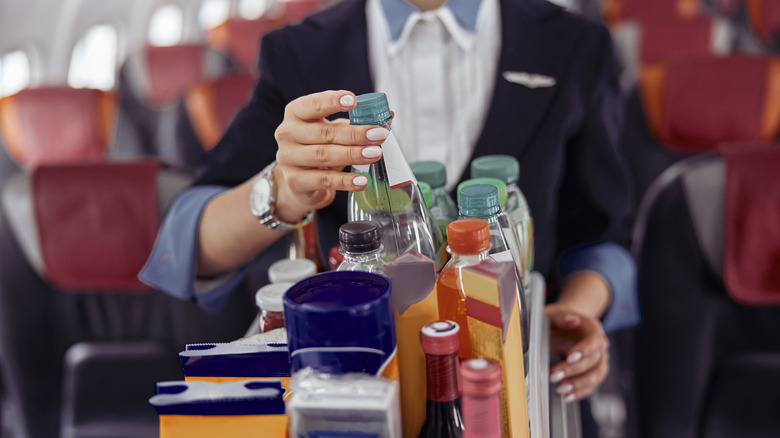
Most people think the primary function of a flight attendant is to be a sky waitress. This couldn't be further from the truth, as the most important part of our job will always be to ensure the safety of everyone on board the aircraft. What is true, however, is that one of the phases of our day in which we have the most customer interaction is during food and beverage service. I've been a flight attendant for more than a decade, which means I've served thousands of drinks above 30,000 feet during my career, and, believe me, we have thoughts about what you're ordering. Water is by far the best thing to get, and almost everything else, from sugary sodas and juices to coffee and cocktails, is an undesirable choice for various reasons.
It's just a hard, scientific fact that being on an airplane is likely to dehydrate you. The American Heart Association lists dehydration as a health risk associated with flying, which is why you'll catch me guzzling water every time I get in the air (although asking a flight attendant to fill your personal water bottle is bound to annoy them, so be sure to utilize the airport refill stations before boarding). In fact, we're so overwhelmingly aware of the dangers of dehydration that crews often have little contests to track who is meeting their water goals throughout the day.
While beverages that include caffeine or alcohol can negatively affect your health, other orders are just plain annoying for your in-flight crew. Read on to learn some of the worst choices you can make for yourself (and the ones that make our lives more difficult) so you can keep this advice in mind on your next flight.
Avoid drinks high in sodium and sugar
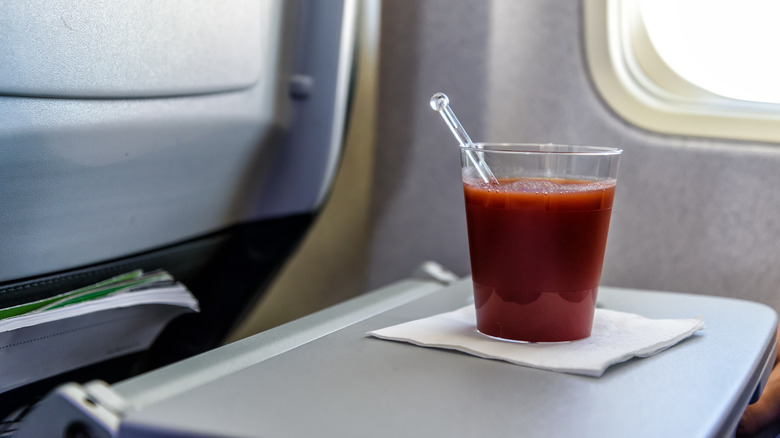
You may have seen travelers on social media recommending tomato juice as an elite drink choice while in flight, but I would actually caution against it for the same reason it's popular: the high sodium content. There's a scientific reason it tastes better in the air, and it has to do with the fact that your taste buds are significantly compromised due to the lack of humidity, as well as other sensory factors, like aircraft noise. This means that things are going to taste more bland than they do on the ground, making sweet and salty drinks more appealing. But while beverages high in sodium may be a satisfying choice at altitude, that doesn't mean there aren't health consequences. As we've already discussed, flying dehydrates you, and consuming high amounts of sodium can make that even worse.
In addition to being bad for you, an order for tomato juice can be annoying for us flight attendants. While I'm stocked with plenty of cola and ginger ale in my beverage cart, I only get two or three portions of tomato juice. When everyone's craving tomato juice or decides they want to drink it after seeing a viral TikTok clip about it, I run out of product during the first row of my service.
Drinks high in sugar will also taste better, but they're not a healthy choice for the same reason. According to Medical News Today, experts believe that dehydration can occur because of the way sugar causes water transfer within the body's cells, leading to more urination.
Skip the alcoholic drink on your next flight
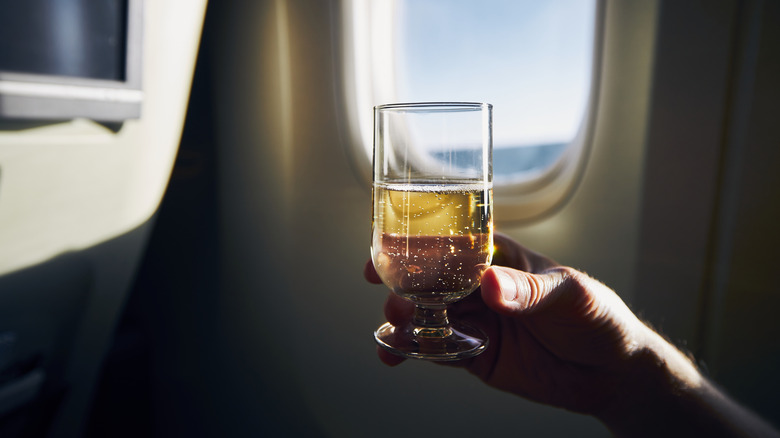
Although drinking alcohol on an airplane is a fairly common occurrence, it's (you guessed it) dehydrating, and therefore not the best choice due to everything I've already mentioned. "Drinking [alcohol] and sleeping on a plane puts a big strain on your body, especially your cardiovascular system," Dr. Matthew Mosquera, medical director of the Alcohol, Drugs, and Addiction Inpatient Program at McLean Hospital, told Harvard Medical School's Harvard Health Publishing. "And there's even more strain if you have heart or lung disease. It places you at a higher risk for a heart attack or stroke." In addition to increased cardiovascular strain, drinking on a flight puts you at a higher risk of falling, increasing the potential for injury.
But there's another reason your flight attendant considers your alcoholic order to be a red flag, and it has more to do with bad passenger behavior than making healthy choices. Alcohol is one of the biggest causes for behavioral disruptions on board a flight, due to the fact that many people feel the effects of alcohol differently in the air. One drink on a plane can have a much more potent effect than its counterpart on the ground, and impaired behavior is often a recipe for disaster when combined with the inconveniences and frustrations that long travel days can bring.
Not only that, but from a serving perspective, alcoholic drinks take more time to prepare than anything else on the plane due to their multiple components, as well as the extra time needed to take payment, if the drinks don't happen to be complimentary. All in all, the fewer people who drink alcohol on board one of my flights, the better.
Coffee, tea, or any beverage that utilizes hot water
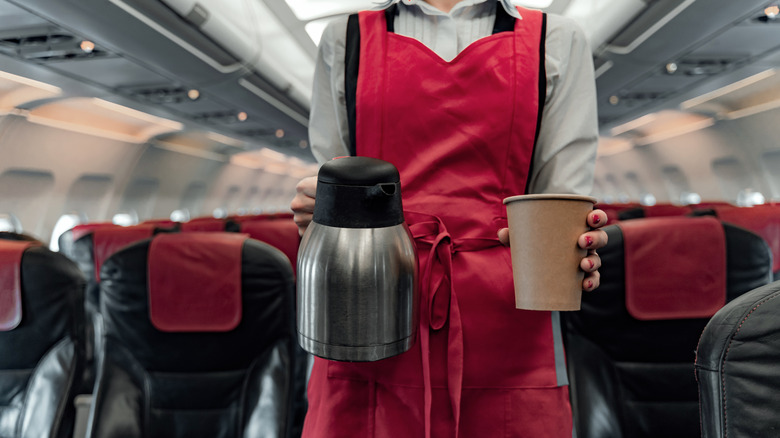
As a general rule, I would avoid ordering anything that doesn't come directly out of its own container, due to the disturbing reason you may want to avoid drinking coffee and tea on airplanes. First, the water tanks on board that contain the water are infamous for not holding a high standard of cleanliness, so you're already beginning with a questionable main component to your drink. In fact, a study conducted in 2025 by the Center for Food as Medicine and Longevity found samples that tested positive for coliform bacteria, including E. coli.
Next, this questionable water is moving from coffee pots and into carafes, neither of which is sanitized after every use. In fact, the coffee pots themselves are only routinely cleaned with a hot water rinse, and that's only if your flight crew is proactive — depending upon the airline, this is not a required part of duty. In addition, the components of the coffee machine itself are likely not cleaned unless the machine is broken and needs to be serviced, or replaced entirely. Finally, the carafes that end up on our carts are only washed by a third-party catering company, which means they go through multiple flights before being offloaded for cleaning.
As if all that isn't bad enough, the only safe way for flight attendants to dispose of coffee is in the lavatory toilet. That means these carafes are not only entering the lavatories but being held down close to a toilet to prevent spillage when it's time to dispose of the coffee or tea water at the end of each flight, which brings to mind the idea that backsplash could occur.
Think twice before asking for ice
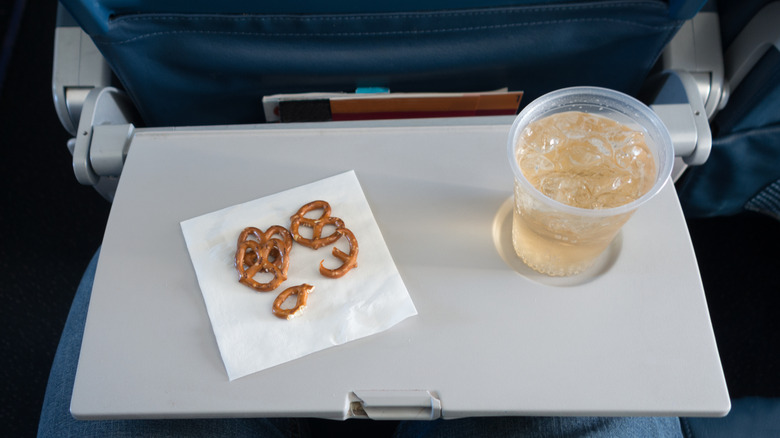
On the subject of cleanliness, the airplane is a difficult place to keep ice clean under the best of circumstances. For example, I've seen ice scoops placed on contaminated counters and then put back in the ice bins. Flight attendants face all kinds of challenges when it comes to keeping their galleys (food preparation areas) tidy, and a lack of space, paired with how our ice is catered from third-party companies, tends to make handling it challenging.
The bags of ice come from catering trucks riddled with holes, and are then placed in plastic bins that are not routinely sanitized. They're also packed with dry ice to keep them frozen, but this causes the ice to freeze together into one large block, necessitating that we break it apart again before the ice goes into our beverage cart. I've witnessed flight attendants dropping these bags of ice on the ground in order to break them up — the very same ground that's located right outside of the airplane lavatories. It goes without saying that certain substances are tracked out of there on passengers' shoes, potentially ending up on the outside of the ice bag. This type of contamination can pass to the ice if there are holes, and once the bag is broken open to be poured into the serving trays.
Finally, when it comes to inconveniencing your crew, there is only a certain amount of ice that we can fit in our drawers, and we are often close to running out by the end of our service. If the flight is full, asking your in-flight crew for an extra cup of ice will almost guarantee we won't have enough for everyone, especially if multiple passengers request it.
Uncommon orders can cost us extra time
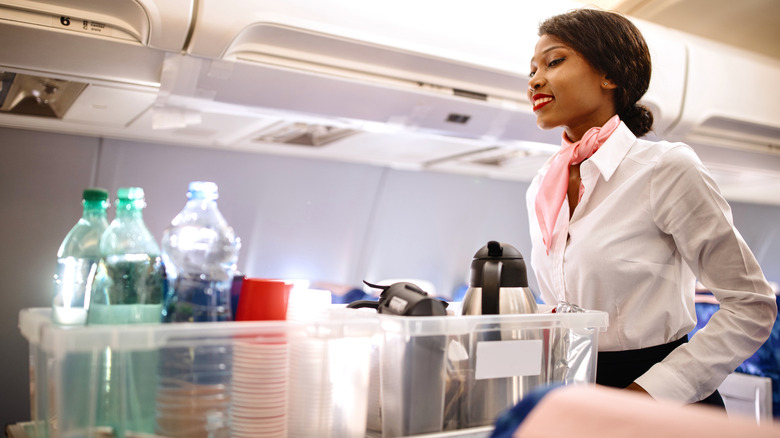
Speaking of making things easier for your crew, there's a right way — and some wrong ways — to ask us for a drink. For example, there's a reason flight attendants can't stand when you ask for water just after boarding, so waiting for beverage service to begin is one big way you can help us out. Then, once we're in the aisle to serve you, we want everything to run as smoothly as possible, including not running out of beverages. But just like with tomato juice, there are certain drinks that we have in short supply. Tonic water, flavored seltzers, and most juices fall into this category, especially if you're flying on an airline that doesn't pour drinks, but rather hands out the full can.
While most of us will take the time to add more stock to our carts before rolling out, sometimes it's difficult to predict what we'll need extras of, and it's disruptive to our service when we run out of things. If we have to bring our carts all the way back to the galley to restock (a safety standard) at a time when passengers are likely beginning to get up to use the restroom, it's going to take longer to serve everyone on the plane.
It's also unhelpful to request things that require multiple components, such as seltzer with a splash of cranberry, or both a cranberry and apple juice if we don't serve Cran-Apple, as these orders can contribute to shortages. Remember, the best choice for both you and your crew is always going to be something you need more of in the air, as well as what we always have in ample supply: good, old-fashioned water.