

Scientists Reveal Why It's Better For Elderly Couples To Be Separated During Flights
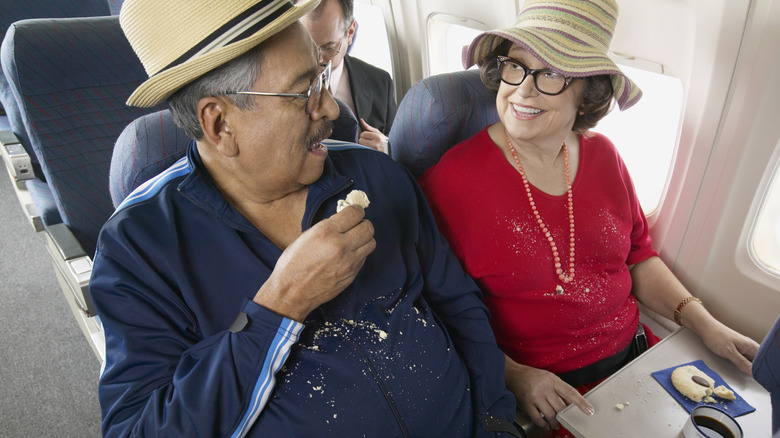
Safety is always a top concern for airlines and flight crews, and there are multiple ways to ensure your trip is as safe as possible. The easiest, of course, is to listen to your flight attendants' safety instructions and maybe even assist them with their pre-flight "crotch watch." But you can also help by preparing your elderly parents or grandparents for a possible, temporary separation once they board the aircraft.
That's because a 2026 study published in AIP Advances found that it may be safer for everyone on board an aircraft if elderly passengers are seated separately. The reason behind the finding comes down to the not-so-simple act of quickly evacuating an airplane during an emergency. Ideally, the study said that an aircraft should be evacuated in 90 seconds in the event of an emergency. However, researchers discovered that when elderly passengers, especially those with mobility issues, are seated together, evacuation times are much slower.
Change is never easy, which explains why, sometimes, airlines eventually roll back their controversial seating policies. But when scientists used computer simulation to run scenarios on an Airbus A320 experiencing a dual-engine fire, they had concerns. Every simulation found that both the number of elderly passengers aboard and where they were seated directly impacted the evacuation time. "These findings emphasize the need for age-sensitive modeling and seating strategies to improve evacuation safety," the researchers wrote. The study also offered practical insights into emergency planning to improve safer travel for all passengers.
Cabin seating arrangements impact evacuation speeds
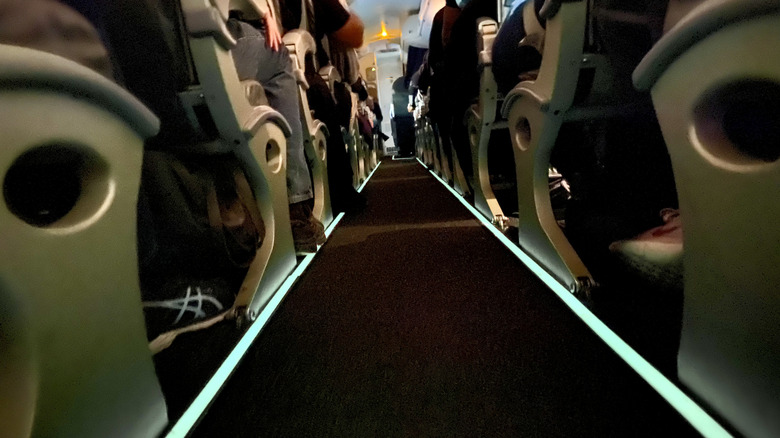
The Airbus A320 is considered one of the most common narrow-body aircraft used around the world, seating between 150 and 180 passengers. Authors of the study determined that the best-case scenario of their tested scenarios is a plane with 20% elderly passengers, who are placed at opposite ends of the plane. But even with this arrangement, the evacuation time was still at 141 seconds, well above the recommended 90 seconds.
And it's not just elderly passengers with mobility issues that raise safety concerns. The study also determined that elderly passengers with symptoms of cognitive decline may be slower to make time-sensitive decisions in a crisis or react to directions issued by flight attendants. The slower response not only endangers the elderly passenger, but also other passengers who must move quickly and efficiently to exit the plane safely.
While it may not be ideal for couples, separating elderly travel companions can help make cabin crews' jobs easier. Their focus is on passenger safety, as well as their own, which is why flight attendants sit on their hands during takeoff and landing. Authors of the study wrote that flight crews who optimize seating strategies that designate certain seats to elderly passengers can enhance the efficiency of an unexpected evacuation. The research also encourages airlines to create age-related considerations that can "better accommodate the growing population of elderly air travelers."