

Tourists Can't Stop Damaging Famous Landmarks In Europe, Leaving Locals Outraged
Initials carved into the Colosseum, historic fountains broken, timeless works of art damaged — incidents like these are part of a troubling trend unfolding across Europe's most popular tourist sites. These incidents have left locals feeling angry — rightfully so — and are part of the reason why Europeans have become anti-tourist, according to Rick Steves.
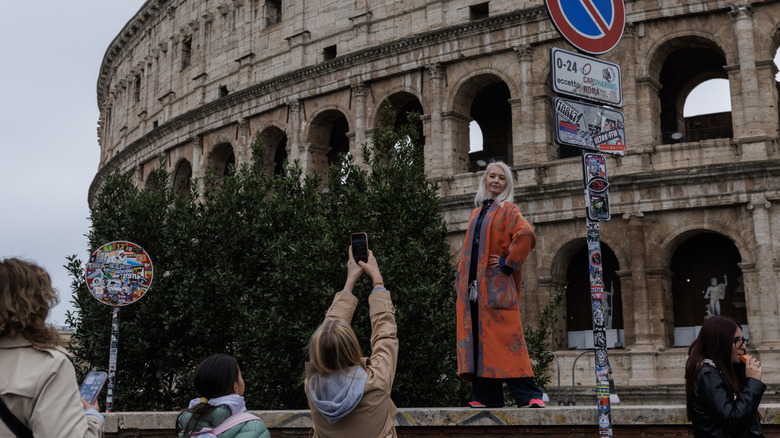
Europe's famous landmarks have been meticulously preserved for centuries, both out of respect for the awe-inspiring craftsmanship and to give visitors a chance to appreciate the region's heritage. But according to recent reports, not all foreigners treat these sites with the same care. One common target seems to be the Colosseum in Rome. In the summer of 2023, multiple tourists were caught allegedly carving their names into its historic walls, according to CNN – a crime that is taken seriously by police. Punishment for the act can be a substantial fine and up to five years in prison, CNN reported at the time.
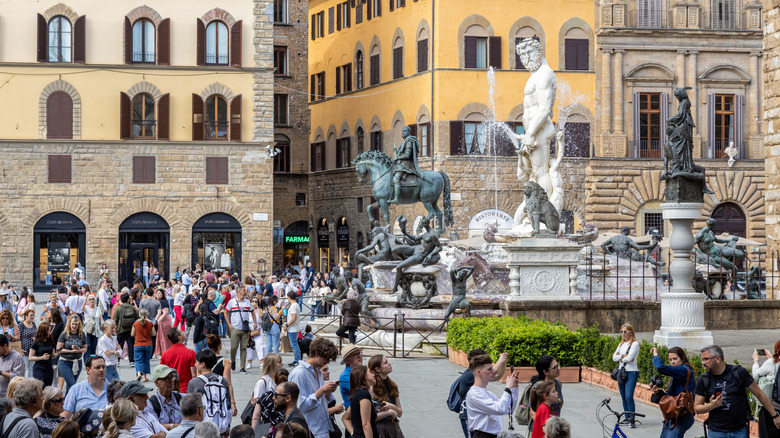
More recently, a 28-year-old woman damaged the 16th-century Fountain of Neptune in Florence, Italy after friends dared her to climb on it to touch Neptune's "private parts," according to a press release from City of Florence officials. The incident occurred in April 2026, and police quickly intervened. However, the woman did manage to damage the statue in the process, specifically the hooves of Neptune's horses and a frieze, or ornamental band, that she grabbed to avoid falling in the water. The sculpture, commissioned by Cosimo I de' Medici in 1559, required €5,000 in repairs, equivalent to nearly $6,000 USD. In addition to climbing statues and scribbling on ancient walls, tourists have also damaged priceless works in pursuit of the perfect photo.
Locals say selfie-seeking tourists do more harm than good
In June 2025, a quest for a humorous photo led to the damage of a Swarovski crystal-covered art piece at the Palazzo Maffei museum in Verona, Italy. In a video shared by Palazzo Maffei on Instagram, security cameras capture two tourists taking turns pretending to sit on a chair made by artist Nicola Bolla, which he modeled after a famous Vincent Van Gogh painting. One of the visitors lost his balance and fell onto the art piece, breaking its front legs. The chair has since been fixed, but gallery representatives used the incident as an opportunity to promote greater respect for art. The rise of social media-fueled travel is an overhyped trend worth leaving behind, and in situations like these, getting the perfect photo is definitely not worth the risk.
One local from Trastevere, a neighborhood in Rome, took to Reddit to lament about the disrespectful behavior of tourists. "If you come [to] Rome, be [respectful]," they wrote. In the comments, another user said they saw a woman in Vienna climb on a monument to take a selfie. "They don't care that it's [forbidden] and it soils and damages the statue," they said. "Made me so angry." Others agree that social media has fueled a rise in carelessness among foreigners in Rome. Another person from Trastevere says the situation "got way worse in the past year because of social media," with visitors treating "a neighborhood where people actually live like it's a zoo."
While tourism is important to local economies, it's important for travelers to remember that they are guests to these places, and access should be treated as a privilege. There are many things visitors can do to reduce the harmful impact of over-tourism. But one of the easiest ways to minimize harm is to respect local culture and rules, especially when it comes to famous landmarks.