

New Mexico's Biggest National Park Is An Otherworldly Desert With Cool, White Sand
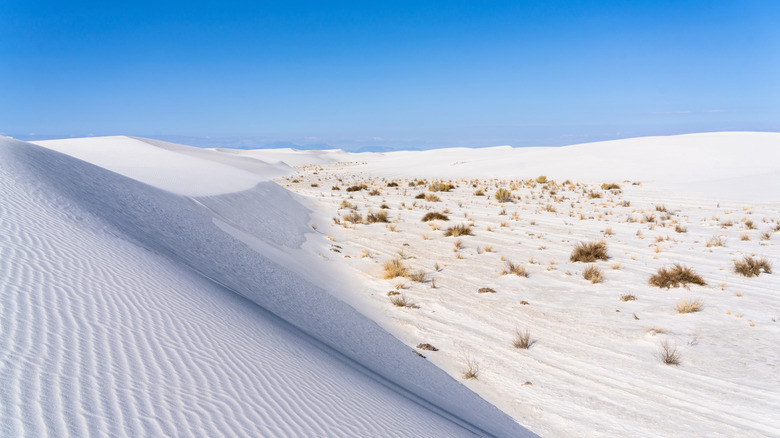
For an out-of-this-world experience in the Land of Enchantment, the International UFO Museum in Roswell, New Mexico might come to mind. But if you prefer something more outdoorsy, the scenery at White Sands National Park is truly otherworldly. Stretching for 275 square miles across the Chihuahuan Desert in southern New Mexico, and contrasting with the bright blue skies above, White Sands is "like no place else on Earth," as the National Park Service (NPS) puts it. The extraordinary park has set the stage for Hollywood blockbusters, including "Book of Eli" and the first two "Transformers" movies.
Like Great Sand Dunes National Park, another otherworldly national park in Colorado, White Sands is known for its majestic dunes. However, unlike those in Colorado, around 98% of the grains are comprised of gypsum, a soft white mineral. These deposits are the remains of Lake Otero, a 1,600-square-mile lake that began to evaporate after the last Ice Age, eventually transforming into what is now known as Alkali Flat. Once the lake dried up, wind and other natural forces scattered the gypsum into dunes. The dunes are constantly shifting, and some move nearly 30 feet every year. Gypsum does not absorb the sun's heat, so the sand stays pleasantly cool even in the intense desert climate.
The dunes at White Sands National Park are still evolving today. After periods of heavy rainfall, Lake Lucero in the park's Tularosa Basin begins to dry up. As the water evaporates, gypsum crystals form on the lake bed. Over time, the crystals are exposed and weathered down until they turn into fine grains of white sand.
Must-do activities at White Sands National Park

If you plan to spend all day at White Sands National Park, head to the visitor center first, which opens at 9 a.m. Nearby, you'll find restrooms, the only source of drinking water at White Sands, and a shop to grab a snack. The shop also has sleds available for purchase or rent, which you can use to soar down the 40-foot sand dunes.
In the park, every trail apart from the Interdune Boardwalk – which is closed, at the time of writing – is clearly marked with a colored signpost and a symbol to guide visitors through the desert. Be sure to walk from marker to marker and stay on the trails to avoid getting lost. The park has about 9 miles of hiking trails in total. These range from the Dune Life Nature Trail, a mile-long loop ideal for families, to the Backcountry Camping Trail, with magnificent views of dunes as far as the eye can see. The Alkali Flat Trail takes you into the heart of this stunning landscape — keep in mind that this route is strenuous, with many hills to climb.
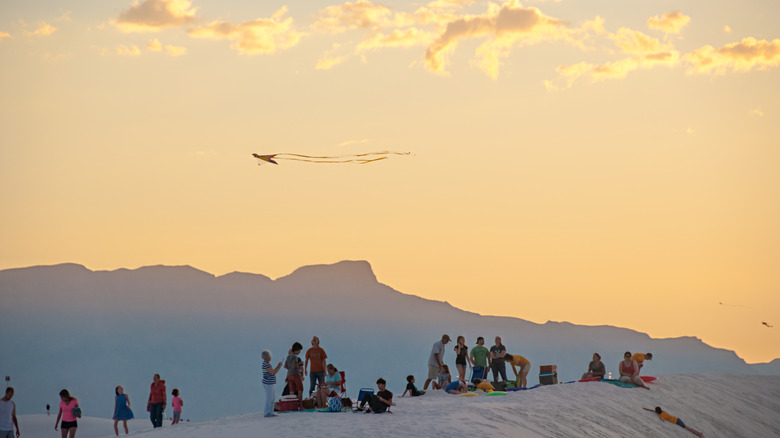
If you're apprehensive about exploring on your own, ranger-led hikes are available. These include a beautiful year-round sunset stroll accompanied by information about local wildlife and geology. To see the park in an entirely different light, sign up for a special moonlit hike. This hike is incredibly popular, and tickets can be booked online one month in advance. White Sands could be considered one of the best U.S. national parks for stargazing, and this after-dark excursion is an ideal way to enjoy it. Once a month between November and March, the park offers ranger-led tours to Lake Lucero, where visitors can witness the park's unique geological forces at work. The lake is within the White Sands Missile Range, and for this reason, photography and video opportunities are limited.
Planning your trip to White Sands National Park
White Sands National Park averages 330 days of sunshine every year. But that doesn't mean that the weather in New Mexico's high desert always cooperates. In spring, powerful winds of up to 50 miles an hour can occur, and in summer, the park experiences frequent thunderstorms in the late afternoon and evening. The summer season is also scorching hot, with average highs of 97 degrees Fahrenheit in June and July. When temperatures are 85 degrees Fahrenheit or warmer, the NPS says it's unsafe to venture out on a hike. The coldest months are December and January, with average highs of 57 degrees Fahrenheit.
White Sands National Park is open daily all year long, from 7 a.m. until half an hour after sunset. It stays open for one hour past sunset from late May to early September. Entry fees are $25 per car and payable at the park's main entrance station. Before setting off, check the park's safety page to ensure that you have everything you need, and the current conditions bulletin for closures and alerts. Note that White Sands National Park is used by the U.S. military for testing purposes, and Dunes Drive – the only gateway to the dunes – may close to the public on short notice, for up to three hours at a time.
Despite being in New Mexico, the closest international airport to White Sands is in El Paso, Texas, about 90 minutes away by car. Before reaching the park, be sure to stop in Las Cruces, one of the coolest desert towns in the U.S. for an outdoorsy getaway. Though smaller, Alamogordo is about 30 minutes closer to the park, making it a more convenient destination to spend the night or shop for essentials. Unfortunately, the campsites at White Sands National Park remain closed for maintenance, at the time of writing. You will, however, find a handful of campgrounds in the area, including a popular KOA campground in Alamogordo, as well as the scenic Oliver Lee Campground in Oliver Lee Memorial State Park, the closest one to White Sands. If you'd rather retire to a comfortable hotel room, you'll find several major hotel chains in Alamogordo, including a Holiday Inn Express and a Hampton Inn.