

Should Tourists Be Worried About Scientists' Startling Discovery At Yellowstone?
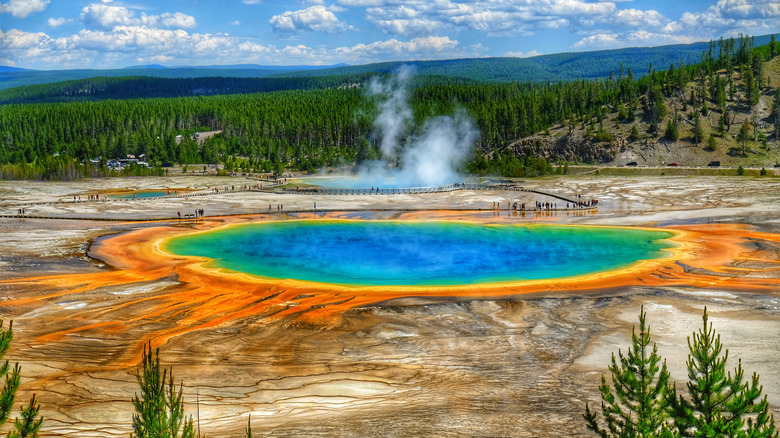
Scientists have known for years about the "supervolcano" beneath Yellowstone National Park. But a new discovery has found that some of its characteristics are vastly different than experts previously believed. Recent research by the Institute of Geology and Geophysics of the Chinese Academy of Sciences (IGGCAS) published in the journal Science has found that the mechanics behind the active volcano operate very differently, which could mean that its eruption pattern is less predictable.
According to the United States Geological Survey (USGS), eruptions are caused by thick magma deep within the earth that pools in chambers and eventually explodes after long periods of continuous gas buildup and pressure. But the new model shared by IGGCAS has found that the Yellowstone supervolcano contains shallower, sprawling fields of magma "mush," and a titled magma system. "The results suggest that magma originates much deeper than previously thought," says a press release from the Chinese Academy of Sciences. If a supervolcano was to erupt at Yellowstone, it would have worldwide consequences, changing the Earth's climate and creating effects that could last decades, says the USGS.
But does this new discovery mean tourists should be nervous about visiting Yellowstone National Park? Thankfully not, as experts still believe that the supervolcano will not erupt for a very long time, if at all.
Here's when Yellowstone's supervolcano could erupt, according to experts
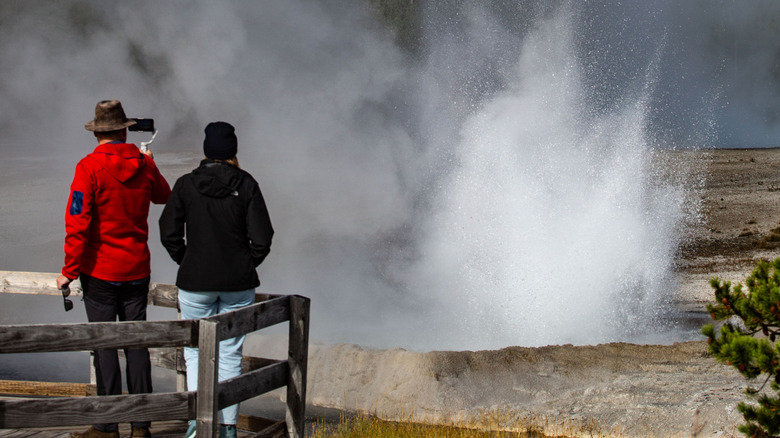
Tourists have flocked to Yellowstone for generations to see its hydrothermal features, including its steaming hot springs and epic geysers, some even more incredible than Old Faithful. The national park even holds an impressive world record for its concentration of geysers. But scientists say that Yellowstone is still a long way off from unleashing the wrath of its supervolcano upon the world.
According to the USGS, Yellowstone has produced massive eruptions three known times in the past. Calculating the timeframe between these eruptions means that the volcano has exploded once every 725,000 years or so, on average. Since scientists believe the last major eruption at Yellowstone was approximately 631,000 years ago, the supervolcano is still a good 100,000 years away from its next world-altering explosion. But the organization admits that there is not enough data to make a reliable prediction on the state of Yellowstone's supervolcano or when it will blow. With only two previous intervals between eruptions to base their predictions on, their 100,000-year estimate is effectively "meaningless." But rest assured that, "although another catastrophic eruption at Yellowstone is possible, scientists are not convinced that one will ever happen," says the USGS.
Even as scientists continue to try and understand what lies beneath Yellowstone and what fuels its activity, tourists shouldn't cancel plans to visit the national park. What they should do, however, is take proper steps to remain safe when they do visit. The area can be dangerous, for sure. But it's not sudden volcanic explosions that visitors should worry about at Yellowstone National Park. Tourists put themselves at great risk by breaking important safety rules, such as trespassing into restricted zones. Those who are caught trespassing at Yellowstone may face hefty fines or even jail time.