

Utah's Stunning National Park Rivals The Grand Canyon With Unique Hikes And Views
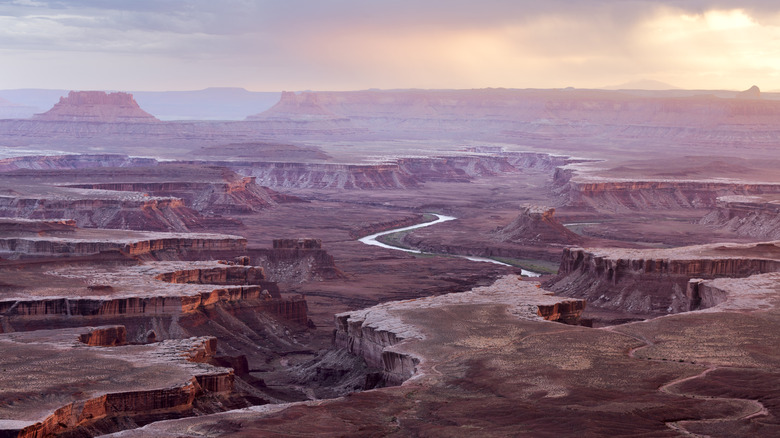
The Grand Canyon may get all the glory, but Canyonlands National Park proves Utah has its own rockstar, and we mean that literally. Big desert rocks are the stars of this national park, and they come in many different stratified shapes, sizes, and colors. Some of them form river canyons and natural mazes, while others rise from the ground in sky-high arches and spires. These formations and landscapes are present across the 337,598 acres of Canyonlands National Park, the largest national park in Utah. The park is home to hundreds of canyons that are arguably even more stunning than the Grand Canyon, and with fewer crowds.
Located in southeast Utah, the park offers a range of hikes suitable for leisurely day trips and longer backcountry treks. It's divided into four main sectors: Island in the Sky, The Needles, The Maze, and The Rivers. People come here for solitude in nature, as well as thrilling outdoor activities such as rock climbing and whitewater rafting down Cataract Canyon. As an International Dark Sky Park, Canyonlands is also one of the best U.S. national parks for stargazing.
If it's your first time visiting Canyonlands, the Island in the Sky sector is likely a good place to start, given its location just 10 miles north of Moab. The closest international airport is in Salt Lake City, which is a solid 4-hour drive from Moab. Visitors who prefer creature comforts instead of camping will find cozy accommodations and an assortment of cafes and restaurants in Moab, which is easily one of the coolest desert towns in the U.S. for an outdoorsy getaway.
The best hikes and views in Canyonlands National Park
At Canyonlands National Park, the views are the whole point. As you may guess from its name, Grand View Point Overlook is one of the best trails for stunning vistas during the day, and stargazing at night. It's a paved 1.8-mile trail that sits within the Island in the Sky sector. At an elevation of more than 6,000 feet, you can see the White Rim, Junction Butte, and even The Needles in the distance on a clear day. At night, the overlook provides a gorgeous view of the Milky Way.
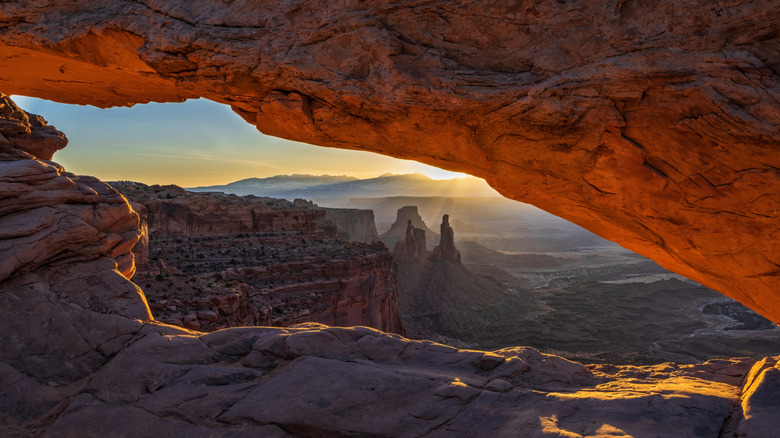
Mesa Arch is another spectacular site in the park, known for its picturesque, 27-foot-long stone arch. The arch sits on the ledge of a cliff, meaning that when you look through it, you can see down into the canyon below — the view is especially beautiful at sunrise. It's an impressive landmark that's easy to get to on a 0.6-mile loop hike. That said, it also tends to be one of the most popular sites in the park. Still, Canyonlands remains one of the least-visited national parks in Utah.
If you're looking for something more challenging, give the Chesler Park Viewpoint Trail a try. It's 5.8 miles round-trip and can take roughly 3 to 4 hours to complete. It's perfect for a full-day outing. Pack a picnic to enjoy as you sit in the shade of massive sandstone spires. There's an overlook along the trail with views of desert grasses and dense clusters of stone towers for miles into the distance. There is an elevation change of 533 feet, and the trail is considered quite strenuous. The National Park Service (NPS) recommends packing one liter of water per person, per hour for this hike.
Planning your trip to Canyonlands National Park
Timing matters more than you might expect at Canyonlands National Park. Spring and fall bring the most stable weather, with mild daytime temperatures that make longer hikes feasible. Summer can be punishingly hot, often exceeding 100 degrees Fahrenheit. Winter is cold and quiet, and snow occasionally dusts the mesas. Some park services are unavailable in the winter, requiring visitors to be more self-sufficient, but the trade off is near-total solitude.
Water is also a constant concern. There are limited water filling stations in the busier areas of the park, and none in more remote districts like The Maze. Carry more than you think you need, and drink plenty — the NPS warns that it is easy to become dehydrated here, even on colder days. Cell service is unreliable across most of the park, so offline maps or printed trail guides are useful to have.
The park has two main entrances: Island in the Sky in the north and The Needles in the east. Island in the Sky is the easiest to navigate as a first-time visitor, with paved roads and clearly marked viewpoints. The Needles requires a longer drive but offers more extensive trail networks. A third entrance is located at The Maze, but getting there can be challenging and a high-clearance vehicle is essential due to the rugged terrain. Permits and reservations are required only for certain activities, such as overnight backcountry trips and river travel. Otherwise, the standard entrance fee for one vehicle is $30.