

5 Eye-Opening Ways 1980s Air Travel Was More Forgiving Than It Is Today
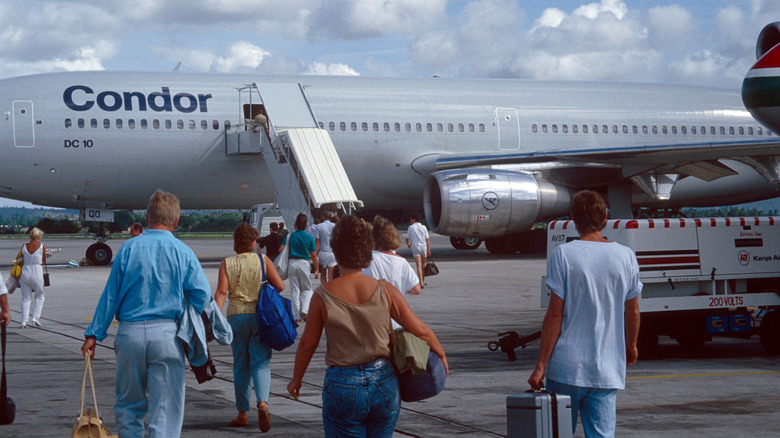
Many of the frustrating aspects of flying are a common fact of life for travelers, whether it's dealing with long lines at security or squeezing into the ever-shrinking airplane seats. Yet, flying wasn't always like this — a fact that's easy to forget, even for those who are experienced (read: old) enough to have traveled before 9/11.
Although the 1980s weren't quite the golden age of air travel — that title belongs to the 1950s and 60s – it was still more of a luxury experience than it is today. The Airline Deregulation Act of 1978 was bringing prices down for the average traveler, but it was still out of reach for most. In 1979, for example, the average cost of a round-trip ticket for a U.S. flight was around $615.82 in modern day currency, reports Travel + Leisure.
Using a combination of research and firsthand accounts from seasoned travelers, we explore five ways that flying was more forgiving in the 1980s than it is today. That said, not every change has been for the worse — for example, smoking on airplanes is no longer allowed. So, while it may seem inevitable that you'll be called in for additional security screening for a weird reason (like having too much volume in your hair — true story), you can rest assured that air travel is constantly evolving.
There were no baggage fees
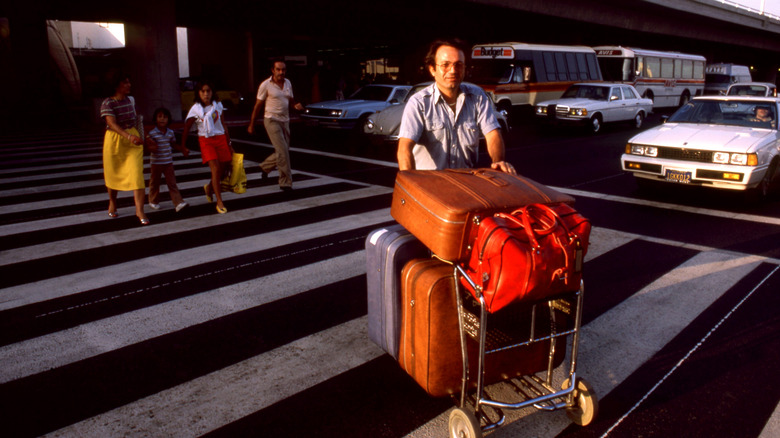
These days, preparing for a flight requires expert-level packing skills. Thanks to limited space allotments, hefty checked baggage fees, and carry-on restrictions, it behooves any traveler to pack light. While there are all kinds of packing methods to help you save luggage space, it's safe to say that many of us would overpack with reckless abandon if checked bags were free.
In the 1980s, baggage fees were unheard of. American Airlines didn't institute checked baggage fees until 2008 and was among the first major airlines to do so. While size and weight limits did exist, there were way fewer restrictions. You rarely saw anyone cramming their vacation wardrobe into a single carry-on. And don't even get us started on what you could pack. The rules on what toiletries you could bring were so lax, you could essentially fill your suitcase with liquids.
The TSA did not yet exist
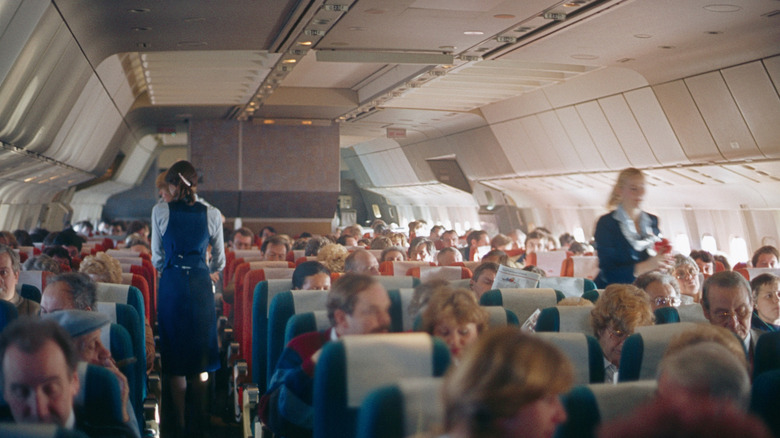
Arguably the biggest change to U.S. air travel since the 1980s is the Transportation Security Administration (TSA), which was established in 2001 following the 9/11 terrorist attacks. Prior to 9/11, security in airports had been slowly increasing, but was run by private security companies rather than the federal government, and generally involved a much simpler process. "Before 9/11, security was almost invisible, and it was really designed to be that way [...] It was designed to be something in the background that really wasn't that noticeable and definitely did not interfere with aircraft or airport operations," said Jeff Price to National Public Radio (NPR), who was the assistant security director at Denver International Airport at the time of the attacks.
Security measures increased in the wake of future terrorism attempts. One man tried to sneak bombs in his shoes in December 2001, and another tried to smuggle liquid explosives in 2006. Today, TSA security rules impact nearly every aspect of air travel. Agents are constantly on the lookout for red flag behaviors during security checks, and even certain types of clothing can get you flagged by TSA. While safety is crucial, there are far more regulations to navigate today than in the 1980s.
People could wave at the gate
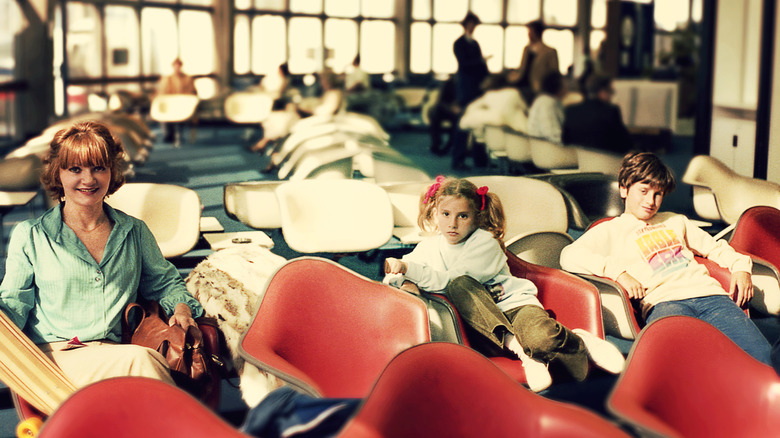
You've seen it in the movies: a person runs through the airport to meet their loved one at the gate, just before they board the plane. Nowadays, this scene is nothing but fantasy, as there's no way could you make it through security without a ticket and a proper form of identification. Waving farewell from the gate was possible in the 1980s. This practice was discontinued after 9/11 along with many other federal security updates.
But here's a bit of good news: non-passengers can now enjoy this beloved airport tradition for the first time in decades at certain locations around the United States. Non-traveler guest passes enable you to accompany your pal all the way to the gate and take advantage of airport amenities while you're at it. Participating airports will typically allow you to book ahead to reserve your guest pass, but be sure to read the fine print, as you'll only be allowed to pass through security a certain number of times, and only limited sections of the airport will be open to you.
You could arrive just before take-off
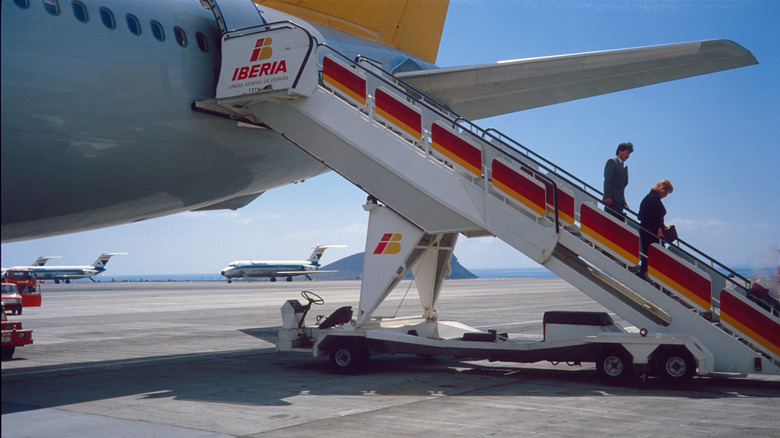
Once upon a time, you didn't have to arrive two to three hours early for a flight — or five hours early if you're a dad. You could technically cruise up with just enough time to hand over your ticket and sprint aboard before take-off. "You could park, run to your gate, and get on the plane just barely making it before they closed the door," one Redditor recalled on r/AskOldPeople.
The standard practice of getting to the airport two hours early was first recommended after 9/11, as a result of longer security lines and more stringent measures. If the current climate is any indication, this practice is not likely to change any time soon. On a typical travel day, airlines recommend arriving two hours ahead of your domestic flight and three hours for international travel. Certain circumstances may require even an earlier arrival time, such as busy travel seasons, staffing shortages, or holidays. Dads, you already know the drill.
Smoking was allowed
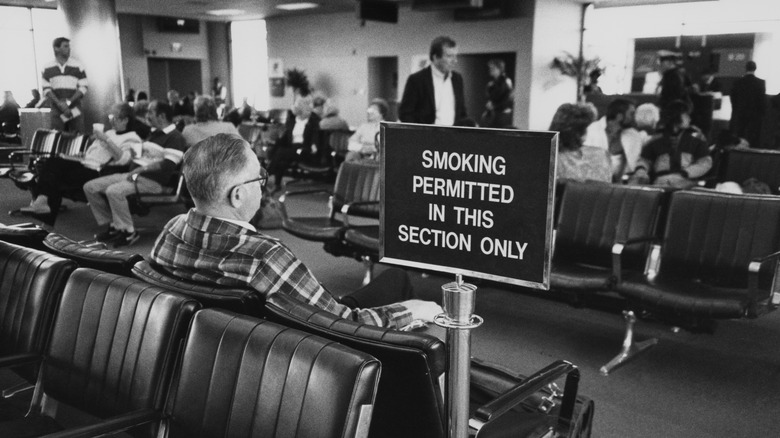
At this point, we know you're wondering if there were any downsides to flying in the 1980s, and there definitely were. If you're a non-smoker, you would likely dread flying during this decade. There were dedicated smoking sections in airports and on planes, but according to some, the barriers were practically non-existent. "The tiny little curtain between smoking and non-smoking was a joke," pointed out one Redditor on r/AskOldPeople. "I was on a Las Vegas charter full of retirees and the smoke got so bad the pilot turned on the No Smoking light because the air filtration system couldn't handle it and the flight attendants couldn't see each other," another person wrote.
Smoking bans became more commonplace in the late 1980s. It was eventually banned on all domestic airline cabins within the United States in 1990, for the health of the passengers and crew members. By 2000, the ban was extended to international flights as well, and now it's a standard worldwide.
Methodology
For this article outlining some of the ways that 1980s air travel was more forgiving that it is today, we mined information from a variety of sources. For firsthand accounts, we visited Reddit and other opinion sites for anecdotes from travelers who frequently flew in the 1980s. We also utilized data and expert interviews from reputable outlets such as Travel + Leisure and NPR. For historical information, we referenced the TSA's official website and the Smithsonian National Air and Space Museum's website. It's clear that, in many ways, air travel was better back in the old days than it is today. Instead, you might want to consider taking the train, like one of the most scenic train rides in the world, to get from Point A to Point B.