

Why Oregon's Beaches Are Covered In Tons Of Bizarre Blue Creatures
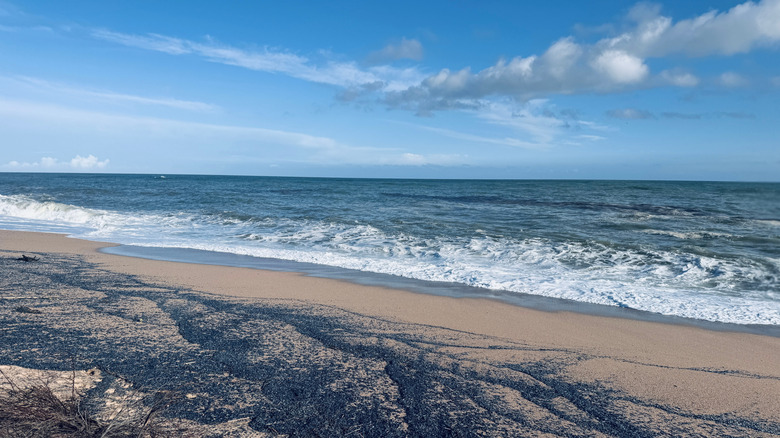
Beaches are among the most popular tourist attractions in Oregon. Visitors flock to renowned cities like Cannon Beach for their otherworldly views and natural landscapes. But beachgoers in the Beaver State recently encountered an unusual sight: long stretches of sand carpeted with thousands — sometimes millions — of small, translucent blue creatures called Velella velella. Also known as "By-the-wind sailors," these organisms accumulate in dense clusters that can make the shoreline appear dusted with bright cobalt blobs. Most are only a few inches long, but when gathered together, they are visually striking, especially against pale sand or wet rocks. They are jellyfish-like in appearance, with a flat oval body topped by a delicate transparent fin, or "sail."
The creatures washed ashore by the thousands in places such as Newport's Nye Beach in recent weeks, reports KLCC. However, the phenomenon is not new to Oregon or the West Coast. It has been recorded over decades along various parts of British Columbia and all the way down to California, usually during springtime. As the seasons change, so does the direction of the wind, sweeping up millions of these creatures who live at the wind's mercy. Because the organisms drift freely, their distribution changes quickly with the wind and tides, making sightings unpredictable.
What are Velella velella and why do they wash ashore?
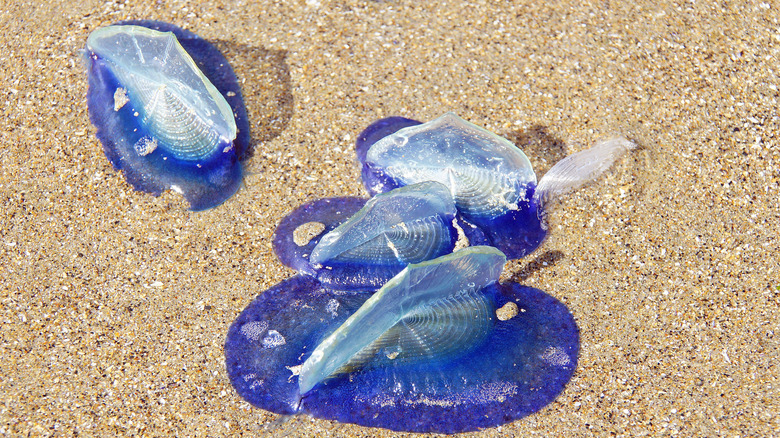
Despite their jellyfish-like look, Velella velella are not true jellyfish. They are actually a floating colony of organisms called hydrozoans that function together as a single unit. Each colony includes feeding polyps, reproductive structures, and defensive cells. They are unique creatures that live at the ocean's surface and float at the interface between air and water, usually in warm and temperate oceans. Velella velella have tiny stinging tentacles that they use to capture plankton and larval fish.
Their most distinctive feature, however, is the small, clear sail that rises diagonally from the body and reaches above the ocean's surface. This structure allows them to harness both wind and surface currents, drifting across the open ocean. Under normal conditions, the sail's angle causes them to travel slightly across the wind rather than directly with it, helping to keep them offshore. However, when weather patterns shift, particularly when strong winds blow toward land, Velella velella can be driven onto the shore in massive numbers. They cannot swim or propel themselves back to sea, so they become stranded. This accumulation tends to happen in the spring to early summer and is more common along the Pacific Coast, but also occurs elsewhere around the world.
Here's what to do if you see Velella velella on the beach
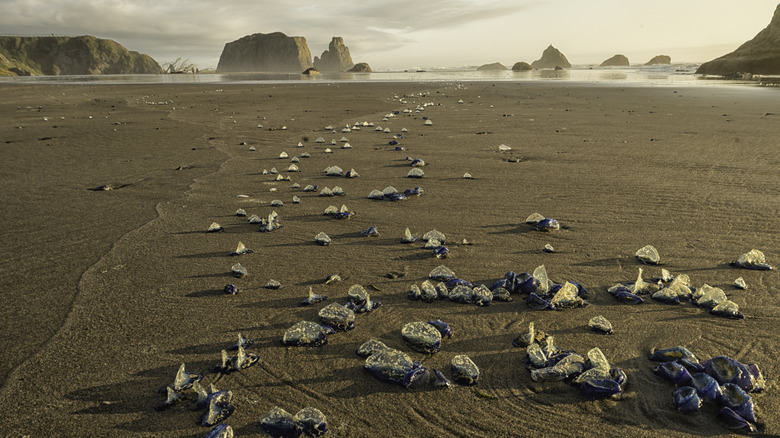
For those lucky enough to arrive at the right moment, this unusual sighting is truly unforgettable. However, responsible viewing is essential. Experts advise against walking barefoot through dense accumulations, as the bodies can be slippery and may still contain mild stinging cells. It's also best to avoid touching Velella velella, as touching your eyes and face afterward may cause painful burning. Dogs should be kept on leash and away from these organisms as they can cause digestive upset if consumed.
Visitors should know that this phenomenon is short-lived. The creatures cannot survive on land, and within hours of washing ashore, their bright blue bodies begin to fade to a dull gray. Over time, decomposition can produce a strong, unpleasant odor. You'll have the best chance of seeing their bright colors if you visit immediately after a period of strong onshore winds, when the hydrozoans still retain their glassy, translucent look.
Wildlife lovers will appreciate the opportunity to observe an ocean-dwelling species up close — something that's rarely possible unless you visit a snorkeling hot spot like Turks and Caicos. Families may use it as an educational moment to learn about marine life with their kids. Photographers will delight in the contrast between the swaths of cobalt and the pristine golden sand. In any case, it's best to observe from afar and allow nature to run its course.