

California's Anticipated Bullet Train Will Connect LA And San Francisco In Under 3 Hours
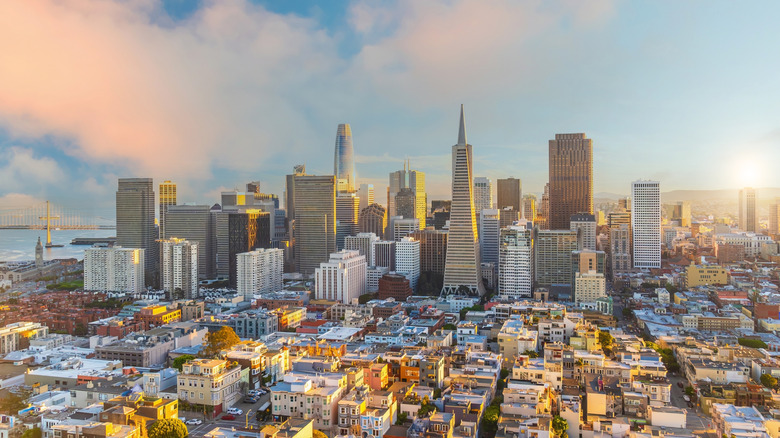
Often referred to as California's "bullet train," the state's 800-mile high-speed rail project could dramatically change the nature of travel for the state's visitors and residents. California is the third-largest state by area, and travel between major cities such as San Francisco and Los Angeles often requires either long highway drives or short-haul flights. If the bullet train succeeds, you could travel that distance in under three hours, with little hassle. It would be among the first truly high-speed rail systems in the United States, along with a lightning-fast bullet train connecting LA and Las Vegas.
The core concept is a modern rail system that operates on dedicated tracks designed specifically for high-speed trains. Unlike traditional passenger rail, these trains are designed to reach top speeds of about 220 miles per hour, placing them on par with the fastest high-speed rail systems in the world. At those speeds, the journey between San Francisco and Los Angeles could take about two hours and 40 minutes. Today, driving that distance takes just over six hours, not counting any rest stops. By bus, it's a grueling eight-hour ride.
The first phase of the system is designed to connect San Francisco and Los Angeles, with additional extensions planned north to Sacramento and south to San Diego. The project also promises broader economic and environmental benefits. Officials leading the project claim that construction has created thousands of jobs. The system is also expected to significantly reduce highway congestion and cut greenhouse-gas emissions.
Why the California bullet train is such a big deal
The project represents a significant shift in how Americans think about transportation. In the United States, long-distance travel has historically been dominated by cars and airplanes. After World War II, federal investment focused heavily on building thousands of miles of interstate highways, with nearly no investment in public transit.
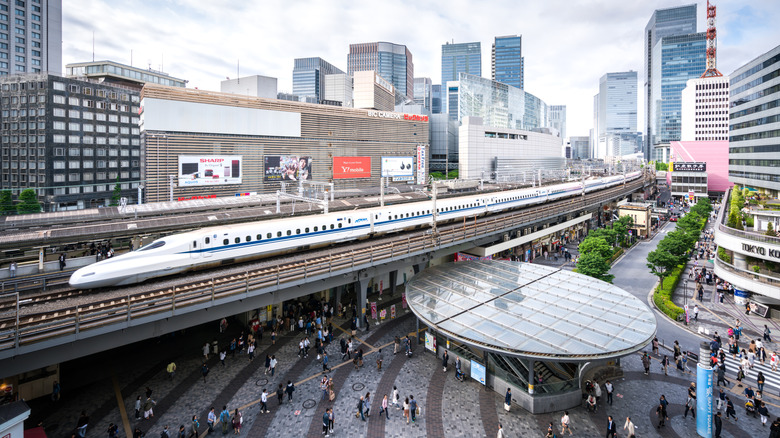
In the 1970s, the federal government created Amtrak to maintain basic passenger rail service across the country. While Amtrak has modernized some of its services since then (which you can enjoy on the most scenic Amtrak routes), much of its technology is outdated, and its trains generally operate at lower speeds than true high-speed rail systems. Right now, the fastest train in the U.S. is the Acela, which can reach 160 miles per hour in certain parts of the Northeast Corridor. But on average, it only runs about 103 miles per hour. By contrast, high-speed rail has been a major part of transportation infrastructure in other countries for decades. Japan launched the world's first modern high-speed rail system, the Shinkansen, in 1964. France followed with the TGV network in the 1980s, while China has built the world's largest high-speed rail system with some of the fastest bullet trains in the world in just the past two decades. California's project is intended to bring similar technology to the United States.
Planning for California's high-speed rail system began in the 1990s with the creation of the California High‑Speed Rail Authority, the agency responsible for planning and building the network. A major milestone came in 2008, when California voters approved a $9.95 billion bond measure to help fund construction.
The bullet train moves forward, despite setbacks

Despite early enthusiasm, the California rail project has faced some challenges that have slowed progress and increased costs. In fact, when the bond measure passed in 2008, the projected cost of the system was about $45 billion, according to Grist. Current estimates place the full Phase 1 cost somewhere in the ballpark of $90 billion. Construction is currently concentrated in California's Central Valley, particularly along the route between Merced and Bakersfield. This section is expected to become the first operational segment of the system, potentially opening in the early 2030s.
Several factors – politics, engineering challenges, and an unusual amount of red tape — have contributed to the project's long timeline and escalating costs. These challenges have made the railway a frequent target of criticism. Opponents argue that the system is too expensive and that construction delays undermine its original vision. Even so, the project continues to move forward. State leaders have adopted a phased strategy that focuses on completing usable segments of the system first, particularly the Central Valley portion. The idea is that once trains begin operating and demonstrating their value, additional funding may become easier to secure.
To that end, the agency in charge of the project released renderings of several stations planned along the first phase, including Merced, Fresno, Kings Tulare, and Bakersfield. Sleek, futuristic trains are pictured pulling into stations emphasizing natural materials such as wood and stone, and abundantly lined with trees and fountains. If completed as envisioned, California's bullet train could represent a turning point in American transportation infrastructure. After decades in which cars and airplanes dominated long-distance travel, the project may determine whether high-speed rail can finally take hold in the United States.