

12 Stunning Train Stations To Visit In Europe
The adage famously attributed to writer Ralph Waldo Emerson, "It's not the destination, it's the journey," is often invoked as a reminder to make the most of travel's in-between moments — the long drives, train rides, and walks — as much as the main attractions. But Emerson may not have taken Europe's stunning and historic railway stations into consideration, all of which make arriving at your destination all the sweeter.
Taking a train through Europe is an iconic and time-honored way to explore the continent, and options range from ultra-luxury, all-inclusive itineraries to budget-friendly passes and overnight routes that Rick Steves recommends if you want to save time and money. In places like Stockholm and London, which are well known for their subway systems, you can typically transfer very easily from the railway station to the subway terminal, making the transition to the next leg of your journey fairly seamless.
From Antwerp's ornate stone entrance hall to Madrid Atocha's tropical botanical garden to Liège-Guillemens' sweeping, ultra-modern architecture, some stations around Europe brim with character, making them attractions unto themselves. They're often visitors' first impressions of a new place as they step off a train onto a platform, and when the station itself makes you go "Wow," it's a good bet you'll be impressed with the rest of the city, too. Below, explore 12 of the most incredible train stations in Europe.
Madrid Atocha, Spain
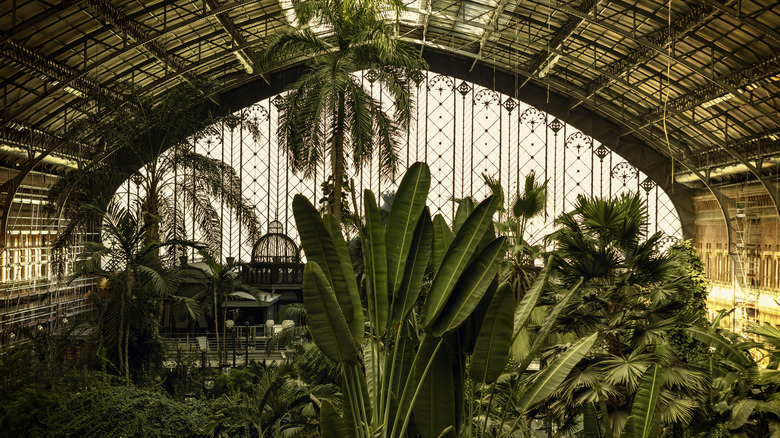
In an 1892 expansion to Madrid's central train station, headed by a French engineer named Henri de Saint-James, an ornate steel-framed hall rose up nearly 90 feet high and elegantly mirrored how quickly international railway travel was expanding during that era. Today, Madrid Atocha (short for Madrid Puerta de Atocha – Almudena Grandes) has a kind of dual identity. A major modernization project completed in 1992 emphasized a new addition for high-speed trains, while the historic part is now dominated by a feature unique among European stations: a lush, interior botanical garden.
Originally, Madrid Atocha's garden included a turtle pond amid its thousands of plants, representing well over 200 species. Over time, travelers released their own amphibians into the tiny pond, and its capacity was eventually overloaded. The turtles were removed to a wildlife park in 2018, but the rest of the garden is still maintained. In addition to the tracks used for routes to major destinations like Barcelona, Seville, Malaga, Cadiz, and others, a lower level known as Madrid Atocha-Cercanías offers local train connections.
Milano Centrale (Milan Central), Italy
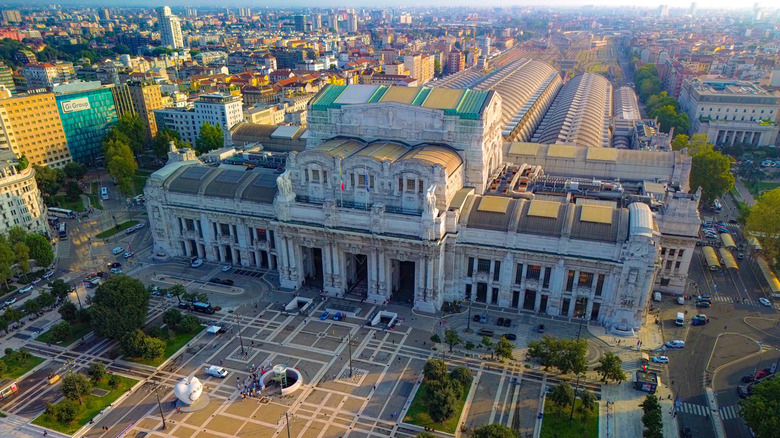
Milano Centrale is a palatial fusion of architectural styles in what Rick Steves calls "Italy's most underrated city." Construction of the current station commenced in 1912, and it opened in 1931 with a facade that's more than 650 feet wide and blends features from predominantly Art Deco and Liberty styles — Liberty is Italy's version of Art Nouveau. It's a hulking presence on the Piazza Duca d'Aosta that originally functioned as propaganda; the infamous dictator Benito Mussolini intended its striking size and appeal to advertise his fascist regime. Today, these symbols of brute strength and swagger persist in giant stone sculptures of hulking animals and references to ancient Rome.
Italy is renowned for its marble, and Milano Centrale is packed with more than 350,000 cubic feet of the beautiful quarried stone. Complementing this timeless material, the train sheds are soaring glass-and-steel constructions that hover elegantly over the tracks. Throughout the station, you'll also find a number of murals, one of which still depicts Mussolini. And on the east side of the station, at Platform 21, you'll find the somber Shoah Memorial, which is open daily from 10 a.m. to 4 p.m. The striking monument memorializes the thousands of Jewish people who were sent from this terminal to concentration camps throughout Europe during World War II.
St. Pancras International, London, U.K.
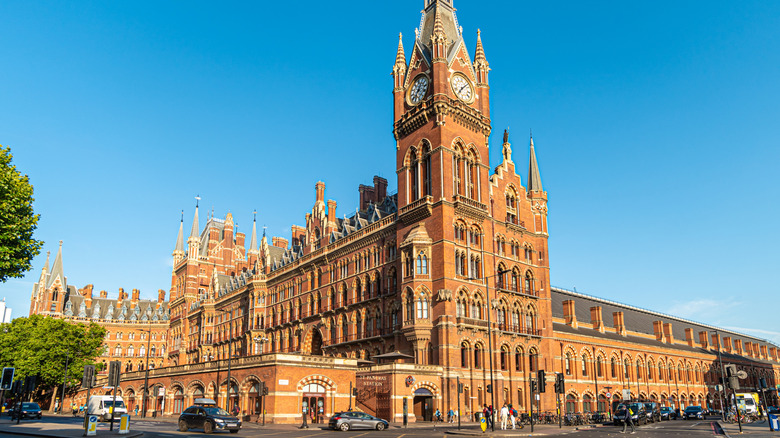
If you're traveling to the U.K. via train from the European continent, St. Pancras International is your gateway to London's most iconic attractions to explore. Located right next to Kings Cross, this striking Victorian-era station provides high-speed connections to European hubs including Amsterdam, Paris, and Brussels. And while it's all about modern technology today, its ornate exterior harkens back to the Industrial Revolution and Victorian train travel, when steam locomotives would have conveyed passengers and goods around the country more than a century before the existence of the Eurostar or the "Chunnel."
St. Pancras' towering Gothic Revival architecture still stands out. It's home not only to the train terminals, numerous fine shops, and characterful dining and bars, but it also houses a 5-star hotel, currently operated as part of Marriott's Autograph Collection. With Victorian details around every corner, it melds historic elegance with contemporary comforts and makes a great spot to drop your bags for a night — or a few — in the heart of London. Even if you're just passing through, take a moment to stop into the striking Gothic Bar to savor a craft cocktail in the spirit of bygone eras.
Helsingin päärautatieasema (Helsinki Central Station), Finland
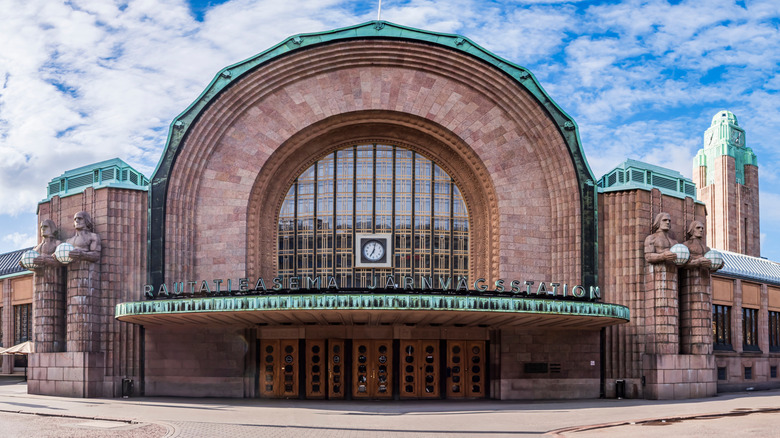
Helsinki is a unique and creative city that Rick Steves describes as a "spruce-and-stone metropolis," at the southern end of Finland. Regional routes, commuter trains, and long-distance journeys all converge here, and if you're making the city your home for a few days, you can easily connect to the tram network right outside the front door.
Remarkably bold, ahead-of-its-time architecture characterizes the amazing Helsinki Central Station, which is often cited as Finnish architect Eliel Saarinen's magnum opus. (His son, Eero, is well-known for his mid-century modern terminal design at JFK Airport in New York City, plus the Gateway Arch in St. Louis, Missouri.)
The station's entrance is almost theater-like, complete with a massive stone arch over a window, which is flanked by bold statuary and geometric forms that, when it opened in 1919, heralded a transition from Art Nouveau to the Art Deco movement. Pink granite sets off the green patina of weathered copper details, and the whole feel is one of forward-thinking modernism with just a tinge of romance. To soak up some of its interior heritage and relax at the same time, head to Olivia Central Station, an Italian restaurant nestled in the former ticket hall.
Amsterdam Centraal, The Netherlands
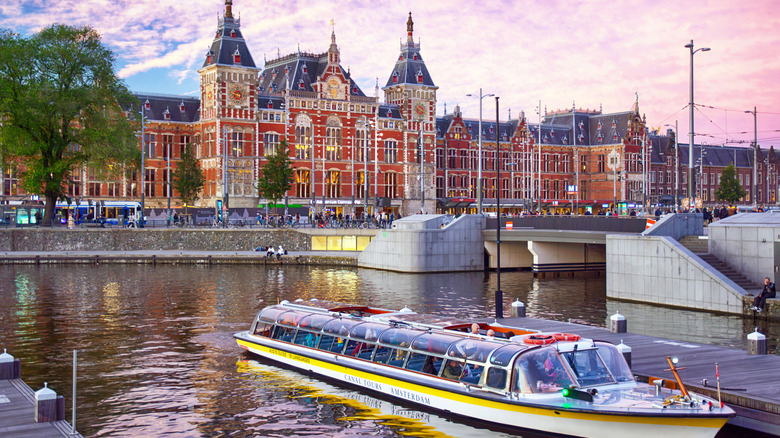
Catering to travelers moving around the Netherlands and other parts of Europe, Amsterdam Centraal is one of the country's busiest stations. Intercity trains usually consist of longer journeys within the Netherlands that only stop at major points along the way, while Sprinter routes are like commuter trains, better for shorter journeys with more stops along the way. A slew of international trains connect visitors to and from European centers like Paris, London, Prague, and many more.
Amsterdam Centraal's architecture is impressive, completed in 1889 and coinciding with a range of other construction projects that have since become major landmarks, like the Rijksmuseum and the Concertgebouw — the performance hall for the philharmonic orchestra. The station's setting in the center of the city, renowned for its many canals, means that it's surrounded by water, and the building can be enjoyed from various vantage points in addition to exploring inside.
Another bonus of having canals literally right outside is that it's very easy to hop on a water taxi or one of many canal cruises straight from the station. Or, if you'd prefer to land first and relax with a great view, hop across the street to Loetje Amsterdam Centraal, housed in a historic coffee house with views of the station entrance in one direction and the water in the other.
Gare de Lyon (Lyon Train Station), Paris, France
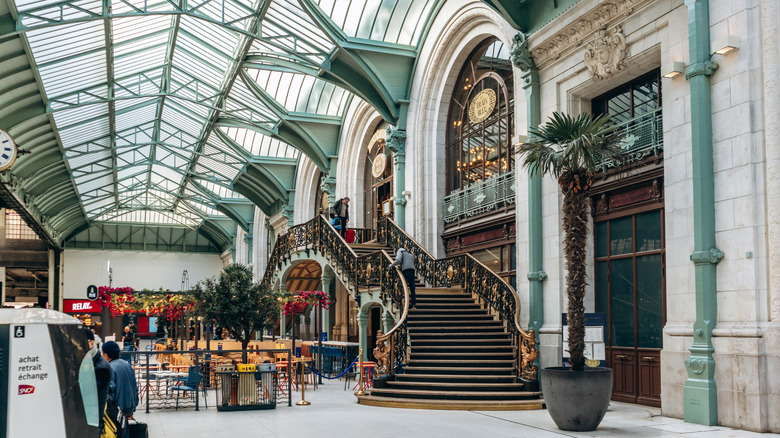
Gorgeous arches and a prominent clock tower, paired with a bold steel-and-glass roof and Art Nouveau details, make Gare de Lyon a truly remarkable building. Don't let the name confuse you, though — it's located in Paris, not the city of Lyon. Its name comes from the mid-19th-century Paris-Lyon-Mediterranean Rail Company, reflecting the destinations its routes were built to serve, and the name stuck. When the station was rebuilt and expanded in 1899, it was imbued with the gorgeous style we still get to enjoy today.
Paris is a sprawling city with some of the world's most recognizable landmarks — think the Arc de Triomphe, the Eiffel Tower, Notre Dame, and many more. European travel guru Rick Steves has some helpful advice for first-time visitors to make the most of Paris. If you're heading to or from a southeasterly direction via one of Gare de Lyon's many destinations, including Marseilles, Nice, the Alps, and beyond — and of course, Lyon! — take some time to explore this phenomenal building before heading on to your next stop.
Make the most of your visit to Gare de Lyon with a meal at Le Train Bleu, which has a sumptuous interior chock full of murals and is accessed via a grand double staircase fit for a royal residence. The restaurant specializes in elevated regional cuisine with takeaway options available, and its atmosphere invokes the timeless romance of rail travel. You can also cozy up in its lounge areas if you're more in the mood for a cocktail or coffee.
Antwerpen-Centraal (Antwerp Central), Belgium
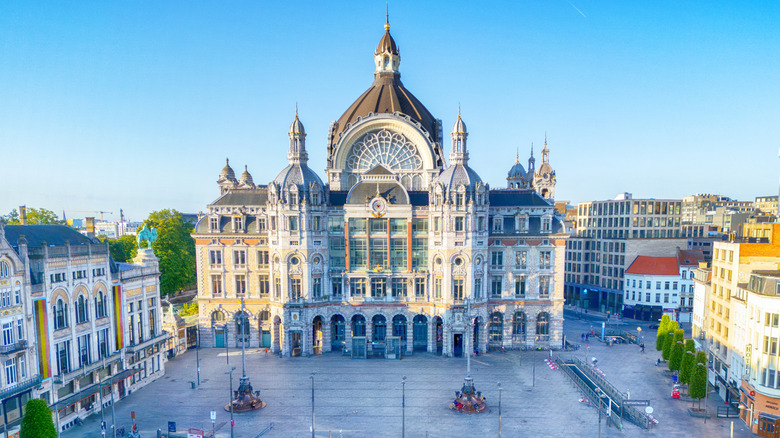
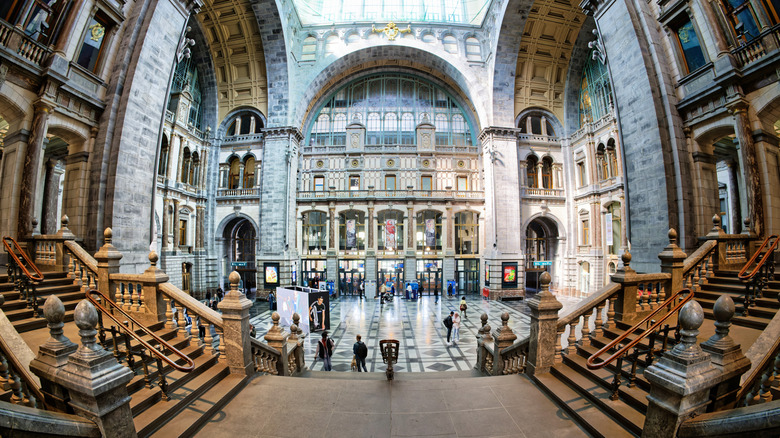
With a nickname like "Spoorwegkathedraal" ("railway cathedral" in Dutch), it's not hard to imagine why Antwerpen-Centraal has a reputation as one of the most impressive train stations in Europe. It was completed in 1905, and its mish-mash of styles was drawn from a range of sources. The architect also drew inspiration for the main hall from the Pantheon in Rome, one of Italy's most iconic tourist attractions. Its huge stone hall and massive staircases have a palatial feel, as awe-inspiring now as they were when the building was inaugurated.
Antwerpen-Centraal is preserved as a historical monument, pointing to not only its own grand presence but the foresight Belgium demonstrated when it became the second country in the world to construct a railway line when the technology was still very new (England was the first). The station's architectural heritage is wonderfully eclectic, including Art Nouveau details interspersed amid Gothic, Byzantine, and Baroque elements. And, like many railway terminals from this area, a striking steel-and-glass roof covers the tracks, letting in natural light that plays off the many patterns and sculptural details around the building.
São Bento (Saint Benedict), Porto, Portugal
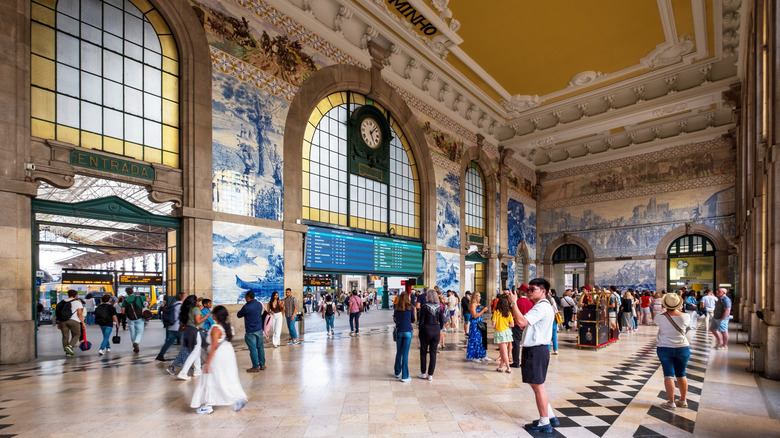
In Portugal, ceramic tilework known as "azulejo" is a natural treasure. The tradition became very popular with royals and the wealthy in the 16th century, when hand-painted compositions could be customized to add glossy and stylish details to both interiors and exteriors. Walk down any historic street in Lisbon or Porto, and you'll encounter beautiful facades and entryways embellished with a huge range of patterned tiles. And one of the best places to see these, in addition to Lisbon's National Tile Museum, is Porto's gorgeous São Bento railway station.
São Bento serves primarily suburban stations, so if you're taking the train in from outside of the area, you'll end up at Porto Campanhã, which is about 1.5 miles from Porto's city center. Hop on a local train to São Bento, and you'll be transported right to the middle of it all in just a few minutes. You wouldn't really guess the inside is so unique, as the exterior of the station is a nice-looking but fairly ordinary Beaux Arts-style structure opened in 1916, but once you've entered the main hall, it's an entirely different story. The blue-and-white tile decor inside, created by azulejo artisan Jorge Colaço, is evocative of Dutch Delftware. Scenes depict Portuguese history and culture, and around the top, a huge frieze in full color depicts the history of transportation.
Edinburgh Waverley, Scotland
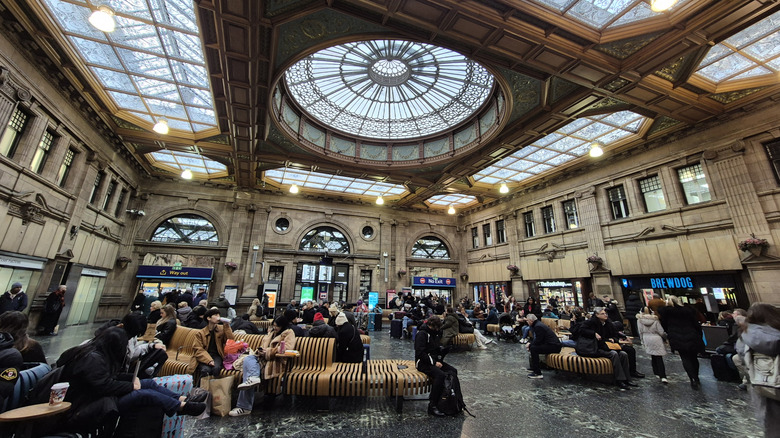
Edinburgh Waverley, named after Scottish author Sir Walter Scott's famous "Waverly" novels, is set in a unique part of town. The architecture itself is an atmospheric Victorian structure with the era's elegant yet austere glass-and-steel train sheds and skylights, but it also has a feeling of being uniquely sunken into the earth. That's because the station's location, sandwiched between the joint UNESCO World Heritage Site districts of Old Town and New Town, used to be underwater. Rolling in on a train is tinged with drama, as centuries-old buildings and towering volcanic cliffs hover overhead.
Located at the end of a long, low park called Princes Street Gardens, dotted with monuments and museums, Waverley sits in what was once called Nor Loch, a body of water below Edinburgh Castle that unfortunately turned into what the National Transport Trust aptly describes as a "fetid open sewer" by the early 1800s. It was eventually drained, and the train station went in. Today, it's a striking building tucked amid the historic town, and some of the most iconic views of Old Town can be captured from the pedestrian-only street in front of it. Additionally, if you exit the station toward Princes Street, you'll be in the presence of the iconic Balmoral Hotel, where you can stop in for a mixed drink at Bar Prince.
Liège-Guillemens, Belgium
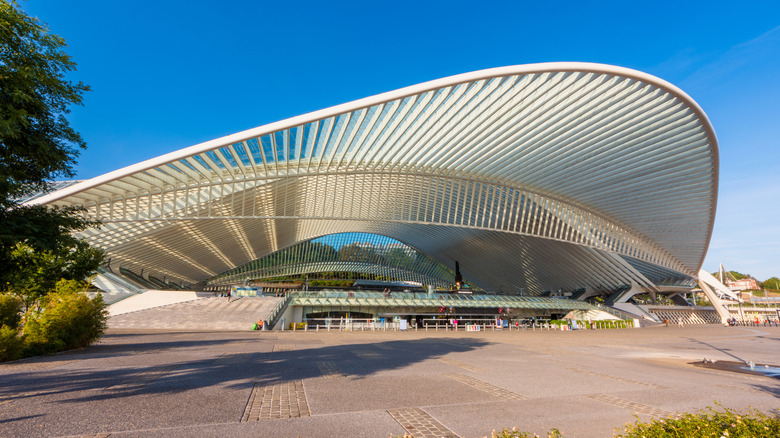
An incredible contemporary building that highlights streamlined technology, Liège-Gillemens train station in Liège, Belgium, is something of a dramatic foil to many of the more historic buildings on the list. Designed by the renowned architect Santiago Calatrava, its swooping, organically arched exterior evokes movement and grace, like a giant swath of fabric billowing in the wind. It's one of the busiest stations in the region, and Calatrava's state-of-the-art design mirrors the progressiveness of technology and rail travel, especially internationally, and with more demand for high-speed travel options.
Unlike traditional buildings, which have a facade that clearly delineates the boundary between interior and exterior, Liège-Gillemens is essentially both at once. The colossal roof, with its ray-like patterns and glass, nods to the huge steel train sheds of the past while inviting travelers to experience something bright and sculptural, which almost appears as though it could be kinetic — a feature the architect incorporated into the Quadracci Pavilion, known as "The Wings," at the Milwaukee Art Museum, one of Wisconsin's most iconic tourist attractions. If you want a unique view of the station, drop your bags at ibis Styles, a series of vacation rentals called Guillemens Station Flats, or Hôtel de la Couronne across the street.
T-Centralen, Stockholm, Sweden
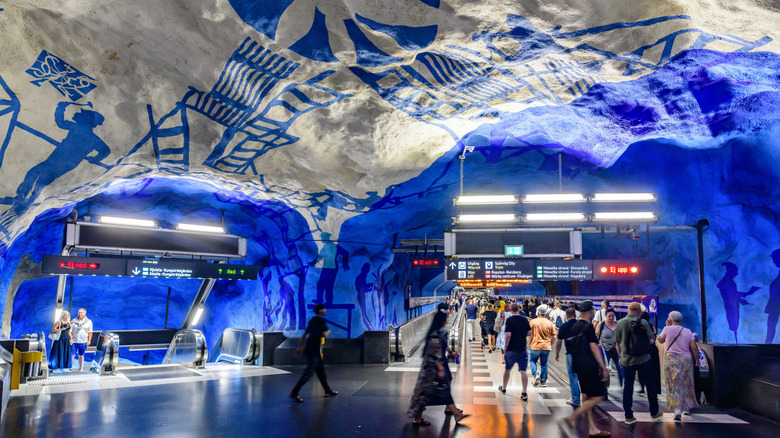
The exterior of Stockholm Central station, sometimes referred to as Stockholm C, is a prominent building located on a thoroughfare called Vasagatan. It's certainly a nice building, and its historic train shed was transformed into a main concourse once the station expanded in the early 20th century, so its interior feels like a blend of the historical and the modern. But it's actually an adjacent rail hub known as T-Centralen, the city's central subway station, that is a true treasure — and it's just the starting point of a truly unique underground network.
Stockholm's subway system doubles as a giant public art exhibition, with numerous stations decked out in original artworks. T-Centralen, which opened in 1957, was the first station in the area to incorporate artwork; here, you'll see installations created by artist Per Olof Ultvedt in an eminently pleasing shade of blue. Its cavernous feel adds to the unique atmosphere — and it's just the beginning. Spanning nearly 70 miles along the system, a number of other stations offer unique multimedia experiences. At the Citybanan track at Odenplan, which connects via commuter train directly to T-Centralen, a quarter-mile of LED lights double as a huge ceiling installation, and the central Kungsträdgården station's unique artworks reinterpret monuments and sights above-ground.
Estació del Nord (North Station), Valencia, Spain
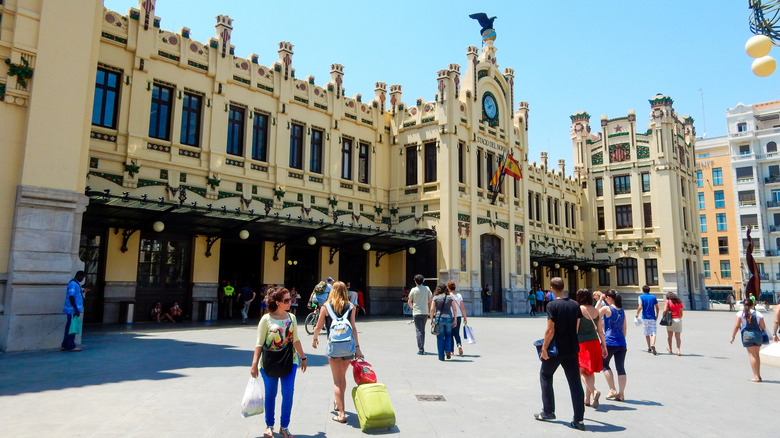
Valencia is a relaxed, beautiful Spanish city on the Mediterranean known for its paella, the Santiago Calatrava-designed City of Arts and Sciences, its annual Fallas celebrations, and the epic Central Market, which holds the distinction of being Europe's largest market for fresh produce and a must-see tourist attraction for first-time visitors to Spain. Arriving by train is a treat, and via high-speed rail, the journey only takes about two hours from Madrid or around three hours from Barcelona. From those cities, you'll likely arrive at another station called Valencia Joaquín Sorolla. But if you take local suburban trains, you'll likely head through Valencia Estació del Nord, which is, hands down, the much better-looking of the two and worth a stop on a walking tour of the city center.
Estació del Nord was completed in 1917 and boasts gorgeous Art Nouveau details. The cream-colored facade includes castle-like crenellations and even some sculptural details like oranges, for which the city is famous, and the red-and-yellow stripes of the Valencian flag. The ticket hall has a beautiful, throwback feel with wooden booths, mosaic walls, and a beamed ceiling, which opens up to the tracks covered with a large steel canopy. Stop into Yuzu Cafe for a Japan-inspired matcha tea or snack. Or, if you have a bit of time to kill before catching your train, head to nearby Parque Central, a beautiful green space with water features and gardens that reflect Valencia's reputation as a green city.
Methodology
In addition to the author's experience visiting more than half of these train stations, we compiled this list by starting with a number of blogs, travel sites, and architectural platforms that focused on the most beautiful train stations, including AFAR, EuropeanBestDestinations.com, CiaoBella.co, and TheSaneTravel.com.
For information about architectural history, we also consulted sources like Monocle, MADWhite, CiaoBella.co, Architectuul.com, AccidentallyWesAnderson.com, SmithsonianMag.com, TheBeautyofTransport.com, Calatrava.com, and Bluffton.edu, plus regional tourism sites like Amsterdam.info, Visit.Antwerpen.be, VisitValencia.com, and VisitStockholm.com. Additionally, specific data or information about amenities, layout, connections was sourced from sites like EsMadrid.com, StPancras-HighSpeed.com, VR.fi, NS.nl, Eurostar.com, The Man in Seat 61, and Retours.eu.