

5 Helpful Tips For Going Analog During Your Travels
We may receive a commission on purchases made from links.
Smartphones have put the world at our fingertips. From finding trending destinations on social media to booking tickets with an electronic wallet and purchasing an eSIM that makes getting lost a thing of the past — and, let's be honest, lets you call mom too! — technology has made travel easier than ever. Plus, with AI-curated trip itineraries becoming a reality — and according the BBC, one of the big travel trends for 2026 — it's not surprising to learn that the other end of the spectrum is also trending.
Since last year, there's been a spike in travelers leaving their smartphones behind, reaching instead for a film camera, a notebook and pen, or even paint to capture their memories. While analog travel isn't anything new, it is a more intentional way to travel that focuses on experiences as doors to discovery.
Rather than blasting through continents or countries, it's about working hard to ditch the latest social media travel trend and channel your inner Rick Steves or Anthony Bourdain, so you can truly devote your time, effort, and energy to the country you've decided to visit. Sure, you may have more uncertainty and inefficiencies by cutting the cord with technology, but instead of chasing perfectly curated itineraries, it's more likely you'll have genuine experiences. If this sounds like your cup of tea, here are five tips to help your senses take the lead, rather than your phone.
Go back to the basics

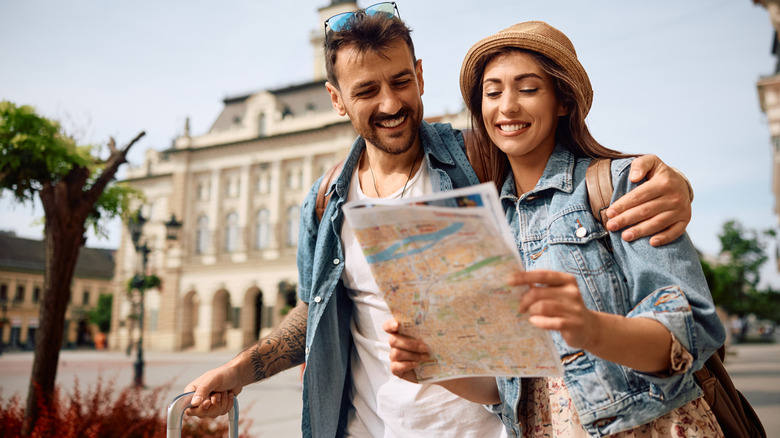
Going analog doesn't mean going with the wind; it means doing your research and having an idea of your destination before yo go. While your phone and technology can lead you down the path to fully planning your trip, don't rely on them alone to find information. Use them to find your local library, connect with fellow local travelers who have visited the country, and to learn about suitable guidebooks, maps, and hard copies of language resources before setting off. On that note, if you've rarely used a paper map or your French is a bit rusty, see these obstacles as learning opportunities to build your personal skill set and self-confidence before you travel.
When you have downtime on your trip, rather than scrolling, be creative. Bring a pen and notebook to doodle, take notes of how you're feeling, or start writing that book — the old-fashioned way. Moreover, they're both handy tools to write down the phone number and address of your hotel or your embassy in case you run into major problems and your phone battery is dead.
Since his first trip, travel guru Rick Steves has made a point of preserving his travels on paper, rather than digitally. Rather than hunting for souvenirs, Steves notes, "The most treasured keepsake of any trip I take is the journal I bring home, filled with descriptions and observations of the people I've met, the places I've seen, and the experiences I've had [...] Without capturing your thoughts on paper (or on your laptop or tablet), the lessons of travel are like shooting stars you just missed...and butterflies you thought you saw."
Take it slow

One key aspect of analog travel is intentionality — truly soaking up your surroundings. Instead of wearing yourself out and making a beeline from Rome to Milan, take a few days to explore some of the most iconic Italian tourist destinations in depth to feel a greater sense of the local culture, language, and natural wonders that many tourists miss. Come rain or shine, the major monuments will still be there. However, that lovely afternoon spent enjoying a picnic, taking a language lesson, or simply grabbing a seat and watching the world turn will last just a few short hours. As you soak up the sights, smells, and sounds of your surroundings, you'll be more present in the environment and will have a stronger connection — and in my experience, better memories — with your destination, rather than literally seeing it from behind a window.
On the same note, whether you're visiting Tokyo or hoping to make the most of your first trip to Paris, don't bite off more than you can chew. While many of us, myself included, often try to compress time into an itinerary, time itself needs a chance to breathe. The late Anthony Bourdain famously noted, "Letting the happy accident happen is what a lot of vacation itineraries miss, I think, and I'm always trying to push people to allow those things to happen rather than to stick to some rigid itinerary." An element of spontaneity — whether it's signing up for a cooking class on a whim, being roped into a traditional dance class, or taking a cold plunge — can help you find a sense of rest and presence in your environment that you can't find in front of a screen.
Follow the locals' lead

Peeled back, analog travel is about reconnecting with oneself and others on a person-to-person level. From my years of experience traveling across the globe, no matter which corner of the world I've found myself in, a sure-fire way to spark that connection is by trying a local meal. While you could quickly hop on social media, Yelp, or Google Maps to find someplace nearby, your best source of information about a particular establishment will nearly always be the locals themselves. Once you've arrived at your destination, ask employees at your hotel or your taxi driver where they like to eat, or get a second opinion about the restaurant you've been dying to try.
Similarly, if you are trying to go analog in another country, one key piece of gear that will inevitably come in handy is a phrasebook. Google Lens and other translation technology are incredible for practical uses such as translating road signs, restaurant menus, or bus schedules in a foreign language. However they can't replace the feeling of respect — and a local's willingness to open up — when a foreigner attempts to speak their language. In fact, this small gesture of appreciation is just one tip from Rick Steves to have a more immersive experience while in a foreign country.
Don't go cold turkey

Wi-Fi and technology allow us to bounce from website to website and gain instantaneous access to information at our fingertips, and in the process, our attention spans have taken a big hit. On a podcast hosted by the American Psychological Association, Dr. Gloria Mark noted that technology has caused the average person's attention span to shrink from two-and-a-half minutes in 2004 to just 47 seconds in the late 2010s.
If you are planning to go through a digital detox on your travels, be sure to take it slowly and ease into it. You may find that you're bored; however, according to Mark Hawkins, author of "The Power of Boredom," this powerful feeling is actually the cornerstone of creativity and personal transformation.
That being said, your phone is still a lifeline to your loved ones and your life back home. Rather than turning it off indefinitely, set a goal to limit your daily screen time while remaining reachable in case of an emergency. It's also a good idea to let them know your plans if you'll be harder to reach than normal, and to get their addresses to surprise them with a postcard from the road. Once you've packed your favorite card game and made physical copies of your travel documents, experts like Rick Steves advise travelers to knock out these essential tasks to make your trip go more smoothly.
Your first steps to take action

The best part about going analog is that you don't have to jet across the world to immerse yourself in a signal-free world. If you aren't sure where to start, turn your phone off or keep it on silent for the day, and head outside for a fulfilling and engaging day with your physical and natural world. Take your bike for a spin like we all used to — without tracking your time, distance, or calories — and ride for the sheer thrill of it. Alternatively, give a new activity, such as fly fishing, a whirl. Even if you don't catch many fish, the relaxing sound of a running river or serene pond and natural wildlife will help you build concentration and keep your attention — and your focus — away from your phone.
If you do take the plunge into going analog, note that you'll likely feel more engaged and will gain deeper local insight into the destination, especially if you travel with a friend or in a group. A 2019 study from the University of East Anglia, University of Greenwich, and Auckland University of Technology revealed that bringing a friend will not only help you strengthen your relationship, but also help fight digital withdrawal.
For an even bigger reset on vacation, consider combining your trip with outdoor activities such as camping or visiting one of the best national parks for stargazing, where you'll be miles away from the nearest city. Another popular option is to enjoy a mindfulness retreat. And if you're set on flying off to a faraway land, Islands.com highlighted 9 destinations across the world where neither of you will have to worry about learning "What's the wifi password?" in the local language.