

11 Epic Geysers In Yellowstone That Are More Incredible Than Old Faithful
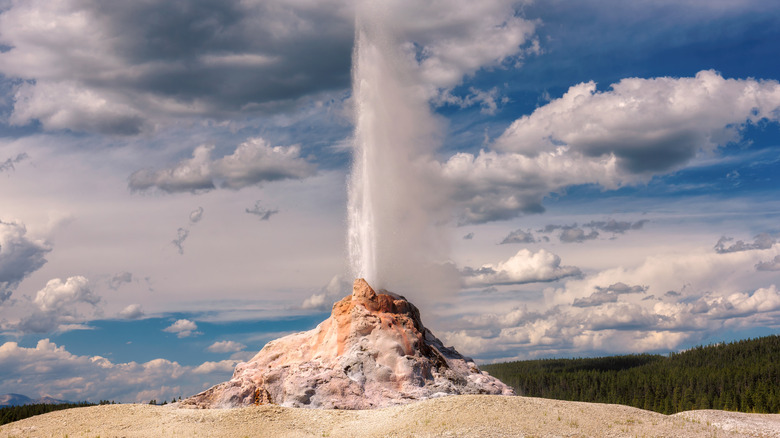
One of the very first things to pop to mind at the mention of Yellowstone National Park is its iconic Old Faithful, one of the most spectacular landmarks in U.S. national parks. It's known for erupting at predictable intervals — hence the name. And while its frequency has changed in the past few decades, lengthening to its current pace of every 68 and 94 minutes — with a little wiggle room — it can still be predicted pretty well. Combined with its ability to reach heights of up to 184 feet, its reliability is a major reason it's so incredible; it draws millions of visitors every year.
Old Faithful is far from alone. Of all the geysers in the world, Yellowstone is home to around half of them, with nearly 500 gurgling, spewing, splashing, and spraying at all times of day in a range of hydrothermally active areas around the park. You'll find the biggest active geyser on the planet here, plus spouts that regularly exceed 100, even 200 feet. The park is also home to numerous hot springs and glistening pools with rainbows of mineral hues.
So what makes a geyser truly incredible? Without throwing any shade at Old Faithful, there are others dotted around Yellowstone that stand out for unique characteristics, whether shape, size, location, frequency, or sheer power. While not all of them may be as predictable or as frequent, some are very large or visually compelling — and definitely not as crowded. Pro tip: if you're looking forward to seeing specific geysers, download the official NPS App to keep tabs on updates about predicted eruption times. And while you can drive past the occasional geyser, be prepared to walk or bike. Read on for 11 more remarkable geysers well worth visiting at Yellowstone.
Riverside Geyser
The Upper Geyser Basin is where most of the active geysers in the world can be found. If you enter the park at the West Entrance, it's a 30-mile drive to this area, home to Old Faithful. From the North Entrance, it's about 57 miles. Mostly accessible on foot via boardwalks, there is also a paved trail open to bicyclists that connects the popular Old Faithful area to the northern section of the basin.
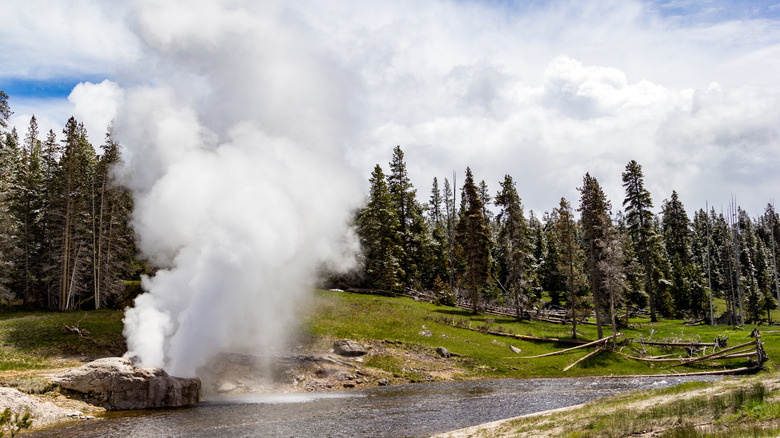
After a pleasant walk north, just shy of a mile from Old Faithful along the boardwalk past numerous other features, you'll find Riverside Geyser. It gets its name from its place along the bank of the aptly named Firehole River, and it erupts approximately every 6.5 hours, give or take a half-hour. Riverside is one of six geysers in the park that can be predicted with any regularity, making it a popular stop for visitors. Ironically, it even has a reputation for being more reliable than Old Faithful, at least when it comes to its consistency over time. Unlike some other geysers, Riverside doesn't share its thermal plumbing with others, so its energy is always reserved for only its own eruptions.
For about 20 minutes, the impressive spout produced by Riverside Geyser's cone is usually around 75 feet high. Its situation on the edge of the river creates a picture-perfect arc, often producing a rainbow. And because Riverside has two vents, one higher than the other in a "chair" shape, spouts and steam can emerge from both to create a billowing heart-shape that's a special treat for photographers if you're fortunate enough to time it just right.
Castle Geyser
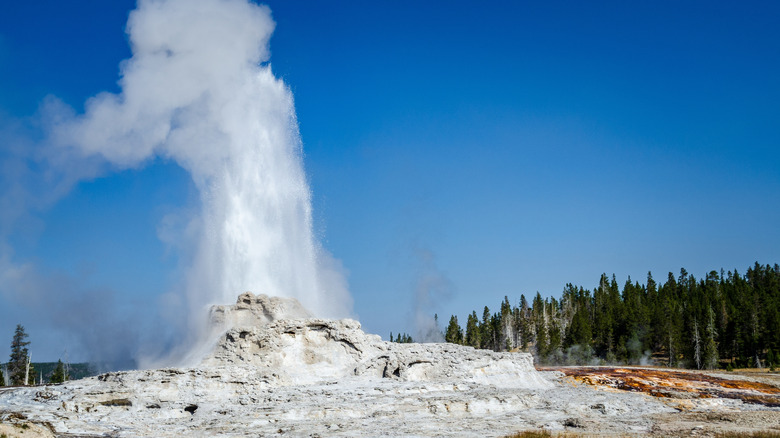
In 1870, during a surveying trip known as the Washburn-Langford-Doane Expedition, Castle Geyser was among those named in the Upper Geyser Basin. One glimpse of this assertive hydrothermal feature, with its cone formed over the course of thousands of years, and it's easy to understand why it was thought to resemble a castle turret. The geyser's visible age is remarkable, especially compared to some geysers where all the mechanics are hidden underground. Castle's current cone sits on one of the world's largest bases of sinter, which is a deposit made from mineral springs. Called geyserite, it's a type of silica stone that forms (you guessed it) only around geysers.
Only a 10-minute walk along the paved, bike-friendly path north of Old Faithful in the Upper Geyser Basin — or just a few minutes' stroll from the Old Faithful Inn parking lot — Castle Geyser is another of Yellowstone's predictable geysers. Although it comes with a caveat: it occasionally spews steam for a few minutes and doesn't fully erupt, which means that its next exhibition can't be forecasted. When it does blow, though, it gushes for around 15 to 20 minutes and regularly sprays 75 feet high, sometimes up to 90. Its intervals range from 13.5 to 14.75 hours, depending on whether it's feeling a little tricky.
Beehive Geyser
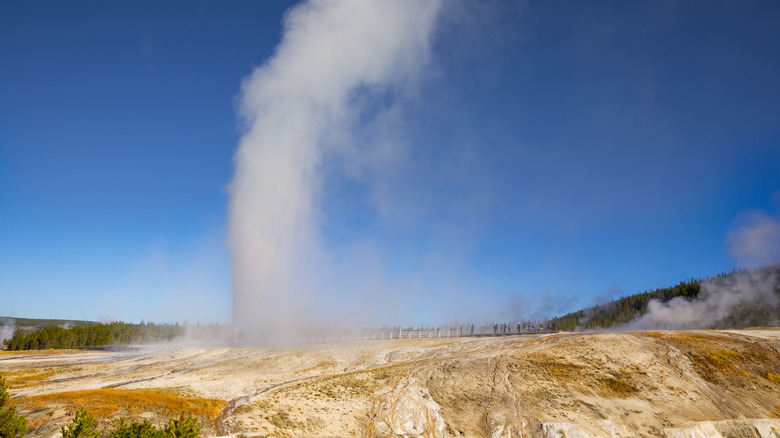
Sticking around in the Upper Geyser Basin, one showstopper it's worth practicing patience for is the zippy Beehive Geyser. It's very close to Old Faithful, situated just north of the Firehole River, making it only about a 6-minute walk from one to the other, or if you're starting at the Old Faithful Inn parking lot, it's about a 15-minute jaunt.
Very hot and intense, Beehive is an irregular gusher, meaning sometimes it goes a little bit quiet. It's known to erupt every 22 to 36 hours but can also sit dormant for a couple of weeks at a time. Nearby, a small geyser known as the Beehive Indicator Geyser performs its namesake task, giving a sense of whether the main spout is about to break free. Geyser-spotters have even given the indicator a nickname: "Indy." When it's active, Beehive Geyser can erupt a couple of times per day for four to five minutes each time, with temperatures averaging just shy of 200 degrees.
Beehive's "nozzle," which looks a little bit like an angular boulder stuck on the side of Geyser Hill, is relatively small, so when it erupts, highly pressurized water can shoot up as high as 200 feet, making it one of the tallest geysers in Yellowstone and proving it's a mesmerizing destination for nature-lovers. You're especially in for a treat if you can observe Beehive when there's no wind, as its tall spout is impressively defined. If there's a bit of a breeze — especially if it's blowing in the direction of the boardwalk — you might want to don a poncho or bring an umbrella along, unless you don't mind a little misty immersion. Fortunately, the water isn't too hot by the time you'll get drizzled.
Daisy Geyser
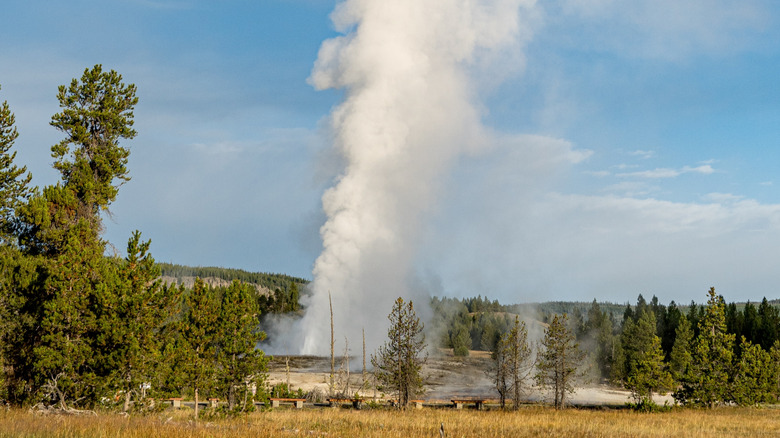
Upper Geyser Basin can be amazing to visit by the light of moon — not to mention that Yellowstone's dark skies place it among the best U.S. national parks for stargazing. Photographers often revel in capturing geysers erupting against the awe-inspiring backdrop of the Milky Way. Daisy Geyser is relatively predictable, making it another popular stop in the northern part of this active area, but what makes it so wonderful is its frequency and unique orientation. It's about a 20-minute walk from the Old Faithful Inn parking lot, or a 5-minute bike ride.
Water sprays forcefully out of the Daisy Geyser at an angle, and it doesn't skimp, with heights regularly upwards of 75 feet. On average, it erupts every two hours and 45 minutes, give or take about 30 minutes, and its show goes on for three to five minutes at a time. Like Castle Geyser, it comes with a little caveat, too: if the nearby Splendid Geyser erupts, which cannot be predicted, it can throw Daisy off its game for a little while, but that hasn't happened for nearly 30 years. While it's difficult to see the pool that Daisy is connected to, it's entertaining to watch the water levels fill in the nearby Brilliant Pool, which helps to indicate that Daisy will erupt once it gets hot enough.
Grotto Geyser
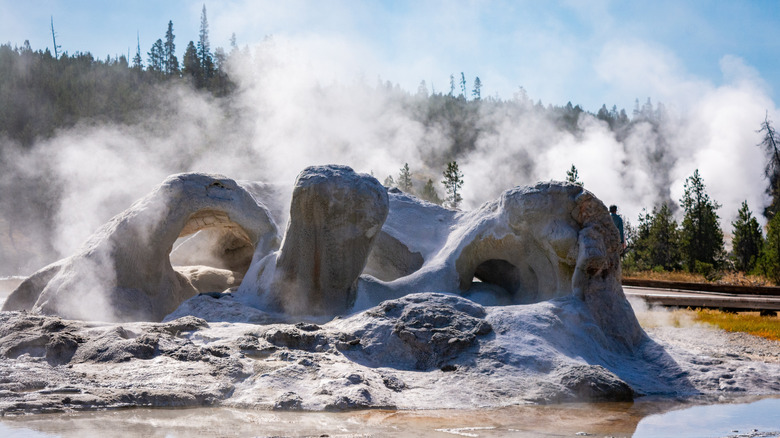
Located just a few minutes' walk from Daisy Geyser in the Upper Geyser Basin, Grotto is pretty predictable, erupting around every eight hours for about 20 minutes at a time, with bursts up to 75 feet. It often splashes around at a playful 10 feet or so, but it's the oddly shaped cone that's the real point of interest, resembling some sort of otherworldly creature emerging from the depths. It was named during the Washburn-Langford-Doane Expedition in 1870, as its little portals reminded the surveyors of niches or miniature caves. It's a spectacular reminder of the forces of time and the elements, and the weird factor makes it all the better.
It's thought that, during the course of thousands of years, the sinter formed over fallen trees, which are now long decomposed and may have caused the arch-like formations in the geyserite we see today. Grotto is located a little more than a mile north of Old Faithful in Upper Geyser Basin, and it's connected to a slew of other hydrothermal features, including Rocket Geyser, Grotto's Indicator Spring, Grotto Fountain, Startling Geyser, Marathon Pool, and more. You may be fortunate enough to get a "twofer" with Rocket Geyser, as it has been known to alternate eruptions with Grotto as they share energy.
White Dome Geyser
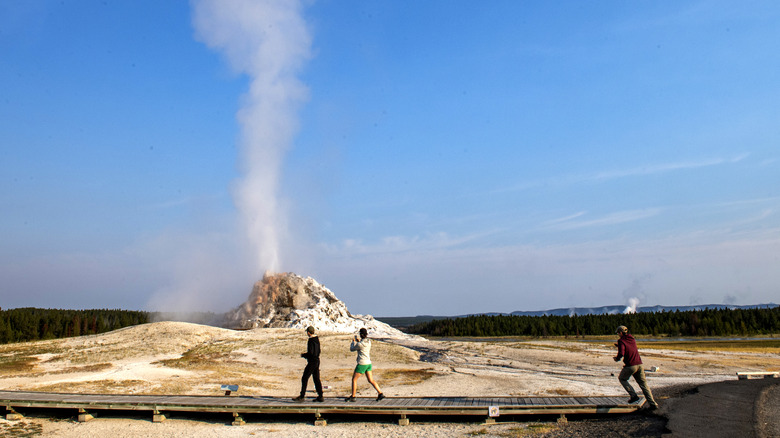
Located about a 5-minute walk from Great Fountain Geyser in the Lower Geyser Basin, which is around 8 miles north of Upper Geyser Basin, White Dome has a 12-foot-high cone with sinter deposits that make it look like a frosted pastry. It's also one of the biggest cones in the whole park. Because these thick silica bases can take millennia to form, it's a fantastic illustration of the park's deep geological history that, even when on the quieter side, seems to effuse even more drama than Old Faithful.
One of White Dome's best attributes is its setting along the Firehole Lake Drive, a one-way cruise that detours for three miles off the Grand Loop. It's a great way to take in geysers and other hydrothermal features from the car, but there are boardwalks to get closer to major features, too. Although White Dome never spews super tall — usually around 30 feet at the most — it's very frequent, with intervals that are usually around every half-hour. Because it's so often active, it's perfect to enjoy while waiting for Great Fountain.
Great Fountain Geyser
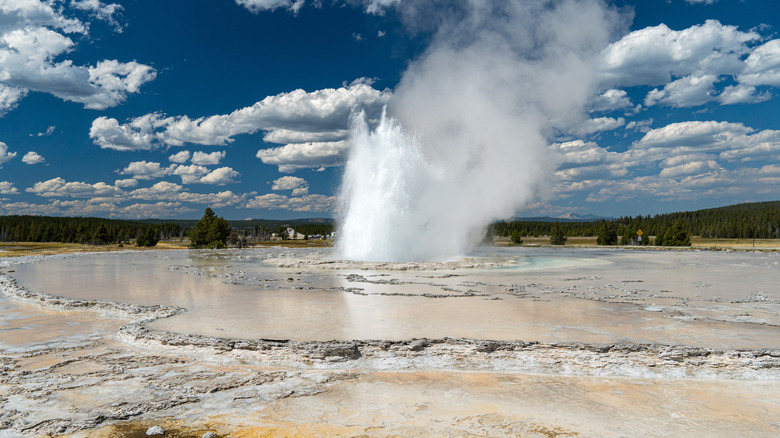
With a name like Great Fountain Geyser, we'd expect nothing less than incredible shows that remind us of the supervolcano that sits under Yellowstone National Park. It doesn't present as dramatic magma flows like at this incredible national park that offers explosive natural beauty in paradise, but it's a bit of an understatement to say there are signs!
Located about a 20-minute drive north of Old Faithful, Great Fountain is easy to see from Firehole Lake Drive or walk up to in just a couple of minutes, so unlike many other geysers in Yellowstone, it requires little effort to visit. Its intervals are on the longer side at about 11 hours and 30 minutes, give or take a couple of hours, so it can be a little more difficult to predict, but it still counts among the handful that the National Park Service predicts, and it's the only forecasted one located outside of the Upper Geyser Basin. It's especially photogenic with its wide, shallow, reflective pools and textured silica deposits.
Great Fountain typically erupts for a pretty sustained length of time, often between 45 and 60 minutes, and it averages an impressive 100 feet. It occasionally lives up to its name with so-called "superbursts," when its height can exceed 200 feet.
Lone Star Geyser
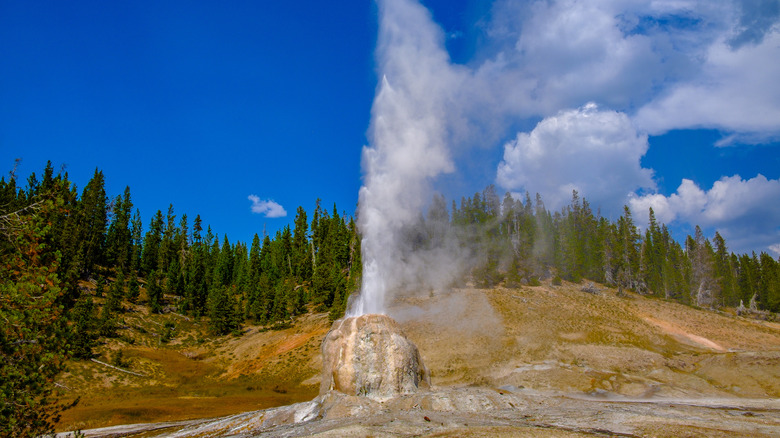
A choice geyser for nature photographers, Lone Star represents a kind of "ideal" form with its 12-foot-tall cone and eruptions that typically reach around 45 feet. So, while it's not the tallest geyser in Yellowstone, it does erupt for a lot longer than Old Faithful — usually for about 30 minutes compared to O.F.'s quick-fire episodes of up to five minutes. Lone Star's situation in its own clearing amid lodgepole pine trees also has an air of magic about it.
To add to this aura, Lone Star's more remote area makes it extra rewarding for those who wish to escape the park's famously large crowds. A 5.3-mile out-and-back hike — or cycle — is required to access Lone Star Geyser, starting from the Lone Star Trailhead on Highway 191. The path is partly paved, making it possible to visit on your bike. In the winter, the path and road are open to cross-country skiing. One thing about hydrothermal features is that they're immune to whatever weather is affecting the earth's surface, making them just as amazing to visit when Yellowstone sees fewer tourist crowds in the winter..
Lone Star erupts approximately every three hours, although not with enough regularity that the NPS considers it "predictable." It's frequent enough, though, that you have a fairly good chance to catching its show during a visit. As you head out, check with other people returning on the trail to see if or when they witnessed any activity. There's also a log book at the geyser, where visitors can note when they last observed an eruption.
Steamboat Geyser
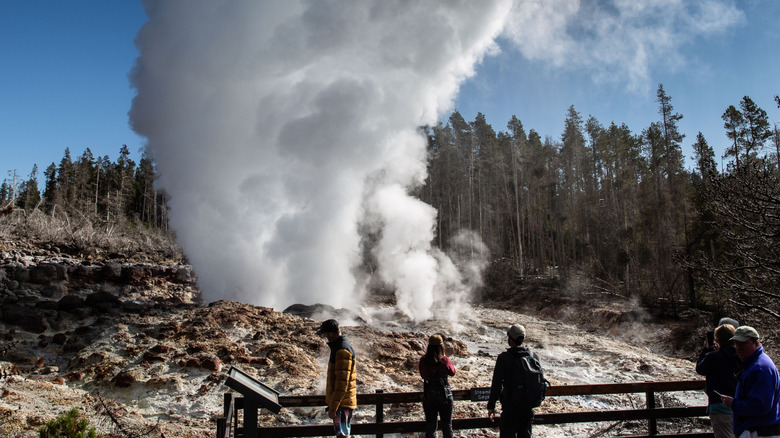
Yellowstone's geysers often see spurts of activity, sometimes in places we don't look for geysers specifically today. The Excelsior Geyser Crater, for example, gushes over 4,000 gallons of water per minute into the Firehole River, but back in 1888, it had one of the largest eruptions recorded since the park's founding — so powerful it may have altered its own internal plumbing. Dormant since, it's the only geyser — other than Sapphire Pool in Biscuit Basin — that has exceeded what is currently the tallest active geyser on Earth: Steamboat.
About a 1.5-hour drive north of the Upper Geyser Basin is Norris Geyser Basin, a must-see attraction to see during your visit, Steamboat Geyser is famously unpredictable, making it a bit of a foil to Old Faithful, but its major eruptions can exceed 300 feet. Steamboat became suddenly very active in 2018, before which time it sat dormant — sometimes for several years — between eruptions. Then, thanks to some unknown subterranean change, it began putting on huge shows dozens of times per year, and while it's slowed again, you just never know if you'll be in the right place at the right time. It's only a few minutes' walk from the parking lot off of Grand Loop Road.
Steamboat's huge eruptions have a tendency to start with shorter bursts, followed by a huge, powerful spout that sends water, mud, and earthy bits everywhere and lasts anywhere from three to 40 minutes. The geyser also regularly erupts with smaller water spouts up to 40 feet, with a time between which can be just a few minutes. A steam phase can last for hours or days, meaning that even if it's not in its water phase, it still reminds us of its huge potential.
Imperial Geyser
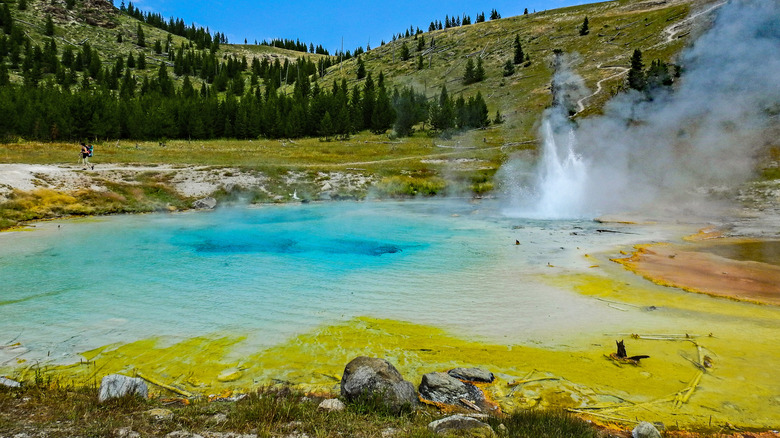
Imperial Geyser counts among Yellowstone's most photogenic features, not just because of its own splish-splashing energy but its entire setting. Imperial is nestled amid a tree-lined landscape that is reachable via a hike along Fairy Falls Trail (closed in the winter), most efficiently accessible from the Fairy Falls Trailhead parking lot, although if you fancy a longer walk, there's another trailhead around 6 miles north at the end of Fountain Flat Drive. The route is a real gem, as it's how you can reach both the Grand Prismatic Spring overlook and the trail's namesake cascade. But add another .6 miles past Fairy Falls, and you'll encounter both Imperial and Spray Geysers, which are rewarding because they're so consistently active.
Imperial is particularly stunning with its wide, shallow pool that glows with vibrant thermophiles, which are micro-organisms that thrive in temperatures too intense for any other kinds of life. The edges often glow yellow and orange with this strange life form, while a number of deep vents are a rich cerulean blue. Imperial erupts out of different vents within the pool at different times, and they can sometimes reach up to 15 feet tall. It's a photographer's dream with a splendid no-crowd viewing experience, as long as you're happy to hike about 6.5 miles round-trip.
Shoshone Geyser Basin
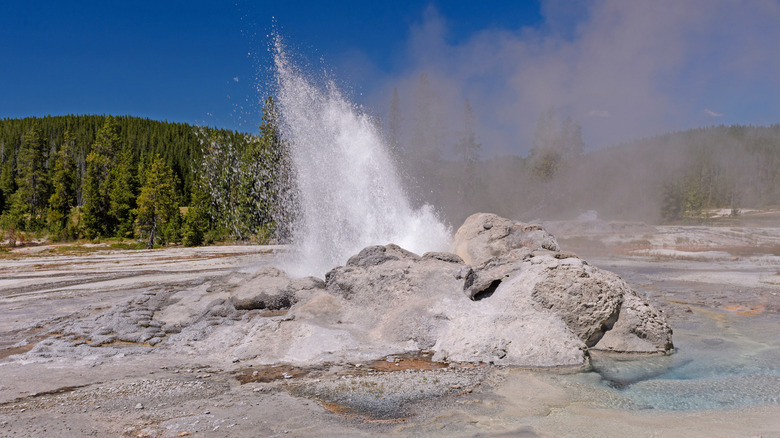
A rewarding area of geysers for those ambitious enough to hike the 8.5-mile route it takes to get there, as there aren't any nearby roads, Shoshone Geyser Basin is typically very quiet and crowd-free. Unlike the rest of this list, the basin isn't just one geyser — it's more than 80, in fact. Including other features, there are hundreds of hydrothermal highlights here. Shoshone comprises one of the planet's highest concentrations of geysers, giving it an intense, energetic feel. Interestingly, one side of the basin, which spans about 1,600 x 800 feet, is quite acidic, while the other side is totally alkaline.
What really makes this area stand out is its wilderness location on the western side of Shoshone Lake, where you can soak up the activity without hoards of other people around. The trail to Shoshone Geyser Basin starts at Lone Star Trailhead, or you can paddle across the lake to reach geysers like Minute Man, so named because it erupts almost every minute. Due to the length of the hike, this is an epic backpacking destination for an overnight camping excursion. Just remember to get a requisite backcountry permit, which can be reserved in advance on Recreation.gov.
Methodology
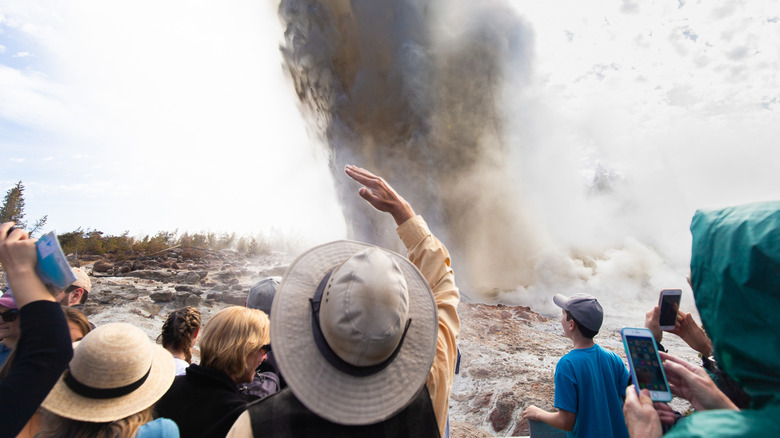
More than half of the world's geysers are sprinkled around Yellowstone, where its enormous, subterranean supervolcano literally lets off steam 24/7. Whether it's frequency, size, or surrounding natural beauty, Yellowstone's geysers are magnificent — and they're just the beginning of everything the U.S.' first national park has to offer.
To compile this list, we focused on information and research published on NPS.gov, USGS.gov, YellowstoneNaturalist.com, Volcanic-Springs.com, YellowstonePark.com, and YellowstoneNationalPark.com, plus additional data from Montana State University, Atlas Obscura, The Historical Marker Database, and Cowboy State Daily. In addition to the author's own experience visiting Yellowstone and observing a number of the listed geysers, we referenced visitors' experiences and favorite geysers as shared in discussions on Tripadvisor, and Reddit, plus the best trails — where relevant — on Alltrails.