

California's Picturesque National Parks Are Full Of Giant, Ancient Towering Trees
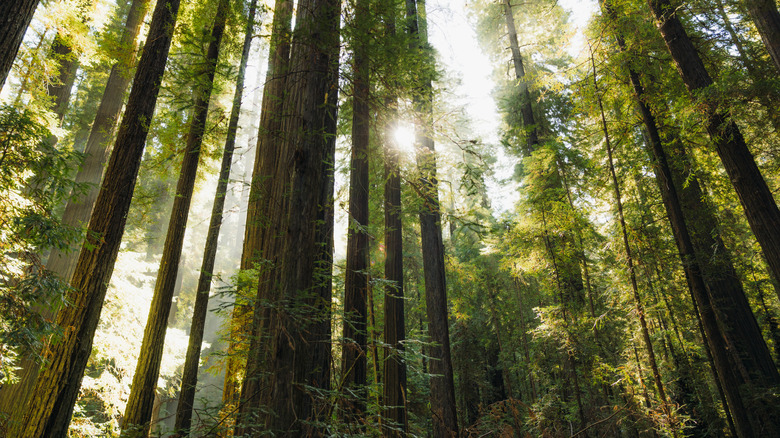
California's nine incredible national parks are home to some of the most diverse geography in the United States — as well as some striking extremes. While barren Death Valley National Park has some of the harshest living conditions on the planet, in the northern part of the state, you'll find the opposite extreme: lush, ancient forests home to some of the oldest and tallest trees in the world — redwoods. Travelers looking to see these larger-than-life behemoths could visit crowded — and, for foreign visitors, expensive — Yosemite National Park, or they could head to the quiet far northwestern corner of the state to Redwood National and State Parks.
Redwood is a unique partnership that brought three California state parks and one national park together to preserve roughly 120,000 acres of forest for future generations. Within the joint park, you'll find five visitor centers where you can start your trip on foot, by bike, or by car through the towering redwood forests, or learn more about the majestic trees and the region's deep history — both of which are highly recommended while exploring the area.
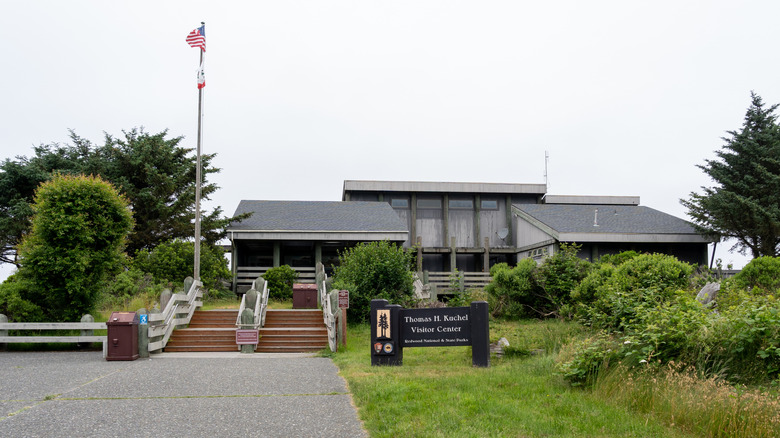
The nearest commercial airport to Redwood National and State Parks is California Redwood Coast-Humboldt County Airport (ACV), located roughly 30 minutes away from the Thomas H. Kuchel Visitors Center on the south side of the park. The nearest alternative airports are Oakland and San Francisco International Airport, both about six hours away by car. Whether you're flying most of the way or driving from San Francisco, you'll have stunning views when the weather isn't cloudy or foggy. If you have the time, opt for a longer road trip and explore Mendocino, a scenic coastal village with panoramic views along the way.
Exploring the Redwood National and State Parks
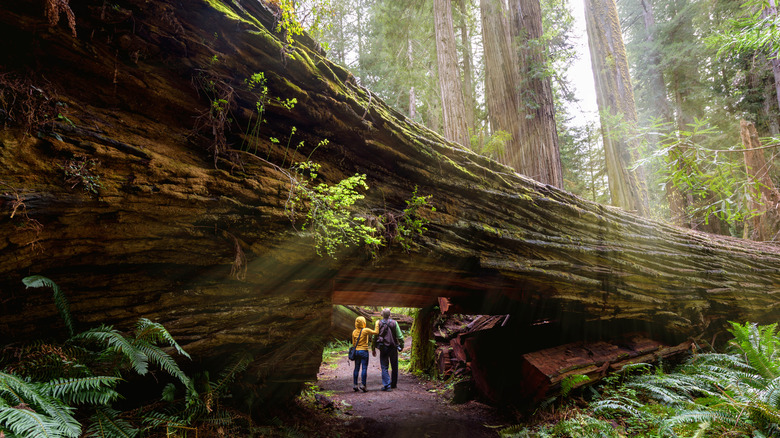
Eons before Hollywood and California's booming tech industry took root, the towering redwoods along California's coast were no more than the size of tomato seeds, eventually growing into the tallest trees in the world. Perfect natural conditions — weather, climate, and soil — slowly nurtured these seeds into behemoths that have stood tall through fires, natural disasters, and earthquakes. To see them up close, you'll have several options.
To quote the National Park Service, the Newton B. Drury Scenic Parkway fully lives up to its name and "will likely be one of the most stunning drives, or rides of your life." The fully paved road is open and free year-round; however, if you're planning a weekend visit, keep in mind that the road is closed to vehicles on the first Saturday of each month between October and May. At other times, visitors looking to get away from vehicle traffic and find peace in solitude (or with their pup) should opt for the Cal Barrel Road, less than a mile from the Prairie Creek Visitor Center. This redwood needle-covered former logging road is a steady 3.6-mile incline deep into the redwood forest. That said, some of the best sights and tallest trees are just a short walk from the entrance gate.
Redwood and its campgrounds are understandably most crowded during the drier summer months, when a layer of fog often hangs over the forest in the mornings. In case the campgrounds are full, a new camping law in California will likely make overnight stays a lot easier. If you're planning to explore on foot or by bicycle, opt for late spring or fall, when the weather is crisp and crowds have thinned.
Let your experiences take root at Redwood National and State Parks
Due to major industrial logging at the end of the 19th century, just 5% of the old-growth redwood forests remain along California's coast. The park not only stands to preserve one of the world's last stretches of redwood forests, but also to educate the public about the importance of protecting and preserving an environment that's home to one of the world's most effective carbon sinks. In case you're curious, approximately one acre of old-growth redwoods can store up to 890 metric tons of aboveground carbon — the equivalent to roughly 8.3 million miles of emissions.
In order to support this conservation mission, the park warmly welcomes volunteers of all backgrounds and from around the world to participate in its environmental stewardship programs throughout the year. Meanwhile, visitors who want to learn more about California's beautiful redwoods shouldn't miss a one-hour walk with a park ranger. Walks begin at the Prairie Creek Visitor Center and run seasonally through May. If you'd rather go solo, download the park's app on your phone and explore the stunning Lady Bird Johnson Grove, a short loop that the whole family will love.
Also unique to the park are two outdoor schools: the Howland Hill Outdoor School and the Wolf Creek Outdoor School. While both are primarily designed for introducing youth to conservation and the great outdoors, the Howland Hill Outdoor School is often used as a venue for wellness retreats for adults during the spring and summer. Finally, while Redwood National and State Parks do not charge an entrance fee, certain day-use areas require an $8 per-vehicle fee. This includes access to places like the Jedediah Smith Redwoods Day Use Area, popular for swimming, boating, and picnicking.