

11 Eerie, Abandoned Hotels Around The World That Will Keep You Up At Night
Hotels take years to plan, build, and turn a profit — after which millions of dollars have already been spent to ready them for opening. Despite all of this, however — and even despite the best efforts of developers and owners — outside factors can cause them to become nothing but ruins. From environmental decay to political unrest, financial collapse, and natural disasters, certain events can transform what were once some of the most lavish and stunning hotels on the planet into nothing more than crumbling walls, rust, and a look back at what once was.
A similar fate to what has happened to some of the most beautiful abandoned churches around the world, these hotels tell their own haunting stories. From a Bolivian ski resort that became bereft of tourists after its glacier melted to several hotels that were forced to close after war erupted outside the windows, we rounded up 11 of the eeriest abandoned hotels around the world, sharing the stories of what led to their downfalls.
Many of the hotels featured are structurally unsafe, privately owned, or illegal to enter, and should only be viewed from a distance unless official access or guided tours are explicitly permitted. Whether you choose to see them in person or not, we hope you're not kept up too late at the thought of these creepy, abandoned hotels that span the planet.
Bedugul Taman Rekreasi Hotel, Indonesia
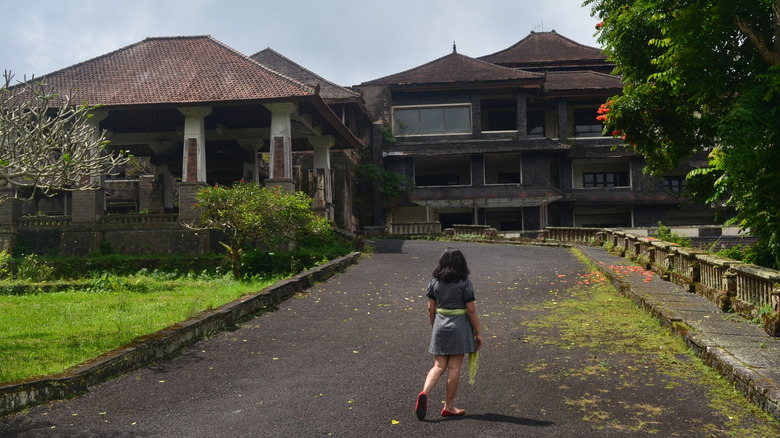
Located on a remote Bedugul mountain ridge in Bali, Indonesia, the nickname of the Bedugul Taman Rekreasi Hotel is the "Ghost Palace Hotel" — and the site lives up to the name. According to first-hand accounts, visitors have felt the supernatural presence of the mysteriously disappearing guests and staff — or maybe it was the ghosts of the people who were worked to the (literal) bone to build the hotel.
What happened before the hotel was abandoned is just as foggy as the mist that blankets the surrounding mountains. However, most accounts suggest that the hotel was the brainchild of Tommy Suharto — one of the sons of former Indonesian President Suharto — who was convicted of orchestrating an $11 million land scam. According to these accounts, Tommy Suharto's project — meant to be the most beautiful in the country — quickly fell apart after he was sentenced to prison in 2002 for hiring a hitman to take down a Supreme Court judge who had found him guilty of his previous offenses. Worse yet, this all happened before the luxury hotel even got a chance to open.
While the site remains privately owned and entry is discouraged, recent accounts by urban explorers claim that they've been granted access to the Ghost Palace Hotel by paying the security guards the equivalent of $0.50 to turn a blind eye. As for getting there, the property is easy to find, as it's on a main road near the famous Lake Temple.
Chacaltaya Ski Resort, Bolivia
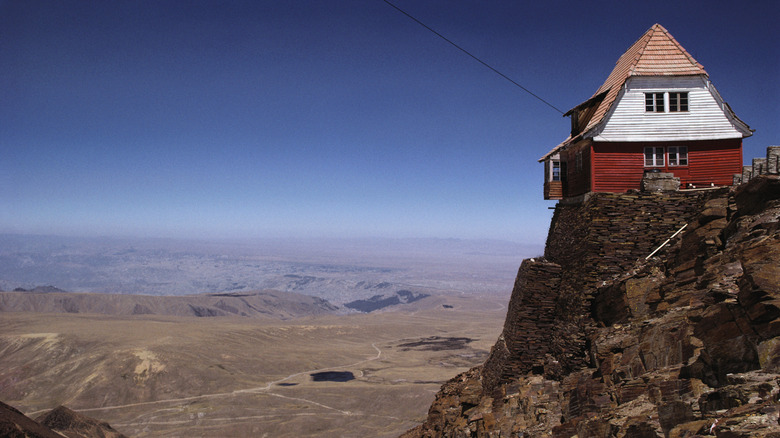
For nearly a century starting from the 1930s, the Chacaltaya Ski Resort, located on the Chacaltaya Glacier in Bolivia, was the place to be for skiers as the highest ski resort on the planet — even higher than the North Base Camp of Mount Everest. However, that all came to an end in 2009, when the resort — which sat at 17,519 feet above sea level — ended up on rock rather than snow and ice.
A once thriving tourism destination, the reason for its downfall is painfully simple: the glacier melted due to the climate crisis, leaving the once-prosperous resort — home to the highest restaurant in the world — completely abandoned with nothing but a solitary toilet remaining.
A worthy addition to the list of the top 10 former tourist hotspots that fell on hard times and never recovered, the Chacaltaya Ski Resort is a clear symbol of climate change's impact. These days, curious tourists can still visit the site to see the remains of the former slopes. You can even dine at the still-operating restaurant, which is run by brothers Adolfo and Samuel Mendoza, who help look after the place. To get here, book a guided tour with a local operator, or hop in a taxi from La Paz, which is located about a 90-minute drive to the abandoned resort.
Deertrail Resort, British Columbia
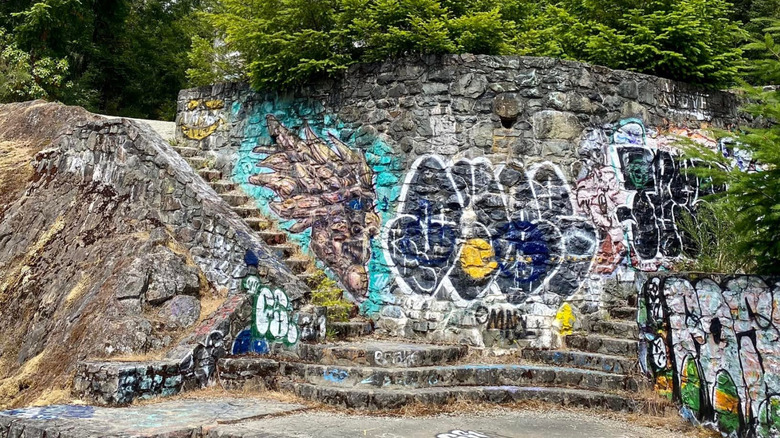
During the 1980s, developer Albert Yuen and his wife Rosabelle Yuen wanted to capitalize on Sooke, British Columbia's, natural beauty by building a resort made with local materials and guided by a sustainable philosophy. Their original plan included building a 200-room hotel with a spa, shopping outlets, a pool, a conference facility, and Canada's largest log-burning fireplace on 160 acres, which the Yuens dubbed Deertrail Resort.
Unfortunately, the project never came to fruition after investment funding fizzled and interest rates continued to rise. As a result, what was partially constructed of the resort was eventually torn down to its stone bones after the Land Conservancy of B.C. acquired the space in 2005 and 2007. These days, the ruins are closed behind fencing within the center of the park due to safety hazards. However, as evidenced by the graffiti that coats the stone and holes in the fencing, it's clear that some urban explorers have illegally and dangerously weaseled their way inside.
That said, there's still plenty to see here without taking any unnecessary risks. The area's natural beauty remains on full display within the forested Sooke Potholes Provincial Park on Vancouver Island, overlooking the Sooke River.
Ducor Palace Hotel, Liberia
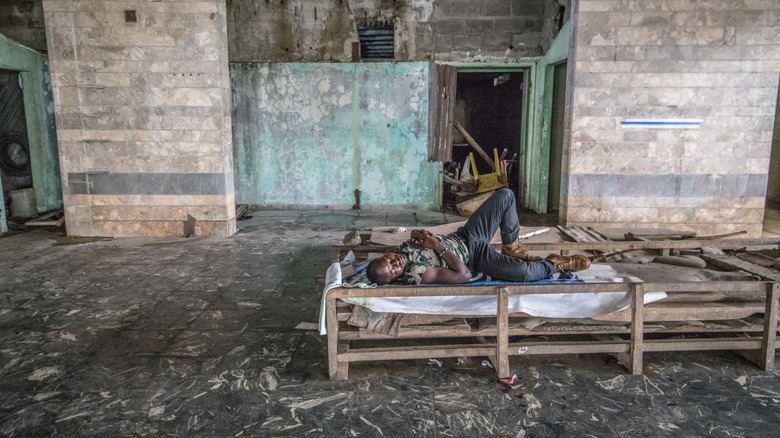
With a nightclub, air conditioning, ocean views, a pool, and welcoming esteemed guests like former Ethiopian emperor Haile Selassie, the modernist-style Ducor Palace Hotel, located in the Liberian capital of Monrovia, was once the epicenter of luxury. The eight-story Intercontinental Hotels lodging was built in 1960 by architect Moshe Mayer to accommodate wealthy corporate travelers and government employees. In fact, the Ducor Palace Hotel was so beloved that Côte d'Ivoire president Félix Houphouët-Boigny had Mayer build a hotel in the neighboring country, too. That hotel still stands, unlike the Ducor Palace Hotel.
Less than 30 years after its debut, the hotel — one of the few five-star hotels in the continent and the first five-star hotel in West Africa — would become just a memory of yesterday's grandeur. In 1989, with the onset of the first Liberian Civil War, The Ducor Palace Hotel closed its doors — leaving behind nothing but a pile of ruins overlooking downtown Monrovia.
In 2011, the country's government announced plans to bring the hotel back to life with more than 150 rooms, restaurants, a tennis court, a casino, and a shopping center. However, more political unrest shattered these efforts. Today, the hotel remains a shadow of its former self, enveloped in bullet holes and mildew. Although it's technically off-limits — and structurally unstable, partially collapsed, and occupied by squatters in some areas — previous travelers have noted they were able to bypass security by claiming to be teachers or Peace Corps volunteers, and paying roughly $2-3.
Hachijo Royal Hotel, Japan
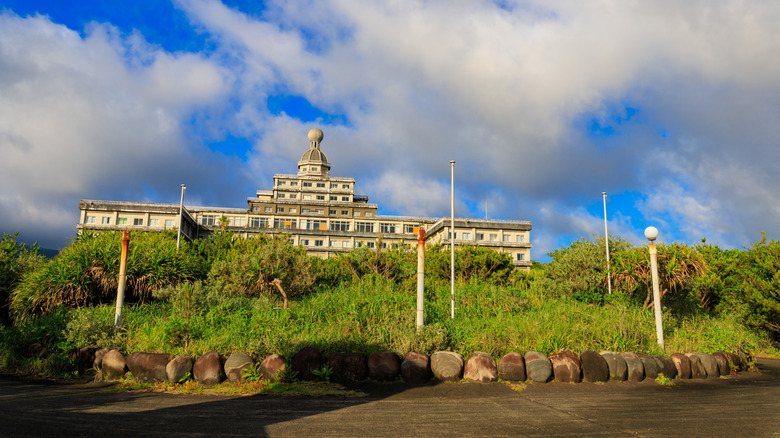
It's hard to believe that the now mossy, mildewy, and abandoned Hachijo Royal Hotel was once one of the largest hotels in Japan. Welcoming guests from all over the country to its 252 rooms, the hotel — located on Hachijojima Island — was nicknamed "Japan's Hawaii," and the property was even featured in "Trick: The Movie 2."
However, the property hasn't been its premiere-ready self since 2006, roughly 43 years after the French Baroque-inspired hotel was built in 1963. This decline was a direct result of Japanese locals' desire to take their travels internationally after passport regulations were relaxed and overseas travel became more accessible in the early 2000s.
Despite Hachijo Royal Hotel's long-past abandonment, visitors can still see some of the luxurious features that guests once enjoyed — including a grand piano, fountain, pool table, black and red marble staircase, outdoor pool, and elaborate statues that helped the hotel achieve its once-luxurious status. To make matters even more eerie, the property's ruins are surrounded by plants that have sprouted throughout the rooms and common spaces, giving it a jungle-like feel.
Haludovo Palace Hotel, Croatia
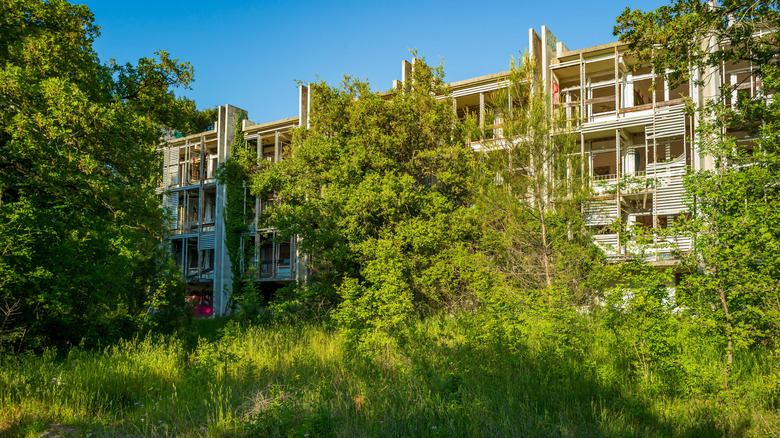
The Yugoslav Wars left a trail of destruction across what's now the Croatian island of Krk. Just a smidgen of that destruction can be seen at the Haludovo Palace Hotel, which was abandoned in 1991. It's tough to believe that the hotel — now a pile of broken glass and skylights, graffiti, and collapsing walls — was once the region's version of a lavish adult playground. It's even more astonishing that it cost $45 million to build — nearly $350 million today.
That hefty chunk of change was paid for by Bob Guccione, founder of Penthouse magazine — the first publication in the U.S. to feature full-frontal nudity. Within his luxurious hotel — staffed by French maid outfit-clad women dubbed "Penthouse Pets" — guests gambled at the casino, drank champagne, and indulged in lobster and caviar. They also had access to 17 tennis courts, a mini football pitch, a mini golf course, swimming pools, a bowling alley, and various spots to paraglide and waterski, all of which took four years to build.
Designed by Croatian architect Boris Magaš, who formulated the hotel in a brutalist style before it opened in 1972, the Haludovo Palace was designed to attract American and international visitors looking for hedonism, as locals were not allowed by the government to gamble. However, this business model didn't seem to pay well. Just a year after opening, the hotel declared bankruptcy. That said, the property remained open until the onset of the war in 1991, when locals found respite there. Although people continue to enter the ruins, access is considered dangerous due to the deteriorating structure.
Holiday Inn Beirut, Lebanon
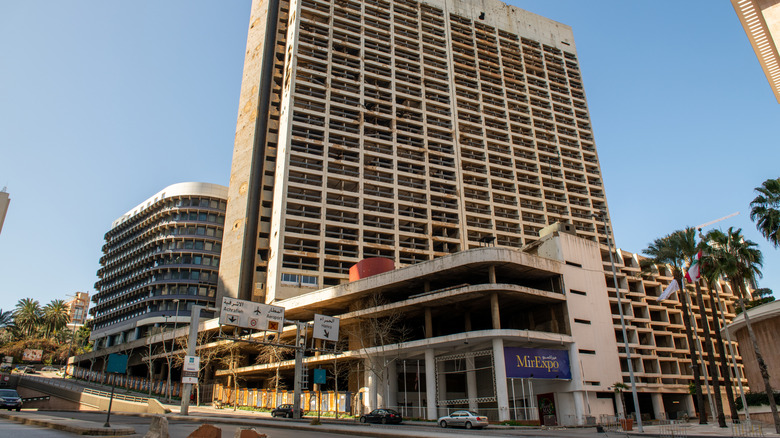
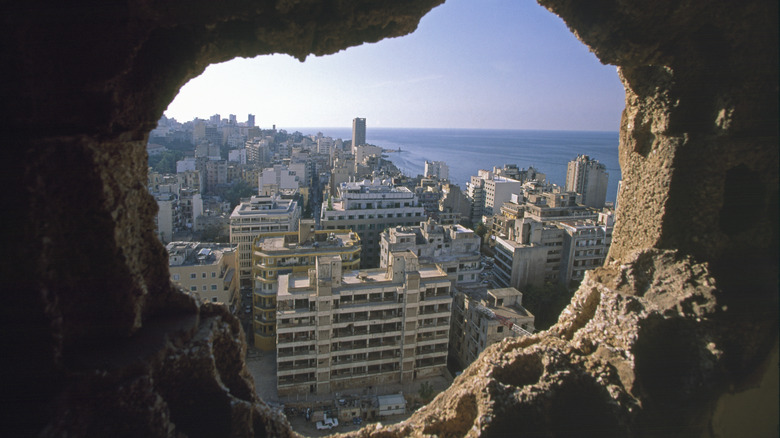
The Haludovo Palace Hotel and Ducor Palace Hotel weren't the only lavish accommodations to fall victim to war. The same end befell the Holiday Inn Beirut, in Lebanon, in 1975 at the onset of the Lebanese civil war. Although the war ended just a year later, by then, the Holiday Inn Beirut — located at the center of the city's fiercest fighting — was too ravaged to reopen. That fate was further solidified just six years later during the 1982 Lebanon War. These days, the hotel's ruins — covered in bullet and blast holes on nearly every floor — are banned from visitors, as they are watched over by the Lebanese Army and a permit is needed to enter.
Years after the hotel's violent past, its future remains uncertain. Two separate companies own the ruins and are unable to come to an agreement about what to do with them. As a result, the building remains a stark reminder of the hotel and the country's dark history, where many people died in battle — and some were even executed by being thrown off the roof. While a portion of shareholders want to transform the structure into a luxury apartment building, others want to rebuild it from scratch. No matter which side succeeds, it's clear that either outcome would help the dilapidated structure match the rest of the area, which has since found new life.
Hotel Belvedere, Croatia
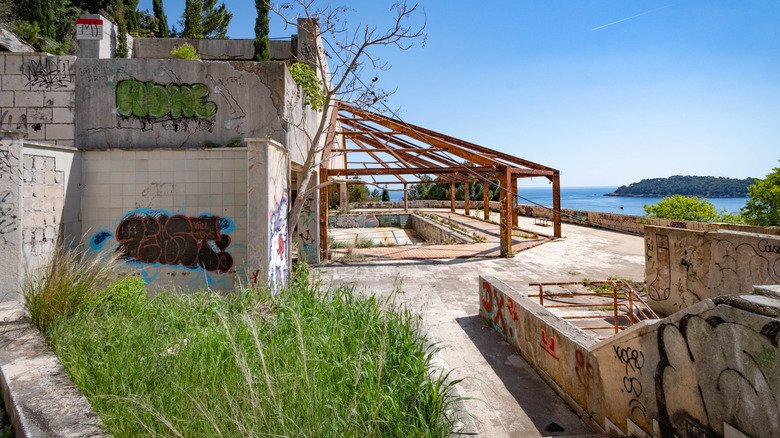
The Hotel Belvedere in Dubrovnik, Croatia, located on the edge of the Adriatic Sea, was once a five-star, 18-story, 200-room accommodation. Beyond its prime seaside location, the property included luxurious features like a helicopter pad, grand staircase, indoor pool, nightclub, and boat dock — making it one of the most exclusive hotels in the area. Welcoming many celebrity guests at the time, an average week's rate for three guests to stay there cost the equivalent of $5,300 today.
However, just five years after it was inaugurated in 1985, it too became the epicenter of conflict during the Yugoslav Wars. The building even served as a safe haven for refugees, among many other Dubrovnik hotels, including Pelegrin and Goricine I. After the end of the wars, the Hotel Belvedere enjoyed a more glamorous use as a film set. In fact, "Game of Thrones" fans might recognize the setting from Season 4, when Oberyn Martell and the Mountain fought a duel to the death at the hotel's outdoor amphitheater.
Despite its current status as one of Croatia's largest abandoned structures — and its informal nickname "Cat City," earned from the feral cats that roam its halls — the Hotel Belvedere still has a chance at revival. In 2014, Russian billionaire Viktor Vekselberg paid roughly $12 million to purchase the property. However, he's yet to take steps to bring it back to life.
Maya Hotel, Japan
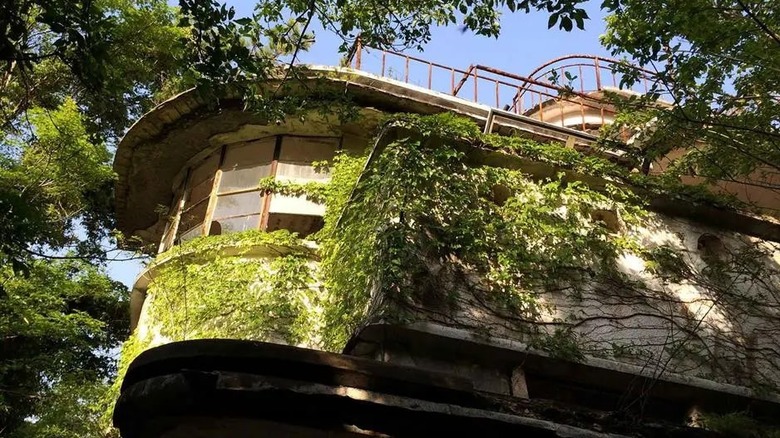
No hotel on this list has been abandoned as many times as the Maya Hotel on Mt. Maya in Kobe, Japan — an unmissable, must-visit tourist destination outside of Tokyo. The Maya Hotel was built in 1929 as a two-story concrete structure and was an early example of Art Deco-inspired style. It's since had a long fall from grace, becoming known as the "Queen of Ruins."
First, the Maya Hotel's room rates became obsolete during World War II, when it was converted into a military facility and used to defend the city. Then, in 1961, it was reimagined as a hotel once again, this time featuring stained glass — just six years before a typhoon and mudslide destroyed it. Seven years after that, the former Maya Hotel was reopened as a student center, although that too met a deadly end when the Great Hanshin-Awaji Earthquake struck in 1995, killing more than 6,000 people.
Since then, the Maya Hotel has been used for music video and television productions. It's now owned by a real estate management company, and visitors can check it out on guided tours led by locals and volunteers. Due to its popularity as a hidden gem tourist attraction, it was even named a Registered Tangible Cultural Property in 2021. For those looking to double-up the spooky sightseeing, the Maya Hotel is located about a 90-minute drive from Nara Dreamland, one of the creepiest abandoned amusement parks in the world.
Hotel Polissya, Ukraine
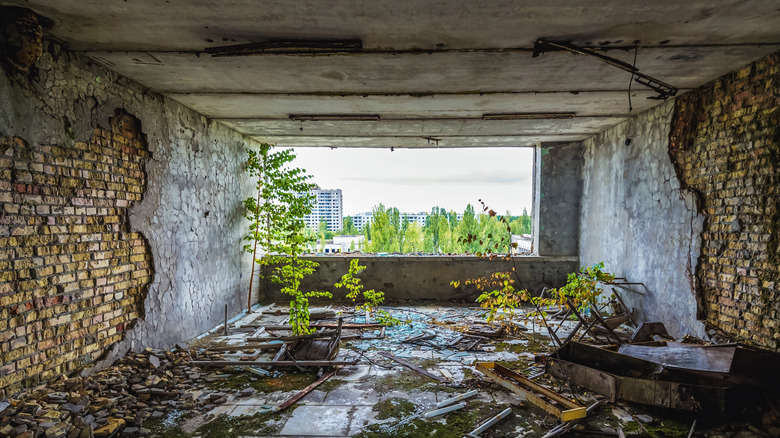
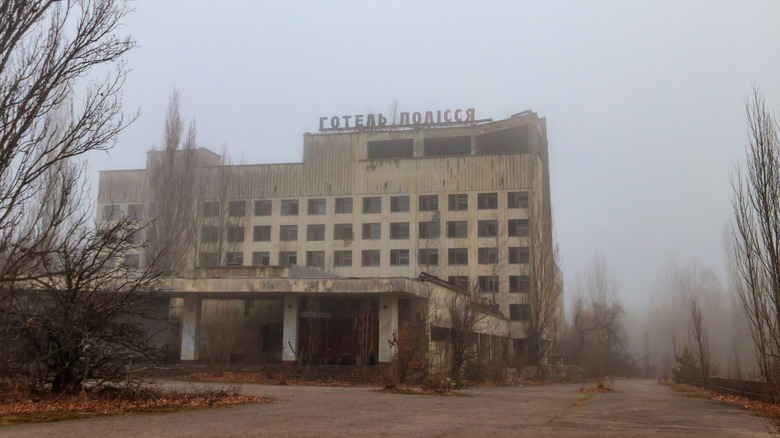
Hotel Polissya isn't the only abandoned building in Pripyat, Ukraine. The city, within sight of the Chernobyl Power Plant, was entirely abandoned after the 1986 nuclear accident that remains the worst the world has ever seen. The 10-story, late Soviet modernist-style hotel was built just under a decade prior to the tragedy in Lenin Square, near a department store, a restaurant, and the Palace of Culture Energetik, intended for guests of power plant workers who called Pripyat home. Those guests included everything from foreign dignitaries to scientists and Soviet officials. With all-encompassing views from the high-end rooftop restaurant's patio, it was one of the most renowned buildings in the city.
Its close proximity to the power plant proved useful during the disaster, when officials and even former Soviet president Mikhail Gorbachev stayed here to coordinate helicopter drop-offs of sand, lead, and boric acid onto the smoky, burning reactors. Inside the hotel — which was without power due to the accident — officials and scientists also met to strategize how to minimize the explosion's effects. Like many locals, they too later suffered the effects of nuclear exposure.
Although the hotel, much like other victims of the Chernobyl Power Plant, cannot be visited due to its location inside the sealed Chernobyl Exclusion Zone, curious fans can explore it virtually in the video game Call of Duty 4: Modern Warfare. Not that there would be much to see, anyway — just crumbling concrete and debris in the once-grand building that formerly featured marble floors and wood paneling.
Ryugyong Hotel, North Korea
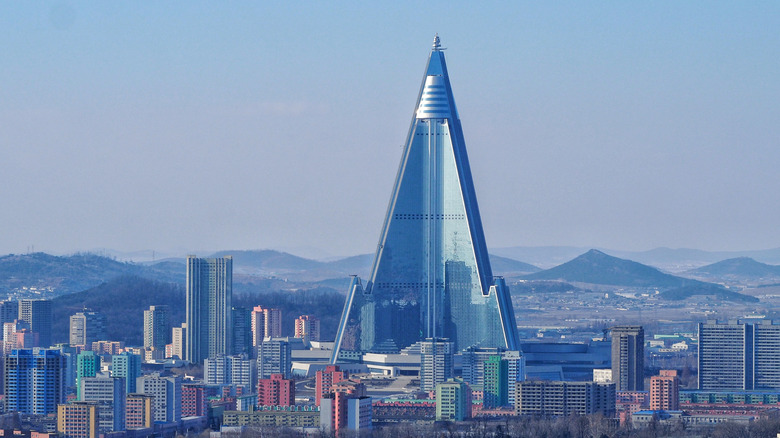
The 1,080-foot-tall Ryugyong Hotel is another hotel that most people will likely never see, even from the outside, as its located in Pyongyang, North Korea— a country that's widely regarded as one of the most dangerous vacation destinations. But unlike most of the others on this list, the reinforced concrete-laden Ryugyong Hotel never had a heyday to enjoy. With completion costs estimated at nearly 5% of North Korea's entire GDP, the 105-story hotel — the tallest building in the country — has never had a single overnight guest in its planned 3,000 rooms.
Its construction began in 1987 to host visitors for the 1989 World Festival of Youth and Students. However, due to North Korea's well-documented financial problems, it was never finished, leaving the pyramid-shaped structure incomplete. Those problems only multiplied when the Soviet Union fell in 1991, leaving North Korea without a trading partner and the hotel — one of the tallest unoccupied buildings on earth — with its infamous "Hotel of Doom" moniker. The trio of revolving restaurants at its top remain empty, there is no electricity, and nothing exists behind the exterior glass panels that line the building.
However, that hasn't stopped North Korea from using the building for other purposes. LED screens on one of the facades have been used for light shows and propaganda, while fireworks have also been set off around the hotel for celebrations. These days, the North Korean government has expressed interest in finding an investor to finish the hotel and turn it into a casino.
Methodology
All across the globe — sometimes in the heart of major cities, while other times hidden in areas taken by Mother Nature — there are abandoned hotels with mildewed walls and empty pools that tell the story of what once was. Although vacationing guests and high-ranking figures once called it a night at these luxurious resorts, these days, they're nothing but rubble — leaving us to only imagine what their pasts were like.
To land on our top 11 picks of the eeriest abandoned hotels, we researched sites around the world that have been left to decay after a dramatic fall from grace. From there, we narrowed down our selection based on which of these properties had the most unusual backstories, were widely recognized, and remain largely untouched since being abandoned. Our research relied on a mix of historical records, local media reports, firsthand accounts, and well-documented sources such as Atlas Obscura. To see even more creepy abandoned sites, try visiting some of the most chilling abandoned places in America.