

The Top 10 Most Iconic Landmarks To Visit Across The US
Let's face it: Few countries offer the sheer scale and variety of landmarks found across the United States. Brimming with incredible nature, breathtaking vistas, and diverse geography, the U.S. is home to an extraordinary range of places that have shaped its identity and captured the attention of locals and visitors alike for generations. Spanning cities, deserts, coastlines, and mountains, these landmarks reflect the nation's history, creativity, and natural beauty from sea to shining sea. America the Beautiful, indeed!
To compile this list of the USA's most iconic attractions and destinations, we focused primarily on man-made landmarks located outside of national parks, with a few exceptions. Relying on the author's personal experience, along with reviews from Reddit and Tripadvisor, websites dedicated to historical preservation, local experts, and tourism boards, we hand-picked a list of the top 10 most iconic landmarks to visit across the U.S. From symbolic statues to world-famous bridges, meaningful memorials, and — in a few cases — natural wonders, these destinations stand out as some of the country's most memorable sights.
Statue of Liberty, New York City
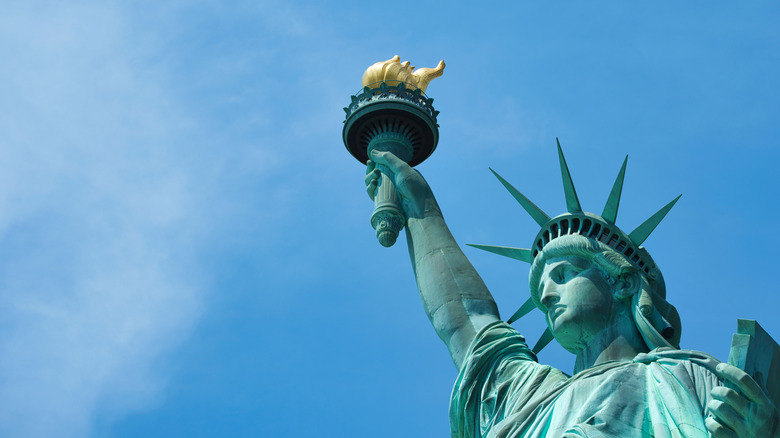
The U.S. has plenty of iconic attractions worth visiting at least once, but perhaps no landmark is as instantly recognizable as the Statue of Liberty. In addition to being one of New York City's top places to check out for first-time visitors, it's also an icon of the country. Standing tall at 151 feet on Liberty Island in New York Harbor, the Statue of Liberty was donated to the United States by France in 1886. The statue's location near Ellis Island — once a major entry point for immigrants and now a museum — means that it was often the first thing new Americans saw when they arrived in the country. Thus, the statue has become a symbol of freedom, hope, and democracy.
Most notably, the tall bronze lady features an inscription that reads: "Give me your tired, your poor/Your huddled masses yearning to breathe free." Plus, with broken shackles lying at her feet — symbolizing the end of slavery — it's one of the country's most enduring symbols of freedom, both across the country and around the world.
Today, the Statue of Liberty receives approximately 4 million visitors each year, making it one of the most visited tourist attractions in the country. To visit the statue's pedestal or the crown, travelers must purchase tickets well in advance. Alternatively, for cheaper views, head to the Brooklyn Bridge — another icon in its own right— walk along The Battery (once Battery Park), or take a ferry to Staten Island. You can also view the statue from above at the One World Observatory in New York's tallest building, One World Trade Center, or take in the views while immersing yourself in Jewish history at the Museum of Jewish Heritage.
Space Needle, Seattle
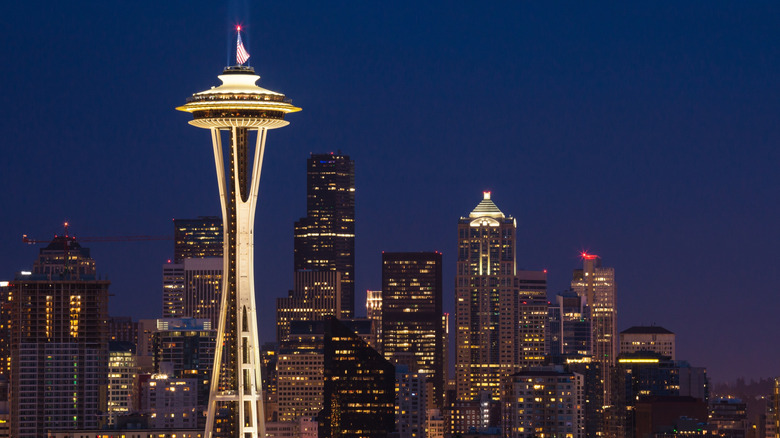
Hop across the entire country to the West Coast and the rainy city of Seattle, the largest in Washington state, where the skyline is defined by the Space Needle. Seattle's most famous landmark — where you'll also find the best views of the city — the tower as built for the 1962 World's Fair, which was themed around the "Age of Space."
Inspired by futuristic designs and modern thinking, the graceful structure, standing 605 feet tall, does resemble a UFO, or at least some kind of spacecraft. Beyond that, the innovative design is considered an impressive feat of engineering, with a center of gravity just five feet above the ground to help it withstand high winds and natural disasters, such as earthquakes.
You can see the Space Needle from all over the city, but for the best panoramic views of Seattle, Puget Sound, Mount Rainier, and the Olympic Mountain Range on a clear day, heading to the top is a must. In addition to incredible views from the observation deck, the top of the Space Needle also features the Loupe, the world's only rotating glass floor. Visitors can enjoy the floor at the Loupe Lounge, along with unique cocktails and, of course, killer views (reservations are required). A ticket to the top costs $49, but we suggest you consider purchasing a combo ticket that includes access to the Chihuly Gardens, a glass sculpture showcase, for $69.
Golden Gate Bridge, San Francisco
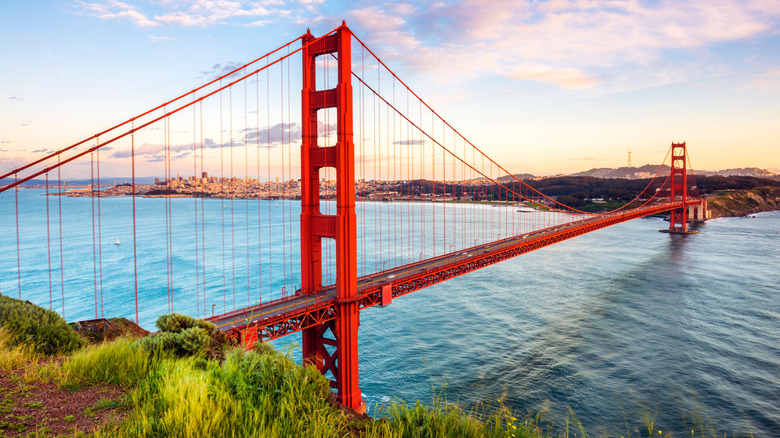
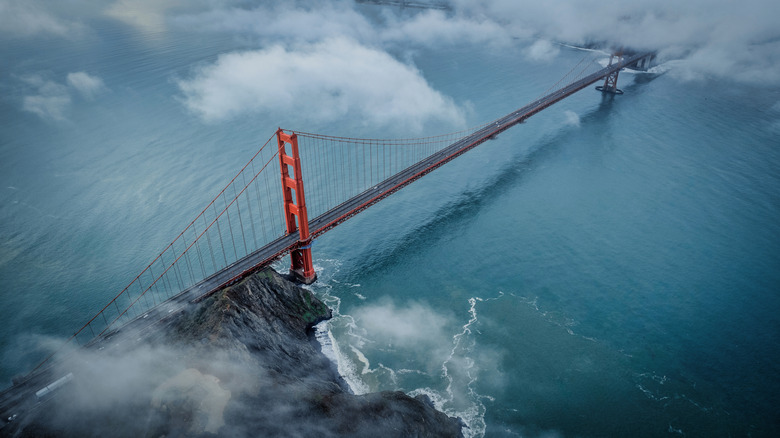
If you've heard of the United States, you've heard of California. And if you've heard of California, you've likely heard of the Golden Gate Bridge. This epic bridge in the San Francisco Bay is often shrouded in fog, but on clear days, it boasts sweeping views that are widely considered the most iconic in the world. At 1.7 miles long, with towers that reach heights of 746 feet, the bridge connects the city of San Francisco with Marin County, crossing over the Golden Gate Strait, which connects the bay with the Pacific Ocean.
Painted an orange-red hue, the bridge is open to walkers, cyclists, and drivers. For the best crowd-free views of the Golden Gate Bridge, head to the free Fort Point National Historic Site, located not far from the Golden Gate Bridge Welcome Center. Other standout spots within the city for particularly impressive views include Crissy Field, Fort Baker, Baker Beach, and the Golden Gate Overlook. Alternatively, you can also take in dramatic views by walking along Lands End — a rugged patch of coastline that also boasts awe-inspiring views of the Pacific. To see the bridge from the water, consider taking a bay cruise past the famous Alcatraz Island and under the bridge itself.
The National Mall, Washington D.C.
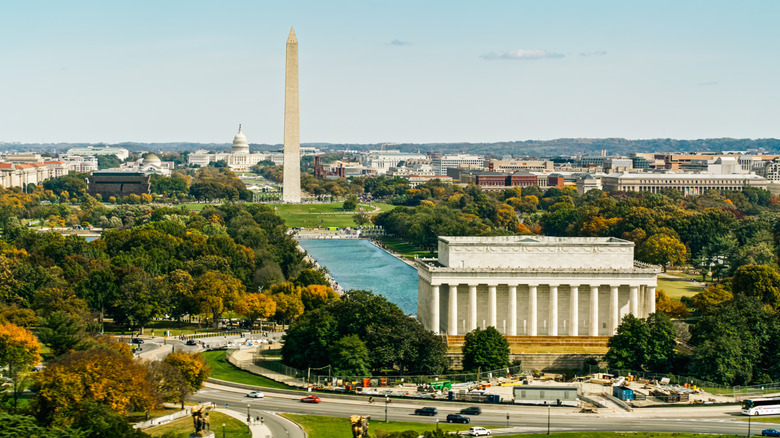
As the capital of the U.S., Washington, D.C. is home to many iconic monuments, including some of the most popular American tourist destinations. Specifically, the National Mall — often called "America's Front Yard" — is home to some of the best. Stretching for over 1,000 acres, the long, park-like thoroughfare is lined with grass, trees, and a reflecting pool, as well as some of the most important structures in the United States.
There's the White House, where the current U.S. president lives, the Washington, Lincoln, and Martin Luther King Jr. monuments, and memorials dedicated to several wars. Another highlight visitors can't miss at the National Mall is the Jefferson Memorial, a white Roman-inspired building situated on Tidal Basin that's especially known for its spring cherry tree bloom and the National Cherry Blossom Festival.
The National Mall technically stretches all the way from the United States Capitol to the banks of the Potomac River, and also incorporates many world-class museums. This includes several branches of the famous Smithsonian Institution, such as the Air and Space Museum and the Museum of Natural History. Nearly all of the monuments, memorials, and museums along the National Mall are free to enter, with the exception of the Washington Monument, which requires a small fee to reserve a timed-entry slot.
Gateway Arch, St. Louis
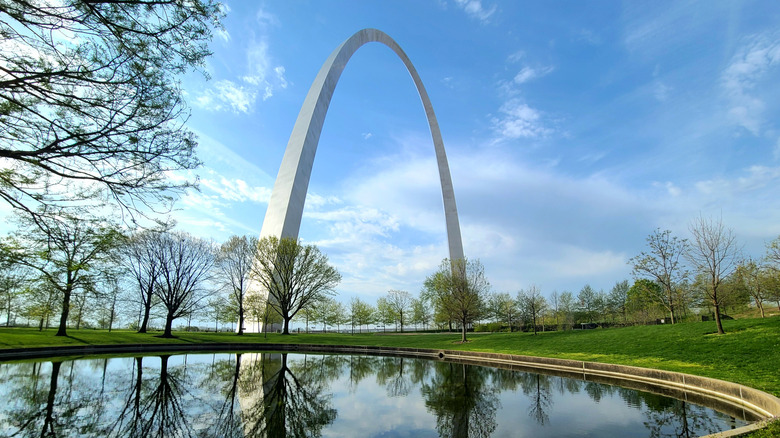
It may seem strange that a giant man-made archway in the Midwest — Missouri, to be exact — has become so iconic to the nation. But located on the Mississippi River in the city of St. Louis, the Gateway Arch represents America's expansion to the West. Tucked away within one of the only U.S. national parks situated entirely in a city, it's easily accessible for visitors short on time. Constructed of stainless steel and standing at 630 feet tall, the Gateway Arch is also the world's tallest arch, which gives it a striking presence.
While you can technically see the arch throughout much of the city and surrounding area, head to Gateway Arch National Park to see it up close. Starting from $15, there's also a tram that takes visitors up to the top — although visits are limited to 10 minutes only, and there's really not much time to take in the panoramic views, which can stretch for up to 30 miles in every direction on a clear day.
Beyond the arch itself, the "Gateway to the West" is also just one feature of the national park, which boasts an on-site museum, the Old Courthouse, and a monument to Dred and Harriet Scott, whose landmark court cases were heard in the aforementioned courthouse. Also on the grounds is a statue of William Clark and Meriwether Lewis, along with their dog, in honor of the Lewis & Clark Expedition, a government-backed mission that explored the newly acquired Louisiana Purchase, expanding the United States all the way to the Pacific Ocean.
Niagara Falls, Niagara County
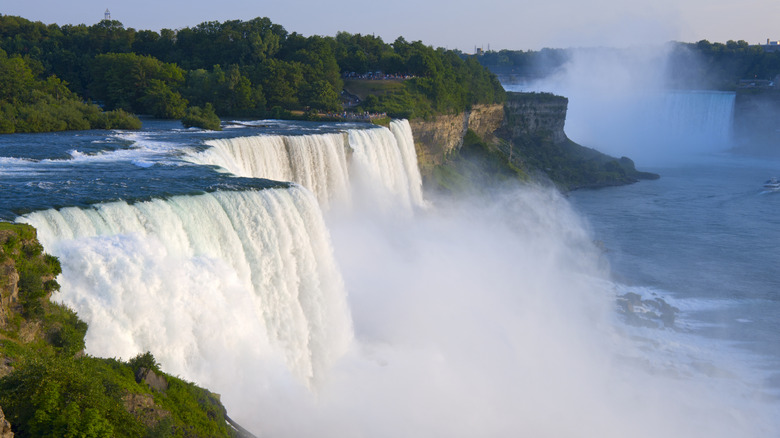
The powerful Niagara Falls is one of the world's largest and can be found on the border between New York State and Ontario, Canada. This unique location straddling two countries makes it one of the top bucket list tourist attractions in North America. While Niagara is neither the tallest nor the largest waterfall in the world, it does have the world's highest flow rate: Around 20% of the planet's freshwater crashes over the three main cataracts of the falls, at a rate of roughly 700,000 gallons per second.
To truly appreciate this beautiful, historic natural wonder, the best approach is to see Niagara from both sides of the border and from the water for full effect. Open year-round and free to enter, Niagara Falls State Park also provides stunning views over the American Falls and the rest of Niagara from the Niagara Falls Observation Tower. While in the park, hop aboard the Niagara Scenic Trolley for even more panoramic views, along with historical tidbits. From there, cross the border to the Canadian side and hop on a boat to the basin below Horseshoe Falls to take in the scope of the thundering waters.
Mount Rushmore, Keystone
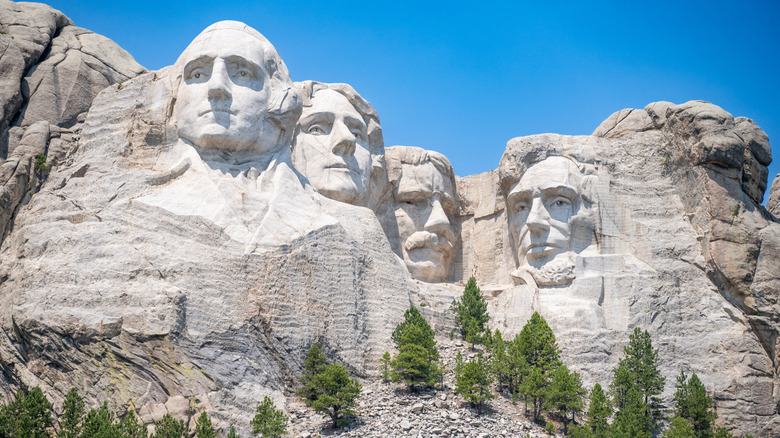
Admittedly, the idea of four U.S. presidents carved into the side of a sacred Indigenous mountain can feel unsettling. And while the history of Mount Rushmore is complex, contested, and often tragic, the massive sculptures — standing above the impressive landscape — remain an undeniable, impressive feat. The four 60-foot presidents are collectively known as "America's Shrine of Democracy," and the idea for Mount Rushmore was initially conceived as a way to boost tourism to South Dakota and signify the "founding, expansion, preservation, and unification" of the United States, per the National Park Service. As for the presidents depicted, they were chosen for specific reasons: George Washington was chosen for his role as a founding father, Thomas Jefferson for expanding the country with the Louisiana Purchase, Theodore Roosevelt for his efforts in conservation and national park preservation, and Abraham Lincoln for his unification efforts during the Civil War.
Completed in 1941, Mount Rushmore has since become a major tourist draw, attracting around two million visitors a year. The monument is located in the Black Hills, a land sacred to the Indigenous Lakota Sioux people who have inhabited the region for generations. As such, many Lakota view Mount Rushmore as a desecration, making the site deeply controversial. Because of this, many visitors choose to also stop by the nearby Crazy Horse Memorial, an enormous, still-in-progress carving dedicated to the notable Lakota chief and hero, Crazy Horse.
To visit Mount Rushmore and the Crazy Horse Memorial, stay in Rapid City, located about 30 minutes from Mount Rushmore, or in the small town of Keystone. It's easiest to visit via car or tour, and the busiest months are during the summer, so it's best to plan your visit for the fall, when the surrounding autumnal hues add extra spectacle.
The Alamo, San Antonio
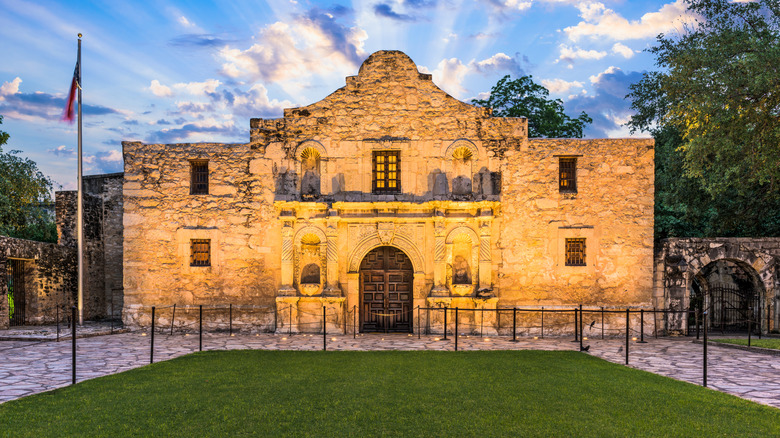
"Remember the Alamo" is a phrase pretty much every American knows, even if they know little else about Texas. One of the largest states in the Union, the Lone Star State was once its own country — a legacy that helps explain why the Alamo holds so much symbolic power. The surprisingly small Alamo sits in the center of bustling San Antonio, nearly lost in a sea of skyscrapers. However, its significance remains undeniable, making it one of the best historical sites to visit in America. Built as one of the famous, UNESCO-listed San Antonio Missions, the Alamo was first known as Mission San Antonio de Valero upon its completion in 1724.
While the Alamo is now a complex with multiple exhibits and a "Living History" encampment, the most recognizable building is still the church, or the original mission. This small, ornate, limestone structure was where roughly 200 Texans fought in the 1836 Battle of the Alamo during Texas' war of independence from Mexico. "Remember the Alamo" became the slogan and battle cry of the Texas Revolution, and the Alamo became a symbol of the state's independent spirit. Although the Alamo is free to visit, guests must book a timed-entry ticket in advance. Keep in mind, however, that select exhibits might require an additional fee.
Liberty Bell, Philadelphia
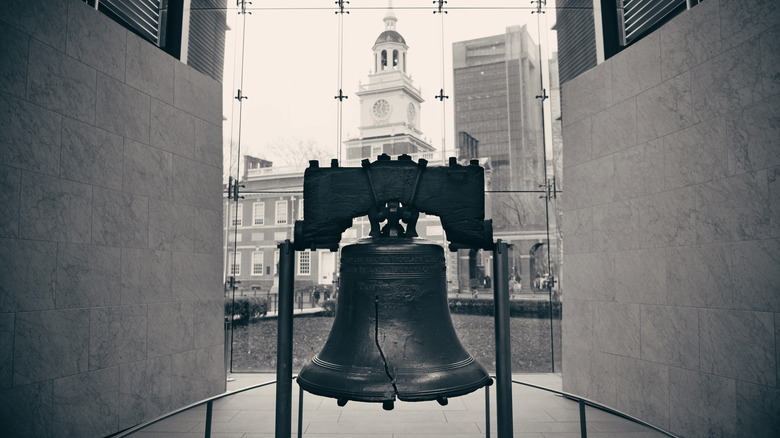
A big, old, cracked bell seems like a strange symbol for any country. Yet the Liberty Bell, located in Philadelphia, is nevertheless one of the nation's most enduring symbols. Beyond that, it's also a symbol, worldwide, for civil liberties, thanks in part to its inscription: "Proclaim Liberty Throughout All the Land Unto All the Inhabitants thereof."
While the iconic bell was originally cast in 1751 and hung in the Pennsylvania Assembly, it wasn't known as the "Liberty Bell" until it was embraced as an emblem by the abolitionist movement in the 1830s. After the Civil War, the Liberty Bell went on tour in an attempt to heal the rifts, and over the years, dozens of imitations have spawned throughout the country and the world.
But what about that iconic crack? The largest, irreparable crack — now a distinctive feature of the bell — occurred during the last time the Liberty Bell was rung on February 23, 1846, while commemorating George Washington's birthday. Today, a different bell hangs in Independence Hall, and the Liberty Bell is on display across the way in the Liberty Bell Center, with Independence Hall still making for an impressive backdrop. While the Liberty Bell is free to visit, Independence Hall requires a timed-entry slot for a small fee.
Hollywood Sign, Los Angeles
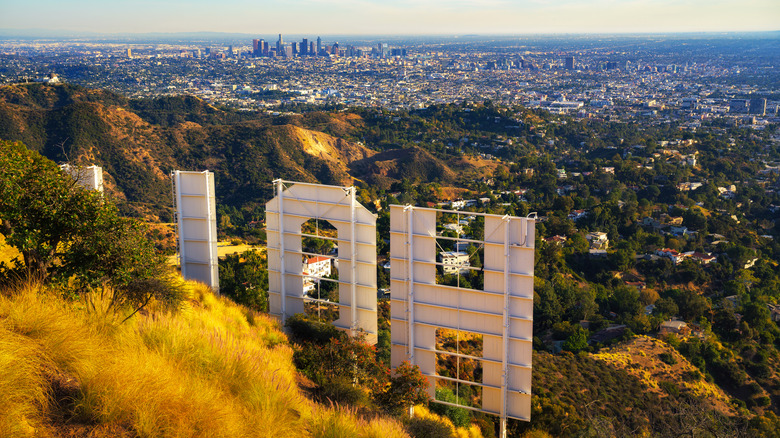
One of California's top tourist hot spots — and a symbol of the state, the city, and the film industry itself — the Hollywood sign became an icon almost by accident. Originally built in 1923, the 45-foot-high white letters spelled out "Hollywoodland" and were intended as a temporary advertisement for a new housing development of the same name. By the 1940s, the iconic "H" had fallen down, a clear sign of neglect. Thankfully, the Hollywood Chamber of Commerce took over the project in 1949, removing "land" and restoring the remaining letters.
Although the sign once again began to deteriorate over time, it had already become widely recognized as a symbol of movies, Los Angeles, and even dreams. As such, it was designated an official historical landmark in 1973. By 1978, a group of key Hollywood celebrities — led by the controversial Hugh Hefner — pooled their funds for another restoration effort. Today, the Hollywood sign is as inextricably linked with California and Los Angeles as the Pacific Ocean itself.
Although the sign is visible from many parts of the city, some of the best views can be found at Griffith Observatory, Lake Hollywood Park, and the Hollywood Walk of Fame. More active travelers can also hike to viewpoints near the sign itself — and popular trails like the Mt. Hollywood Trail and the Brush Canyon Trail depart from Griffith Park and are especially lovely at sunrise or sunset. For a true bird's-eye view of the iconic letters, book a helicopter tour to see them from the sky.
Honorable mention: America's national parks
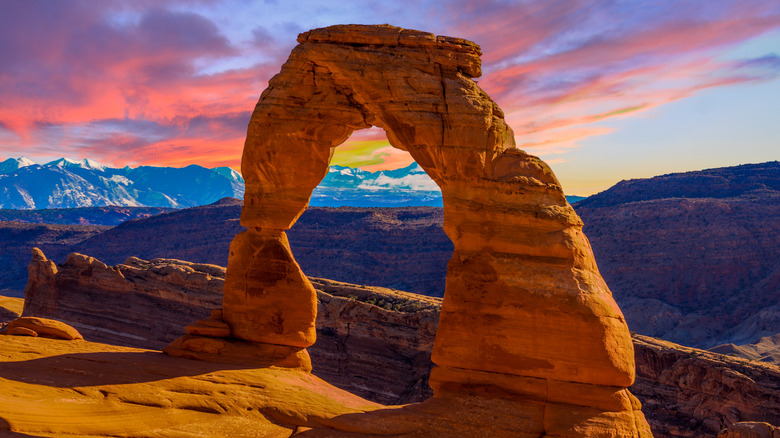
They remain America's best idea, and the countless landmarks found across all 63 national parks run the gamut from geysers to waterfalls, canyons to rivers, gorges to mountains, and caves to islands. The oldest national park, Yellowstone National Park, in Wyoming and Montana, is home to icons like Old Faithful and Mammoth Hot Springs. Not far from Yellowstone is Grand Teton National Park, known for its craggy mountain peaks. And further south in Utah sits the famous Arches National Park, which boasts a host of distinctive sandstone rock formations.
Then, there's the Grand Canyon, located in its eponymous national park, and considered one of the most incredible sites in the world. Meanwhile, the Everglades preserve — located in southern Florida — is one of the most unique ecosystems in the world. From Hawaiian volcanoes to the North Dakota Badlands, and from snowcapped peaks to coastal gems, America's national parks exist to protect the country's most extraordinary landscapes, ensuring they remain for generations to come.
Methodology
In order to select the top 10 most iconic landmarks in the United States, we consulted official landmark websites, government websites, tourism boards for cities, states, and neighborhoods, and the National Park Service. This helped us verify each attraction's historical significance, visitor access, and cultural relevance.
Additionally, we also consulted sites like Reddit and TripAdvisor to better understand past visitors' opinions on the country's icons. Finally, we also reviewed tourism magazines and travel blogs that provided additional context and perspectives on what makes these landmarks so iconic.