

Tourists Visiting The Grand Canyon Need To Follow This Important Safety Rule
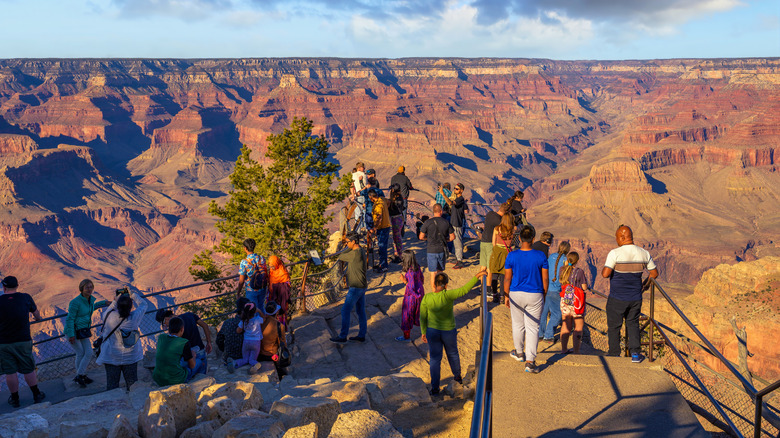
Carved over 6 million years ago by the Colorado River, and home to thousands of species of plants and wildlife, the Grand Canyon is truly majestic. Millions of visitors flock to northern Arizona annually to witness, photograph, and pose among its natural beauty, aiming to get as close as possible to the edge. However, due to safety reasons — including the risk of death to you or others — visitors should make sure to stay behind the safety barricades and on marked paths at all times while taking in the breathtaking views.
While saying that the canyon's environment is fragile may sound like a cliché, in this case, it is true — and it can potentially mean life or death when walking down paths or standing on the Skywalk, a thrilling, gravity-defying canyon walkway. Geologically, the Grand Canyon is composed of layers of sedimentary rock stacked on top of igneous and metamorphic rock. Over millions of years, these layers of rock have risen thousands of feet due to plate tectonics, been pushed downward and carved by the Colorado River, and weathered by erosion — a process that continues today.
As such, the canyon's rims are truly fragile, and a rainstorm, windstorm, seismic waves from an earthquake, or even a person's weight could loosen up ground that looks firm to the eye. This means that hopping over the barricade or making your own path, even for a moment, can cause the ground to give way, sending you falling thousands of feet. While, statistically, only 2.4 visitors tragically fall to their deaths each year — one in 1.95 million — your odds of surviving such a fall are effectively zero.
Other safety rules to heed at the Grand Canyon
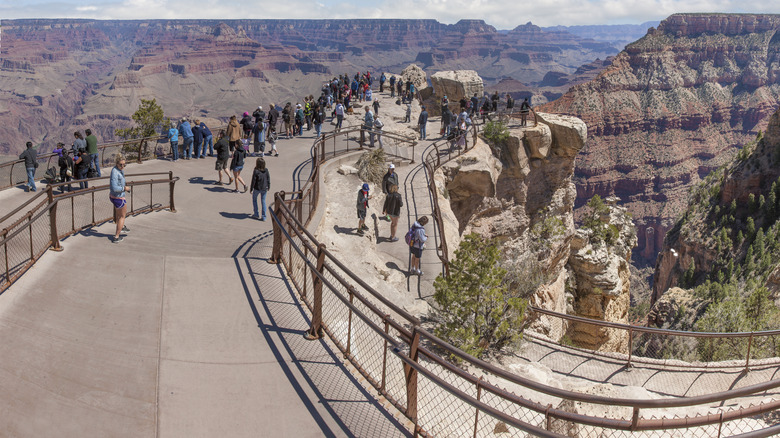
For all of its beauty, the Grand Canyon surely has a dark side. Of all the national parks in America, the iconic national park has the highest fatality rate of all, and is definitely not a place to test Mother Nature. That being said, you can take several precautions while visiting to limit your risk and still have a wonderful trip.
For starters, if you plan on visiting the Grand Canyon, be sure to prepare well for your trip in advance — especially if you are venturing out. Trails here range from kid-friendly to one of the most dangerous in America, and even if you're going for a short walk, make sure to check the weather and prepare for the unexpected, such as a summer rainstorm or a lost water bottle. Additionally, paths on trails can be narrow, so keep your focus and your eyes on your next step, not the subject you're snapping, regardless of the scenery.
Another important safety rule is never throwing rocks or other objects into the canyon. Although it might seem like innocent fun — especially for kids — it can be dangerous to both hikers, park staff, or animals below the rim. Even small rocks can gain dangerous speed or trigger a landslide. Because of this, the National Park Service constantly reminds visitors to remember their "inner ranger" and consider how their actions will impact others' experience.