

These 10 Common Clothing Choices Make You Look Like A Tourist When In Europe
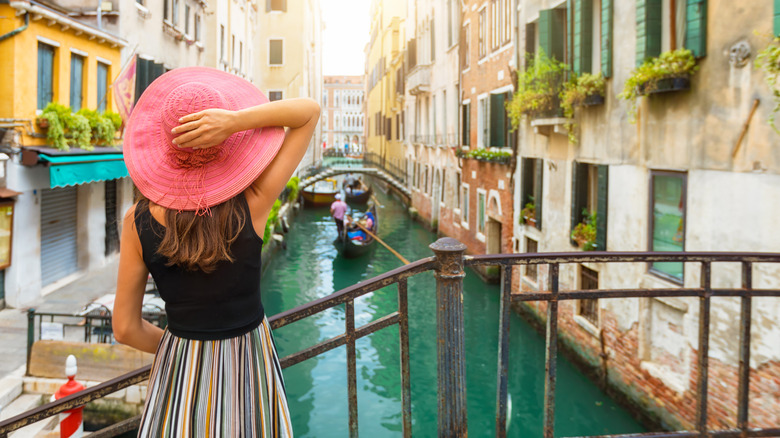
As a fashion lover and frequent European traveler, I've learned that clothing choices often instantly signal whether someone is a local or a tourist in the world's most stylish cities. For a high percentage of native Europeans, style isn't about following trends or standing out. Rather, they focus on dressing intentionally, looking polished, and staying appropriate for whatever setting they are in. What Americans often consider to be comfortable sightseeing outfits can unintentionally stand out in cities where "casual" doesn't mean "careless" and "practical" doesn't translate to "gym wear."
Across Europe, everyday style tends to prioritize clean lines, neutral palettes, and well-fitted basics. Even in cities where residents walk just as much as tourists, anything verging on loungewear and athletic wear is usually reserved for exercise, not for errands or café hopping. Here, we'll look at 10 common clothing items that will generally make you look like a tourist in Europe. For each item, I'll explain why it reads as "tourist" in elegant places like Paris, Rome, London, and Barcelona, and how locals typically approach dressing instead. Most importantly, I'll share practical alternatives that still allow for comfortable days full of walking and traveling between destinations.
Athletic sneakers worn as everyday shoes
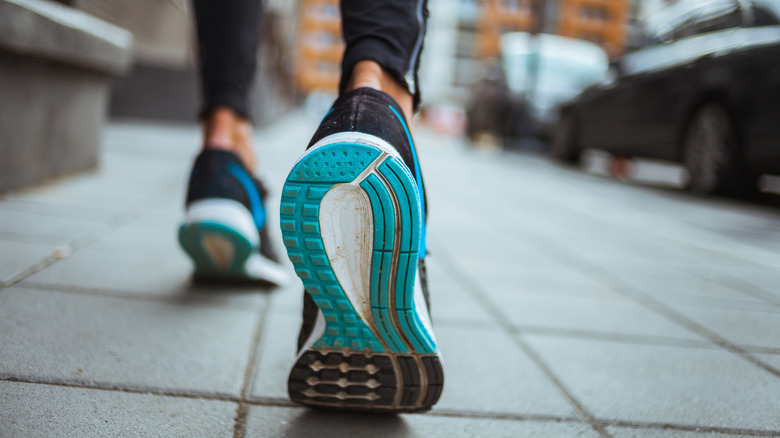
This one often surprises American travelers, because European cities are very walkable, and locals do tend to walk everywhere. And yes, they do wear sneakers. The difference lies in which sneakers they choose. In general, you won't see people wearing overtly athletic shoes designed for running, training, or hiking unless they are actually exercising. This type of footwear, paired with jeans, dresses, or casual outfits, immediately signals "tourist." If you are going to don sneakers that lean athletic, go for something classic and not bulky, like adidas Originals styles or Chuck Taylors. I personally wear low-top Chucks in Europe often, typically paired with a designer bag and an all-black outfit.
Locals usually favor sleek, low-profile sneakers with clean lines and minimal branding, like the examples above. Other great options under $125 include Kizik's ultra-comfortable Milan sneaker and the adidas Gazelle Bold, which has a platform sole that reads a bit more fashion-forward than some of the other suggestions here. You can also go more high-fashion with something like Balenciaga's $1,000 Triple-S sneaker in beige and gold. Generally, any well-designed sneaker in white, cream, black, or navy is a good option for a European outing. Even when comfort is a priority for a day of sightseeing, the goal should be to appear polished, not sporty (unless you're actually climbing the Matterhorn!) If you want to blend in while still protecting your feet during a 20,000-step day, the European style swap is simple: select fashionable sneakers designed for walking, not working out.
Baseball caps

Some Europeans do wear baseball caps, but how they wear them is key to styling yourself like a local (or at least a regular visitor) during your next Eurotrip. In many stylish European cities like London, baseball hats are relatively uncommon, and those that are worn tend to be subtle, understated, and designed to be part of an intentional outfit rather than a purely practical accessory. What will instantly mark you as a tourist are backwards caps, oversized hats, and hats with large logos or busy graphics. Europeans who choose to wear baseball caps typically choose minimalist styles in neutral colors with extremely subtle logos or no logos at all. Something like the Chloé Swing Cap in a beige silk/cashmere blend is a great, albeit pricey — it runs about $300 on sale — option. Another high-end option is Prada's Drill baseball hat in navy.
If you're looking for a cheaper alternative, search for something simple rather than flashy. Europeans often pair their caps with tailored coats, upscale knit sweaters, and structured bags, which keeps the overall look polished. Couture designers have helped normalize caps as a high-fashion item, but only when they're sleek and stylish. Baseball hats associated with American sports teams, featuring splashy U.S. college logos or souvenir-style designs, stand out quickly in a not-so-great way. To be on the safe side, avoid overt branding and choose a low-profile cap in a neutral shade, worn forward, with minimal detailing. Oh, and visors? An absolute no-go if you don't want to stick out like a sore thumb.
Cargo shorts
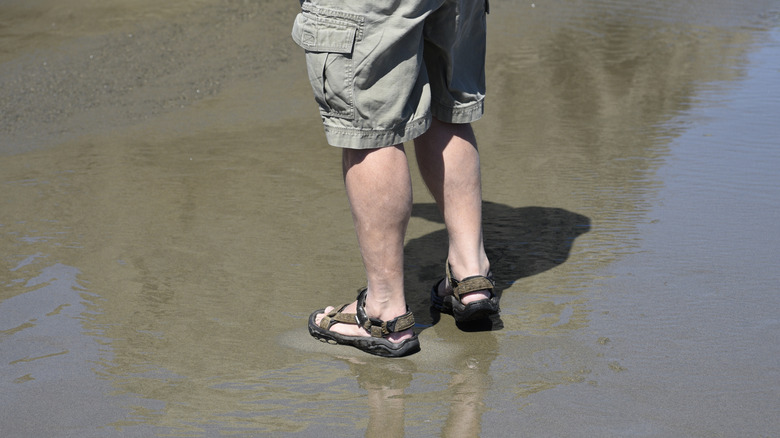
Ah, cargo shorts. Among the most enduring tourist fashion red flags in history, cargo shorts are a surefire way to mark yourself as a non-local during a European summer holiday. While they're popular in the United States for their comfort and extra pockets, cargo shorts stand out negatively in stylish European cities like Paris and Barcelona, where casual dressing still tends toward intentionality. The oversized pockets, knee-length cut, and utilitarian feel of cargo shorts read as functional and slightly sloppy, which sharply contrasts with how locals typically approach everyday style. Even on the hottest days, in fact, wearing shorts can be a style mistake in Europe. Since men are the most likely cargo shorts culprits, a good alternative is a lightweight linen trouser, like Tommy Bahama's Beach Coast style, available in multiple stylish colors and under $150. Dresses and skirts are also a great option for European summer travels.
It's worth noting that some Europeans do wear shorts when the weather warms up, but they're usually tailored and cut above the knee. If the men in your party are committed to shorts, look at styles like Brooks Brothers' cotton-linen blend shorts. It's also important to consider what you're doing on any given day of your trip. Generally speaking, you won't see native Europeans wearing shorts in nice restaurants, art museums, or houses of worship. Some historic sites and religious institutions even have dress codes, so it's good to be a bit cautious when you pack. In short (no pun intended), it's best to avoid shorts in Europe altogether if you don't want to signal that you're a tourist, but if they are a necessity for whatever reason, stick to sleek, minimalist designs in neutral hues.
Athleisure outside of exercise

While leggings, sweatpants, and matching athleisure sets are staples of everyday American streetwear, it's rare to see them outside of a Pilates class or a jogging path in places like Milan, Vienna, and Rome. In much of Europe, these items are still viewed primarily as gym clothes or loungewear, not as outfits for sightseeing, shopping, or dining. Due to this cultural difference, wearing a complete workout ensemble while exploring a European city is likely to single you out as an American tourist almost immediately. This doesn't mean Europeans never wear comfortable clothes, because they absolutely do, but they save them for the couch or the gym. One of the key clothing etiquette rules to be aware of in Europe is the strong stylistic separation between exercise attire and daywear.
A matching leggings-and-crop-top set that you might wear to grab Starbucks at home is likely to look oddly out of place somewhere like Caffé Gilli in Florence or in the queue for the British Museum. Remember, this isn't about cost. Even very expensive athleisure like Moncler leggings will look out of place outside of the slopes in Austria's can't-miss ski resorts. Europeans tend to prioritize daily comfort through fabric choice and fit, rather than athletic design. A pair of comfortable trousers like Quince's $45 wide-leg ponte pants provides a polished alternative to leggings, while the $50 cashmere crewneck sweaters that put the brand on the map are the perfect choice for nearly any European outing. Add a chic scarf, and you'll blend in in any historic district!
Logo-heavy designer pieces
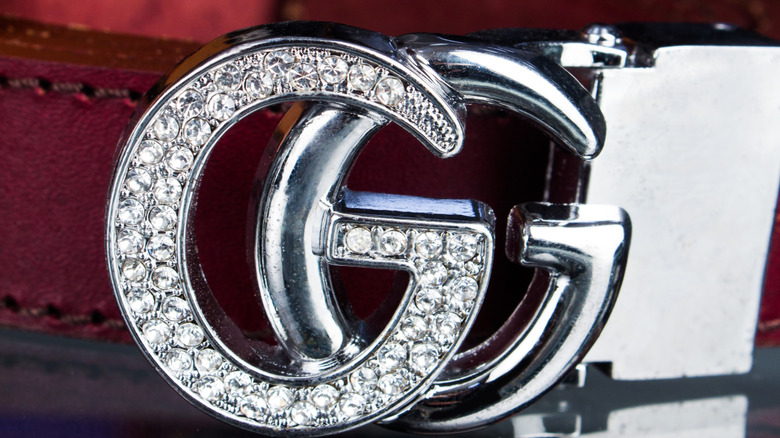
Of all the common clothing mistakes to avoid in Europe, wearing logo-laden designer pieces just might be one of the biggest. In some US cities, particularly "go-big-or-go-home" places like Los Angeles or Miami, large logos and overt designer branding have long been used as status symbols. There has, however, been a shift toward "quiet luxury" in recent years, even in the boldest U.S. markets. In much of Europe, that same subtle approach has always been the hallmark of luxurious living. Oversized logos (think the traditional Gucci "Double G" design) and branding often look less high-end and more like an immediate beacon that someone is a tourist.
Rather than advertising a brand name, upscale European fashion culture values craftsmanship, fabric quality, tailoring, and classic silhouettes, not logos and graphics. Labels like Loro Piana, The Row, Brunello Cucinelli, and Totême have become popular precisely because their pieces don't loudly announce themselves at first glance. Rather, understated, high-quality pieces whisper that you are someone who deserves the best of the best at hotels, restaurants, and shops. If you're on a budget, don't fret. There are plenty of outfit options that won't break the bank. J. Crew's brushed cashmere t-shirt is an elevated, wildly comfortable basic that is often on sale for around $120, while Aritzia's Limitless Japanese crepe pants will help you stand out in all the right ways for about $150.
Flip-flops away from the beach
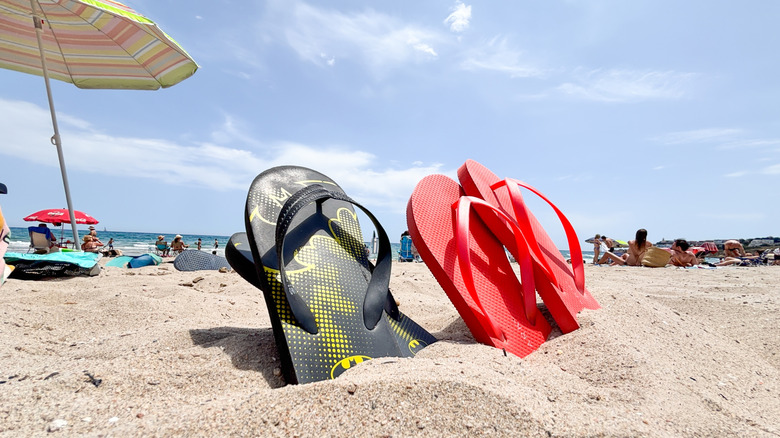
In much of Europe, flip-flops are not the norm when it comes to warm-weather footwear. While people may wear inexpensive rubber flip-flops to the pool or the beach, you're unlikely to see them walking through major cities or picturesque villages in Provence and Tuscany. In fact, flip-flops are often a dead giveaway that someone is a tourist, no matter how stylish the rest of their outfit might be. This isn't just about style, though. Europe was historically built for walking, but that history has left behind cobblestones, uneven pavement, and ancient streets that call for less flimsy footwear than flip-flops. Europeans who walk, well, everywhere unsurprisingly gravitate toward well-made sandals and espadrilles that are designed for traversing long distances on occasionally challenging terrain.
Flat leather sandals, neutral open-toe slides, espadrilles, and low block-heel sandals are all great options for ladies. Margaux's supple leather MX sandals are a popular choice that come in under $300. Gentlemen should consider something like Prada's tan fisherman sandals – though at $1,120 a pair, they are a pricey option. Sabah Shoes' $275 Porto style is a more affordable design. For American travelers, the swap here is a no-brainer: leave the flip-flops in your beach bag and choose footwear that feels like part of your outfit, not an afterthought. No matter how hot it gets, Europeans still dress well and put their best foot forward, as it were, on a daily basis. A pair of quality leather sandals or chic espadrilles will keep you cool, comfortable, and stylish for all of your adventures.
Visible athletic socks

White crew socks paired with shorts, or really visible at all, are one of the most instantly recognizable tourist signals in many European cities. While this combination is common, and even trendy at times, in the United States, it simply isn't how most Europeans style themselves for everyday life. Though it is worth noting that German and Austrian nationals, in particular, are known for pairing socks with sandals, namely Birkenstocks, on occasion. In most European nations, however, socks are a functional part of an outfit that should reflect the wearer's generally tailored appearance.
Typically, if socks are required with an outfit where legs are showing — like shorts or a sundress — Europeans in nations like Spain, France, and Italy don no-show socks or low-cut socks that disappear within the shoe. You should seek to create an uninterrupted silhouette when planning your outfits. White crew socks break the visual line and often appear unkempt as a result. This doesn't mean Europeans never wear visible socks, however. They do, but with purpose. For example, dress socks are usually the same color as a person's trousers or shoes. For a more fun interpretation, choose a style that intentionally contrasts with the formality of an outfit, such as a polka dot or striped design. If you go this route, focus on quality. MeMoi's cashmere blend socks are a classy option for any gender.
Backpacks worn all day

This one is less about style and more about safety. While small backpacks are practical, they often mark someone as a tourist, especially in places like Paris, Barcelona, and Amsterdam, where pickpocketing is a well-known issue, and locals are hyper-aware of how they carry their belongings. In many European cities, backpacks are associated with travelers because they make people easy targets. Since they're worn on both shoulders, they sit out of the wearer's line of sight, making these individuals vulnerable to burglary in crowded areas like metro stations and busy intersections. Locals know this, which is why they often carry a cross-body or a tote as their daily bag. These styles are easy to carry in front of the body and subtly indicate that the wearer understands the city's public dynamics.
There's also a visual cue in the mix here. Backpacks, especially nylon ones, are often associated with literally backpacking through Europe. The smart alternative to any backpack, even a smaller, stylish one, is a zippered crossbody you can wear across your chest or a structured tote with a secure closure. Longchamp's Le Pliage tote is a European staple that will last you for years. Meanwhile, Tumi and Quince both offer understated cross-body travel bags that will blend in perfectly in cultured European destinations. There is one notable exception to this rule: Disneyland Paris. Inside the Marne-la-Vallée parks, Loungefly's Disney-themed mini backpacks like this Minnie Mouse bag in polka dot print are extremely common, mirroring U.S. Disney culture. In that specific environment, a backpack won't raise safety concerns like it would in other locales.
Graphic t-shirts
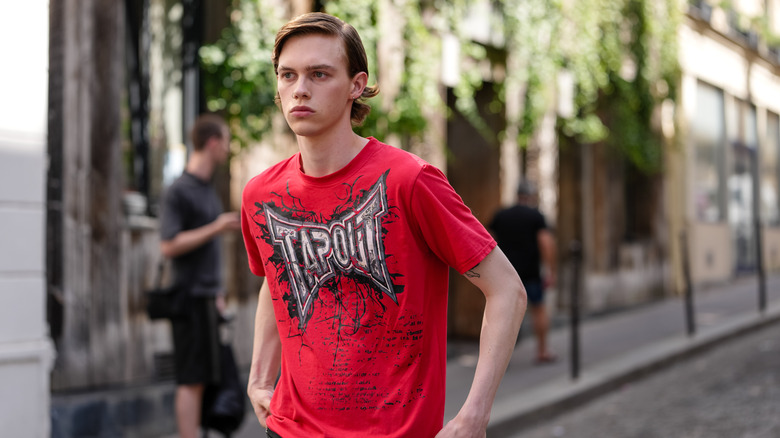
Oversized graphics and novelty logo shirts are one of the quickest ways to visually stand out negatively when traveling in Europe. While these types of shirts are completely normal in the United States, especially for casual errands or running to a fast food restaurant, they're much less common in everyday European street style. While it is not rare to see people wearing clothing, even t-shirts, from popular brands like Nike and North Face, they often have subtle logos. For example, to blend in, pack a shirt with the Nike Swoosh subtly embroidered on the chest, not screen-printed across the entire shirt.
In addition to graphic tees immediately outing you as a tourist in Europe, they also tend to look too casual for settings where locals would wear something slightly more formal. Even when they're just going for a morning coffee run, most Europeans will wear something more polished than a graphic t-shirt. You're unlikely to see a Venetian, for example, grabbing an espresso at Cafe Florian in a sports t-shirt and jeans. Another thing to consider here is lifestyle. Europeans, notably Parisians, often build capsule-like wardrobes of high-quality basics that can easily transition from work to dinner to a nightcap. If you want to fit in while still being comfortable, pack simple, high-quality t-shirts from brands like Calvin Klein and Buck Mason.
Overly casual outerwear

The final major giveaway that someone is a tourist in Europe is overly casual outerwear worn in the wrong context. Oversized hoodies, fleece zip-ups, and hiking jackets clearly made for the mountains are undeniably practical, but in most European cities, they're generally worn for exercising or actual hiking. Wearing them while sightseeing, shopping, or dining immediately sets American travelers apart from locals. In stylish spots like Edinburgh, the Cotswolds, and Copenhagen, outerwear is treated as part of an outfit. Sometimes, in fact, it's the statement piece that ties together a whole look.
When the weather is cold or rainy, as it often is during fall and winter in the U.K., specifically, Europeans tend to opt for structured coats or wool jackets with hoods. Americans, on the other hand, often default to hoodies with puffer jackets or even flannel, both of which look out of place in upscale European establishments. A classic Burberry Kensington trench or Lauren by Ralph Lauren's quilted, hooded coat is a great choice, as is something like Michael Kors' cashmere and wool blend overcoat.
That being said, dress for the weather. If you can only pack one coat and you're heading somewhere colder like Helsinki or Reykjavik in the chilly months, make sure it's something that can withstand the low temperatures. If you're packing a lighter coat, warm, wool layers underneath will keep you toasty.
Methodology

This guide relies heavily on my own knowledge of how to dress in Europe based on numerous European trips. I also pulled in information from travel subReddits on Reddit and forums like Rick Steves' discussion boards. In addition, I used guides and articles from sites like Europe Up Close, Fodor's, Who What Wear, and The Savvy Backpacker. High-authority magazines like CN Traveler and Travel + Leisure also assisted.