

Trier, Germany Offers Plenty Of Tourist Attractions Worth Visiting
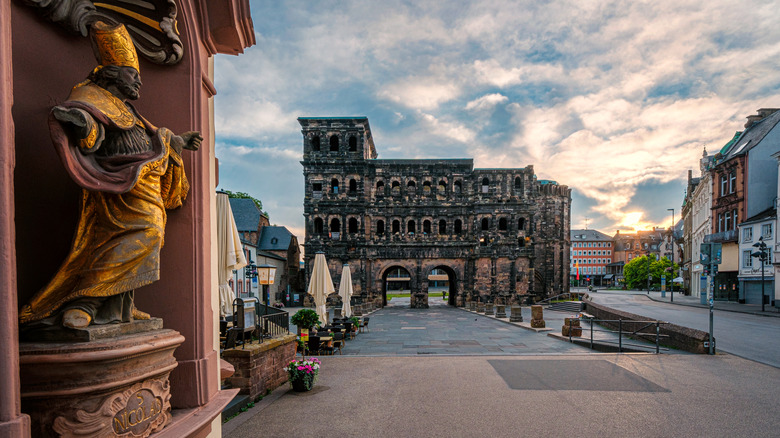
What do Roman baths, Karl Marx, Riesling, and the Mosel River all have in common? The often overlooked German city of Trier, located along the border with Luxembourg. At first sight, Trier is a typical charming German town in the scenic Mosel Valley, surrounded by vineyards, near the river, crowned with several church towers. However, pay a visit to Trier's cobbled streets, and you'll discover that this German town is special. Not only does it have some of the best Roman monuments outside of, well, Rome — it's even known as the "Rome of the North" — but it's also the oldest town in Germany. Founded as Augusta Treverorum circa 16 B.C.E. (with roots dating back even further), Trier became such an important Roman city that even then it was known as "Roma Secunda" (second Rome). Yet despite this impressive history, Trier, a city of Roman ruins, historic cathedrals, delicious wine, and incredible European Christmas markets, still flies under the radar.
This is good news for visitors, in that Trier can feel less crowded than other, more well-known cities, yet it has plenty to see and do. Discover these 12 tourist attractions worth visiting in Trier to help you make the most of this hidden gem. Using data from local news sources, tourism boards, German blogs, and travel experts, along with personal experience, we compiled a list that showcases the beauty of Trier.
Porta Nigra
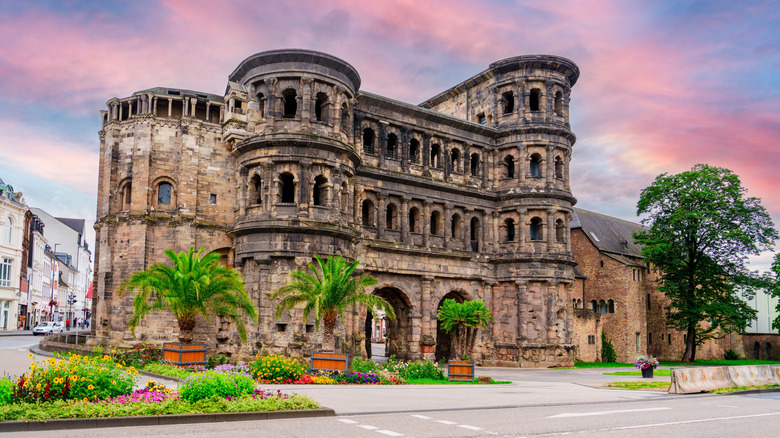
Trier, Germany's oldest city, an overlooked historic beauty, has an incredible array of Roman ruins. And one of the best is the Porta Nigra, a 2nd-century Roman gate that's become the symbol of the city. Known as Porta Nigra, or the "Black Gate" due to its now age-blackened stones, this gate has stood the test of time.
While it's been known as Porta Nigra for at least 900 years, the original Roman name has been lost to time. Perhaps it was never named, as the builders had no idea this particular gate, one of many throughout Ancient Rome, would one day become so significant. In fact, Porta Nigra was originally one of four gates within Trier itself, connecting the city walls. The rest were demolished for parts during the Middle Ages, but Porta Nigra escaped this fate thanks to a holy man-turned-hermit, Simeon, who moved in during the 11th century. He spent the last five years of his life walled up in one of Porta Nigra's towers until his death in 1035. After his burial on-site, a church was constructed in his honor, and he was canonized by the pope, thus ensuring the survival of the gate. However, the attached church was dismantled in the 19th century and returned to its Roman splendor.
Nowadays, visitors come to marvel at this ancient structure, made from over 7,000 sandstone blocks, held together with nothing but iron clamps (no mortar). Climb to the top for panoramic views, take a tour from a Roman centurion (okay, an actor playing one), and gaze in wonder at its sheer size.
Main Market (Hauptmarkt)
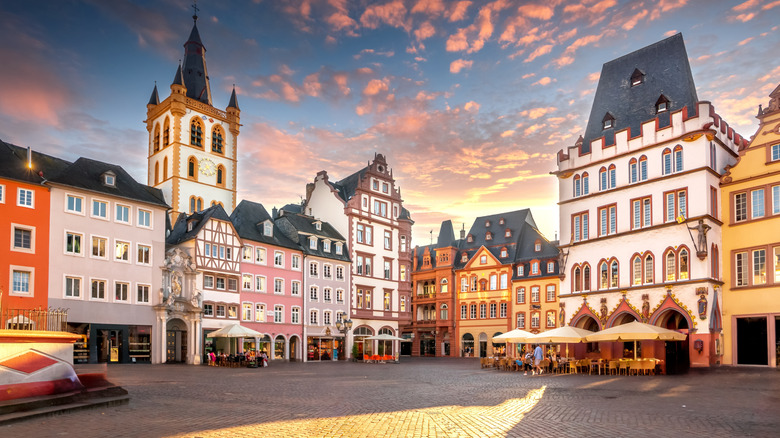
The utterly charming main square of Trier, the Main Market or the Hauptmarkt, is a highlight for visitors. With daily flower stalls, beautiful facades, and a dramatic fountain, plus one of the most charming and least crowded Christmas markets in Europe, this is Trier's picturesque hub. Trier became a market city in 958, commemorated by a large Market Cross (Marktkreuz) still in the center of the square, erected for the occasion. For preservation reasons, the one on display in the square is a replica; view the original in the City Museum.
The medieval Hauptmarkt is considered a gateway to some of Trier's best sites, such as the Porta Nigra, but the square itself is worthy of your time. Have a drink or a meal on one of the many restaurant terraces lining the square and visit the 16th-century fountain, dedicated to the city's patron saint, St. Peter. Other notable buildings include the 15th-century Steipe banquet hall and the white facade of the Three King's House, which dates back to the 13th century.
Basilica of Constantine (Throne Room, Palace Gardens)
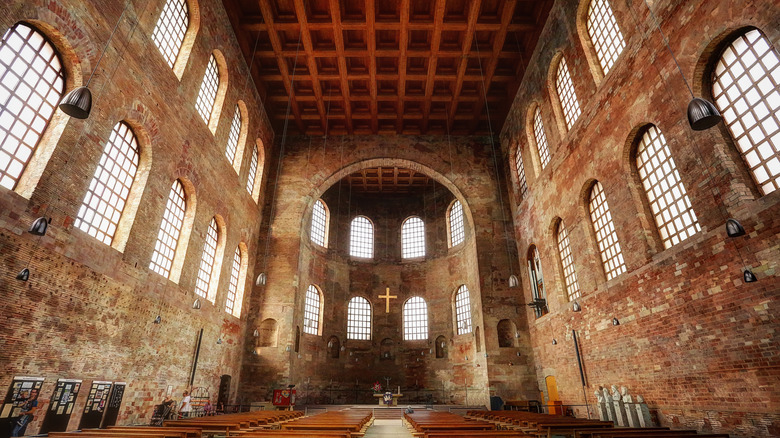
The Basilica of Constantine, or the Aula Palatina, is an enormous audience hall built in lavish style by the Roman emperor, Constantine I (Constantine the Great), the emperor responsible for many of Trier's later Roman landmarks. The major feature of the 4th-century structure is the immense throne room, with a height of 108 feet, a length of 220 feet, and a width of 87 feet. The size is truly astonishing, even more so as it's not supported by columns and is considered the largest single-room Roman building left standing. After necessary renovation due to damage sustained in World War II, it now functions as a Protestant church. The acoustics of the room are astonishing — echoes of the organ reverberate for a full seven seconds. These are put to good use several times throughout the year during special concerts and events, like the annual Mosel Music Festival.
It's also adjacent to the 18th-century Electoral Palace, now a government building. Just south of the basilica and palace are the gorgeous Palace Gardens, a must-see when in Trier. Explore the winding paths between fountains and flowers while drinking in the views of the ancient, imposing basilica.
Karl Marx House
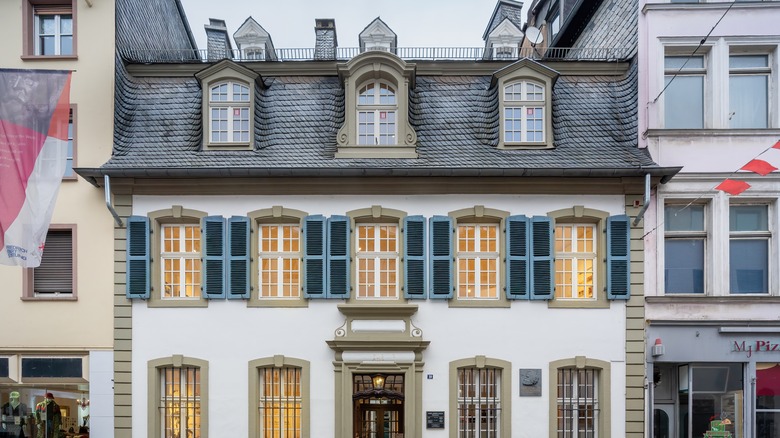
Another one of Trier's claims to fame is that Karl Marx, the father of communism, was born here in 1818. His former birthplace, on Trier's Brückengasse, where he lived for only about two years, remains nearly as it was when originally built in 1727. However, instead of families, the graceful white facade, dormer windows, and blue shutters now hold a museum dedicated to Marx's life. After a time as a Nazi printing house, the Karl Marx Museum was officially opened in 1947 and has slowly expanded to what it is today.
The rooms detail Marx's life in Germany and throughout Europe, until his death in London in 1883, where he was living during exile (you can even view the reading chair where he is said to have breathed his last). Exhibits cover stories of his youth, career paths, extensive writings, and eventual political persecution, which left him stateless after 1845. There's also an exhibit dedicated to the impacts of communism throughout Germany and the world, from Marx's lifetime to the present day. Don't miss the beautiful courtyard, now a garden with several sculptures of Marx himself. Whatever you feel about Marx and his philosophy, after a visit to his museum, you'll take home one souvenir for sure: a lot of food for thought.
Roman Baths (Barbara Baths, Forum Baths, Imperial Baths)
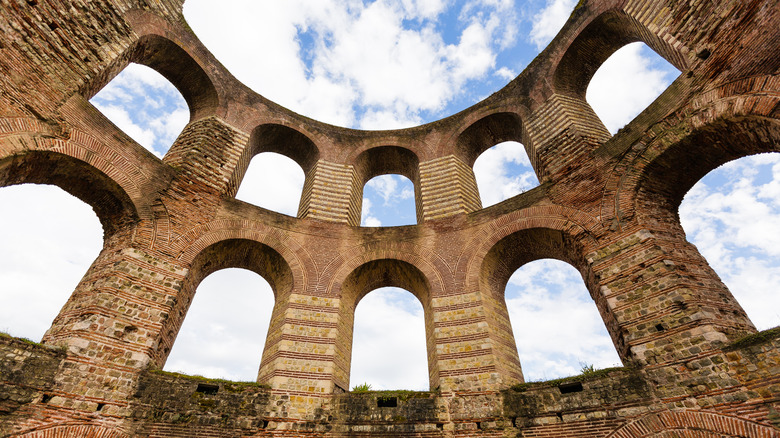
Like any respectable Roman city, Trier has a selection of Roman baths (now ruins). The Barbara Baths were the most extensive and were thought to be some of the biggest in the entire Roman Empire, with the only known bigger baths being the Trajan Baths in Rome itself. Built in the 2nd century, at their peak, the baths covered 452,000 square feet. And these weren't just a collection of hot pools, but also hidden grottos, restaurants, salons, a library. The marble-encased baths are now in ruins, and have had a variety of uses since the fall of Rome, including as a village (Barbeln), as a castle (in the Middle Ages), and a quarry. A boardwalk built above the baths is lined with helpful informational plaques.
Trier's Forum Baths were discovered in 1987 when a local company was attempting to build a parking garage (which ultimately had to be built elsewhere). Dating back to the 1st century, the Forum Baths are the oldest in Trier and get their name from their location near the Roman Forum. Encased in a large building in the middle of Trier, the ruins are nearly entirely underground and can be viewed from above, in the glass Ungers Building.
The 4th-century Imperial Baths (Kaiserthermen) are the best-preserved Roman baths in Trier, with their impressive archways and seemingly endless tunnels. Builders labored for 30 years on the order of Constantine the Great, but they were never completed, although they had other uses (including, for a short time, as baths). Still, visitors can marvel at the remaining relics, such as the giant bath that could host at least 600 people.
The Archaeological Museum (Rheinisches Landesmuseum Trier)

Perhaps not too surprising in a city with so many Roman ruins, Trier's Archaeological Museum, or the Rheinisches Landesmuseum Trier, is excellent. In addition to a wide array of Roman relics compiled in the best Roman exhibit in Germany, the museum holds artifacts from the Middle Ages to the Baroque period. In total, the museum features approximately 4,500 historical artifacts, providing an in-depth exploration of Trier as well as a peek into the massive scale of the Roman Empire.
Visit a scale model of Trier as it was during Roman times and gaze upon Roman relics, including mosaics, armor, burial monuments, and sculptures. Of particular note is the Trier Gold Hoard, unearthed by workers in 1993 while building a new bank in Trier. One of the largest Roman treasures ever discovered, with 2,650 solid gold coins, museum visitors can marvel at this literal hidden treasure.
Trier Cathedral
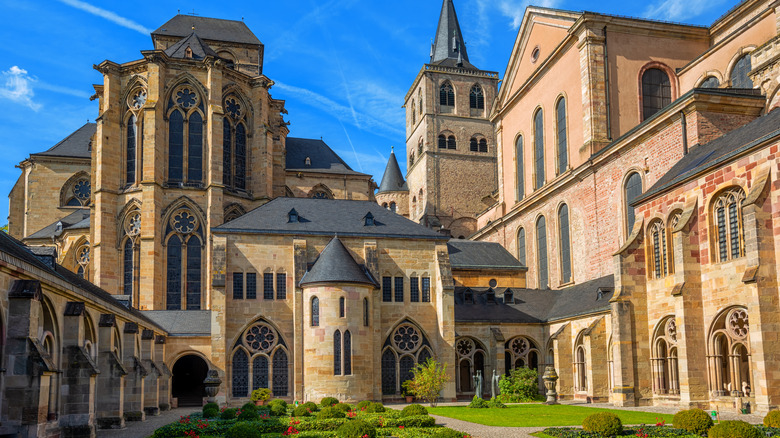
Trier Cathedral, or St. Peter's Cathedral, is a large, imposing church that's thought to be one of the oldest churches in the Western world. Original elements, dating to the 4th century, are still evident throughout the church (spot the Roman bricks in the nave), with additions added in the 11th and 12th centuries. As you wander the impressive halls, the various architectural styles that influenced the cathedral during its myriad building phases can be seen, including Gothic towers, Baroque gables, Romanesque arches, and Roman columns. Make sure to view the church from the lovely courtyard, to attempt to take in its full grandeur (and appreciate the serene beauty).
Within the church, you'll discover many a treasure, especially within the Treasury (Domschatz), which features art and relics from over the centuries, including a robe that (according to legend) belonged to Jesus and a nail that was reputedly used during his crucifixion, along with ancient manuscripts and historical statues. For more history of the Trier Cathedral and more artifacts, head down the street to the off-site Cathedral Museum (Museum am Dom).
Trier Amphitheater
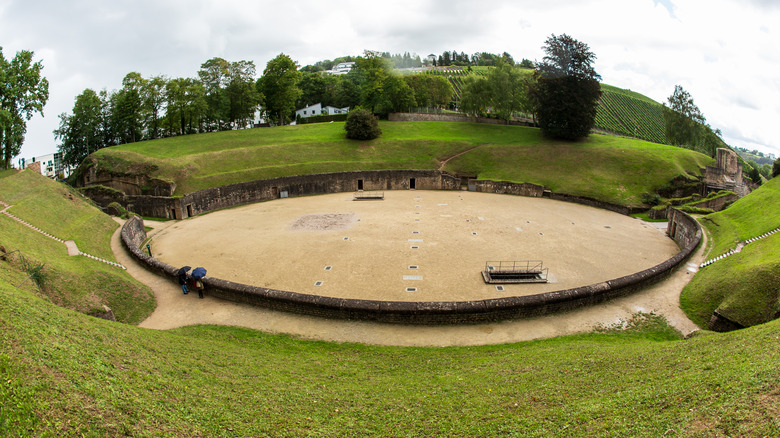
The Trier Amphitheater was constructed by the Romans in the 2nd century for gladiator fights, public executions, religious events, and gatherings. Once able to seat approximately 20,000, the center stage is now surrounded by grassy mounds, but still serves some of its original purpose — open-air concerts are performed here in the summer. While the now-excavated cellar no longer houses lions and tigers and bears (oh my), or prisoners sentenced to death via "ad bestias" (to the beasts), it can still be explored, and some stone cages remain. The last gory events waned off in the 5th century, and in subsequent years, the amphitheater became a quarry, a storage area, and a vineyard.
Nowadays, the peaceful green hills surrounding the sunken theater stand on the edge of Trier, built into a hillside with lovely views of the Mosel Valley with its endless vineyards. The immense scale of the amphitheater is hard to imagine until you're standing in the center. The death and gore that once took place here can also be hard to imagine, as children run and play within the greenness, and local festivals occur on the stage. Yet the cages in the basement give you some idea of what was once a center for the "bread and circuses" of Ancient Rome.
Jews' Alley (Judengasse)
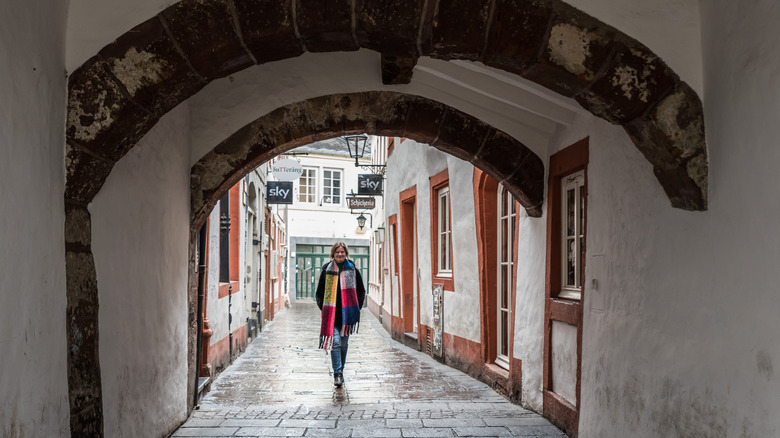
Trier's Judengasse (or Jews' Alley) was the medieval quarter for the Jewish population in Trier (and unlike much of Germany, was never utilized as a forced ghetto). Enter the narrow streets off the Hauptmarkt through the Little Jewish Gate, circa 1219, one of three such gates that could enclose the quarter during the Sabbath, creating an "eruv," where locals could carry items between buildings, a practice otherwise not allowed during the holy day. The Judengasse, with some of the existing dwellings dating back to the 13th century (including 2 Judengasse, the oldest Jewish home in Germany, circa 1240), eventually grew to include two synagogues, an inn, a hospital, and a Tanzhaus (Dance House), with a population of around 300.
Unfortunately, a pogrom in 1349, the result of false accusations that Jews had caused the plague by poisoning water in cities throughout Germany, decimated much of the Jewish population, and the rest of the city's Jews were expelled by 1418. Although the Jewish population grew after the 16th century, they integrated into the city rather than living in the former Jewish quarter. Few Jews are living in Trier now, after World War II, when most of Trier's Jewish population was murdered or forcibly expelled by the Third Reich.
The Roman Bridge & Zurlauben Riverside

Another iconic Roman site in Trier is an ancient bridge, crossing the Mosel River, an under-the-radar German river as scenic as the Rhine. The Roman Bridge, or Römerbrücke, an arched, red-bricked thoroughfare with origins dating back to the 2nd century, is the oldest in Germany. Although parts of the bridge have been rebuilt, the nine main supporting pillars are original. Once lined with chariots, now lined with cars, it's hard to wrap your head around the sheer age. As you walk across, take a moment to picture a former Roman resident of Trier, stopping to toss in a coin in honor of the river goddess, Mosella. (And marvel at the fact that one million Roman coins are thought to remain in the Mosel.)
Pair a visit to Trier's Roman Bridge with the historic Zurlauben riverfront, Trier's former fishing village, connected to the bridge via a one-mile path. The scenic trail follows the Mosel River, past historic 15th- and 18th-century cranes, to the charming promenade. Zurlauben was originally built as the St. Symphorian Monastery in the 7th century, which was destroyed by the Normans in the 9th century. The remaining buildings became houses known for their arbors, or laubes in German, leading to the eventual name of Zurlauben. A fishing village was established on the site in the 17th century, although many of the arbor houses remained.
Nowadays, Zurlauben is one of the most relaxing places in Trier, with many riverside pubs, paths, and lovely views. Stop in one of the beer gardens for a pint, sample the local apple wine, and enjoy the historic facades along the river. Zurlauben is also where you'll find Trier's pier, where Mosel boat tours depart.
Mosel River Boat Tour
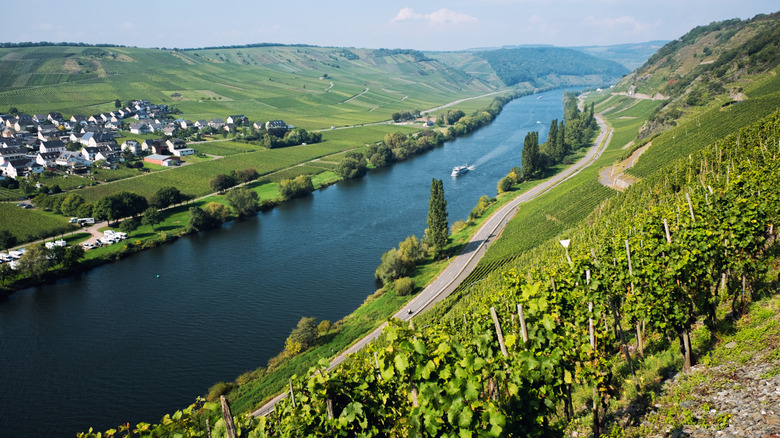
The Mosel River plays host to some of the best river cruises in all of Europe, thanks to its picturesque riverside towns, castles, and historic wineries. You don't have to pay for a multi-day tour to experience the Mosel, however; just take a day trip from Trier to nearby cities like Saarburg or the half-timbered town of Bernkastell-Kues. The tours can be as little as 1-2 hours or up to a full day. Mosel River wine cruises also depart from Trier, as the steep, renowned vineyards are best viewed from the water. The wine cruises stop at wineries along or near the river, providing ample time to taste (and usually a selection of wines for tasting on board, of course, because there's nothing better than sitting on a deck with a glass of crisp white, watching fairy tale villages and endless vines pass you by).
Another themed boat tour on the Mosel is on a replica Roman wine ship, where you'll even have the chance to row the old-fashioned vessel. Most cruises depart from Trier's former fishing village, Zurlauben. During Zurlauben's Mosel Festival in July, and during other select events, special cruises leave from Zurlauben, as well.
Wine Routes
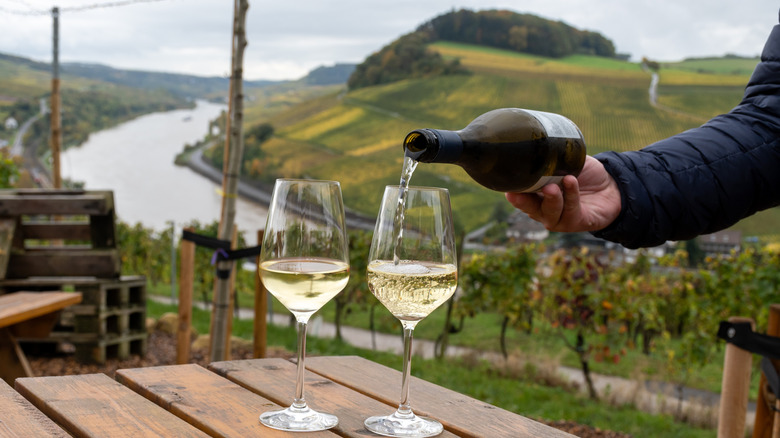
Wine has been grown and produced around Trier since the time of the Romans (if not before), and the Mosel Valley is still renowned for its excellent wine, especially Riesling. Trier has several "wine trails" that take you to multiple wineries in the surrounding valley, including what is perhaps Germany's oldest wine cellar. The Vereinigte Hospitien wine estate is home to this Roman wine cellar, dating back at least 1700 years, and is open to the public for viewings and tastings. Vereinigte Hospitien is also part of the Via Mosel Wine & Architecture Route, which follows the Mosel River and its wineries through France, Luxembourg, and Germany.
The Roman Wine Route (Römische Weinstraße) incorporates modern wineries, historic wine cellars, and Roman ruins in one neat package. Or, on the free one-hour Wine Culture Path (Weinkulturpfad), which starts at the Trier Amphitheater, explore Trier's Olewig district, known for its many wine taverns. Discover the history of wine in the Mosel Valley, along with traditional and modern wine-making methods, and, of course, sample some excellent local vintages.
If you have time, consider venturing through the vines to one of the other charming towns in the romantic Mosel Valley, like Cochem, known for fine wine and scenery. If you'd prefer to stay within Trier's city limits, there are plenty of opportunities for wine tastings at one of the many wine bars, pubs, or restaurants scattered throughout the old town. In addition, Trier hosts several wine events throughout the year, including Rhythm & Wine (every Easter) and the Olewiger Wine Festival (every August).
Methodology
For this list, we utilized traveler reviews from sites like Tripadvisor and Reddit, along with travel experts like Rick Steves, to narrow down the top sights in Trier. We then consulted the local Trier tourism board, German travel websites, and bloggers, plus our own experience, as well as local and international news sources (Luxembourg Times, National Geographic) for more information on each attraction. When applicable, we sourced data from UNESCO and directly from attraction websites to ensure the accuracy of relevant information provided. We discovered much about the Mosel Valley during our research, including ideal day trips from Trier, like Burg Eltz, one of the must-see castles to visit on your next trip to Germany.