

The Largest Mansions In The USA Are Stunning Sights To Behold
These days, everyday Americans are always looking for an extra square foot, especially in big, pricey cities like New York City and Los Angeles. But for the rich and famous — including those from decades or even centuries past — residential square footage is counted in the tens of thousands or even hundreds of thousands. Planetware rounded up the biggest mansions in the United States that can be visited by the public based on the ones with square footage that trumps all the rest. These homes were once owned by some of the richest people on the planet.
Throughout the country, mega mansions up to 175,000+ square feet span the country. These huge houses are decked out with bowling alleys, private salons, indoor pools, expansive gardens, elevators, and more. Some of them date back to the Gilded Age and beyond, making them some of the historic mansions to visit in America, now serving as conference centers, museums, colleges, and places where you can pretend to be a millionaire — at least for a day. Prepare to be wowed by their over-the-top grandiosity — and perhaps hit with a bout of jealousy.
Biltmore Estate, Asheville, North Carolina
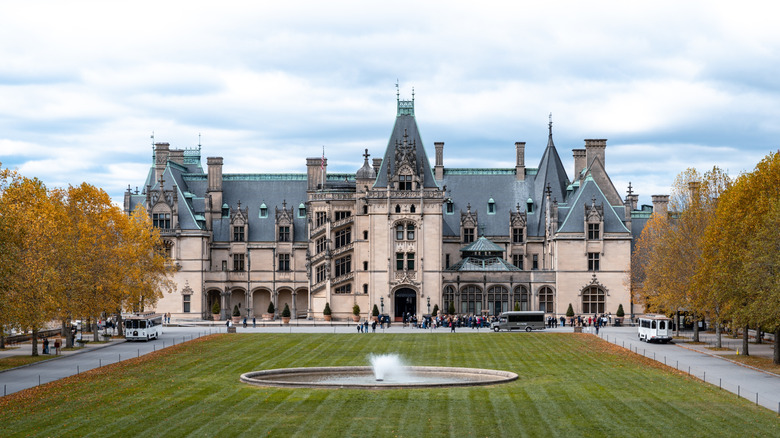
More than a century after its 1895 completion, the largest privately owned home in America — which spans 175,000 square feet with 35 bedrooms and 43 bathrooms — is the Biltmore in Asheville, North Carolina. It was built by George Washington Vanderbilt, the grandson of industrialist Cornelius Vanderbilt, after six years of work directed by architect Richard Morris Hunt, who also designed the family's Newport, Rhode Island, mansions.
The Biltmore, which was inspired by French and English estates, was named for Bildt, the Dutch town from which the Vanderbilt family originates. George lived in the French chateau-style mansion with his wife, Edith Vanderbilt, and their daughter, Cornelia Stuyvesant Vanderbilt, settling in the area because he was enamored with the beauty of the Blue Ridge Mountains. He implemented some of the most innovative technologies of the time in his home, including two electric elevators.
Today, the Biltmore is still owned by the Vanderbilt family, who welcome the public for self-guided audio tours of three floors of the mansion, as well as the basement. Tickets include the tour and admission to the 8,600 acres of grounds, which include gardens designed by renowned landscape architect Frederick Law Olmsted. Admission prices start at $70-$130, depending on the time of year. But get them early, as the Biltmore is the most-visited tourist attraction in North Carolina.
Oheka Castle, Huntington, Long Island, New York
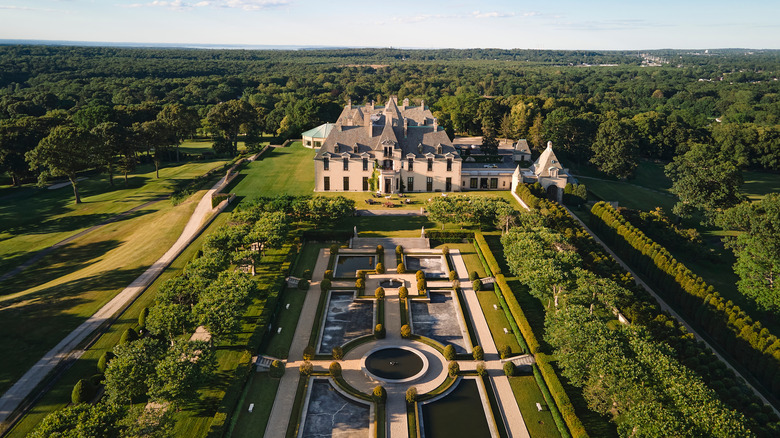
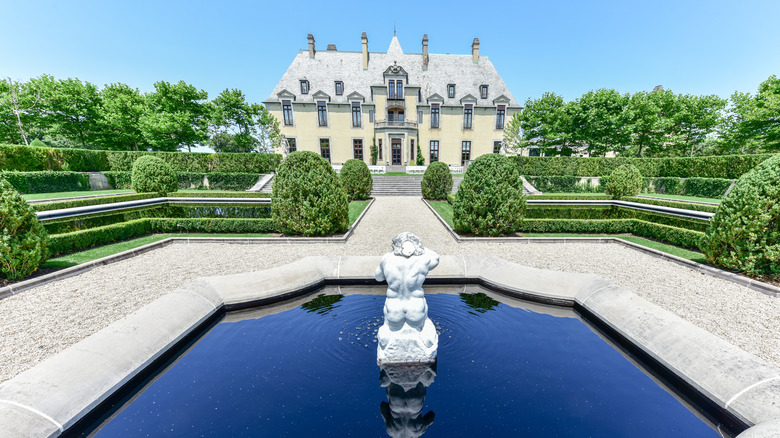
Listed on the National Register of Historic Places, the French chateau-style Oheka Castle in Huntington, Long Island, New York, which spans more than 115,000 square feet, is an epicenter of old-school glamour. It was built over the course of two years after philanthropist and financier Otto Hermann Kahn bought the property it now sits upon in 1914 to make a summer home for his family. He spent $11 million (the equivalent of more than $350 million today) to create the home with 39 fireplaces, a library, a grand ballroom, and a secret passageway. Like a real-life Gatsby mansion, the estate hosted lavish parties for the most famous figures of the day before Otto died in 1934.
After that, the mansion became a subdivided shadow of its former self. Instead of hosting luxurious events, it spent time as a military academy and a sanitation worker retreat before it was abandoned for more than a decade. It was rescued by developer Gary Meliu in 1984, who restored the property to its current 117 rooms and 50 bathrooms. He also restored 85% of the estate's lush grounds. Since then, Oheka Castle has been featured in a "Succession" episode, Taylor Swift's "Blank Space" video, and more.
These days, people can get married at the castle, following in the footsteps of celebrities like Joey Fatone, Brian McKnight, Kevin Jonas, and Megyn Kelly. They can also stay overnight in one of the property's 34 guestrooms and live like royalty at this gorgeous castle-inspired hotel or tour the grand property on guided tours by appointment only.
Arden House, Harriman, New York
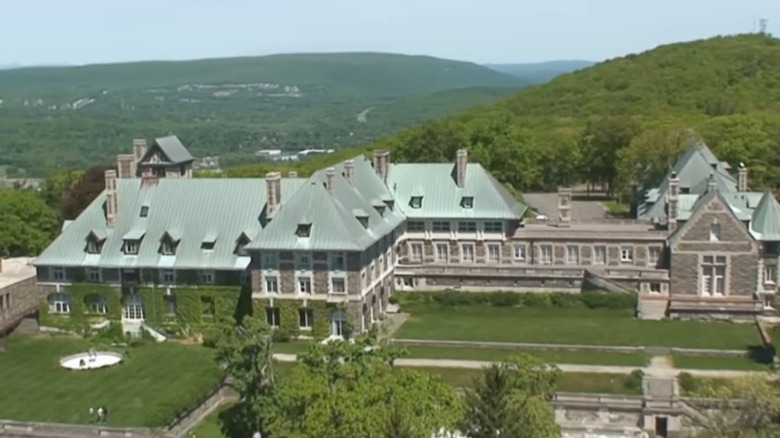
E. H. Harriman, who completed the construction of Arden House in Harriman, New York, as a summer home in 1909 after five years of work, didn't see an issue with constructing a 97,188 square foot home 1,300 feet above sea level on the top of Mount Orama. That's because, as a railroad baron who was worth $100 million by the time he died, he knew that he could use a railway to get his workmen and materials to the top of the lush ridge where he wanted to build his mansion. What resulted was a home on 450 acres of protected land, which, uniquely, didn't follow ornate European styles as many American mansions did during this era.
Instead, Arden House — which was named for the wife of the previous owner of the land, Mary Antoinette Arden — was all-American, with artwork and wood sourced from its home country and stone sourced from Mount Orama. Now a National Historic Landmark, in its heyday it boasted an outdoor pool, music room, and bowling alley.
Arden House was used as a summer retreat through 1950. After that, it was used for various purposes, including serving as the home of The American Assembly (a think tank founded by Dwight D. Eisenhower) as well as the headquarters of the nonprofit organization Research Center on Natural Conservation. These days, organizations can book the Arden House as a 120-seat conference center with 97 guestrooms. It's popular given its convenient location, just 40 miles from Manhattan.
Whitehall, Palm Beach, Florida
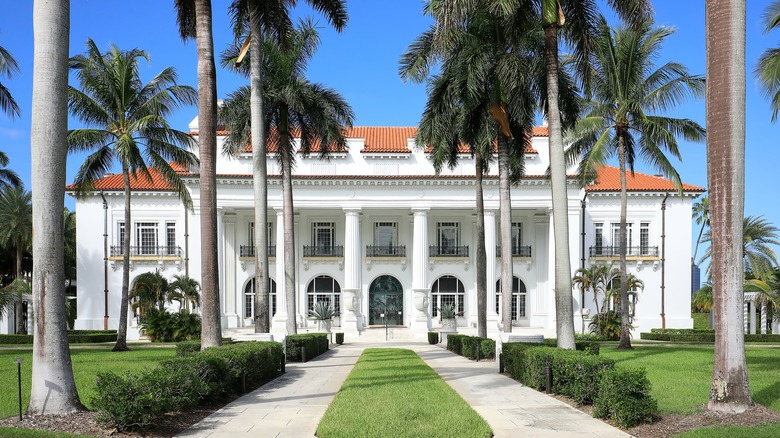
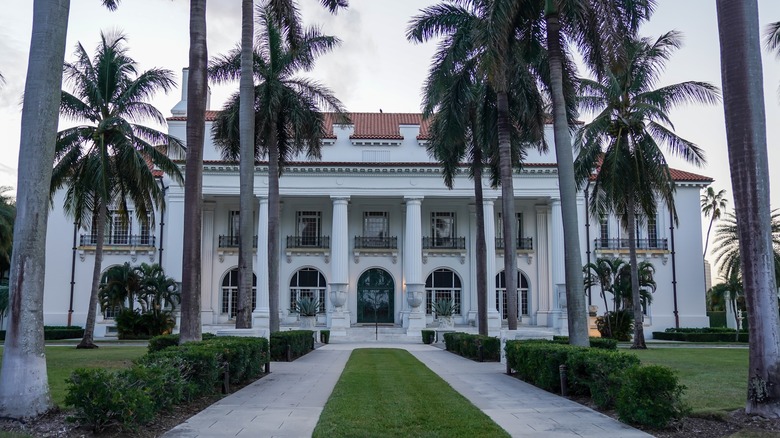
For generations, the rich have known that Palm Beach, Florida, is the place to be. Standard Oil co-founder Henry Flagler completed his 75-room, 100,000-square-foot winter escape there in a Beaux Arts-style in 1902 after paying $50,000 (just under $1.8 million today) in 1893 for the land. He named his mansion Whitehall, a nod to its white façade and columns that now overlook stunning views of the Intracoastal Waterway and the West Palm Beach skyline. He gave it to his wife, Mary Lily Kenan, as a wedding gift.
To add to its luxe appeal, Flagler and his wife got to the estate on the shores of Lake Worth every winter via a private railcar that was referred to as a "palace on wheels." The property displays that railcar — which visitors can now enter — as well as many other historic details in what is now the Henry Morrison Flagler Museum, a National Historic Landmark. Some of these relics include 10 still-working original clocks, the original iron and bronze fence that dates back to 1901, and period furnishings throughout the two floors of the mansion that are open to the public.
Unfortunately, Whitehall's luxuriousness was also the cause of Flagler's demise. He died after falling down the mansion's marble stairs, and his wife died four years later. After that, with a 300-room, 10-story addition, the mansion became a hotel. Later, it was rescued by Flagler's granddaughter as she helped make the mansion into a museum — and got rid of the massive hotel addition.
Winterthur, Winterthur, Delaware
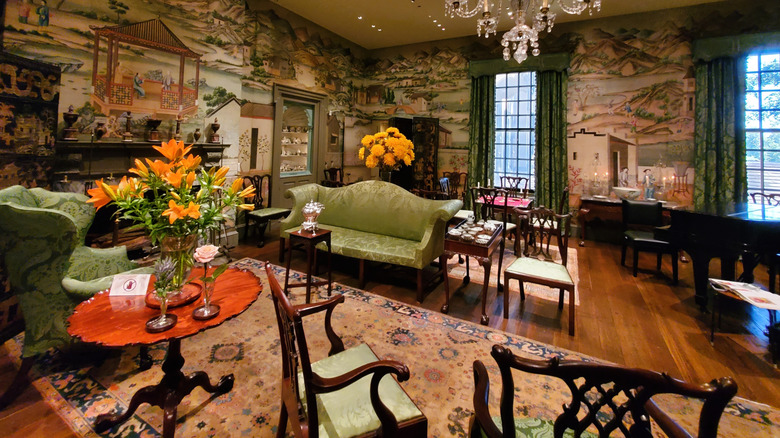
Although Winterthur retains the same name as it did when it was a (comparatively) modest 12-room Greek-Revival home belonging to Jacques-Antoine Bidermann and his wife, Evelina Gabrielle du Pont, it couldn't be more different today. The original home was completed in 1839 and named after the Swiss town where Bidermann's ancestors were from.
Nearly a century later, Henry Francis du Pont enlarged Winterthur in Winterthur, Delaware, to 175 rooms and 96,582 square feet, making it one of the biggest mansions in America. Increasing the home's square footage between 1928 and 1932, du Pont wasn't driven by a need for more living space but out of a desire to serve the public. The expansion turned the home into a public museum to display American pieces dating from 1640 to 1840, all within rooms specifically designed to demonstrate a certain time and place using salvaged items from historic homes. He opened the museum to the public in 1941.
These days, the museum houses 90,000 antiques, including furniture, rugs, and textiles. Outside the museum are 60 acres of gardens that du Pont also designed. More than 100,000 people see what is now known as the Winterthur Museum, Garden, and Library every year by embarking on hour-and-a-half guided tours. Tickets are $27 per adult, $25 per senior ages 62 and over, $25 per student and teen, $10 per child ages 3-12, and free for kids ages 2 and under.
Great Hall at Shadow Lawn, West Long Branch, New Jersey
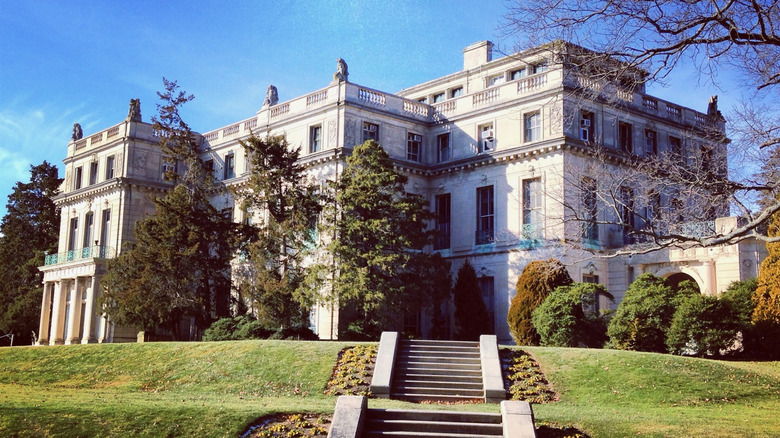
In 1903, former president of the New York Life Insurance Company John A. McCall had a 52-room, colonial-style mansion built in West Long Branch, New Jersey, just a few blocks from the Atlantic Ocean. It was even used by U.S. President Woodrow Wilson for a little over two months during his 1916 re-election campaign. Unfortunately, that structure was lost to fire in 1927, but a phoenix soon rose from the ashes.
In its wake, the 90,000 square foot, 130-room, limestone and marble Great Hall at Shadow Lawn was built in 1929 for $10.5 million (what would be nearly $200 million today) in the American Beaux-Arts style. It was the private home of F.W. Woolworth Company president Hubert Templeton Parson. What people probably best recognize the mansion from is its appearance in the 1982 film "Annie," as it was Daddy Warbucks' Park Avenue home.
Even though the former structure where Wilson stayed was long gone, it was referred to as Wilson Hall from 1955, when it was purchased by what is now Monmouth University. It was renamed the Great Hall at Shadow Lawn in 2020. The university made the decision to update the name as Wilson believed Black Americans should not be U.S. citizens and resegregated spaces at Princeton University, where he was president. Today, the Great Hall at Shadow Lawn is a National Historic Landmark at Monmouth University. Its 130 ornate rooms are used as administrative offices, classrooms, and event spaces.
Meadow Brook Hall, Rochester Hills, Michigan
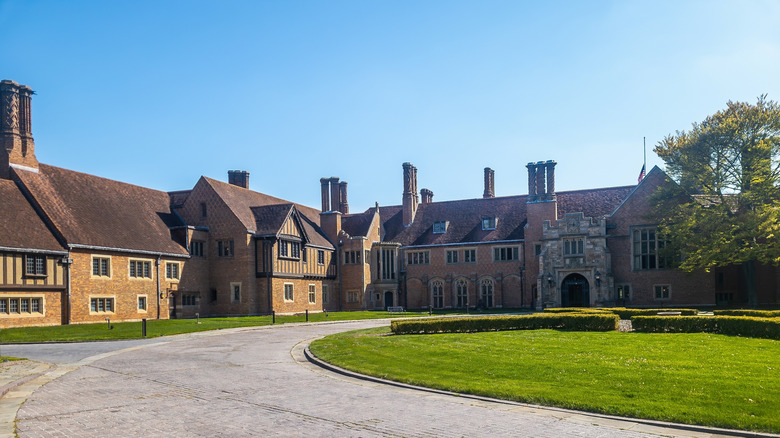
With its Tudor revival style, Meadow Brook Hall looks more like it belongs in the English countryside than in Rochester Hills, Michigan. That's on purpose. The 23-bedroom, 25-bathroom home, built between 1926 and 1929, was inspired by English country homes built during the Tudor and Elizabethan periods with a sandstone, brick, and wood exterior. Making it even more notable is a clay-tiled roof and 39 distinctive chimneys. The house was also built with three kitchens, a movie theater, gold-plated bathroom fittings, a 1,600-book library, two elevators, two rooftop patios, a room just for newspaper clippings, a beauty salon, a gift-wrapping space, and a doctor's house call area.
The 88,000-square-foot mansion was built for $4 million (around $73 million today) for Matilda Dodge Wilson (widow of Dodge co-founder John Dodge), her second husband, and their children. The project was steamrolled by Matilda, who took ownership of every home construction detail, small and large, in line with her philosophy to always dream big. She even co-wrote a book, "A Place in the Country: Matilda Wilson's Personal Guidebook to Meadow Brook Hall," to showcase the mansion's many ornate details to readers.
Matilda donated the property to Oakland University in 1957, and years later, it opened to the public. These days, it's one of the best examples of Tudor-revival style architecture in the country; the mansion and its 75,000 artifacts can be toured. It can also be booked as a wedding, corporate, or event venue, and is one of Michigan's premier destinations that hosts events year-round.
Methodology
Many of the American mansions on this list, especially those that are historic, are inspired by European estates across the Atlantic, making them enchanting real castles. But in their gargantuan size, they are uniquely American, as the country is known for its bigger-is-better attitude. That mindset is fully on display at these over-the-top abodes that have amenities many of us only dream about.
To determine the largest mansions in the country that always make jaws drop, we examined each of their square footages to see which have the highest of all the rest. We also selected homes that are open to the public in some way, so that you can see these stunning places for yourself. That brought us from one end of the United States to their other, running the gamut from modern mega mansions to homes on the National Register of Historic Places.