

Ditch This Overhyped Travel Trend To Make The Most Of Your Adventures
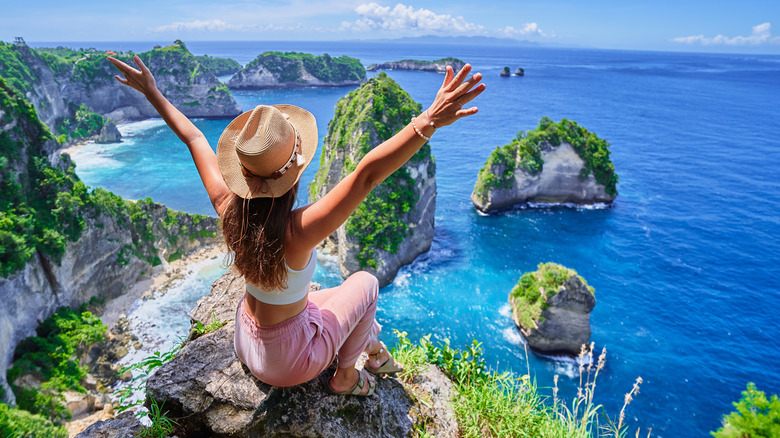
Sitting on the couch and flipping through your favorite social media app may produce some incredible travel ideas. In fact, recent research has found that user-generated travel content on social media often influences a person's travel plans more than the recommendations they get from friends. But there's one travel trend that needs to be left in the dustbin of 2025: focusing too much on content. After all, "performative travel" for the sole sake of likes and clicks can actually prevent us from being truly involved and from savoring all of those memories that can't be caught digitally.
Sure, that amazing photo on Instagram may showcase an exotic location where everything is perfect. But what we don't see is what it took to get there, what props and lighting were brought along for the trip, and just how (excuse us for saying this) disrespectful the person in the photo might have been to other travelers or locals nearby. Sure, the locale could be among the world's most iconic attractions to add to your travel bucket list and worthy of a snap or two — but don't forget to also enjoy it while you're actually there.
Make your own experience, rather than recreating someone else's
However you feel about social media influencers, they come by their name naturally — influencing everything from travel to fashion, design, and more. They can even inspire us to take bold steps and seek out adventure or new experiences. And relying on their content to make informed decisions is not necessarily a negative. In fact, travel experts like Rick Steves often offer advice to thousands of people online — such as what you should never forget to do before taking a trip, or how to prepare for common pitfalls. But there's a big difference between gathering inspiration or general guidance, and trying to recreate a curated moment exactly as it appears online.
Too often, social media users stumble across a photo that is too perfect to not try and replicate. That said, what we see may not always be what we get. A recent study by the Department of Tourism Management at South China University of Technology found that travel photos are more commonly processed through filters and other editing software than not. This essentially means that the pictures we consume are less likely to be an accurate representation of the influencer's experience.
The same can be said for the physical representation of a photo. According to travel planner Irina Vishnevskaya in conversation with HuffPost, photos complete with props have gained traction across social media sites. What those highly-liked photos don't show, however, is that the location may be far more remote or inconvenient than it appears, or that there may be hidden factors not immediately obvious from an image alone.
Don't let Instagram add anxiety to your vacation

For most of us, the whole point of travel is to disconnect, unwind, and (hopefully) relax. However, according to researchers, social media-inspired travel can actually do the opposite by increasing anxiety — which ultimately ends up being counterproductive to what a leisurely vacation was supposed to accomplish in the first place. It's even possible that seeing someone else's "perfect" presentation of their experience can reduce travel intention, leading to a negative impact on a social media user's well-being.
While sharing your travel experiences on social media is the norm these days — and there's no inherent issue with doing so — it's important to be able to differentiate between sharing experiences and chasing clicks. After all, traveling solely for the purpose of taking the perfect Instagram photo won't just diminish the experience, but can also strip away the joy of personal connection that makes travel meaningful.
And it doesn't stop there. Performative travel can also negatively impact locals, especially when visitors start treating destinations like props rather than places people call home. In fact, according to Rick Steves himself, traveling for the sake of social media content and likes is one of several reasons why Europeans have become anti-tourist. "If you want to be warmly welcomed," Steves says, "be deserving of a warm welcome."