
Rick Steves Recommends This Helpful Money Tip When Crossing Borders In Europe
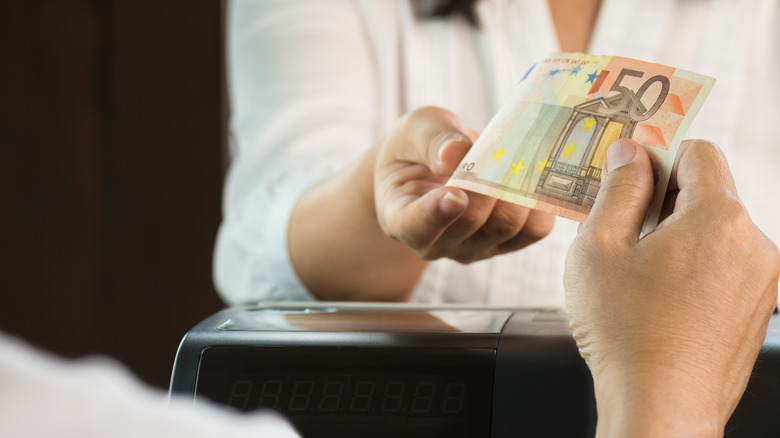
When traveling in Europe, you're obviously going to be using different currency. For instance, most European Union countries use the euro (though a few do not) and the United Kingdom uses the pound. While you may be someone who likes to use their credit cards for most purchases overseas, some smaller stores or cafes may only take cash. Because of this, you're probably going to end up with some coins at the end of your trip, even if you try to spend all your paper money. If that's the case, travel pro Rick Steves has a helpful money tip for you. On his website, Steves says, "Spend coins before crossing a currency border. While you can always change paper currency, coins are generally worthless outside their domain. A €2 coin is worth nearly $3."
We, as Americans, are used to our biggest commonly-used coin being a quarter, so a pocket full of change may not seem like much to us, but as Steves tells us, coins often have more value in Europe. It's worth going through them before you get close to leaving a country where you can use them. You can exchange them for bills if you want to add them to the money you're changing over (though make sure you don't use the currency exchange at the airport which can end up costing you quite a bit in fees). Another, often easier, option is to simply pick up snacks, coffee, or little souvenirs before you leave. In fact, Steves even mentions giving them away if you're not going to use them.
Spending your foreign coins before you leave the country, as per Rick Steves
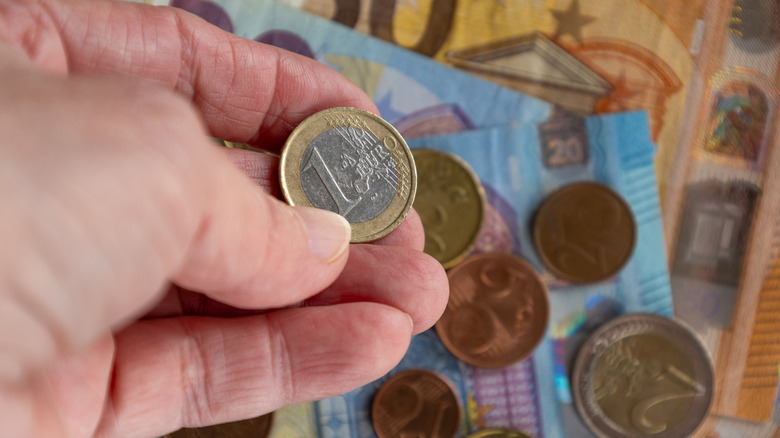
If you're a coin collector, or you like, as Steves calls them, "round, flat souvenirs," then by all means, keep them as a memento from the trip. However, you probably don't need that many, and it's easy to let these pile up in your pocket or wallet. That's especially true if you're on an extended trip, or moving through several EU countries. In case you didn't know, Steves reminds us that, "while euro coins each have a national side (indicating where they were minted), they are perfectly good in any country that uses the euro currency."
If you're traveling with kids, make the roundup of coins a game, with a little prize for whomever has the highest total. You might also want to pool everyone's change and get ice cream or a small treat at the airport. If you have some from different countries, you can take pictures with each one rather than keeping them all.
However, if you don't remember to spend those coins, or you can't find anything you want to spend them on, there is another option. Some airlines have a collection during the flight that donates those coins to charities. You may also find donation boxes at some airports. In addition, UNICEF accepts foreign currency for their Change for Good program, even if you end up back at home and find a bunch of euros that were left in a pocket while doing laundry. A little bit can go a long way, and its better to put your change to good use instead of simply letting it sit.
More travel money tips from Rick Steves

There are a few other things you should know about in terms of money when you travel to Europe. First, Steves tells us not to bother changing money at home before your trip. You're better off, he says, hitting the ATM at the airport when you arrive at your destination to take out some cash. However, if you choose to exchange money during your time in Europe, Steves says to look for places that don't charge commission.
Steves also has a warning about which ATMs to use while on vacation. He tells us to avoid independent ATMs as they can often charge more fees or be a scam. Instead, he recommends using ATMs in a bank. If you don't have a choice, he suggests looking at the front of a machine to make sure nothing is cracked, loose, or seems off in any way. That may indicate that a card-skimming device is being used. Make sure there's nothing in the slot, and if someone comes up to help you, be wary. They (or someone nearby) are likely watching as you enter your PIN.
In addition, if you're using your credit card instead of cash while traveling abroad, you may be given the option to have the total in American dollars or local currency. Always pick the local currency. In fact, circle it on your receipt. Otherwise, you'll be charged a fee for dynamic currency conversion (DCC). If you're given the option at an ATM, again, choose local currency.