

This Spectacular National Park In Washington Is Home To An Active Volcano
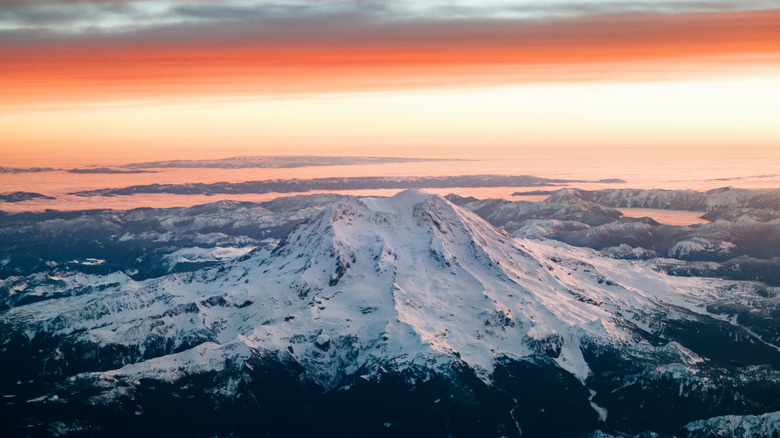
When we think of volcanoes in the Pacific Northwest, Mount St. Helens usually springs to mind. This peak in southwestern Washington state blew its top in a cataclysmic eruption on May 18, 1980, and while it still periodically lets off a bit of steam, it's been quiet for years now and is open to hikers, though the path to the top is as dangerous as it is breathtaking. However, Mount St. Helens is not the only volcanic rise in the Cascade Range. Stretching from British Columbia to northern California, the Cascades are home to roughly 20 major volcanoes and around 4,000 volcanic features, including the mighty Mount Rainier in Mount Rainier National Park.
Rising to an altitude of 14,410 feet, Mount Rainier — which looks over the populated centers of Seattle and Tacoma (perhaps Washington's most underrated city) like a sentinel — is the tallest peak in the Cascades. This behemoth is also surrounded by a national park that shares its name and features glaciers, deep river valleys, thick evergreen forests, pristine alpine lakes, and meadows, as well as loads of native wildlife. However, despite the fact that the park is indeed a slice of paradise, it sits on a dangerous piece of real estate, as Mount Rainier is an active volcano whose eruption could have catastrophic consequences.
Experience the unspoiled majesty of Mount Rainier National Park
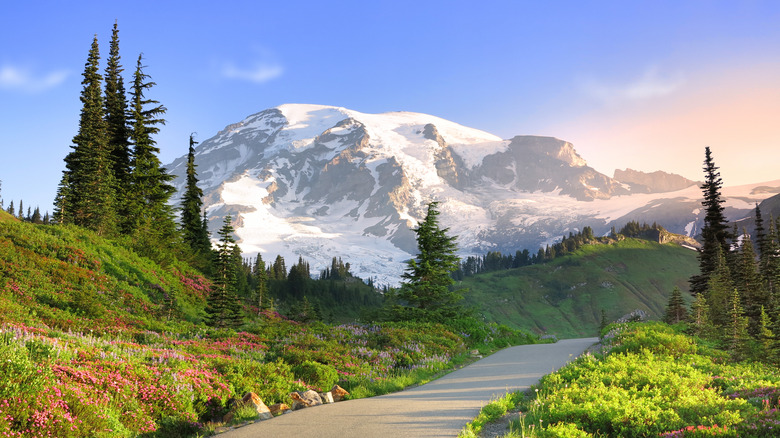
Established in 1899 after a lobbying campaign by famed naturalist John Muir's Sierra Club, Mount Rainier National Park occupies over 236,380 acres of prime wilderness that's just an hour-and-a-half drive from Seattle. The mountain is covered with year-round snow and ice, with 28 named glaciers, making it the most glaciated peak in the Lower 48. All of this ice and snow birth five of Washington's major rivers, which makes exploring the valleys of the park just as gratifying as heading up above the timber line.
The park features three large established campgrounds accessible by car (no RV hookups), as well as scores of backcountry camping sites, with a permit. It is criss-crossed by over 260 miles of maintained hiking paths (pets and bicycles are prohibited), including the renowned Wonderland Trail — a 93-mile backpacking jaunt that takes you through all of the park's major features. Mount Rainier is also a top destination in the winter, when skiers, sledders, and snowshoers flock to Paradise. This spot is known as one of the snowiest places on Earth (up to 30 feet recorded annually) and is home to subalpine meadows, a visitors center, and the Paradise Inn, a National Historic Landmark considered one of the best lodges in the Western U.S.
Mountaineers also come to the park in hopes of reaching Rainier's lofty summit. About 10,000 reportedly make the attempt each year, with only about half achieving their goal. In addition, Mount Rainier National Park is a terrific place to spot wildlife, with healthy populations of deer, elk, mountain goats, marmots, black bears, mountain lions, and foxes, along with plenty of birds such as eagles, hawks, and owls.
Mount Rainier: a beautiful ticking time bomb
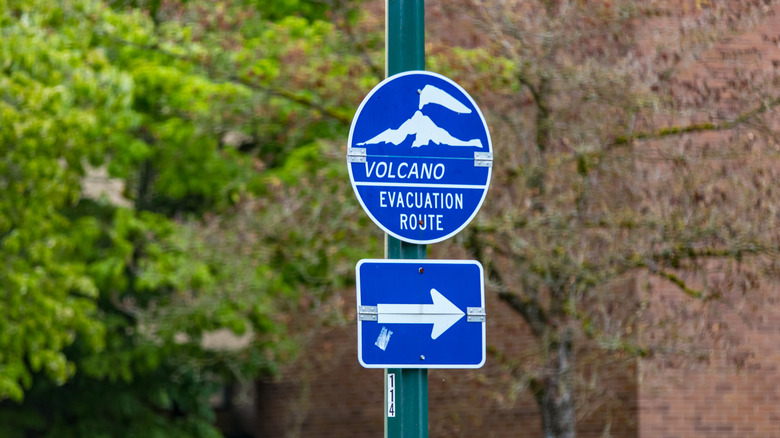
For all of its raw grandeur, it pays to remember that Mount Rainier is also an active volcano. While it hasn't experienced a major eruption for 1,000 years, it likely will again someday, so the only question is: When? While scientists can't predict when the mountain will blow with any accuracy, Mount Rainier is the second-most seismically active peak in the Cascades (after St. Helens), with up to 20 small earthquakes occurring annually. This — along with its size — makes it one of the most dangerous volcanoes in the U.S. A massive eruption would immediately trigger glacial floods and massive mudflows, which would inundate much of the park and likely cause injury and loss of life. Towns and cities near the mountain would surely be impacted as well, making Rainier a volcano to watch.
This means visiting Mount Rainier National Park will always carry some degree of risk. That said, many volcanic eruptions are preceded by a flurry of seismic activity that acts as a kind of advanced warning. Just make sure to keep abreast of the mountain's seismic situation before you go, and familiarize yourself with what to do in the unlikely case of a major volcanic event. This includes paying attention to any information posted around the park. For more volcanic action in the Cascades, check out this California gem blending lake views and renowned fishing and hiking.