

Munich's Top 12 Sights And Attractions For First-Time Visitors

Like many cities in Europe, Munich, Germany, is a unique juxtaposition of old and new, blending medieval and high-tech. Just like Stuttgart, one of the world's most walkable cities with culture, food, and art, Munich has a major stake in the automobile industry — it's home to BMW. Munich is also home to sprawling palaces, an iconic central square, one of the world's largest city parks, and so much more.
Based in Germany's picturesque southern state of Bavaria, Munich is home to around 1.6 million residents and is the world's most walkable city. It was founded in the early 12th century when a group of Benedictine monks established a market along the Isar River. This was later fortified, grew steadily into a town, attracted nobility, and the rest is, as they say, history. The German name for the city is München, which literally translates to "Home of the Monks." Today, the city boasts centuries of history that you can experience at landmarks and museums like Marienplatz, Alte Pinakothek, Frauenkirche, and more. But like many parts of Germany, Munich also grapples with the dark legacy of the Holocaust; Dachau, the Third Reich's first concentration camp, is located just north of the city. Today, it serves as a solemn memorial.
It's very easy to get around Munich via public transport, which features a four-prong system consisting of the S-Bahn, U-Bahn, bus, and tram. Tickets can be purchased from machines at stations and stops, and a single ticket is good for any mode you choose, so you can easily transfer between them as needed without needing to pay additional fares. Now, gather your favorite itinerary-building tools and check out these 12 top sights and attractions around Munich that are must-sees, especially if it's your first time in the city.
Visit Marienplatz
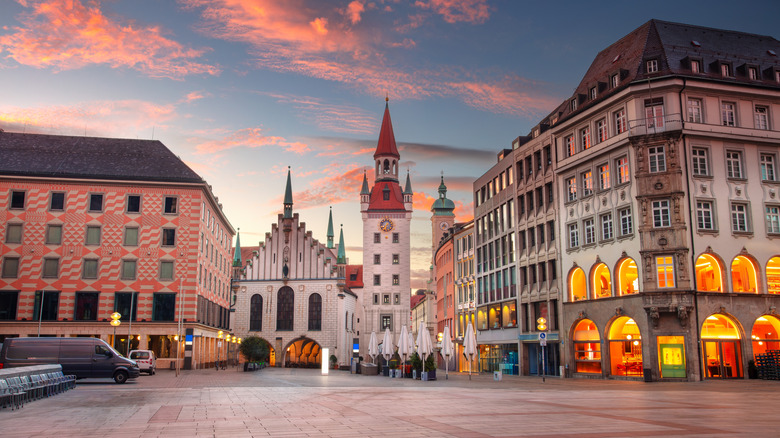
Marienplatz is a great place to orient yourself when you first arrive in Munich. It's the cultural and commercial center of the city, just as it has been since the 1100s, when Munich was established. Lined with cafes, it's photogenic and pedestrian-only, and it's very easy to access via the S-Bahn and U-Bahn — and connect to other places on the network.
A quick note on public transportation: day tickets are a great value if you plan to do a lot of traveling, and the city also offers two tourist cards: Munich Pass and Munich City Pass. The former offers free public transportation and discounts to numerous museums and attractions, while the City Pass boasts free entry to numerous sites and some priority access, depending on the experiences. Munich Card starts at €5.90, and City Pass starts at €37.90, with the option to tack on supplementary benefits like restaurant and shopping discounts.
Marienplatz is home to the iconic Alte and Neues Rathaus, or Old and New Town Halls. The latter features a prominent tower with one of the most popular attractions in the city: its elaborate glockenspiel featuring a 43-bell carillon and an animated scene of two jousters and many other characters. Get there at 11 a.m. and noon every day — plus 5 p.m. between March and October — to see the drama play out on its embellished, elevated stage. From Marienplatz, embark down the pedestrian zone to pop into boutiques and cafes, and take your pick from a number of major nearby landmarks like Frauenkirche, Asamkirche, and the Viktualienmarkt. And if you're interested in Europe's incredible Christmas markets, you won't want to miss the Munich Christkindlmarkt at Marienplatz, which dates back to the 14th century.
Gaze up at Munich's striking churches
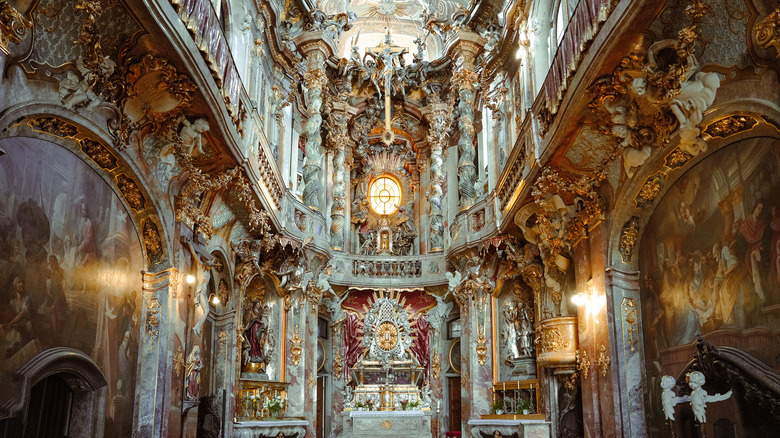
Asamkirche, or Asam Church, is about as Baroque as a church can get, and well worth visiting among the most breathtaking hidden gem churches across Europe. Less than 10 minutes on foot southwest of Marienplatz, this opulent ecclesiastical building was constructed between 1733 and 1745 by the Asam brothers, giving the church its nickname, although it officially goes by St. Johann Nepomuk Kirche. The Asam brothers initially intended it to be a private chapel, but local residents were so interested in visiting that they made it public. And like most classical churches and cathedrals, the whole point of the interior design is to look up. Where the ground level is relatively dark, the higher levels become increasingly brighter and more heavenly.
No more than a five-minute walk from Marienplatz, this time to the northwest, is another large church well worth a stop. In fact, Frauenkirche, or the Cathedral Church of Our Lady, is Munich's largest church, and it's an instantly recognizable feature of the Munich skyline thanks to its two domed towers. These are both more than 320 feet tall, and visitors can climb the South Tower for spectacular views over the city. The church is free to visit.
Munich boasts a remarkable array of prominent churches across the city, with some that are perhaps not quite what you'd expect. In the Neuhausen district, which sits about four miles northwest of the city center, scope out Herz Jesu Kirche, or Sacred Heart Church, which consists of a giant glass cube with an entire wall that opens up into the world's largest church doors.
Climb the bell tower of St. Peter's Church
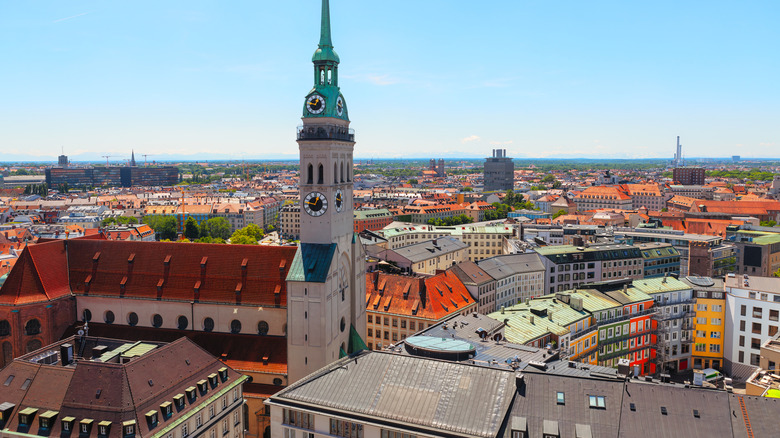
Another fantastic way to make the most of the iconic towers amid Munich's skyline is to climb up one. Take in amazing views across the city from the soaring bell tower of St. Peter's Church, or as the locals endearingly call it, Alter Peter, or Old Peter. It's capped with a distinctive copper steeple. There are more than 300 steps to reach its observation deck at more than 180 feet off the ground, offering astonishing views in all directions. The tower itself shoots to nearly 300 feet high in its entirety. And you can catch a glimpse of the church's historic bells, too, including one called the Arme Sünder Glocke, or Poor Sinner's Bell, which is the oldest and smallest of those housed in the tower. It was cast in the 14th century and was used to declare executions in Marienplatz, which is right next door. It now lives behind bars in the church's basement.
Peruse fresh vittles at Viktualienmarkt
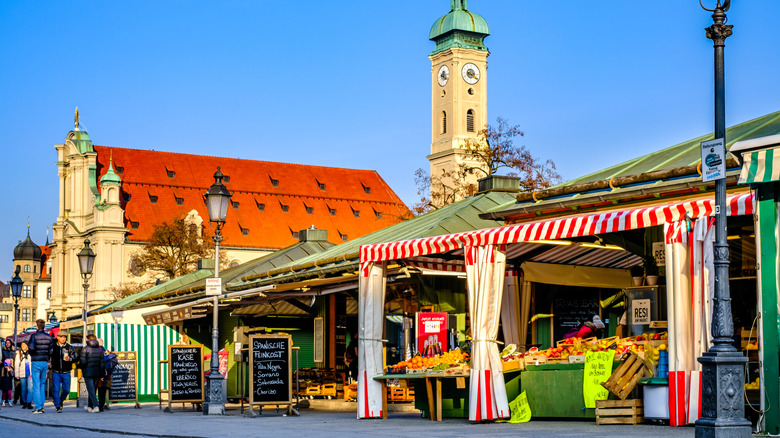
Old Town Munich brims with attractions and experiences to delight the senses, from centuries-old art and architecture to traditional Bavarian beer halls. The Viktualienmarkt, or food market, is one such place. Munich's market has a rich history, going back centuries as a traditional farmer's market that used to be located in Marienplatz — which sits about a five-minute walk north — until in 1807, it was officially deemed too big to stay there and moved to a dedicated home between Heiliggeist-Kirche and Frauenstrasse. Viktualienmarkt is a great place to look for budget-friendly souvenir ideas for your trip or to grab a fresh snack as you wander around the historic streets, and it's organized into sections focusing on certain types of goods, making it easier to shop. You'll find produce, flowers, butchers, bakers, restaurants, a beer garden, and more. The market also offers guided gourmet food tours and tastings that can be booked in advance via GetYourGuide.
Tour the Munich Residence
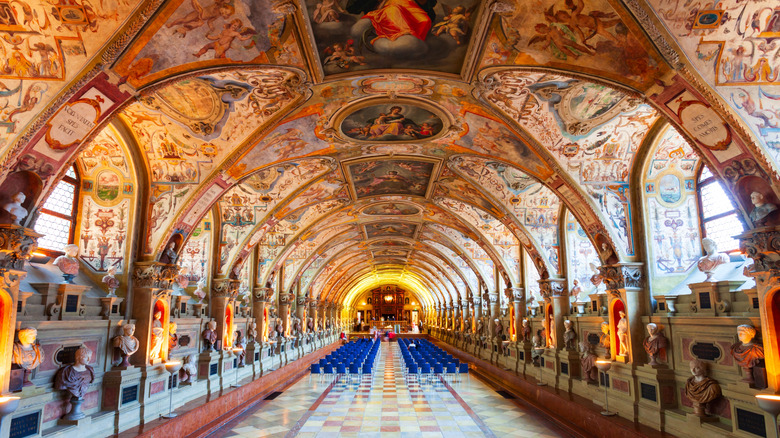
When a building is simply known as the residence, it pretty much goes without saying that its history goes back far and its inhabitants have had a lasting influence on the city. The Munich Residence, or Residenz München in German, has served both governmental and domestic purposes throughout the centuries. Between 1508 and 1918, numerous kings, dukes, and electors — princes who had a stake in choosing who would be selected as Holy Roman Emperor — lived and conducted business in the Munich Residence. Between its origins as a castle in the late 14th century to its status as an opulent palace where rulers and dignitaries went about running the Holy Roman Empire, and later modern Germany, the Munich Residence has seen numerous updates and additions. Like many important buildings in Germany, it also fell victim to substantial damage during World War II and has been meticulously reconstructed over the past several decades.
Tour this lavishly decorated palace museum with art ranging from Renaissance treasures to Baroque and Rococo masterpieces. Standard adult tickets to tour the palace are €10, which is the same cost as a ticket to visit the Treasury. If you plan to visit both, purchase the combination ticket for €15. Additionally, tack on a visit to the sumptuous Cuvilliés Theatre with a combination ticket for all three areas that runs €20.
Picnic in the English Garden
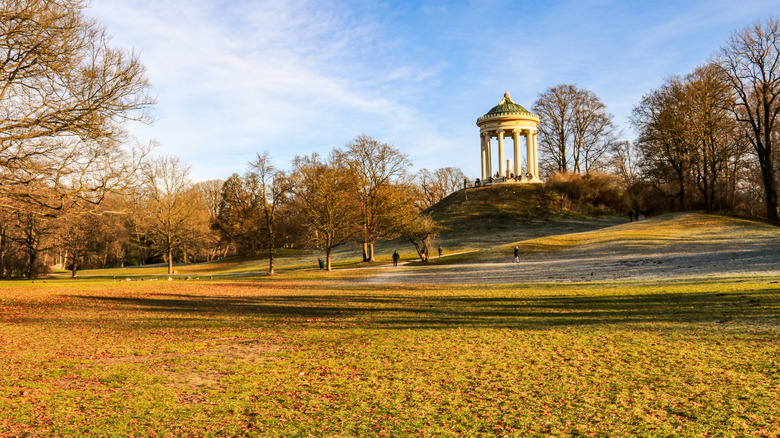
The English Garden is a large scenic park in Munich's city center perfect for a picnic. Known as Englischer Garten in German and located about a 20-minute walk northeast of Marienplatz, it also happens to be Rick Steves' favorite "quirky" experience in Munich, thanks to its nudist river. Along the park's picturesque, sunbathers have long sought to soak up the sunshine during the summer, and many don't shy away from shedding their clothing to take full advantage. Munich has made it legal to wear only your birthday suit in six designated areas around the city, primarily along the river and in parks where people flock to soak up the rays. Three of these are in the English Garden, and one is near the Eisbach River, where tourists regularly visit, so don't be surprised if you encounter folks in the buff.
The Eisbach is also home to the Eisbachwelle, or Eisbach Wave, a rapids feature in the manmade waterway that urban surfers have been hanging loose on for decades. This popular attraction is located at the southern end of the park, closer to the city center, but one other thing that makes the English Garden worth a visit is its sheer size. It's a long, slender park that extends more than three miles to the north, putting it among the largest city parks in the world. Stroll up to the elegant Monopteros temple for beautiful views over the trees, or stop for a good Bavarian lager at one of four beer gardens. Plan your visit in June to soak up Kocherlball, a celebration of folk music and dance.
Delve into auto history at the BMW Museum
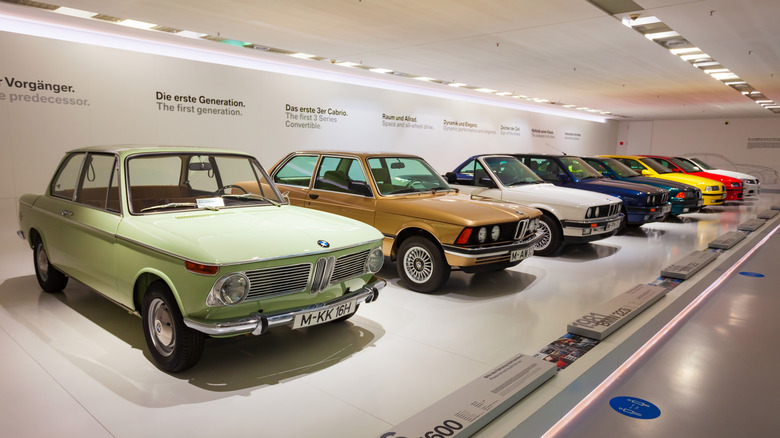
Germany is home to an array of classic and popular car brands, from Mercedes-Benz and Porsche to Audi and Volkswagen. One of the most beloved companies in Europe and beyond is BMW, which makes its home in Munich. Officially called Bayerische Motoren Werke, its roots can be traced back to 1916, and its iconic blue-and-white emblem embodies the state colors of Bavaria.
Located about a half-hour north of the city center via the U-Bahn or around 15 minutes by car, the BMW Museum is a contemporary exhibition space that showcases numerous generations of the company's cars, from sedans we've regularly seen on the road to rare and conceptual models. For several decades, BMW has also commissioned renowned international artists like Roy Lichtenstein, Jeff Koons, and Jenny Holzer — among many others — to create fanciful Art Cars in a range of styles. And it doesn't end with cars! Check out the company's line of motorcycles, vehicles built for speed, the influence of Italian design, and more.
Right next door to the museum is BMW Welt, a spectacular showroom that's free to visit and provides visitors with a glimpse of the latest models and innovations. Tickets are required for the museum exhibitions, though, and a standard adult ticket costs €16.
Explore technology and design at the Deutsches Museum
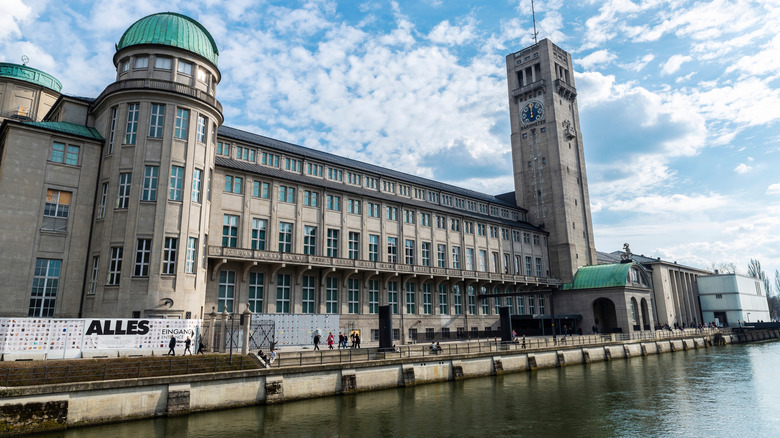
The expansive Deutsches Museum boasts interactive exhibits tracing the history of technology and design. Amid its vast and varied collection of around 125,000 artifacts, you'll find paradigm-shifting inventions like the first powered airplane built by the Wright brothers, a 17th-century portable sundial clock, and the Benz Patent Motor Car No. 1 — the first automobile ever patented. Add to that computers, microscopes, a late-19th-century fishing barge, musical instruments, and much more, and you'll find yourself tracing the history of human ingenuity.
The Deutsches Museum sits on Museuminsel, or Museum Island, which is located on the Isar River about a 20-minute walk southeast of Marienplatz. It's open every day from 9 a.m. to 5 p.m., and standard admission is €15. Part of a multi-year renovation project, the museum opened 19 revamped permanent exhibition spaces in 2022, but the popular high-voltage installation and an immersive mine experience are included in another part of the museum that has been closed since then, with a full reopening set for 2028 to mark the Deutsches Museum's 125th anniversary.
Visit Dachau Concentration Camp Memorial Site
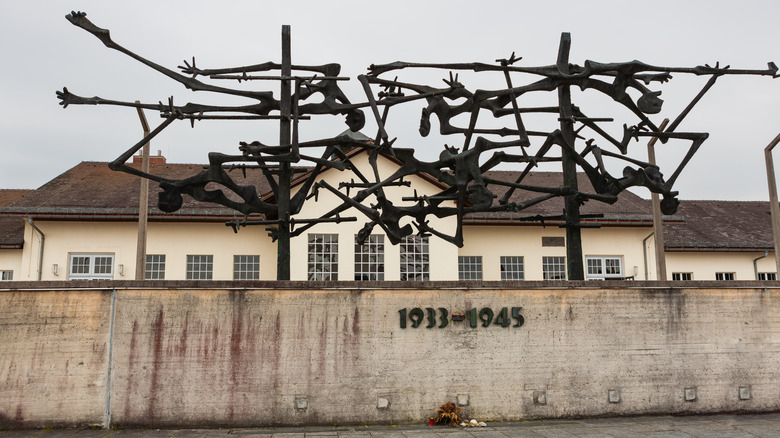
When planning vacations or travel, it's a no-brainer to search for great restaurants, charming hotels, spectacular architecture, and all things "ooh" and "aah." Sometimes the most important sites, however — and the ones that stick with us long after we've left — tend to be the most sobering and, in many cases, the most memorable. That's certainly the case with Dachau Concentration Camp Memorial Site.
Easily reached from Munich for a half-day trip via companies like Radius Tours and Dachau Tour, a guided visit to the Dachau Concentration Camp Memorial Site is a somber look back at the horrors of the Holocaust at the Third Reich's first concentration camp. Expert guides provide transportation and take you through significant buildings and the grounds where around 200,000 people were imprisoned between 1933 and 1945. An estimated 30,000 to 100,000 people were killed here.
Today, the memorial serves to commemorate the victims, serve as an educational experience, and furnish a stark reminder of the dark legacy of the Holocaust. The site can also be reached via the S-Bahn to Dachau Station, from which you can take a 45-minute walk along the Path of Remembrance, which features interpretative panels along the way.
Discover Nymphenburg Palace and Park
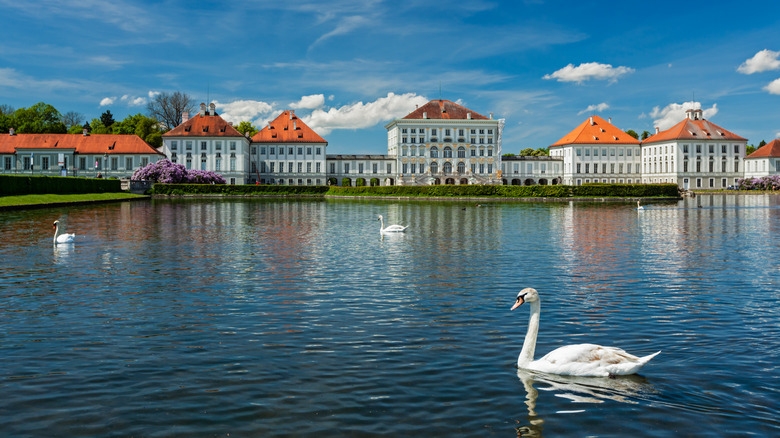
Construction of the impressively sprawling Nymphenburg Palace began in 1664 in an area that used to be surrounded by countryside on the fringe of downtown Munich. Conceived as a summer residence away from the hustle and bustle of the city center, it's complemented by a formal garden with water features and extensive galleries that connect a series of buildings, one of which includes an opulent chapel. There's a museum dedicated to carriages and sleighs, which also houses a unique collection of porcelain. And within the park, in addition to three other opulent pavilions, a Rococo treasure of a hunting lodge called Amalienburg peeks out of the trees like a piped pink cake.
Nymphenburg Palace and Park is open daily throughout the year, with slightly abbreviated hours between mid-October and the end of March. The palace chapel and the four park pavilions are only open from April 1 to October 15. Guided tours aren't regularly offered unless booked ahead with a group, but for an additional €3.50, you can pick up an audio guide to take with you as you walk around, available in eight languages. A combination ticket for €20 in the summer or €16 during the winter grants visitors access to everything open during that time, but you can also purchase individual tickets for each if you'd prefer to only visit, say, the main palace.
See great art at Alte Pinakothek
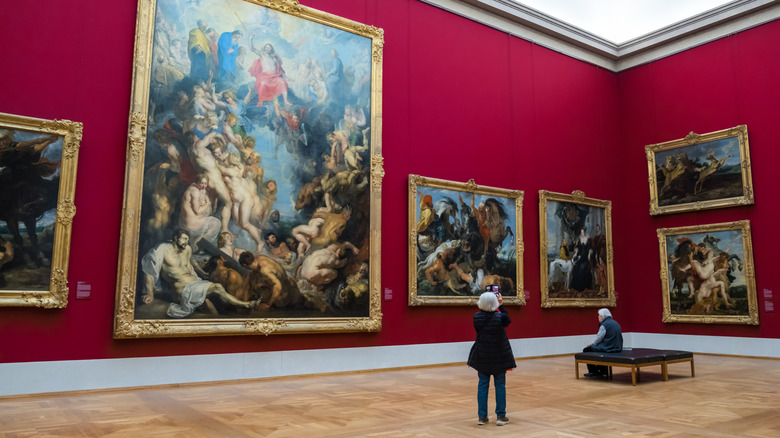
One of the world's most prominent art collections, Alte Pinakothek is an art-lover's paradise. The renowned museum stewards an impressive array of European paintings from the 1300s to the 1700s. You'll find hundreds of significant — and in some cases, monumental — artworks by titans of art history like Titian, Rubens, Dürer, Raphael, and many more. Closed on Mondays, the museum is open from 10 a.m. to 8 p.m. on Tuesday and Wednesday and 10 a.m. to 6 p.m. from Thursday through Sunday. Standard admission is €9, seniors pay €6, and anyone under 18 gets in for free.
The Alte Pinakothek is far from being Munich's only art museum; the city positively brims with the history of creativity. Lovers of Impressionism and other work from the 19th and early 20th century will also enjoy the Neue Pinakotek, although that's entirely closed for renovations until at least 2029. The complex also includes the Museum Brandhorst and Pinakothek der Moderne, chock full of modern and contemporary masterpieces, and the Sammlung Schack, which emphasizes German artists.
Taste local lager at a beer hall
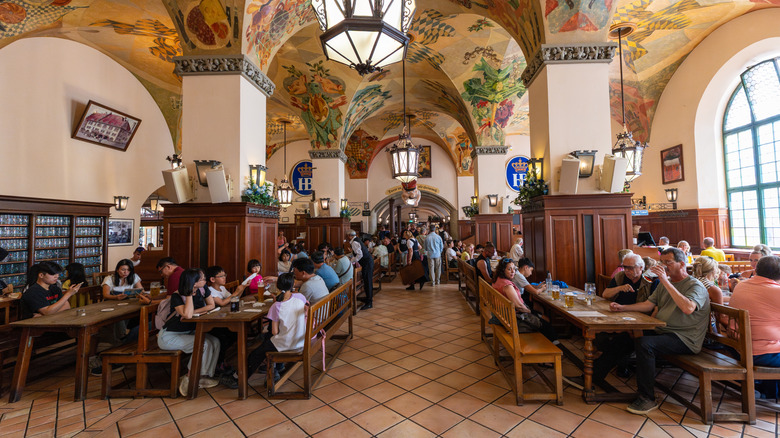
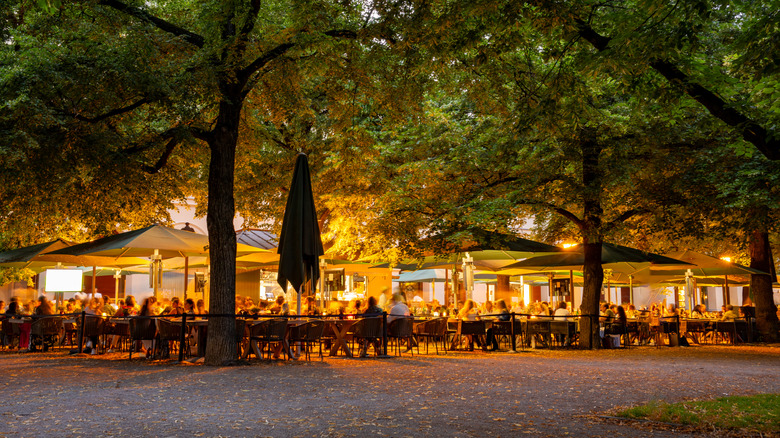
One stop into a traditional Bavarian beer hall and Munich and you'll be saying, "Helles, that's good!" A type of beer, of course, Helles is a light, crisp lager introduced in Germany in the late 19th century. Other varieties of Bavarian beer include Bock, a dark lager called Dunkel, and Weissbier, or wheat beer. And there's no better place to sample some brews, listen to music, grab a bite to eat, and meet people than in the communal atmosphere of a beer hall like Hofbräuhaus, Augustiner-Keller, Paulaner Bräuhaus, and Weisses Bräuhaus im Tal — and plenty more besides! Hofbräuhaus is arguably the city's most famous, and it features a huge gift shop and traditional Bavarian music every day, although it can get very busy. Augustiner-Keller features the city's oldest beer garden, and Weisses Bräuhaus im Tal has been brewing wheat beer for more than 400 years, making it the region's oldest producer of wheat beer. Prost!
Methodology
This compilation of the best sights and attractions in Munich was based on personal experiences visiting the city in addition to researching local tourism websites like Muenchen.de and Munich.travel. For specific information about opening times, admission prices, and historical context, official sites like Viktualienmarkt-Muenchen.de, Residenz-Muenchen.de, BMW-Welt.com, Deutsches-Museum.de, KZ-Gedenkstaette-Dachau.de, Schloss-Nymphenburg.de, Pinakothek.de, and others were consulted. Also consulted were additional history and data from Britannica.com, the U.S. Holocaust Memorial Museum, and EBSCO.com. Finally, these destinations were highly rated by visitors on sites like Tripadvisor and Google.