

China's 10 Best Destinations To Take Beautiful Pictures
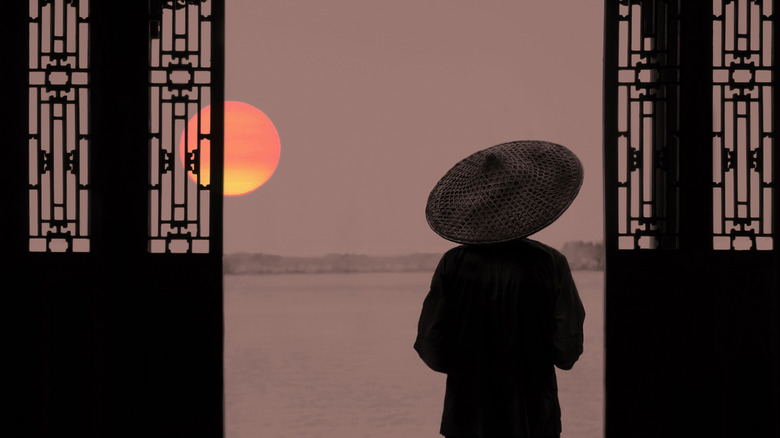
Landscapes in China shift wildly from packed modern cities to quiet traditional villages surrounded by towering snow-capped peaks. The country's millennia of history, deep cultural traditions, and classical architectural styles have shaped the nation's identity, and it's simply a photographer's dream. It doesn't matter if you're a professional or just chasing Instagram moments, China has a spectacular range of locations for stunning photography. Its ancient ruins and archaeological sites will take you back in time, while neon-drenched streets and grand towers of light in its urban centers deliver modern spectacles.
Elsewhere, limestone peaks punch through cotton candy fog, and stepped rice terraces of green and gold reflect the evening sky. In the cities' parks and squares, you'll find residents in groups dancing, practicing tai chi, and singing, while others sit and play chess or paint calligraphy on the ground. Wet markets and evening bazaars reveal the frenetic energy of Chinese trade, while wandering old neighborhoods with camera in hand offers authentic opportunities to snap daily routines and neighborhood traditions. Chinese people are curious about foreigners, too. They'll typically welcome you with interest and openness, and they love to get involved in your photos — just snap quickly if you want a natural pose; otherwise, they'll stiffen up into a signature posture.
We could have easily made a list of 100 photogenic destinations in China, but the 10 spots we did eventually select offer a balance of nature, history, and architecture — and all of them offer spectacle. However, you should account for crowds at these places, as they are popular for a reason. That said, with a little effort, timing, and the occasional early rise, you'll still manage to find peaceful corners to shoot some epic shots.
The Great Wall, Jinshanling
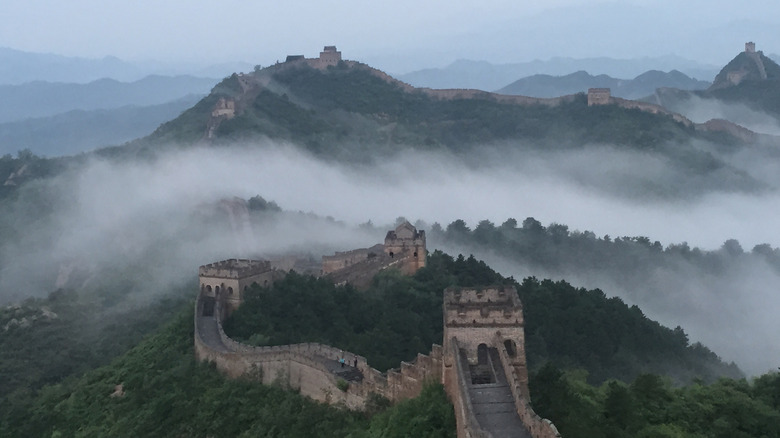
The Great Wall of China is the major tourist attraction for a first-time visit to the country. Most head to the Badaling section for its convenient access from Beijing, but this means it's usually crowded, and the restored structure often feels inauthentic. Luckily, there are plenty of other parts of this structure snaking its way across the country that you might find more photogenic. Jinshanling is one. Widely referred to as a "paradise for photographers," it's accessible by bus from the capital. While parts of it have also been restored, it is generally well preserved with original features, and features the iconic sprawl across miles of landscape that you'll likely be hoping for.
However, don't underestimate the hike. There are some rough sections, so wear proper shoes or boots and tread carefully. Icy conditions in winter may be particularly problematic, but not impossible if it's the Great Wall framed by white snow you seek. That said, with comfortable temperatures and verdant mountain scenery, spring or fall is best. Nonetheless, even though Jinshanling is much quieter than Badaling, expect crowds. As such, avoid major holidays unless you don't mind a sea of faces in your pictures. Also, get there early. Not just to be one of the day's first to step foot on the ancient structure, but also to take advantage of the "cloud sea" that floats below, offering sublime morning-time photo opportunities.
Jiuzhaigou, Sichuan
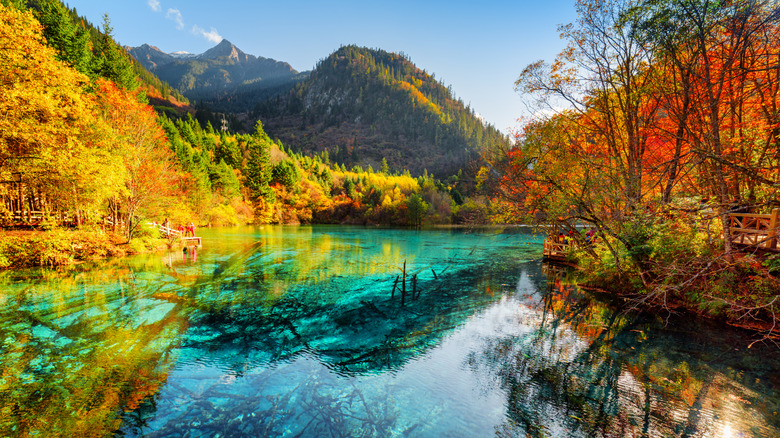
With its multicolored lakes of turquoise, emerald, and blue, Jiuzhaigou could easily be described as one of the most colorful places in the world. This is particularly true if you visit from September through November — especially in mid-to-late October — when golden sunlight sets the red, orange, and yellow leaves ablaze around the park. In winter, if you can brave the freezing conditions, the park transforms into a frosty fantasy. Waterfalls frozen in time patiently await spring and trees are dusted in snow, but those serene lakes still hold their mesmerizing colors.
There are more than 100 of those stunning lakes in this 278-square-mile UNESCO-protected national park, and all have a different mood. Although you can consider almost every one of them a photographer's dream, some stand out above others. Mirror Lake justifies its name by blurring the boundaries between reality and perfect reflection. It's at its most photogenic early in the morning. Then, there are the crystalline waters at Five Flowers Lake. Arrive before midday for the best shots of its transitioning hues from turquoise through yellow, blue, and green.
Five Colors Pond also goes through a mosaic of colors — including green, sky blue, and even shades of gray — while Panda Lake has waters so clear you can see tree trunks rooted under the deep blue water. Photogenic waterfalls also dot the park. At 886 feet, Nuorilang Waterfall is the widest in China, while the Pearl Shoal Waterfall cascades down from 130 feet and is another must-see.
Li River, Guangxi
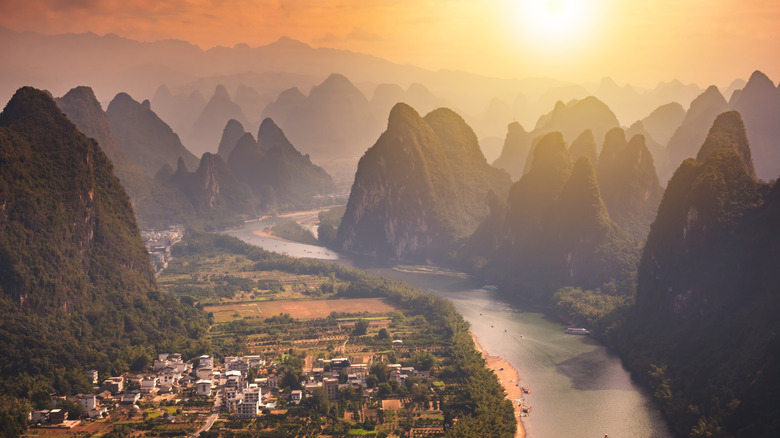
The Li Jiang, or Li River, is a 102-mile natural artery that cuts through the beautiful southern province of Guangxi. It may be a brief journey, but it's a spectacularly romantic destination couples will love — think those fairytale-like Chinese ink paintings coming to life in spectacular fashion. It meanders through green groves and rice paddies, surrounded by steep cone-shaped limestone peaks across a landscape that is quite unlike any other. Many tourists enjoy a relaxing cruise from Guilin or Yangshuo through this UNESCO-protected area, and you'll get fantastic shots from the deck.
However, true photography enthusiasts might want to venture into more remote areas, where you'll need both a local guide and a desire to get up early. And we mean really early. Capturing the perfect mountain sunrise requires you to depart well before breakfast for boat journeys and pre-dawn climbs. If that sounds like a challenge, there are still endless opportunities for Instagram moments and professional shots in more practical locations.
Yellow Cloth Shoal is one of the more famous spots. The water there is remarkably clear, and it creates flawless mirror images of the surrounding peaks. Meanwhile, Nine Horses Fresco Hill is said to resemble nine horses of various forms, and a moderate climb up Xianggong Hill rewards with the best views of the river's most spectacular section. For colorful sky-drenching sunsets and sunrises, consider visiting on the third or fourth day after it has rained. Finally, April through October are the best times for photos, when the water is high and the winter fog has dispersed. Just make sure to avoid the armada of mid-afternoon boats.
Pudong and Bund, Shanghai
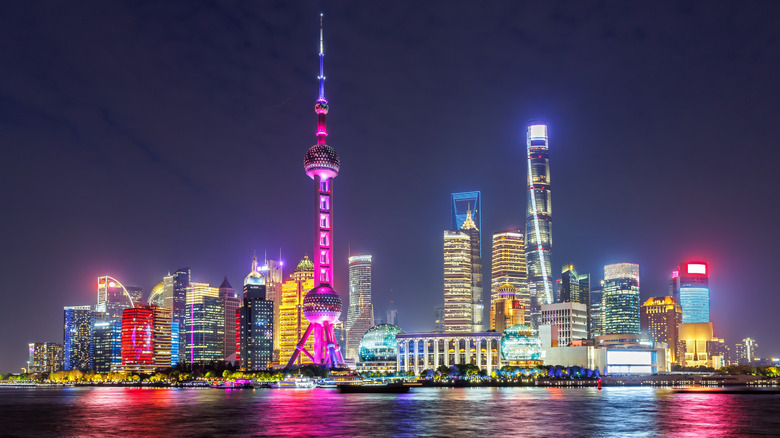
The Huangpu River literally splits Shanghai in two — and slap-bang in the middle of the city is an eastward curve where you'll find contrasting history on each side. On the west is the Bund, with its blend of Gothic, Baroque, Romanesque, and Art Deco structures that will satisfy any photographer with an interest in classical architecture. A 1927 neoclassical work of art that was once the city's center of international trade, the Customs House grabs the lion's share of the attention. Not far, Art Deco blends with Gothic Revival at the Peace Hotel, while the Bank of China building combines local elements with a late-30s modernist design.
If shooting these historic structures isn't enough, take a look across the river at the long stretch of futuristic skyscrapers in Pudong. They tower above as if patiently awaiting the invention of flying cars and the futuristic Jetsons-style skyways to complete their look. You can photograph the spectacle from the mile-long promenade that stretches along the river in the Bund.
Roughly in the center of Pudong you'll find the aesthetically baffling Oriental Pearl TV Tower, which looks like an alien lighthouse balanced on a tripod piercing through a stack of giant orbs. Along the southern section is the Lujiazui financial and commercial district dominated by prominent skyscrapers — including Shanghai Tower, the country's tallest. Early mornings offer atmospheric mist on the river, while in the evening, both the Bund and Pudong are beautifully lit up for luminescent river reflections.
The Forbidden City, Beijing
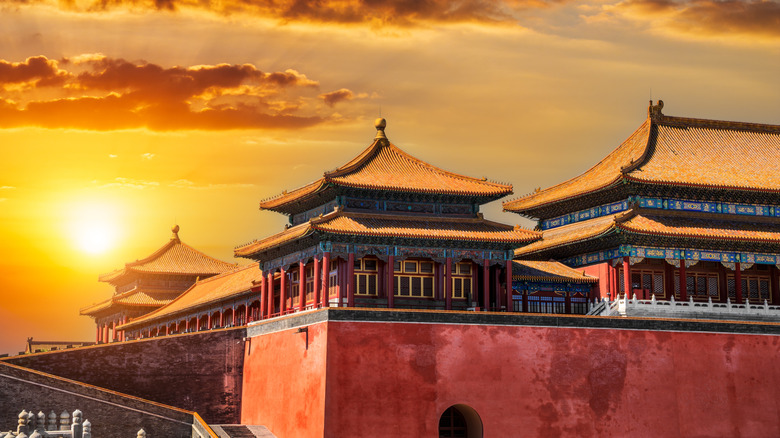
The Forbidden City in Beijing was completed in 1420, meaning it has survived intact over six centuries through the rules of 24 Chinese emperors. With the complex covering around 180 acres and housing 980 well-preserved buildings, it ranks as one of the world's largest ancient palace complexes — some might even say it should be considered a wonder of the world. For sweeping panoramic shots of its rooftops and courtyards, walk up to the Pavilion of Everlasting Spring in Jingshan Park. Within the grounds of the Forbidden City itself, photographers should know that tripods are banned; as are drones, if you were looking for aerial footage. Additionally, commercial photography requires prior authorization.
Gates open at 8:30 a.m., and you should try to arrive before they do to dodge the peak crowds. Remember, this is a city of over 20 million people, and the site is a popular weekend activity. However, if you really want to avoid the crowds, shoot in winter. Arriving before opening time in the cold season might make you one of the few there. And, while it doesn't always snow in Beijing, winter sun produces striking light and shadow contrast. If you are lucky enough to get a fresh fall, your photos will be full of blanketed rooftops and glistening courtyards.
While you are in the Chinese capital, the traditional lanes and alleyways of the city's residential hutongs, the ornate Summer Palace, and the iconic Temple of Heaven also offer photogenic glimpses into historic Beijing. For modern twists on the city's character, the Olympic Park and structures like the CCTV Tower make for fantastic Instagram moments.
Zhangjiajie National Forest Park, Hunan
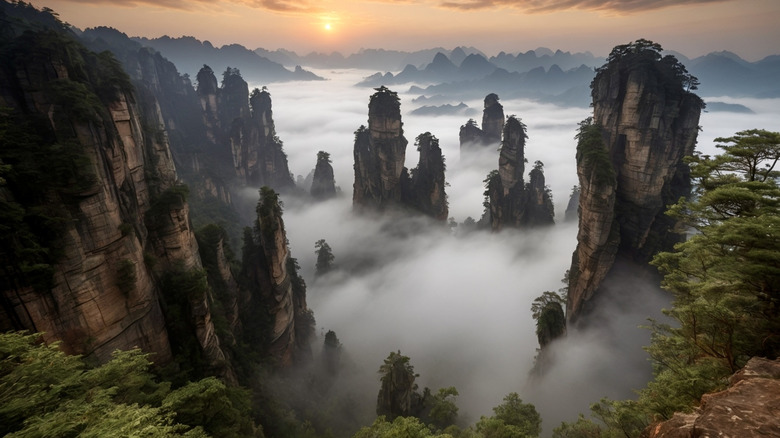
Located within the Wulingyuan Scenic Area in Hunan, Zhangjiajie National Forest Park is a UNESCO-designated World Heritage Site so beautiful that it served as the inspiration for James Cameron's "Avatar." And while there may not be any actual floating mountains, there are thousands of stone towers shooting thousands of feet into the sky, creating a photographer's dream.
Photogenic spots include a naturally-formed stone arch, known as the First Bridge of the World, while close to the peak of Tianmen Mountain is another huge natural arch known as Heaven's Gate. Here, you can climb a steep staircase at sunset to see it turn into a glowing portal of sunlight. A cable car also goes up to the arch if the climb sounds too strenuous. That cable car is far from the only artificial structure in the park. Completed in 2002, the Bailong Elevator currently holds the title of the planet's tallest outdoor elevator. There are three of them, and together, they can shuttle an astonishing 4,000 people per hour up 1,069 feet to the top of the cliffs.
Then, there's the Zhangjiajie Glass Bridge. Suspended 984 feet over a canyon and stretching along 1,411 feet, it's one of the world's highest and longest, and offers some adrenaline-pumping vistas that you will do well to shoot. June is the ideal month to capture the peaks on camera, when mist and cloud form around the tops, creating an ethereal ambience. The weather can be wet, so bring the appropriate attire. Although the rains usually persist into July, things start drying out by August, while the mystical fog is often still lingering.
Fenghuang, Hunan
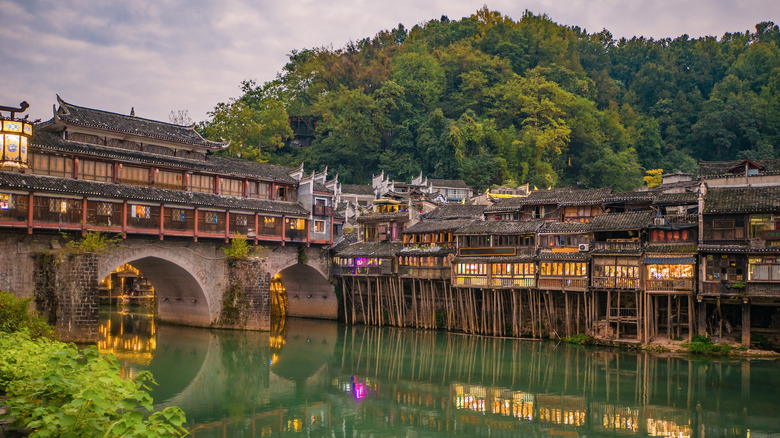
A few hours' drive from Zhangjiajie National Forest Park is another stunning spot for photographers in China. The ancient town of Fenghuang is one of the best lesser-known destinations across all of Asia. Here, mountain peaks and the Tuo River frame a design rooted in classical Chinese garden principles. Today, it stands as a well-preserved walled town and a trove of cultural wealth.
The river snakes through the town, and ancient walls follow its natural curves, with three impressive towers standing guard at each of its gates. Within the walls, you'll find imperial-style structures, courtyard dwellings, and traditional houses arranged together in a maze of cobbled alleys and lanes. Stilt houses lean over the riverbanks, while all sorts of bridges get you from one side to the other.
The stepping-stone bridge looks exactly as it sounds. Hopping the rocks across the water makes for excellent shots — just don't fall in! If it is social media moments you're more interested in, you can even hire authentic garments of the Miao and Tujia hill tribes. But to capture the real charm of the town, take a river cruise for fresh perspectives on those stilted houses with their hanging red lanterns. As you meander under the arches of the Phoenix Hong Bridge, they'll reflect on the still waters. At night, the bridge glows with golden light, creating an enchanting mood across the river. In fact, the whole town lights up after dark, so you might want to have a good tripod handy for your camera or phone.
Pingyao, Shanxi
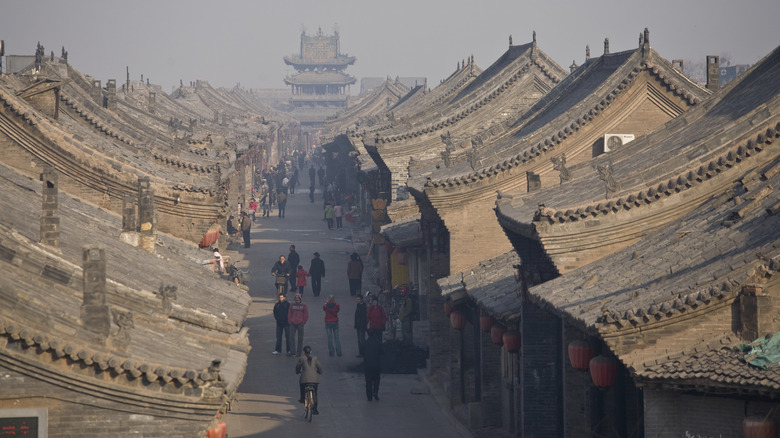
Pingyao is a 2,700-year-old Ming- and Qing-era walled settlement located in Shanxi province. With its deep historical roots and camera-ready scenery, it serves as an excellent stop-off for travelers heading south from Beijing toward the Terracotta Warriors at Xi'an. Its cobbled streets, monumental city gates, and traditional courtyards make it not only a draw for photographers but also for videographers. In fact, its well-preserved period appearance makes Pingyao a prime location for cinema. Zhang Yi Mou's "Raise the Red Lantern" is perhaps the most famous to be shot here, but many other Chinese films and period dramas have taken advantage of its authentic look.
Walking the streets with camera in hand feels like a step back in time. The Ancient City Wall ranks among the town's biggest draws. It dates back to the Western Zhou Dynasty and is one of the country's best preserved. There, you can climb up and explore the 72 watchtowers to get perfect shots of the rooftops while you wait for the sun to drop and paint its colors across the sky.
The ancient city's status as a photogenic wonderland is underpinned by the Pingyao International Photography Festival, which attracts shutterbugs from across the globe to document its timeless beauty. This annual event transforms the historic quarter into an open-air gallery, with Chinese and foreign artists alike showcasing their work in the city's alleys, shrines, and crumbling halls.
Harbin Snow and Ice Festival, Harbin
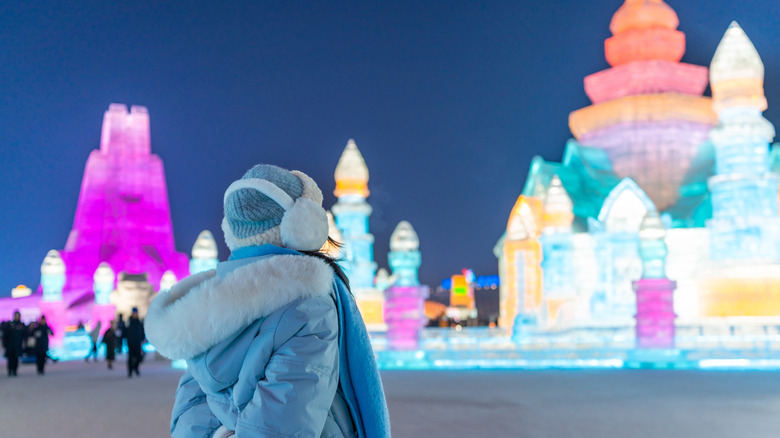
A winter spectacle, the Harbin Snow and Ice Festival sprawls across several areas in the northeastern city of Harbin. It's a place where artists carve sculptures of all sizes out of snow and ice — from the small to the colossal — with many towering in the form of giant Buddhas or ice palaces. If your idea of perfect photos involves the fusion of frost, snow, and light shining through ice, this place is for you.
Natural light in the late afternoon lazily glows and brings out the details of the sculptures. Meanwhile, in the evening, everything lights up from within in a spectrum of colors like a frosty Disneyland. The Ice and Snow World draws in the biggest crowds, and this is where you'll find the biggest sculptures. The Snow Sculpture Art Expo mixes up the sizes and features interactive exhibits, while the quieter Zhaolin Park has been displaying delicate carvings of ice lanterns for decades.
As you've probably guessed, it's a pretty cold experience. Temperatures can reach a frigid minus 22 degrees Fahrenheit, so it's essential to take care of your photography equipment and have a few spare batteries on hand. You'll need the proper clothing, too. Additionally, shooting in the brutal cold can be exhausting, so make sure there are moments when you put the camera away and just enjoy the dazzling show. As the world's largest ice and snow festival, it runs from December through February, and sometimes into March, depending on the freeze that year.
Lijiang and Tiger Leaping Gorge, Yunnan
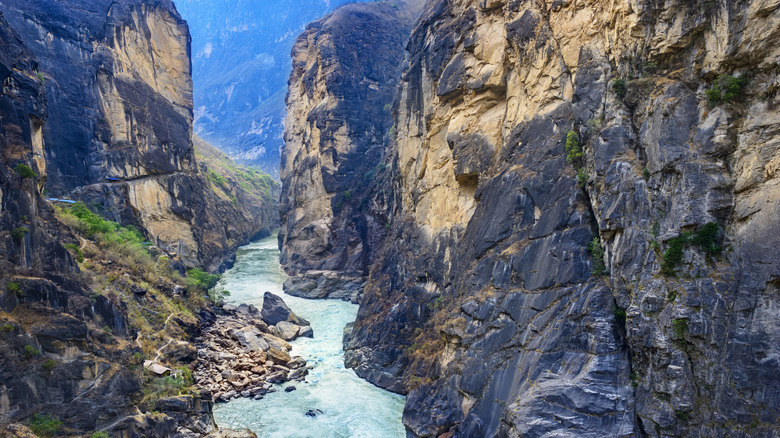
As part of the Three Parallel Rivers Protected Areas, Tiger Leaping Gorge became a World Heritage Site in 2003. At almost 12,800 feet from the top of the gorge down to the water, few canyons in the world plunge deeper. Rising nearby, the Jade Dragon Snow Mountain towers above at 18,360 feet. Across the gorge, you'll also see Haba Snow Mountain standing tall at 17,703 feet. In between is Tiger Leaping Gorge — so named for the leaps that legendary tigers were once said to make while evading hunters. The reality, however, is that there are no tigers here, so you're pretty safe to explore the area.
At the main viewing platform, four levels are connected by lengthy escalators. So, if you're keen on the photos but not on the exertions, this is another photogenic spot where you can save your energy. Better yet, the lower level offers impressive views up the gorge, right next to the churning river framed by jagged rock faces and massive stones. It can get busy here, though, so if you're feeling energetic and wish to escape the hordes, tackling the hike is your best option. The trail unfolds through jaw-dropping scenery along cliffside paths that reveal more snowy mountains above while the river rages below.
Savvy photographers will likely base themselves in Lijiang, an ancient city of exquisitely carved, timber-framed houses and flowing canals. Naturally, it's another photogenic spot — especially Wangu Tower, a five-story wooden pavilion perched upon Lion Hill. It's the unmistakable symbol of this historic city and one that offers photo ops beyond the structure. Climbing it reveals even more views of Jade Dragon Snow Mountain. Once at the top, windows beautifully frame the distant peak.
Methodology
To choose the 10 most photogenic destinations in China, we looked to the opinions of tour operators within the country, as well as blogs from local and foreign photographers alike. The author's personal experience was also a factor when finalizing many of the choices, while practical and photography tips came from both firsthand insights and on-the-ground knowledge. Together, all of these sources helped us compile a carefully curated list of places rich in natural and cultural beauty that offer visual impact, reliable accessibility, and a clear sense of what makes China such a spectacular destination for travelers and photographers alike.