13 Top-Rated Tourist Attractions in the Vatican
When you visit Vatican City, one of the top tourist attractions in Rome, you're actually adding another country to your been-there list. Vatican City is an independent state, and inside its 0.44 square kilometers, you'll find so many things to do that it would take days to see them all.
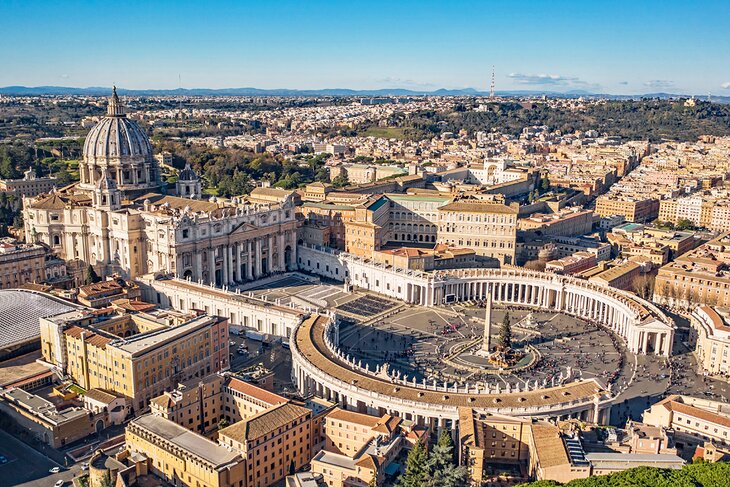
Whether your interest is religion, history, art, or architecture, you'll find plenty of things to see here. The two must-see sights are St. Peter's Basilica and the Sistine Chapel, but the Vatican Palace contains magnificent rooms decorated by the greatest artists of their time.
You will be astonished by the dazzling collections in the more than a dozen museums that fill its grand galleries with everything from ancient Egyptian mummies to works by modern artists such as Matisse and Salvador Dali.
You can decide which places to visit and plan your sightseeing easily with this handy list of the best tourist attractions in the Vatican.
See also: Where to Stay near Vatican City
- 1. St. Peter's Basilica
- 2. Sistine Chapel
- 3. Vatican Palace Highlights: The Raphael Rooms, Appartamento Borgia, and Cappella Niccolina
- 4. Pinacoteca (Picture Gallery)
- 5. Piazza San Pietro (St. Peter's Square)
- 6. Museo Pio Clementino
- 7. Vatican Necropolis
- 8. Vatican Gardens
- 9. Gregorian Etruscan Museum
- 10. Collection of Modern Religious Art
- 11. Vatican Library
- 12. Egyptian Museum
- 13. Museo Chiaramonti
- Where to Stay near Vatican City for Sightseeing
- Tips and Tours: How to Make the Most of Your Visit to the Vatican
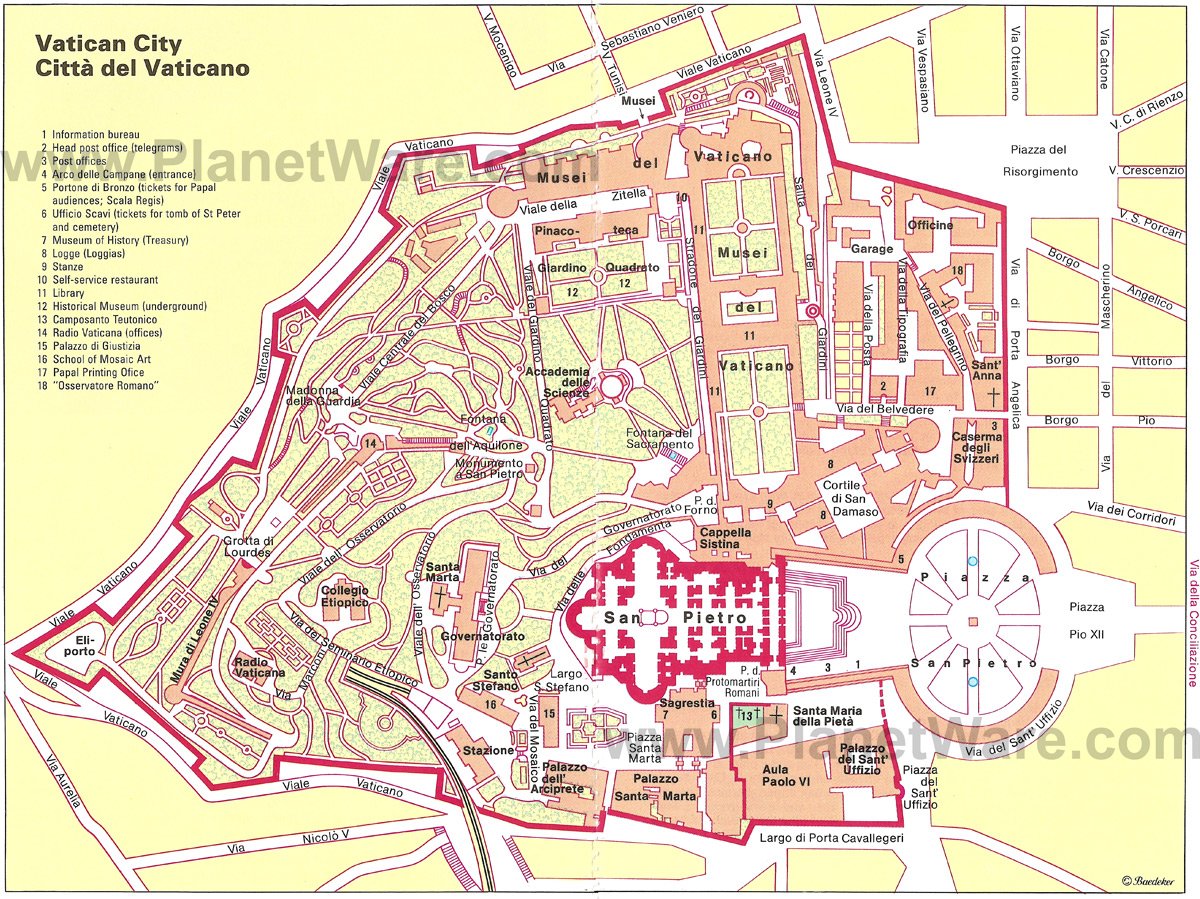
- Map of Tourist Attractions in the Vatican
1. St. Peter's Basilica
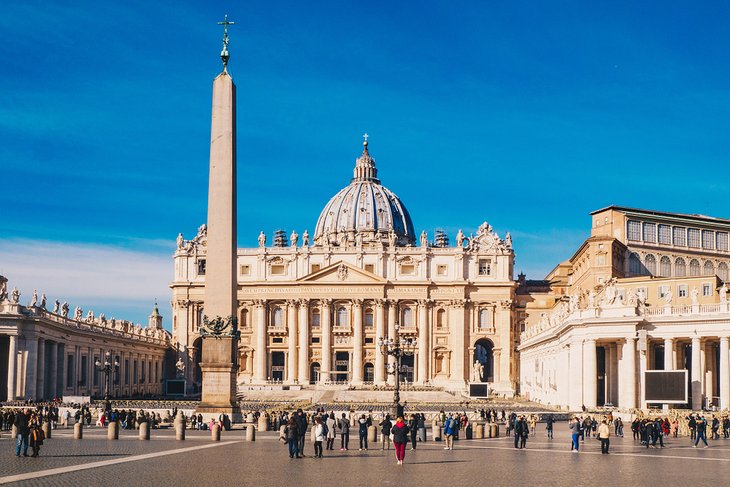
The centerpiece of the Vatican and the place to begin your visit, the magnificent St. Peter's Basilica is the most important of all the churches in Rome. Built between the 16th and 18th centuries, the basilica replaced earlier structures that began in 326 on the site believed to be where St. Peter was buried. Ironically, it was the selling of indulgences to finance this building in the 16th century that provoked Martin Luther to begin the Protestant Reformation.
The work of famous artists begins before you enter the church: in the portico are an equestrian statue of Constantine by Bernini and fragments of a mosaic by Giotto above the main doorway. It's from the old church, as are the double bronze doors.
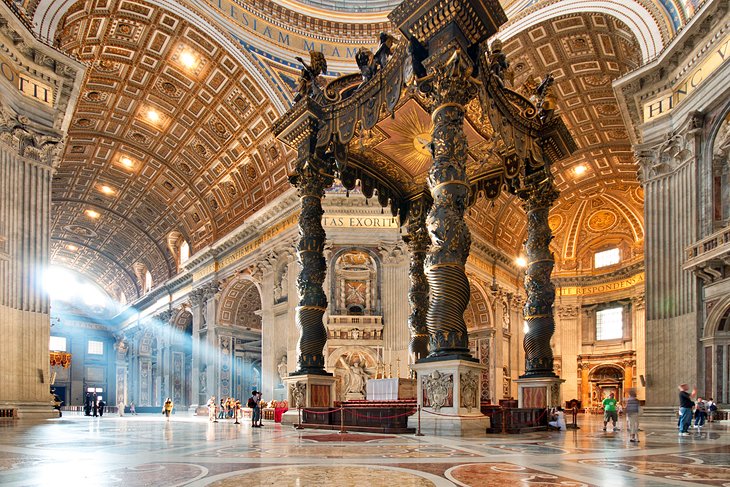
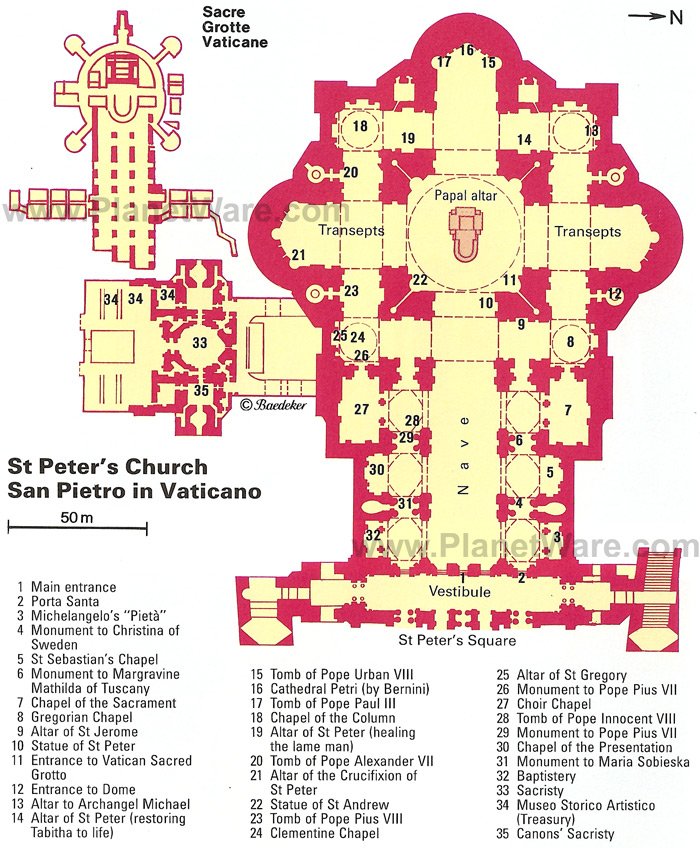
The huge nave — 185 meters long and 46 meters tall — rises to a dome 119 meters above and can hold more than 60,000 people. To appreciate its vast size, you can compare it to the dimensions of other great churches marked in the floor. On your right, Michelangelo's famous Pietà, sculpted when he was only 24, is behind reinforced glass. Also on the right is the richly decorated Chapel of the Sacrament, with Bernini's tabernacle and his rival Borromini's bronze grille.
Michelangelo's dome is held on four massive pentagonal piers, and below it, under Bernini's magnificent Baroque bronze baldacchino (canopy), is the Papal altar. Below is the tomb of St. Peter. The bronze throne in the apse, flanked by papal tombs, is also by Bernini. Tombs of more Popes are in the right aisle.
Near the Baptistery are the stairs (a lift is outside near the Gregorian Chapel) to the roof. From here, you can climb 330 steep steps inside the dome to the lantern for a closer look at the dome's structure and magnificent views over St. Peter's Square. Beneath the church is Vatican Necropolis, the final resting place of several former Popes and said to house the remains of St. Peter himself.
Address: Piazza San Pietro, Rome
2. Sistine Chapel
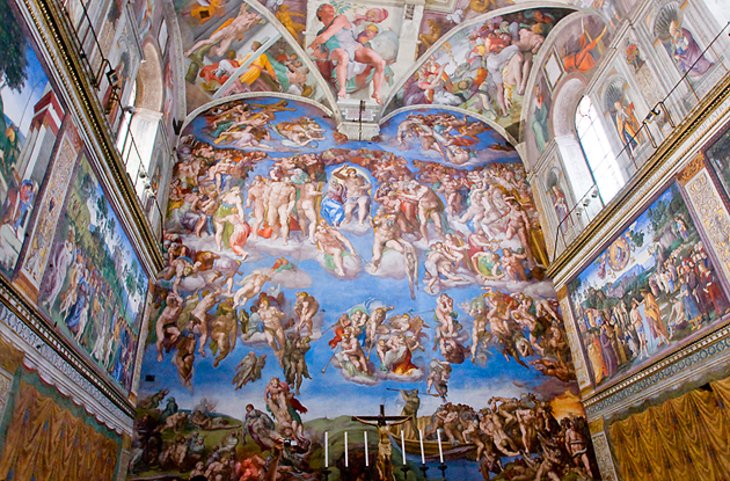
For many tourists, the highlight of visiting the Vatican is the vast Sistine Chapel, with its walls and ceilings covered in vibrant frescoes by Michelangelo and other artists. The frescoes, which are considered the pinnacle of Renaissance painting, were extensively restored from 1980 to 1994, removing layers of candle soot, dust, varnish, grease, and overpainting to reveal their original luminous colors.
The side walls are covered with large frescoes of Biblical scenes against the background of Umbrian and Tuscan scenery, painted for Sixtus IV by the most celebrated painters of the day - Perugino, Botticelli, Rosselli, Pinturicchio, Signorelli, and Ghirlandaio.
These late-15th-century paintings already reflect the ideas of humanism, recognizing humans as individuals and important in the historical process. The left-hand wall shows Old Testament scenes; the right-wall, New Testament scenes.
The frescoes on the ceiling were painted by Michelangelo, almost completely unaided by assistants, in the reign of Pope Julius II, between 1508 and 1512. Michelangelo's ambitious idea was to depict the Creation as described in Genesis, beginning with God separating light from darkness, creating the sun and the moon, separating land and sea, and creating Adam and then Eve, and continuing through the story of Noah.
Below in the vaulting are colossal figures of the prophets and sibyls. Michelangelo began work on the large fresco on the altar wall in 1534, depicting the final scene in the story of the world, the Last Judgment. Its dramatic presentation and artistic finesse rank it as one of the greatest achievements of European painting.
If you don't want to wait in long lines for your chance to admire the world's most famous frescoes, book a "Skip the Line" tour, which includes the Sistine Chapel, St. Peter's Basilica, and The Vatican Museums.
3. Vatican Palace Highlights: The Raphael Rooms, Appartamento Borgia, and Cappella Niccolina
These rooms, commissioned for the Palace of the Vatican's papal apartments by the art-loving Pope Julius II and later by Pope Leo X, are covered with a magnificent series of frescoes by Raphael.
In re-discovering the traditions of historical painting, Raphael began an art tradition that was to be followed for centuries. In each of the scenes, he uses classical symmetry in the composition, positioning the characters in perspective around a central focal point.
While some scenes were painted by students or other great artists after Raphael's death, the Stanza della Segnatura and the Stanza di Eliodoro were both painted by Raphael himself, as were those in the Sala della Segnatura. Completed between 1508 and 1511, these works, like those in the Sistine Chapel, represent the supreme achievement of Renaissance painting.
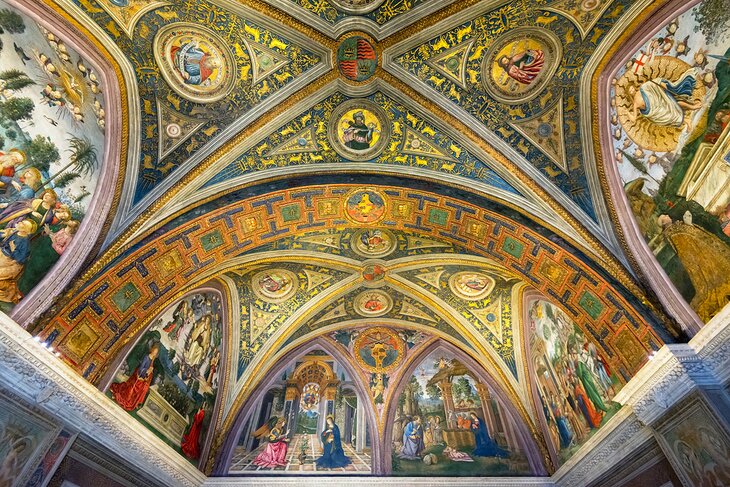
Pope Alexander VI, a Borgia, had a private residence for himself and his family built inside the Vatican Palace, known today as the Appartamento Borgia. Between 1492 and 1495, Pinturicchio and his assistants painted a series of scenes that combined Christian subjects with ancient and Renaissance humanist themes.
The first room shows prophets and Sibyls; the second, the Creed, with prophets and Apostles. The third room is decorated with allegories of the seven liberal arts, and the fourth with legends of saints. Scenes from the New Testament cover the fifth.
It's easy to miss this little gem as you leave the Raphael Rooms and go through the Sala dei Chiaroscuro, where your attention will be on the wooden ceiling. But look in the corner for a small doorway to Nicholas V's Chapel, also known as Cappella Niccolina. It is completely lined in frescoes by the Florentine monk of the early Renaissance, Fra Beato Angelico.
The subjects of the frescoes are the life and martyrdom of St. Stephen and St. Lawrence, and like all Fra Angelico's work, these paintings speak of a deceptive simplicity, gentleness, and devotion that almost makes you overlook the genius of this talented artist.
4. Pinacoteca (Picture Gallery)
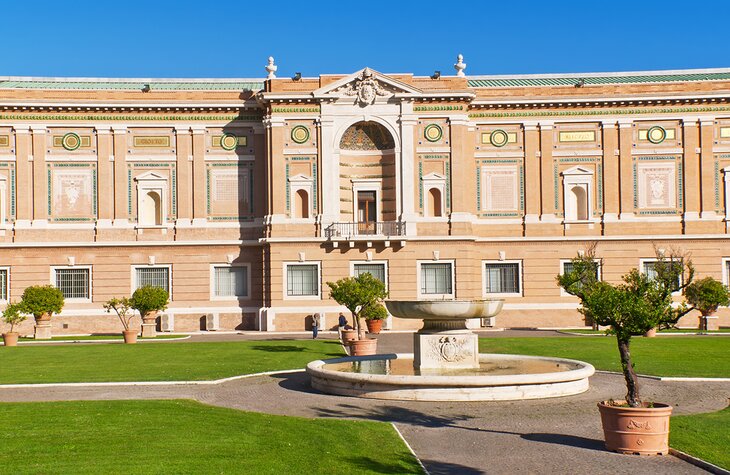
Even though Napoleon robbed it of many of its treasures, the Pinacoteca contains 16 rooms of priceless art from the Middle Ages to contemporary works. Arranged in chronological order, the pictures give an excellent survey of the development of Western painting. Medieval art includes Byzantine, Sienese, Umbrian, and Tuscan paintings, as well as a Giotto triptych and a Madonna and St. Nicholas of Bari by Fra Angelico.
Notice especially the triptych by Filippo Lippi, Coronation of the Virgin by Pinturicchio, and a Madonna by Perugino. A room is devoted to tapestries from cartoons by Raphael; his Madonna of Foligno; and his last painting, the famous 1517 Transfiguration. Portraits include da Vinci's unfinished St. Jerome, a Titian Madonna, and Caravaggio's Entombment.
5. Piazza San Pietro (St. Peter's Square)
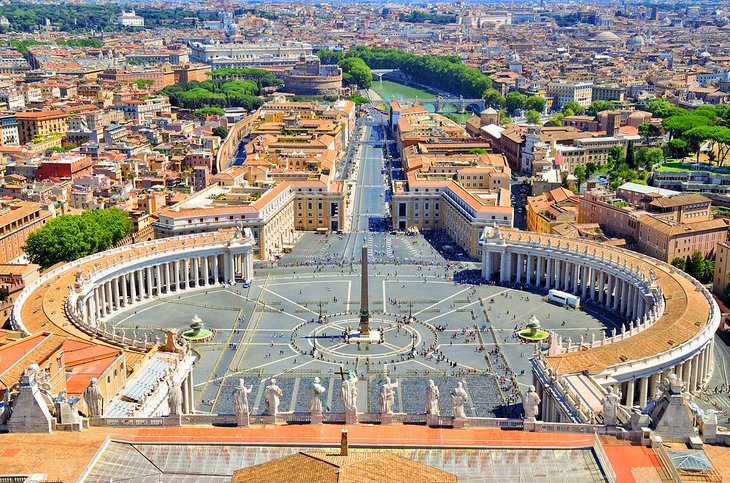
The grand Piazza San Pietro in front of St. Peter's Basilica was laid out by Bernini between 1656 and 1667 to provide a setting where the faithful from all over the world could gather. It still serves that purpose admirably and is filled to capacity each Easter Sunday and on other important occasions.
The large oval area, 372 meters long, is enclosed at each end by semicircular colonnades surmounted by a balustrade with 140 statues of saints. On either side of the oval are fountains, and in the center is a 25.5-meter Egyptian obelisk brought from Heliopolis by Caligula in AD 39 and set up in his circus. It was moved here in 1586, no small task in those days, as the monument weighs 350 tons.
The focal point, however, is the façade of the basilica, from whose central balcony the Pope delivers his blessings and announces beatifications and canonizations. From here also, the senior member of the College of Cardinals proclaims the name of a new Pope elected by the conclave.
6. Museo Pio Clementino
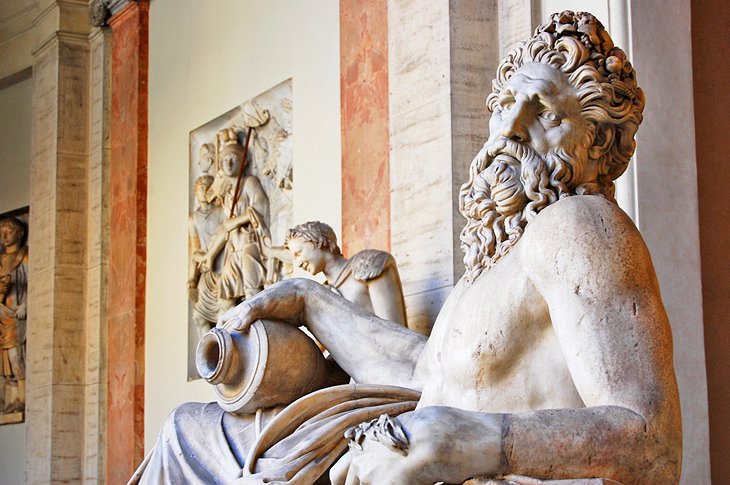
The Vatican Museums have the largest collection of ancient sculptures in the world, mainly found in Rome and the surrounding areas. These galleries contain such a wealth of magnificent and significant pieces that even a list of the highlights is a long one.
In the Sala a Croce Greca, don't miss the red porphyry sarcophagi of Constantine's daughter, Constantia, and his mother, St. Helen, both richly decorated with figures and symbols. In the Sala delle Muse look for Belvedere Torso, a first-century-BC work by Apollonius of Athens that was admired by Michelangelo. In the Gabinetto delle Maschere is a mosaic floor of theatrical masks from the Villa Adriana in Tivoli.
In the Cortile del Belvedere is one of the most famous statues in the Vatican: the Apollo Belvedere. In the Galleria delle Statue, look for the Candelabri Barberini, the finest ancient candelabras known, also from the Villa Adriana at Tivoli.
Galleria dei Busti contains, along with lunette frescoes by Pinturicchio, the celebrated Laocoön group, a masterpiece of Hellenistic sculpture showing the Trojan priest Laocoön and his sons in a mortal struggle with two huge snakes.
7. Vatican Necropolis
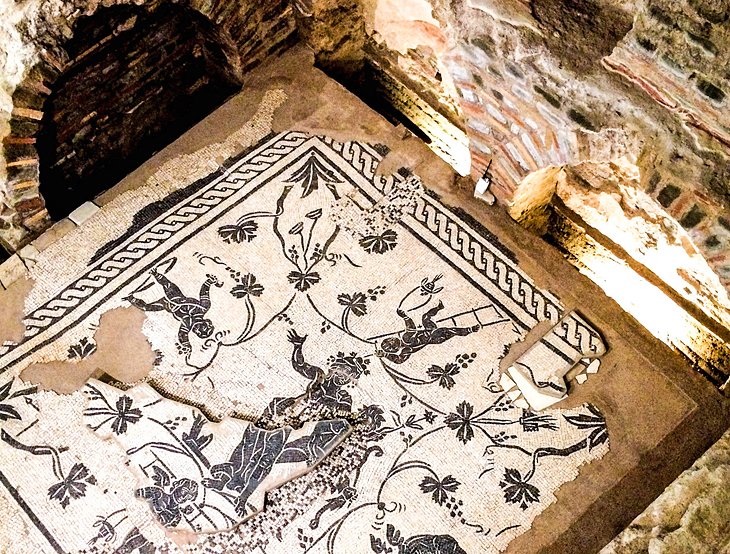
Beneath the grand dome and priceless frescoes of St. Peter's, a treasure trove of archaeological finds awaits. Many are aware of the papal grottoes just beneath the cathedral where former Popes have been entombed in private chapels, and the 12th-century church that accompanies them.
Not so well known are extensive ruins that have been excavated even deeper in the earth below, revealing burial grounds from as early as the 1st century BCE. The deepest of the three levels contains a pagan burial site, and the next level up contains both pagan and Christian graves, as well as ruins including stone crypts and arches dating through the 5th century.
The most significant discovery, however, is a gravesite believed to contain the remains of Saint Peter himself, a relic that the Vatican continues to excavate with painstaking care. A limited number of tourists are allowed to visit each day, and tickets must normally be purchased directly from the Vatican Excavations Office, so it is highly recommended that tourists book a pre-arranged private tour of the Vatican necropolis, which will ensure admission.
Location: Beneath St. Peter's Basilica
8. Vatican Gardens
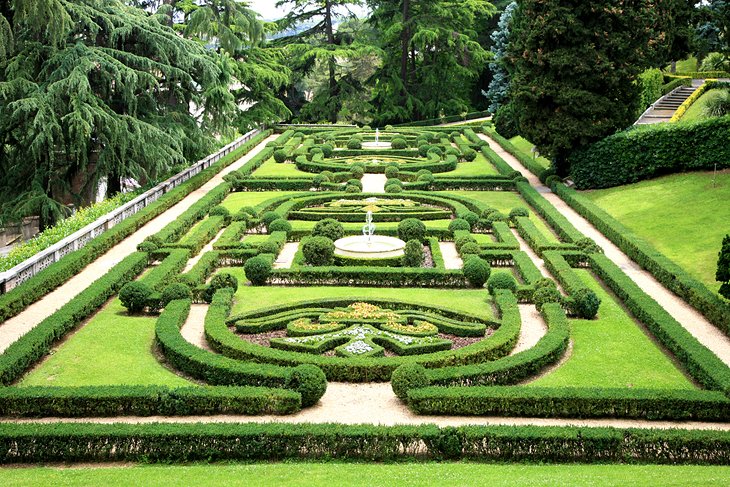
After the overload of grandeur and spectacular art, you may long for some quiet time outdoors. The Vatican Gardens, first created for Pope Nicholas II in the 13th century, were meant to be a space for peaceful reflection.
Over the centuries, the landscaped gardens, grassy spaces, and orchards have grown to cover nearly one-half of the area of the tiny city-state and rival the most beautiful gardens in Italy.
In addition to the formal French Garden, you'll find individually potted plants along the paths, containing azaleas and other lush flowers. Planted among these and in the orchard are several rare trees, including an Australian silk oak, as well as many trees that were brought as gifts by official visitors.
Perhaps the most significant of these trees is the olive tree, which was presented by the State of Israel to symbolize peaceful relations with the head of the Catholic Church. Tours of the garden must be arranged in advance through the Vatican Museum.
9. Gregorian Etruscan Museum
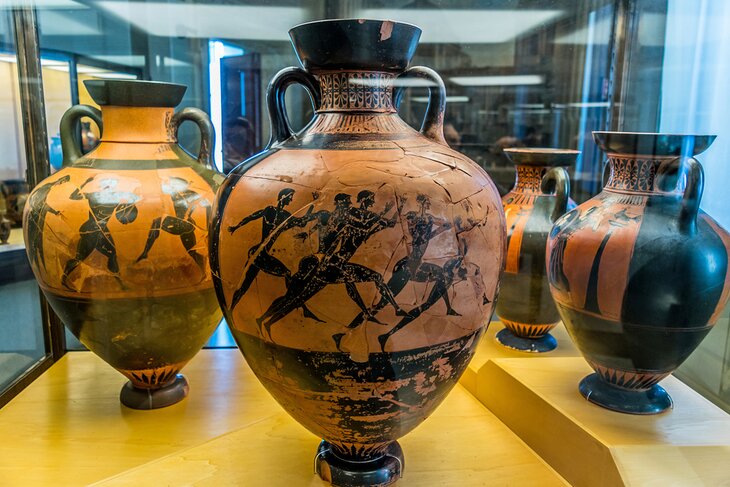
The 18 rooms of the Gregorian Etruscan Museum shed new light on the life of the Etruscans and their idea of the afterlife. Among the findings from the Etruscan graves that have been excavated throughout Tuscany are not just funerary items, but artworks and objects from the everyday life of these enigmatic people.
Particularly outstanding are the grave goods found in the Regolini-Galassi tomb at Cerveteri, the Mars of Todi, a head of Athena, and a number of very fine Etruscan vases.
10. Collection of Modern Religious Art
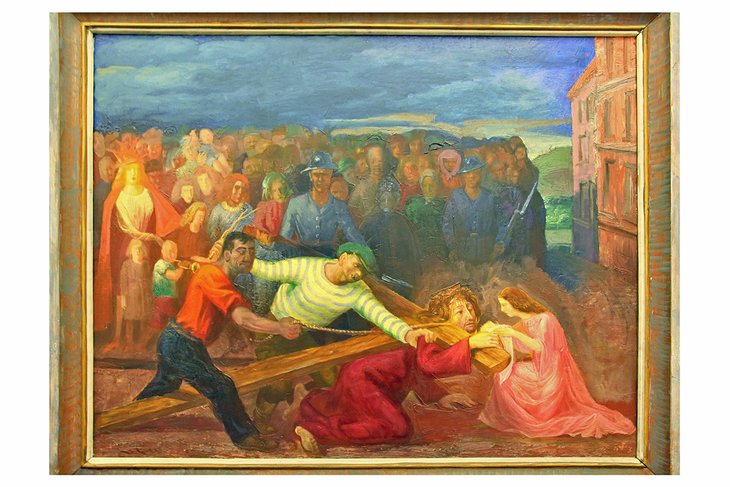
Amid all the antiquities and Renaissance art, a more recent addition to the Vatican treasures was inaugurated in 1973, as a result of an initiative by Pope Paul VI in 1964. The Pontiff noted the gap between the Catholic Church and contemporary art, hoping to bring them closer in the future. That began the extension of the Vatican's small collection of 19th-century art to include more recent works.
As with the other Vatican museums, not all the collection — which numbers more than 8000 — is on display, but the works shown in galleries between Borgia Apartment and the Sistine Chapel present an overview of 20th-century religious paintings.
Works on religious themes in the collection include those by Salvador Dali, Vincent Van Gogh, Marc Chagall, Francis Bacon, Otto Dix, Giorgio de Chirico, and Henri Matisse. An entire room is dedicated to Matisse's Chapel of the Rosary in Vence, France.
11. Vatican Library
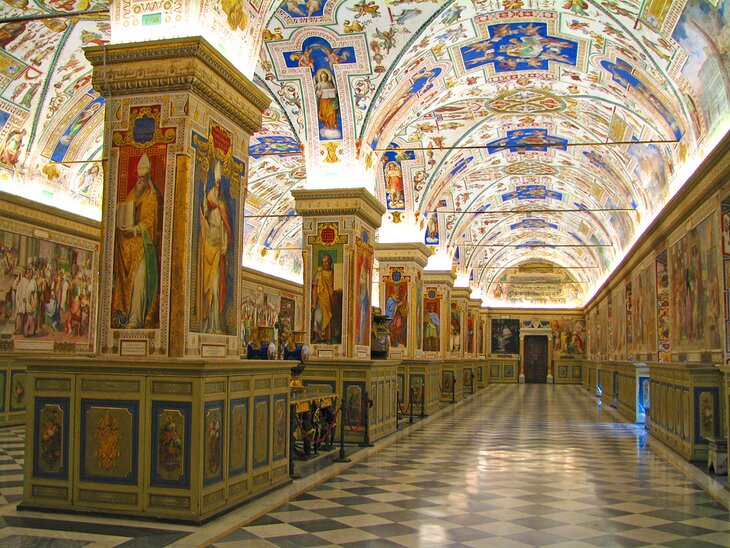
The value of its contents makes the Vatican Library the richest in the world, with 7,000 incunabula (printed before 1501), 25,000 medieval hand-written books, and 80,000 manuscripts that have been collected since the library's founding in 1450. And that's just the old books; it doesn't count all the books it contains that were printed since the end of the 15th century.
In its 70-meter-long hall, built by Domenico Fontana, you can admire some of its most precious treasures: beautiful hand-illuminated Gospels, Biblical codices, early printed books, parchment manuscripts, and ancient scrolls and papyri. The library also has a recently expanded collection of pontifical coins and medals.
12. Egyptian Museum
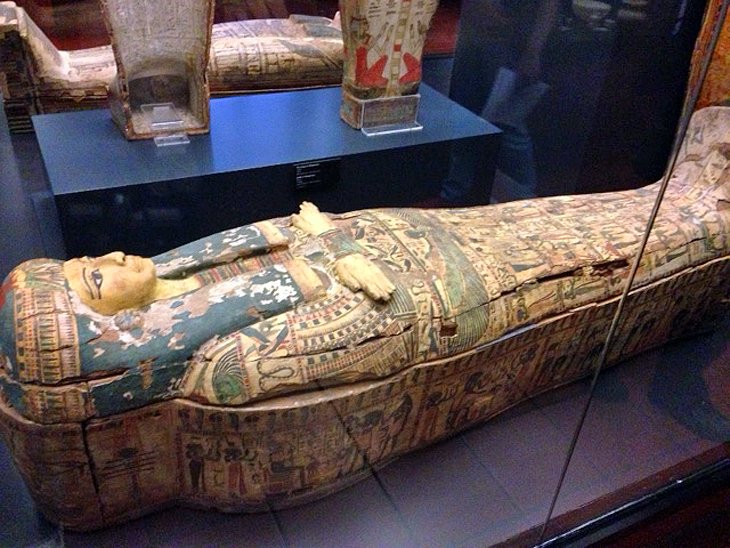
The Egyptian Museum in the Cortile della Pigna was re-founded in 1839 by Pope Gregory XVI, the first collection having been assembled earlier by Pius VIII. Much of the collection was brought from the Villa Adriana in Tivoli, where they had been collected by Emperor Hadrian.
Supplementing Hadrian's collections are artifacts assembled by 19th-century collectors. The nine rooms exhibit some fine examples of Egyptian art from the third millennium to the sixth century BC. Highlights include basalt and wooden sarcophagi, sculptures of gods and pharaohs, bronzes, mummified heads, burial reliefs, stelae with hieroglyphic inscriptions, statues of gods and animals, and papyri.
In the last two rooms, you'll find art from ancient Mesopotamia, vases and bronzes from Syria, and reliefs from Assyrian palaces.
If you're traveling in Rome with children and their patience is wearing thin with palaces and art, this part of the Vatican will likely be their favorite.
13. Museo Chiaramonti
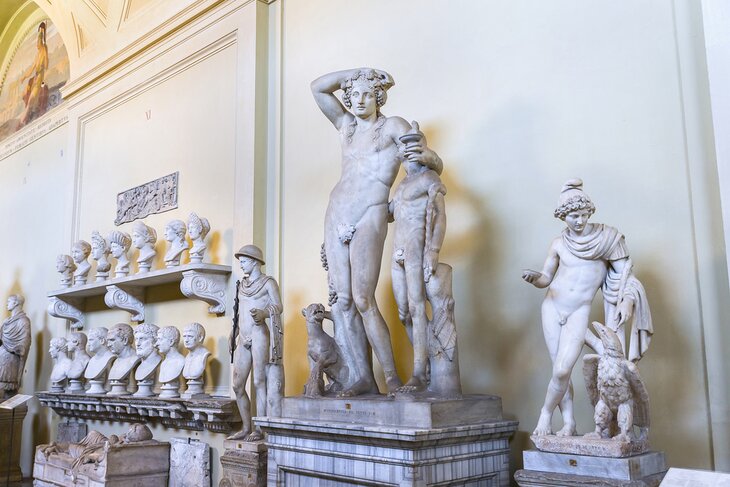
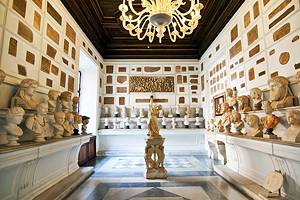
The Museo Chiaramonti, founded by Pope Pius VII in the early 19th century, is housed in a long gallery leading to the Papal palace and in the Braccio Nuovo. Concentrating on works of Greek and Roman art, the museum includes a number of Roman copies of earlier works by some of the most famous Greek sculptors, the only record of them that survives.
Among the highlights of the thousand-odd sculptures, friezes, and reliefs are the Augustus of Prima Porta, a statue of the emperor found in the villa of his wife Livia; a statue of the god of the Nile; and Spear Carrier, a copy of the work by Polycletus.
In the Sala della Biga, near the entrance, are two Discus Throwers, copies of fifth-century-BC works. A funeral monument of a miller dating from the first century was found at Ostia, and two splendid gilded bronze peacocks are thought to have come from Hadrian's Mausoleum.
Where to Stay near Vatican City for Sightseeing
- On a pedestrian-only street, the 4-star Hotel della Conciliazione has a beautiful lobby and well-appointed rooms; breakfast is complimentary.
- Caesar Palace is a good-value bed-and-breakfast, with warm hospitality. The large rooms are elegantly decorated and the included continental breakfast features cappuccino.
- The budget Adriatic Hotel is a short stroll to Vatican City, near restaurants and a supermarket; after a day's sightseeing, relax on the hotel's lovely roof garden.
- Spacious rooms, an outdoor pool, and a leafy terrace make Relais Le Clarisse in Trastevere an oasis in the busy city. The atmospheric Trastevere neighborhood is within easy reach of the Vatican by public transportation and has the added attraction of proximity to Piazza Navona, the Pantheon, and other important tourist sites.
Tips and Tours: How to Make the Most of Your Visit to the Vatican
Skip the Lines:
- Vatican City is an incredibly popular destination for both general sightseeing and religious pilgrimages, and as a result, the lines to see the most popular tourist attractions can take longer to get through than you spend at the site itself — even after upgrading to the "fast track" tickets, where available.
- Anyone who is short on time, finds it difficult to stand for long periods, or simply doesn't relish the idea of a long wait will want to book the Skip the Line Tour of the Vatican Museums, St. Peter's Basilica, and the Sistine Chapel. This three-hour tour grants special no-wait access to the top Vatican attractions, allowing you to make the most of your visit by spending the entire time admiring the artwork of masters like Michelangelo and Raphael, the architecture and splendor of St. Peter's Basilica, and the treasures displayed within the Vatican Museums. The private guide will also provide fascinating commentary, which includes historical background and little-known facts about the Vatican. For those who want a more intimate experience, a small-group option is available, limited to 12 participants.
Map of Tourist Attractions in the Vatican
More Related Articles on PlanetWare.com
Italy's Top Churches: It is no surprise that Italy is home to some of the most spectacular churches and cathedrals in the world, and you can explore some of the top churches in Rome. Italian churches draw tourists who admire the awe-inspiring architecture, unparalleled artwork, and countless treasures within.
While exploring St. Mark's Basilica, one of the top attractions in Venice, you will see gold mosaics and pillars of rare stone, like alabaster and jasper, which were brought back to Venice by every merchant ship that made port during its construction.
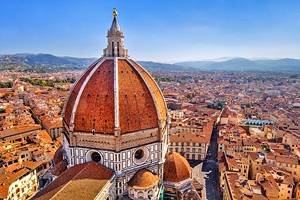
Visitors to Siena will appreciate the magnificent exterior of Santa Maria Assunta as well as the artwork that adorns the interior, the product of masters like Donatello and Bernini. Florence is home to several magnificent churches with equally impressive artwork, including masterpieces by Michelangelo, as well as impressive interiors in the lesser-known chapels, which feature intricate detail work in marble, gold, and exotic woods.
Those who are inspired by architecture will also want to visit Monreale Cathedral, built in the 12th century by William II, which is one of Sicily's most famous attractions for its size and grandeur.
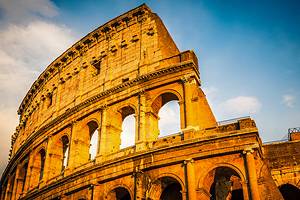
When in Rome: While seeing the Vatican City's top attractions is a priority, there are some top attractions in Rome that absolutely can't be missed. The Colosseum is the city's most popular tourist attraction, a massive ruin that has become an iconic symbol of the city's deeply rooted history.
Even older, yet in much better condition, the Pantheon has endured millennia while honoring Rome's ancient gods and goddesses, providing tourists with a truly remarkable experience as they step into the past.