Exploring Karnak's Great Temple of Amun, Luxor
The Great Temple of Amun is the central temple of the huge Temples of Karnak complex and was the religious epicenter of Theban life.
This house of the gods was built on a giant scale and today remains one of Ancient Egypt's most ambitious examples of Pharaonic era engineering and architecture.
Colossal columns and mammoth statues litter the halls and chambers, while all this oversized stonework is covered in a dizzying amount of intricate carvings.
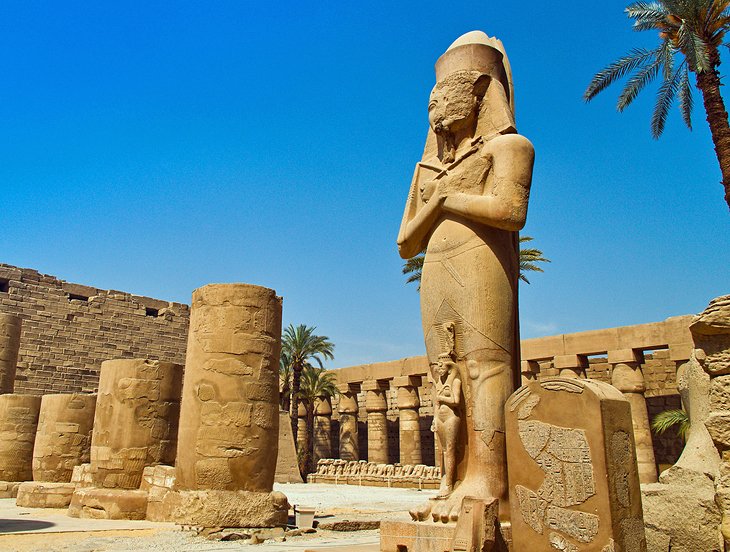
Over the centuries, some pillars and statues may have been felled, but Karnak's Great Temple of Amun remains one the world's most stunning man-made structures and one of Egypt's top tourist attractions.
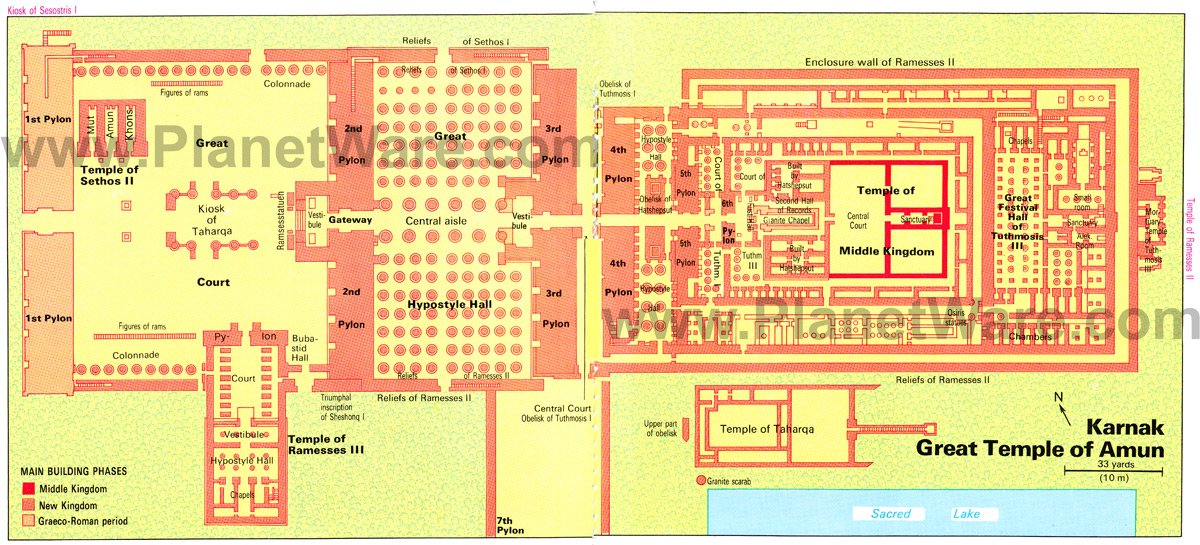
If you're short on time, concentrate your Temples of Karnak visit here in the complex's most audacious building. Our visitor's guide to Karnak's Temple of Amun will help you navigate the various sections of the temple while you're here.
On This Page:
- First Pylon
- Great Court
- Temple of Ramses III
- Second Pylon
- The Great Hypostyle Hall and the Triumphal Inscription of Sheshonq I
- Third Pylon
- Central Court
- Fourth Pylon
- Fifth and Sixth Pylon
- First Hall of Records
- Court
- Second Hall of Records
- Great Festival Temple of Tuthmosis III
- Botanic Garden
- Seventh Pylon
- Eighth Pylon
- History of the Temple of Amun
First Pylon
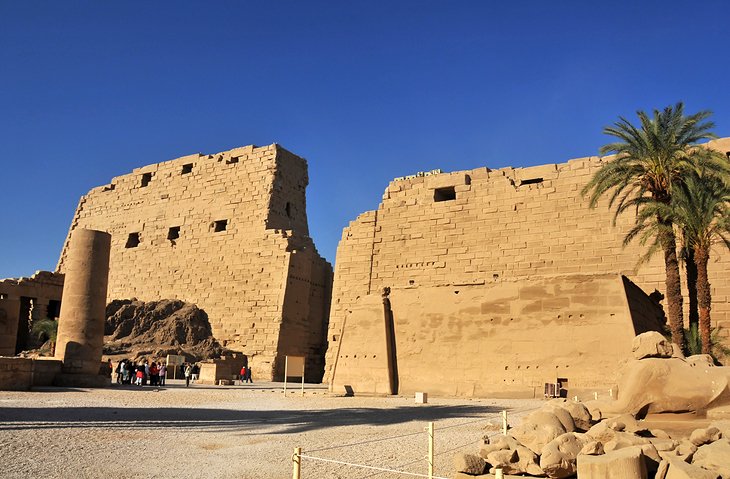
Built in the era of the Kushite pharaohs (25th Dynasty), the gigantic First Pylon is 113 meters wide with walls 15 meters thick, and still stands 43.5 meters high. It was left unfinished, and fragments of the scaffolding of sun-dried brick used during its construction are still visible.
Don't Miss: The rectangular terrace in front of the Pylon was subject to flooding in ancient times, as it shows by the marks on its front recording the heights reached by the inundation under the 21st-26th Dynasties.
Most people rush through this entrance to the temple, but if you look high up on the right-hand side of the doorway, you can spy an inscription recording the latitude and longitude of the principal Egyptian temples as established by the French savants who accompanied Napoleon's expedition to Egypt in 1799.
Opposite that inscription, on the left-hand side, is an inscription by an Italian learned society recording the magnetic deviation (10° 56") as calculated by them in 1841.
Great Court
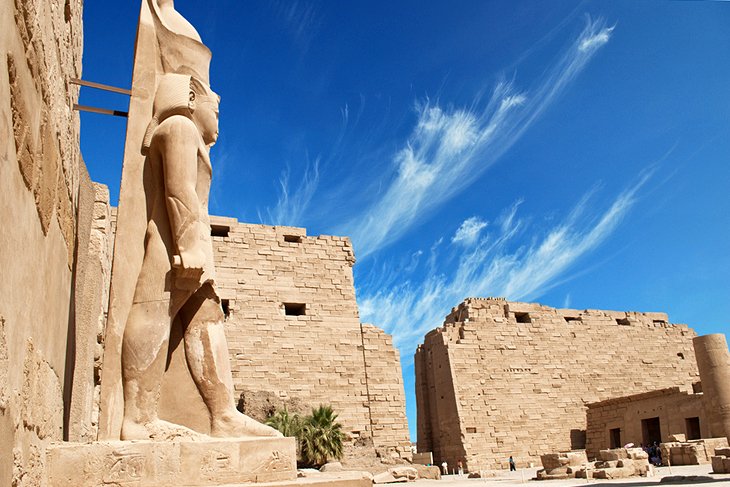
Beyond the Pylon, you come to the Great Court, which dates from the 22nd Dynasty. It is 103 meters wide by 84 meters deep with colonnades on both sides. The south colonnade is interrupted by the front part of Ramses III's temple.
In the north corner of the court is the small Temple of Seti II, which consists of three chapels dedicated respectively (from left to right) to Mut, Amun, and Khons, each with niches for the image of the deity.
The two pedestals in the middle of the court (only the base of the right hand one being preserved) were intended for statues.
Beyond the pedestals, still in the middle of the court, is the Kiosk of Taharqa. Of its original 10 columns, one, on the right, has survived complete with its open capital and abacus; the five on the left have been reconstructed.
The kiosk had doorways on all four sides; in front of the west door, to the right, is a recumbent sphinx. On the right hand column (restored 1927), the name of Psammetichus has been placed over that of the Kushite Pharaoh Taharqa (25th Dynasty). Adjoining it is the name of Ptolemy IV Philopator, which also appears on the abacus.
Temple of Ramses III
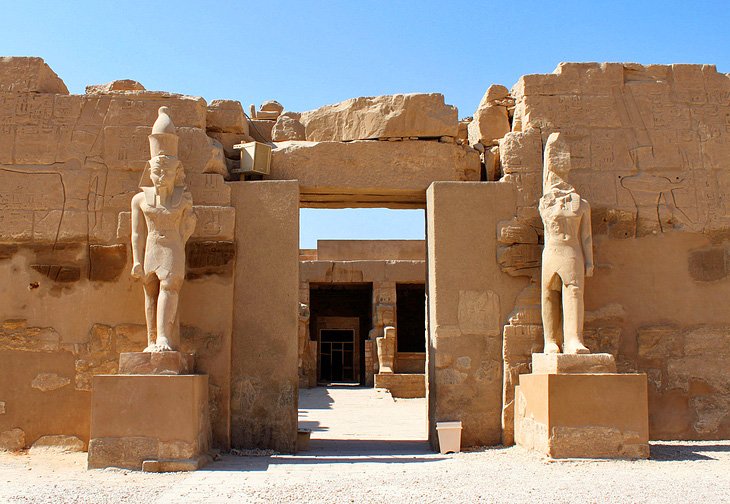
On the right-hand side of the court is the Temples of Ramses III, dedicated to Amun, which is perhaps the best example of a simple Egyptian temple built on a unified plan.
Beyond the temple's Pylon is a Court, with covered passages on either side, the roofs of which are supported on eight Osiris pillars.
On the rear walls of the Pylon towers, Ramses is shown receiving the sign for "jubilee" from Amun, signifying that he would celebrate many more jubilees.
On the far side of the court is the Vestibule of the temple proper, which stands on a higher level. Along the front are four Osiris pillars, while to the rear are four columns with closed capitals.
From the Vestibule, a doorway leads into the Hypostyle Hall, which has eight columns with closed capitals. Beyond this are three chapels dedicated respectively from left to right to Mut, Amun, and Khons.
Don't Miss: The door on the east side of the court of Ramses III's Temple leads into the Bubastid Hall. The reliefs and inscriptions in this hall are by rulers of the 22nd Dynasty and are particularly notable.
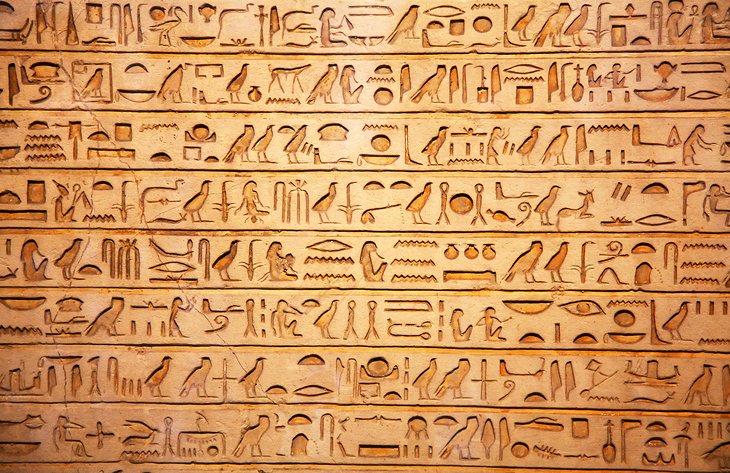
In particular, on the left hand (east) wall, you can see Amun depicted presenting the curved sword and palm branch (symbols of long life) to Osorkon I, while below, Khnum portrayed as holding the hieroglyph for "life" to the King's nostrils and Hathor suckling the King.
Second Pylon
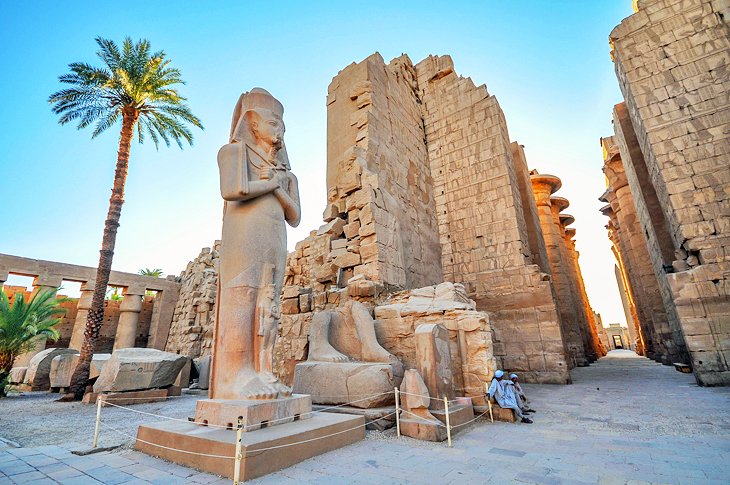
The Second Pylon, built by Ramses II, is badly dilapidated.
The towers have been freed from the ruins of later buildings erected in front of them using stone of the Amarna period.
In the center is the huge doorway, formerly preceded by a kind of small vestibule flanked by two statues of Ramses II: one of these (on the right) still stands, of the other, only the legs are left.
In the doorway, which bears the cartouches of Ramses I, Seti I, and Ramses II, an intervening door was built by Ptolemy VI Philometor and Ptolemy IX Euergetes II during their joint reign; the lintel of this is missing, but the jambs remain, with reliefs showing the King making offerings to the gods of the temple.
The inner side of the earlier doorway has reliefs of the Ptolemaic period with the same scenes on both sides.
The Great Hypostyle Hall and the Triumphal Inscription of Sheshonq I
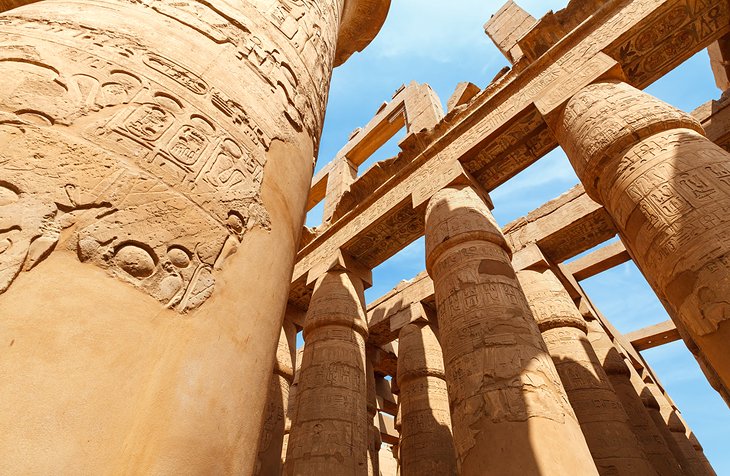
Beyond the Pylon is the Great Hypostyle Hall, justifiably regarded as one of the wonders of the world.
This huge hall still exerts an overwhelming effect on everyone who enters. Measuring 103 meters by 52 meters, it covers an area of more than 5,000 square meters.
The roof was supported on 134 columns in 16 rows. The two central rows, which are higher, consist of papyrus columns with open capitals, while the other rows have closed capitals.
The roof of the central aisle, 24 meters high, rested on the two central rows of columns and on one of the lower rows on each side, the difference in height being made good by square pillars on top of the lower columns.
Between these pillars were windows with stone lattice work (one of which, on the south side, is almost perfectly preserved).
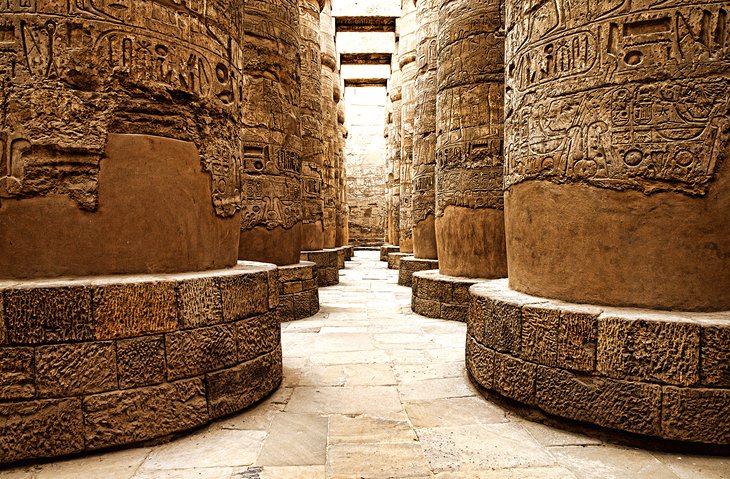
The walls of the hall, the shafts of the columns, the abaci, and the architraves are covered with inscriptions and reliefs of pharaohs making offerings, many of which have preserved their original coloring.
Those in the northern half of the hall (as far as the tenth row of columns), which date from the reign of Seti I, are in delicate low relief; those in the southern half, dating from the reign of Ramses II, are in cruder sunk relief.
Don't Miss: Among the fine reliefs of Seti I's reign, the most notable are those on the north wall.
To the left of the north side door on the lower side, you see Seti in front of the sanctuary, in which is the sacred barque of Amun, followed by Seti conducted into the temple by the falcon-headed Montu and Atum. Above, Seti is depicted in presence of the gods of Thebes.
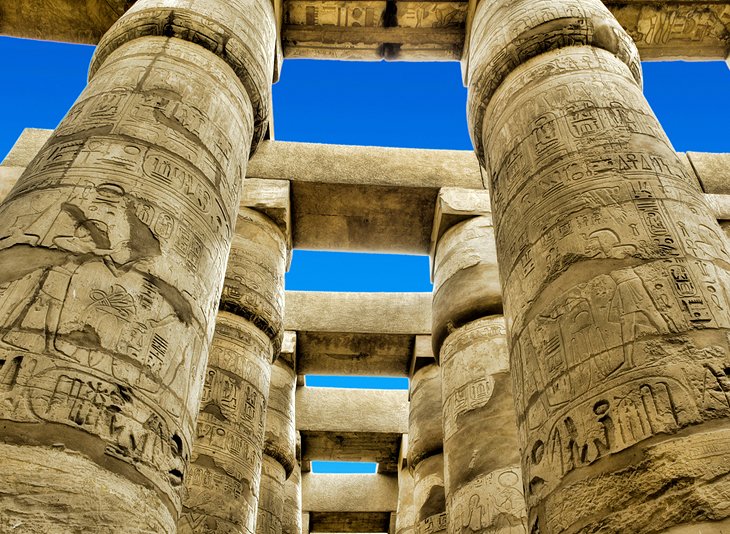
The outer walls of the Hypostyle Hall have historical reliefs depicting the victories of Seti I (north wall) and Ramses II (south wall) over the people of Palestine and Libya. They are best seen by afternoon light.
On the east end of the north wall, you see Seti in Lebanon, while below, a battle with the Bedouin of southern Palestine.
To the right and left of the doorway are two huge reliefs: Seti I holding enemies by the hair with his club raised to smite them; and Amun, with several rows of captured nations and cities, presenting the curved sword of victory.
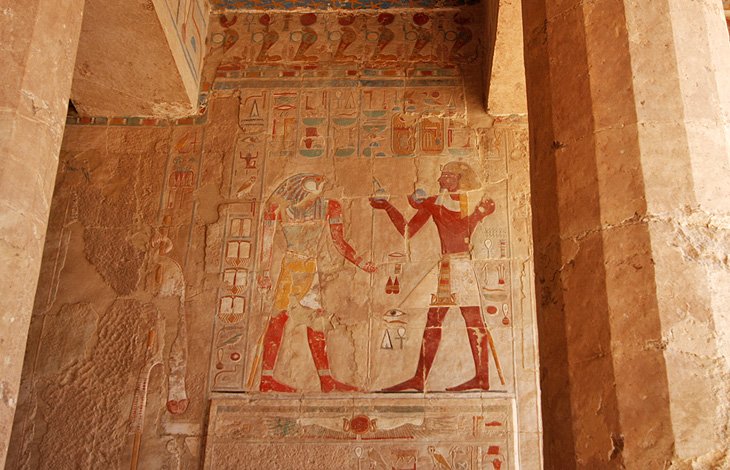
On the western part of the north wall, the reliefs begin at the far end and go from right to left.
On the top row, you see the storming of Qadesh in the land of Amor (northern Palestine): the pharaoh (face missing) shooting arrows from his chariot, which has overturned an enemy chariot, while to the right, on a tree-clad hill, the Fortress of Qadesh with its defenders pierced by arrows.
The middle row shows battle scenes with the Libyans, while the bottom row shows the battle with the Hittites in northern Syria.
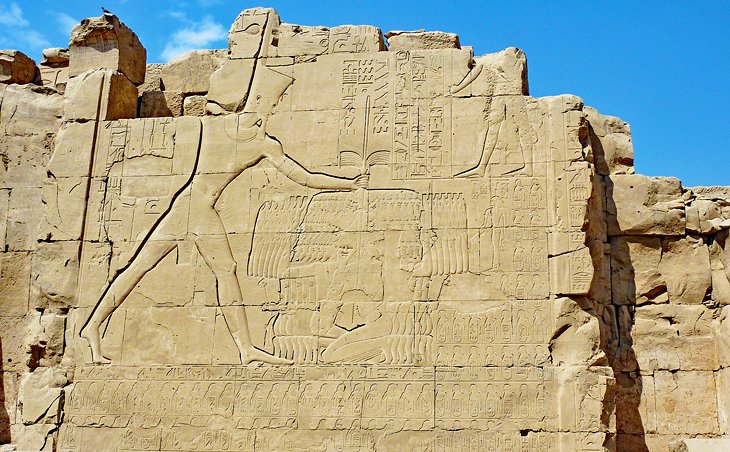
To the west of the reliefs, on the south end of the Second Pylon, is the Triumphal Inscription of Sheshonq I, the Shishak of the Old Testament. It celebrates the pharaoh's victory over Rehoboam of Judah, the son of Solomon.
To the left is a large figure of Amun holding the curved sword of victory in his right hand, and in his left, cords binding five rows of captured cities, each represented by a circuit of walls bearing its name and the upper part of the body of a fettered prisoner.
Below Amun is the protective goddess of the Theban nome, with a club, bow, and quiver, holding cords attached to five rows of prisoners.
To the right, the pharaoh (figure unfinished) holds a group of cowering prisoners by the hair and smites them with his club.
Third Pylon
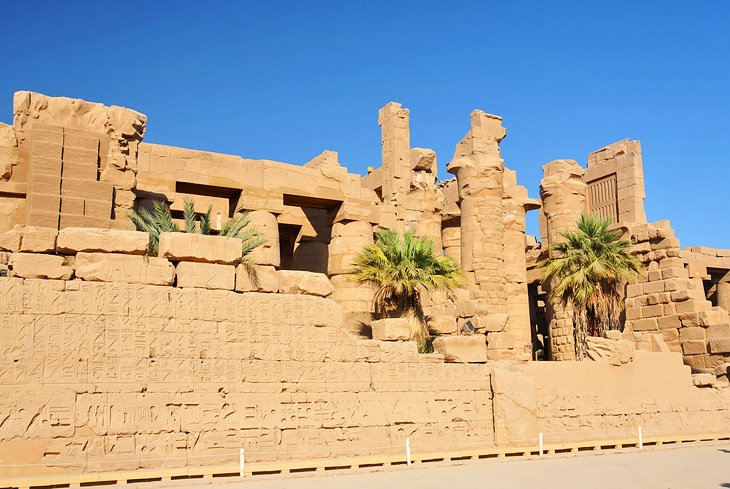
The rear wall of the Great Hypostyle Hall is formed by the Third Pylon, built by Amenophis III. Incorporated in its structure were large blocks decorated with reliefs from 13 earlier temples.
On the south tower is a long inscription (top part destroyed) detailing the gifts made by the pharaoh to Amun.
On the north tower are the last remnants of a relief depicting a ceremonial voyage on the Nile (the pharaoh on the sacred barque of Amun with another vessel).
Central Court
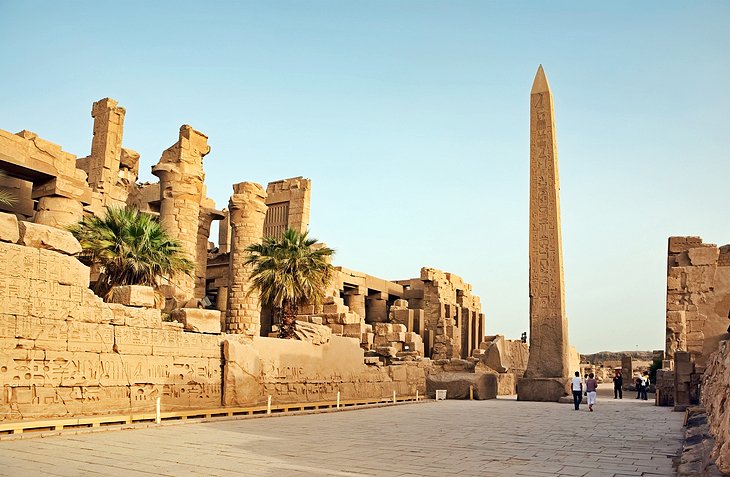
In the Central Court beyond the Third Pylon there were formerly four obelisks, two of them set up by Tuthmosis I and two by Tuthmosis II.
One of these obelisks is still standing, together with the bases of the other three. It is 21.75 meters high and is estimated to weigh 143 tons.
On each face of the obelisk are three vertical inscriptions, the central one being the dedicatory inscription by Tuthmosis I; the other two are additions by Ramses IV and VI.
The obelisks erected by Tuthmosis I marked the former entrance to the temple.
Fourth Pylon
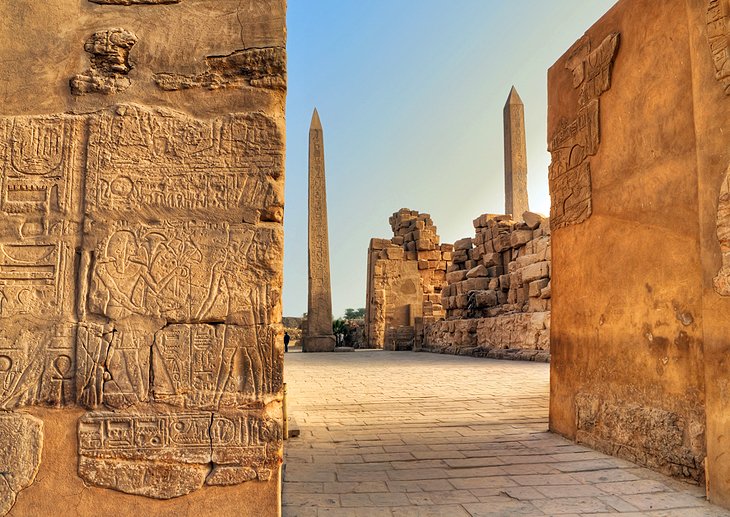
The Fourth Pylon, built by Tuthmosis I, is in a ruinous condition. The doorway, according to the relief inscription, was restored by Alexander the Great.
Beyond the pylon is a colonnade, also ruined, which originally contained huge statues of Osiris set in niches and two obelisks of Aswan granite erected by Queen Hatshepsut, the tips of which were covered with electrum (an alloy of gold and silver).
The right hand (south) obelisk lies broken on the ground, its upper part on a heap of rubble to the right; on the base are long inscriptions celebrating Hatshepsut's power as pharaoh.
The left hand obelisk still stands erect to a height of 29.5 meters and an estimated weight of 323 tons. On each of the four faces is a vertical inscription recording the dedication of the obelisks and the fact that they were constructed in only seven months.
On the upper part are reliefs depicting Hatshepsut, Tuthmosis I, and Tuthmosis III making offerings to Amun; the names and figures of Amun were defaced by Amenophis IV but restored by Seti I.
Against the wall to the left is a granite statue of Tuthmosis kneeling and holding an altar in front of him.
Fifth and Sixth Pylon
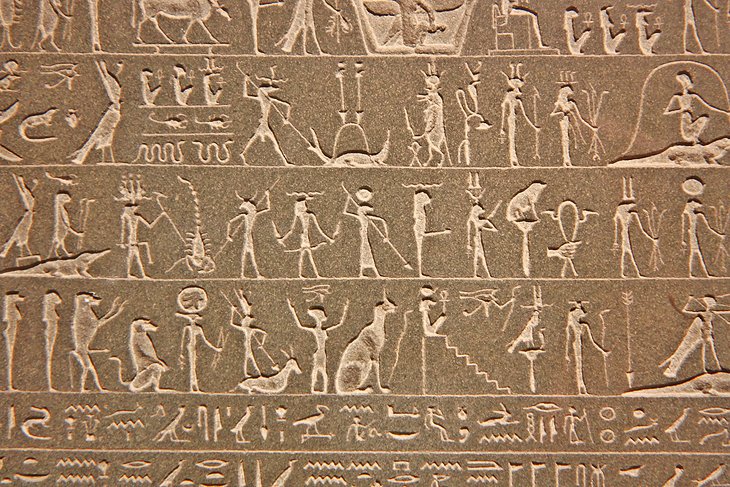
Beyond the Fifth Pylon built by Tuthmosis I, are two small antechambers, now in a state of ruin, built by Tuthmosis III in front of the Sixth Pylon.
To the right and left are courts with colonnades of 16-sided columns and statues of Osiris - remnants of the large court built by Tuthmosis I around the temple of the Middle Kingdom. In the passage leading to the north court is a colossal seated figure of Amenophis II in red granite.
The Sixth Pylon built by Tuthmosis III, the last and smallest of all, is also in a ruined state. On the walls to the right and left of the granite central doorway are lists of the cities and tribes subdued by Tuthmosis III: to the right, the people of the southern lands; to the left, "the lands of the Upper Retenu, which his majesty took in the miserable city of Megiddo."
First Hall of Records
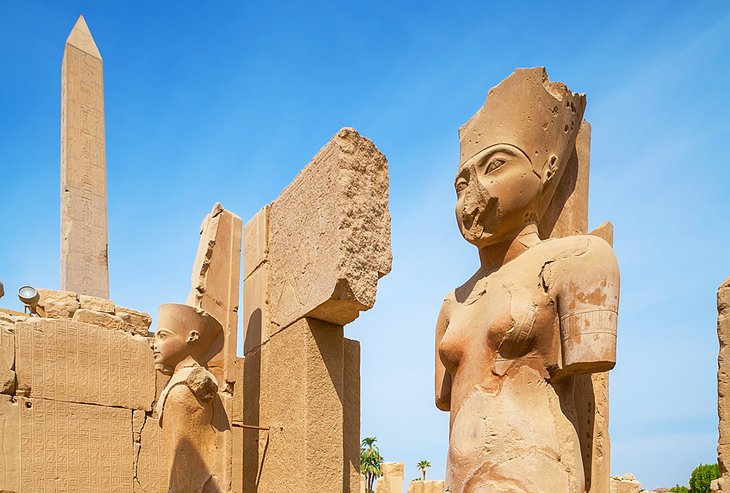
The Sixth Pylon leads you into the First Hall of Records, built by Tuthmosis III in a court, which he had constructed previously.
Here, stand two granite pillars, which once supported the roof - the one on the right (south) with the lotus; the one on the left with the papyrus, the emblems of Upper and Lower Egypt.
Also in the First Hall of Records, you can see the magnificent colossal statues of Amun (much restored) and the goddess Amaunet, of reddish sandstone, dedicated by Tutankhamun, whose name was later chiseled out and replaced by that of his successor Horemheb.
Court
To the left and right of the Hall of Records is the Court constructed by Tuthmosis III, with a colonnade of papyrus cluster columns with 16 shafts.
On the rear side of the doorway leading to the southern part of the court are reliefs of Seti II. In the east wall, on the facade of Hatshepsut's building, is a false door, once lavishly adorned with gold and lapis lazuli.
On the south side are five chapels dedicated to the cult of Amenophis I.
The granite chapel, still containing a base for the sacred barque, was built during the reign of Philip Arrhidaeus (323-317 BC), probably on the site of an earlier structure built by Tuthmosis III, fragments of which lie outside the chapel.
Constructed of pink granite, it is divided into two parts, with the front chamber opening to the west and the rear one to the east. In the east wall of the rear chamber is a double window with four steps leading up to it. Both are covered internally and externally with reliefs, some of them having well-preserved coloring.
Don't Miss: The reliefs in the granite chapel are well worth a closer look.
On the interior walls, in the front chamber, the reliefs show Philip making offerings to Amun in his various forms and performing other ritual actions (figures and inscriptions picked out with bluish green pigment).
On the outer walls, on the south side of the front chamber, ceremonies at the pharaoh's entrance into the temple are depicted, along with a scene where the sacred barque of Amun is borne in a procession by priests.
The reliefs in the rear chamber are larger, but less well-preserved than those in the front chamber.
Second Hall of Records
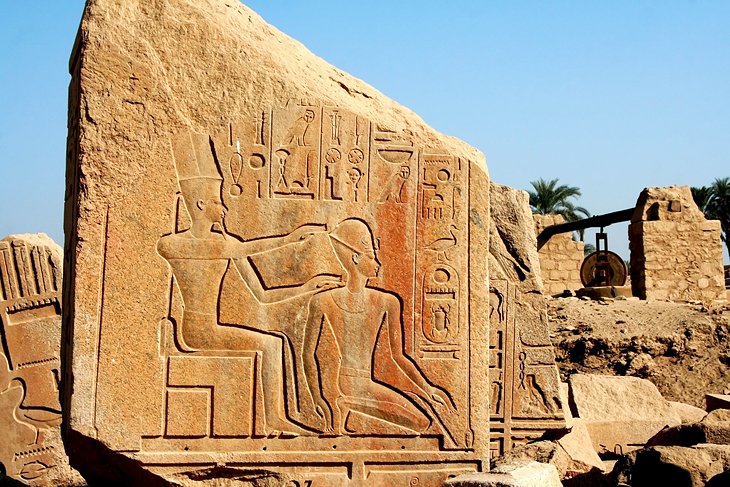
On the north wall of the Second Hall of Records of Tuthmosis III, which surrounds the chapel, are long inscriptions celebrating the pharaoh's military exploits.
To the right of the black granite doorway, above the inscription, is a relief of Tuthmosis III presenting gifts (two obelisks, vases, necklaces, and chests) to the temple.
The rooms on the north and south sides of the Hall of Records, now largely in ruins, were built by Hatshepsut and decorated with reliefs, which were later chiseled out or replaced by the names of Tuthmosis III. Here, too, is a statue of Amenophis II.
To the east of this, on a lower level, an area of rubble is all that remains of the earliest temple of the Middle Kingdom. The rooms built by Tuthmosis III can be identified on the north side; in front of them was a passage in which statues of high dignitaries especially deserving of honor were set up by the Pharaohs.
Great Festival Temple of Tuthmosis III
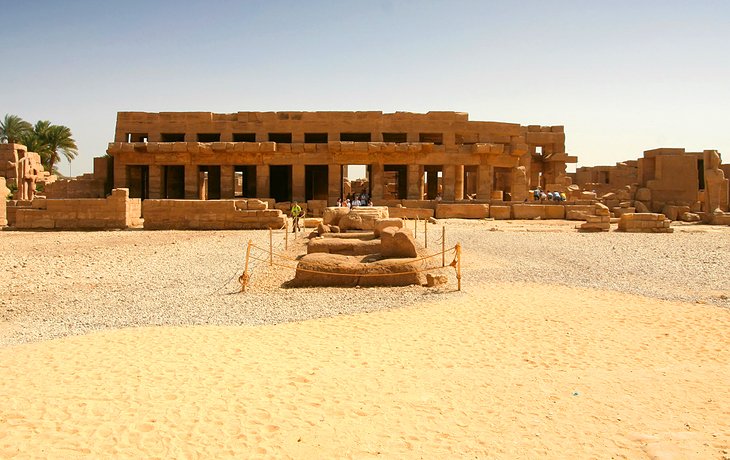
The Great Festival Temple of Tuthmosis III is entered by the main doorway at the southwest corner, in front of which are the stumps of two 16-sided columns and two statues of the pharaoh as Osiris (only the left-hand one being preserved complete).
From here, turn left through the antechambers into the Great Festival Hall, a five aisled basilica 44 meters long and 16 meters deep.
The roof of the three central aisles was borne on two rows of 10 columns and 32 square pillars.
The tent pole columns are unique, indicating that the central aisles were conceived by the builder as a large festival tent. The pillars supported together with the side walls, the pentagonal roofing slabs of the lateral aisles, and also additional small pillars and architraves helped to support the roof of the central aisles.
The reliefs on the pillars show Tuthmosis III in the presence of the gods. In the hall are numerous torsos of statues, which were found here.
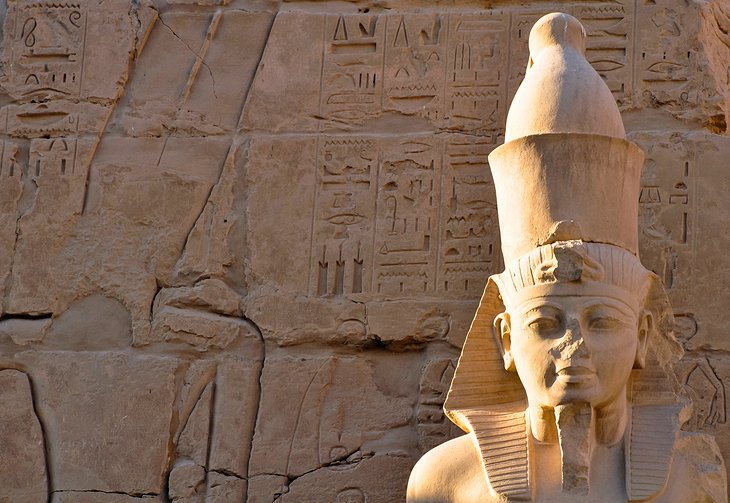
At the southwest corner of the hall is the chamber in which the Tablet of Karnak was found - a list of Egyptian rulers from the earliest times down to the 18th Dynasty, now in the Bibliotheque Nationale in Paris.
The chamber was probably used for storing the statues of earlier pharaohs, which were borne in procession by the priests.
At the north end of the three central aisles are three chapels; in the most westerly is a colossal group of Tuthmosis III between Amun and Mut.
From the northwest corner of the hall is an antechamber with a doorway that leads into a narrow corridor.
On the north wall of the corridor are fine reliefs depicting Tuthmosis III offering incense to an ithyphallic Amun; the pharaohs pouring water over Amun, with priests and male and female singers coming in on the right, and the pharaoh pouring water on an altar and burning incense in the presence of Amun.
From the northeast corner of the hall, a staircase mounts within a tower-like structure to a room containing an alabaster altar, which may have served some astronomical purpose. The rooms on the east side of the hall are in a ruinous condition.
Botanic Garden
To the northeast from here, is a chamber with two pillars, which adjoins a chapel (ruined) with a large granite altar.
The central door in the east aisle leads to the three rooms, which have preserved only the lower parts of their walls.
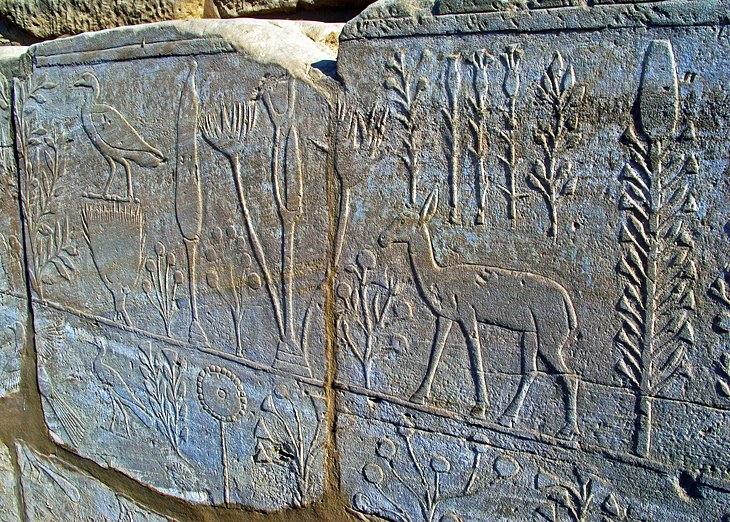
On the north side, reached by steps, is a small room, known as the "Botanic Garden," the roof of which was borne on four well-preserved papyrus cluster columns with closed capitals.
On the lower part of the walls are representations of plants and animals brought from Syria to Egypt by Tuthmosis III in the 25th year of his reign.
Seventh Pylon
Adjoining the south end of the Central Court of the Temple of Amun is a badly ruined court flanked by walls and bounded at the far end by the Seventh Pylon.
In this court stood two temples, both demolished during the reign of Tuthmosis III; one dated from the Middle Kingdom, the other was built by Amenophis I.
The fine limestone blocks from these temples, decorated with reliefs, were built into the Third Pylon erected by Amenophis III.
Here, too, is the Favissa or offerings pit (now filled in) where a huge number of statues of many different periods (779 of stone and no fewer than 17,000 of bronze) were found between 1902 and 1909.
Most of these statues are now in the Egyptian Museum in Cairo. They came from the Temple of Amun, and were probably buried here when they were no longer required.
The Seventh Pylon was built by Tuthmosis III, whose victories are celebrated on the front and rear faces. Like the Eighth Pylon, it lay on the south approach to the Temple of Amenophis I, which was pulled down by Tuthmosis III.
In front of the north facade are seven colossal statues in red granite depicting rulers of the Middle and New Kingdoms. The south facade is fronted by the lower parts of two gigantic statues of Tuthmosis III. A large obelisk erected by Tuthmosis III sits in front of the more easterly of these figures.
Beside the Seventh Pylon is a modern door by which visitors usually leave the temple to see the reliefs on the outside of the south wall of the Great Hypostyle Hall.
Eighth Pylon
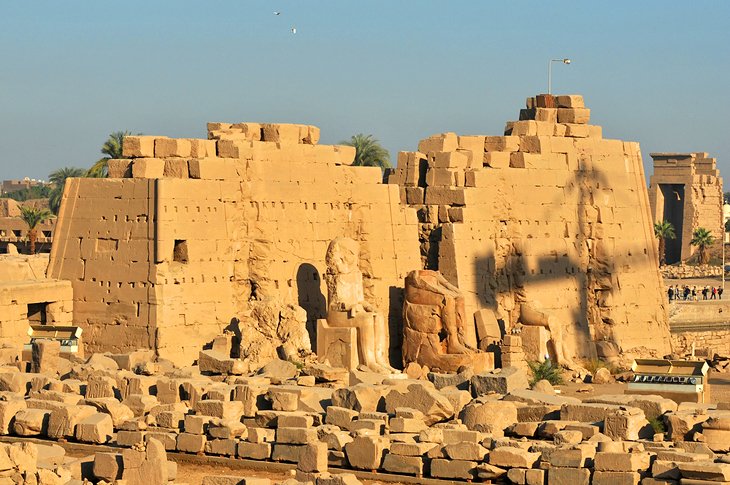
The Eighth Pylon was built by Queen Hatshepsut and is thus the oldest in the whole temple complex. Despite its age, it is relatively well preserved.
Hatshepsut's names were erased from the reliefs by Tuthmosis II. Seti I restored the reliefs after their destruction by Amenophis IV, in many cases inserting his own name in place of those of the earlier pharaohs.
The reliefs on the pylon's right hand (west) tower are the most interesting.
Make sure to check out the relief of Seti I (originally Hatshepsut) being conducted into the temple by the falcon-headed god Montu, who holds the hieroglyph for "life" to his nostrils, with priests bearing the sacred barque behind the king.
Also, if you look up to the upper row, you'll see Tuthmosis II (originally Hatshepsut) standing before Amun and Khons, with the goddess Werethekau and Thoth behind, who inscribes his name on a palm branch.
History of the Temple of Amun: Ancient Egypt's Most Important Religious Sanctuary
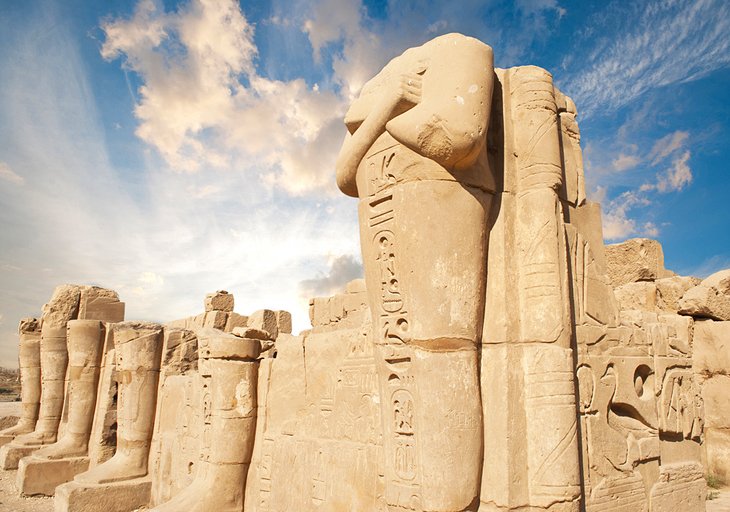
The Great Temple of Amun was founded at least as early as the beginning of the 12th Dynasty (c. 1991-1785 BC).
Amenophis I built a second temple alongside the main temple, but this was soon removed.
When Tuthmosis I made Thebes (modern-day Luxor) capital of the New Kingdom, the original modest temple no longer seemed adequate to the power of the god, and the pharaoh added a large court bounded on the west by a Pylon (V) and surrounded by colonnades with Osiris pillars.
Later, he erected another Pylon (IV) in front of this with an enclosing wall, set up two obelisks in front of it, and built a colonnade between the two pylons.
In the reign of Hatshepsut, various additions and alterations were made in the interior.
In front of the temple of the Middle Kingdom, in Tuthmosis I's court, she built a special shrine and set up two obelisks between the Fourth and Fifth Pylons, besides rebuilding the colonnade itself.
Hatshepsut's stepson, nephew, son-in-law, and co-ruler Tuthmosis III continued to make alterations when he became sole ruler, pulling down most of the colonnades in Tuthmosis I's court and replacing them by rows of small chapels.
The Sixth Pylon was now built, and the court between this pylon and Hatshepsut's shrine, which had been enlarged by the addition of a vestibule, was surrounded by colonnades.
Tuthmosis I's colonnade, between the Fourth and Fifth Pylons, was extensively rebuilt, apparently with the object of concealing Hatshepsut's obelisks from view. In front of Tuthmosis I's obelisks, two new ones were set up.
Some 20 years later, Tuthmosis III resumed his building activity, adding the two Halls of Records and the vestibules between the Fifth and Sixth Pylons, as well as building the large Festival Temple at the east end. On the main front of the temple, Amenophis III built still another pylon.
All these 18th Dynasty buildings, however, were thrown into the shade by the work of the 19th Dynasty pharaohs.
Ramses I erected the Second Pylon, and between this and the Third Pylon, Seti I and Ramses II built the great Hypostyle Hall, which has remained one of the chief marvels of Egyptian architecture. Ramses II also built a new enclosure wall. With this, the building of the great temple came, for the time being, to an end.
The temples erected by Seti II and Ramses III were independent buildings outside the main temple. Then the Libyan Kings of Bubastis (22nd Dynasty) revived the traditions of the earlier pharaohs. In front of Ramses I's pylon, Sheshonq built a large court with colonnades along the sides, incorporating half of Ramses III's temple in it and erecting a large pylon (I) on its west side.
Later, the Kushite Pharaoh Taharqa (25th Dynasty) built a kiosk-like building in the center of this court, with 10 colossal columns.
Thereafter, the temple remained largely unaltered, apart from the addition of the granite Chapel of Philip Arrhidaeus. The decline and decay of the temple began in the Roman Imperial period.
More Related Articles on PlanetWare.com
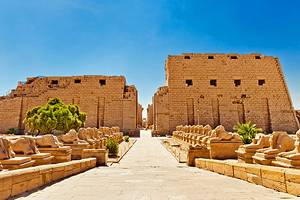
Exploring Luxor: The Temple of Amun is part of the bigger Temple of Karnak complex, which is Luxor east bank's main highlight. In Luxor town though, you'll also find the fabulous museum and Luxor Temple. Over on the west bank, among the glut of temples, the tombs of the Valley of the Kings are the major sight.
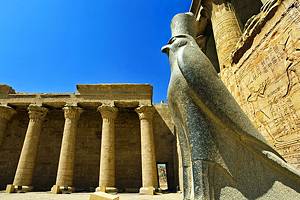
Luxor Day Trips: For more temples, head south to the Nile-side Temple of Kom Ombo, with its columns soaring above the riverbank, and Edfu's Temple of Horus, with its giant hieroglyphics, are an excellent day trip from town.