Slightly more than 100 islands make up the Shetland (from the old Nordic "hjaltland") and they form the northern outposts of the British Isles. Surrounded by the swirling Atlantic Ocean and about 100mi/160km from the northeastern coast of Scotland, the Shetland Islands lie on about the same latitude as the Norwegian city of Bergen, the southern tip of Greenland, the Gulf of Alaska and southern Siberia. However, unlike some of these remote parts of the world, the Shetlands are not frozen wastes. Whipped by wind and rain they may be, but the Gulf Stream provides a relatively favorable climate, although the scope for land cultivation is not as great as on the Orkney Islands.
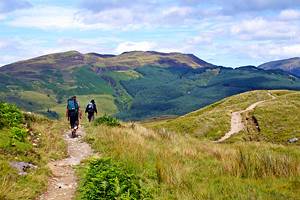
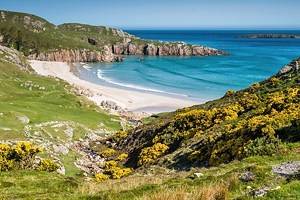
Temperature fluctuations are not that great and a fresh, salty breeze seems to be ever present. At midsummer the sun stays above the horizon for 19 hours and twilight ("simmer dim") persists between sunset and sunrise. The islands, made predominantly of schist but also "old redstone" and granite, have breathtakingly beautiful coastal landscapes and bays (the so-called "Voes") that have cut deep into the land as a result of Ice Age glaciation. Compared to the Orkney Islands, the Shetlands present a more undulating picture. Heathers and broom flourish on the almost treeless hills of the larger islands, together with narcissi, primulas, marsh marigolds, red catchfly, orchids and wild thyme, whose colors contrast strikingly with the blue of the water, the green of the more fertile hollows and the brown of the open moorland. In many places peat is still cut for burning on domestic stoves. The Shetlands are popular with lovers of harsh, almost primeval nature.
Walkers and mountain bikers will find plenty to challenge them and watersports enthusiasts can choose between over 350 lakes and the vast Atlantic Ocean which surrounds the islands. The lochs, well stocked with brown and rainbow trout, are close to paradise for fly fishermen, but there are also many opportunities for deep-sea fishing. For some golfers the chance of a round of golf at midnight on Britain's northernmost golf course is irresistible. Birdwatchers will be drawn to such islands as Fair Isle, Mousa, Noss and near Herma Ness to watch such sea birds as Arctic terns, shearwaters, razorbills, gannets, fulmars and the amusing puffins, known here as "Tammy Noirie". Out on the moors live great skuas ("bonxies"), Arctic skuas, grouse, merlins and golden plovers, while on the lochs shovelers and rain geese are native species. Otters, seals and gray seals enjoy the protection of the sheltered bays and with a bit of luck on a short sea cruise it may be possible to catch a glimpse of dolphins, porpoises and even whales.
The history of the Shetland Islands is closely tied to that of the Orkneys and some spectacular Stone Age sites have been uncovered proving that prehistoric man was able to sustain a living on these remote islands. Boats with dragon figureheads and full of Viking explorers in search of new territories landed here and subjugated the native Picts. The Scandinavian settlers retained their control over the islands until the 15th century and their influence is still clearly in evidence. In the last 20 years, however, the two island groups have had to come to terms with change on a grand scale: the discovery of North Sea oil has had a dramatic effect on the Shetland Islanders' way of life. More recently the loss of the oil tanker Braer and its cargo off the southern tip of Mainland was an example of how crude oil can wreak havoc on the environment.
Some 22,000 Shetlanders inhabit 13 of the islands, with more than half living on Mainland island. The main source of income for the native Shetlanders is farming, predominantly sheep-rearing for the highly-regarded Shetland wool. This is then used to produce jumpers and other warm woolen goods, often to new patterns, but always in accordance with the long-established style. Much of this work is done by homeworkers (follow the road-signs) but some spinning mills and wool factories have opened up on the islands and their products are marketed by the Shetland Knitwear Trades Association, an organization set up in 1983. Among the best-known patterns are those created by the knitters of Fair Isle, a remote Atlantic island with a huge bird population. Other popular souvenirs include the handmade silver and gold jewelry based on Nordic symbols.
The farmland surrounding the crofters' homes produces very meager yields. Fishing and salmon farming, on the other hand, are much more profitable, although both have suffered from the decline in the herring stocks and also oil pollution from the offshore drilling rigs. The loss of the Liberian oil tanker Braer in 1993 on the south coast of Mainland turned out to be not quite as serious as was first thought but it showed the islanders how easily the oil industry could damage fish stocks, and thus their livelihood.
Oil is, of course, the third mainstay of the local economy. When massive reserves of oil were discovered in the East Shetland Basin's Brent Field in 1972, the Shetland Islanders were able to look forward to years of prosperity. The unemployment figures on the islands are the lowest in Scotland, a country where joblessness is otherwise well above the UK average. The discovery of oil brought with it a large airport, new roads, Europe's largest oil terminal and thousands of oil workers from all over the world. The British government - unusually - allowed the island authorities a free hand in their negotiations with the oil companies. Now the initial boom has receded, a slightly more sober attitude has returned. Output has stabilized and many of the supply flights out to the oil rigs start from Aberdeen. Attempts have been made in recent years to improve facilities for tourism which is set to play a more important role in the islands' future.
Perhaps more than on the Orkneys, the influence of the islands' Nordic forefathers is keenly felt. The islanders are, after all, more oriented towards Norway and the Faroes than the Scottish mainland and their language exhibits a greater Nordic element than that of the Orcadians. Most place-names are of Nordic origin.