Exploring Monreale Cathedral: A Visitor's Guide
One of Sicily's top tourist attractions, the cathedral at Monreale was conceived as a political statement, as well as an artistic one. The result is the most important monument to the artistic tastes of the Normans in all of Sicily.
The entire concept of the Norman kingdom as the highest secular and religious authority is represented here in incomparable fashion. With its cycle of mosaics on a gold ground and its extraordinary cloister, the cathedral can rightly claim a place in the highest ranks of Europe's art history.
The cathedral was built by William II after the English archbishop of Palermo sought, with the solid backing of the Pope, to assert his authority over the king by refusing to honor his father's wishes to be buried at Cefalù, instead interring him at Palermo Cathedral. William II immediately set about building a bigger and more artistically inspired cathedral, appointing his own archbishop, and making his cathedral the royal pantheon. The results survive today almost exactly as built in the 1100s.
See also: Where to Stay near Monreale Cathedral
On This Page:
Mosaics
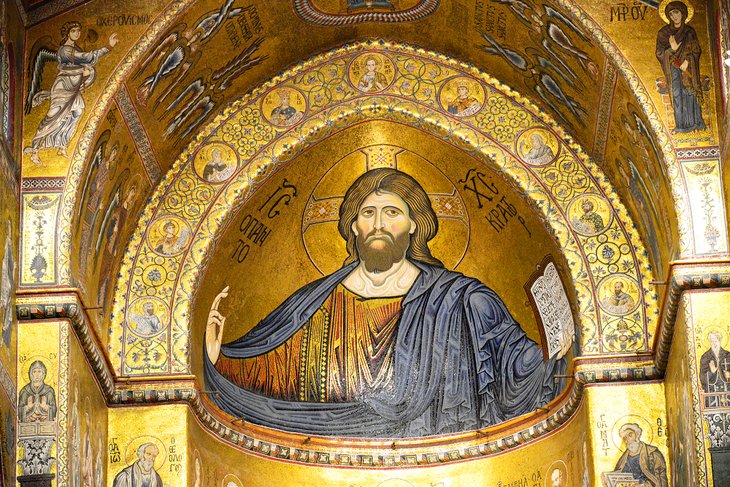
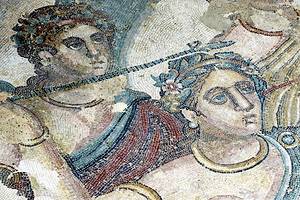
Although Monreale Cathedral moves away from Eastern Byzantine concepts of space with a basilica floor plan, the spirit of Byzantine culture is very much present in the superb mosaics that cover every available surface.
That the artists from Constantinople and local mosaicists were able to cover all the walls–6,340 square meters–in the short time between 1179 and 1182 is nothing short of amazing, but that they achieved such artistic quality in the process is simply overwhelming.
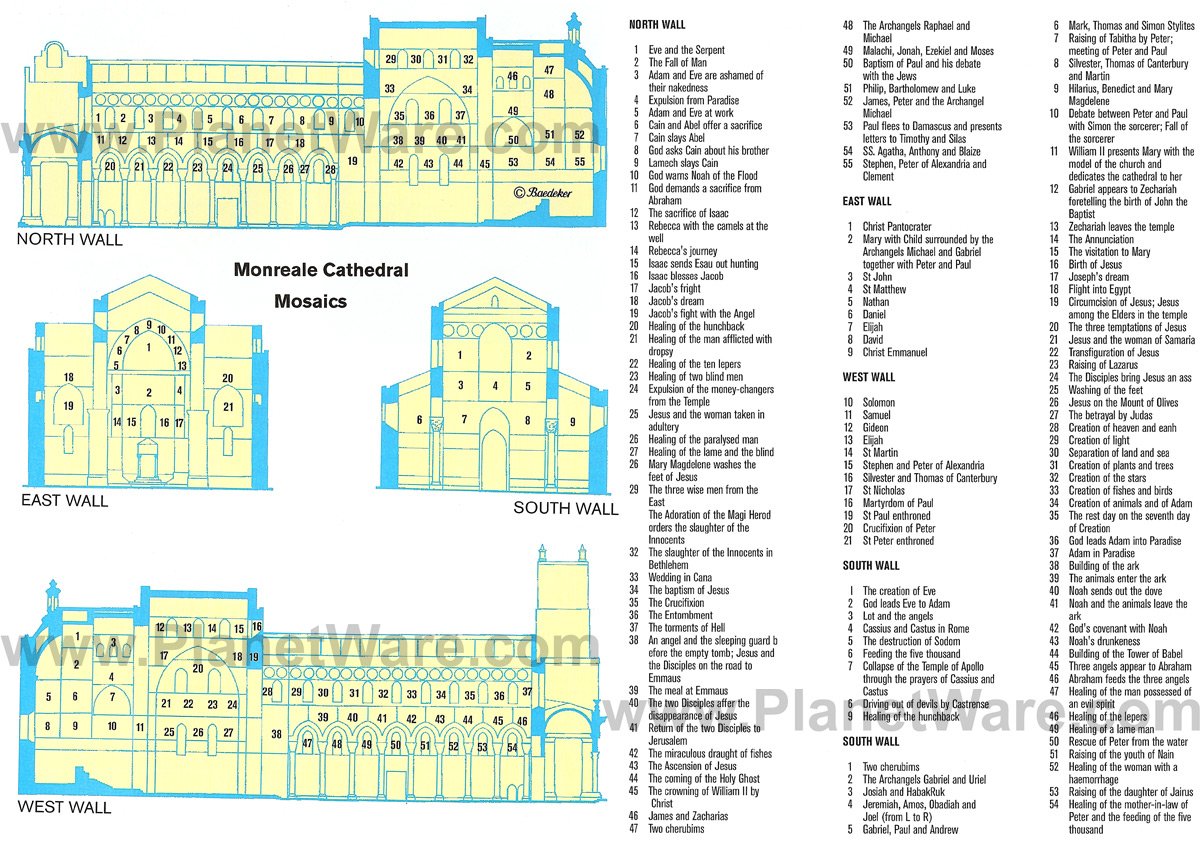
To follow both the Old and New Testaments, begin in the nave on the south wall of the central aisle, at the left (east) end, with the upper row of pictures, and move clockwise. You'll begin the story of the Creation here, continued on the shorter west wall with the creation of Eve, and on the north side, the Fall of Man, expulsion, and Cain and Noah's orders to build the ark. Continuing on the south side, you'll find Noah's ark and continue through Abraham and Jacob.
The transept is devoted to the life and Passion of Jesus, the Resurrection, and the apostles Paul and Peter, ending on the north wall with the Passion, Crucifixion, and the risen Christ. The saints, archangels, and apostles fill the apse, reaching a climax in the half-dome of the central apse with the monumental picture of Christ the Pantocrator.
Cloister
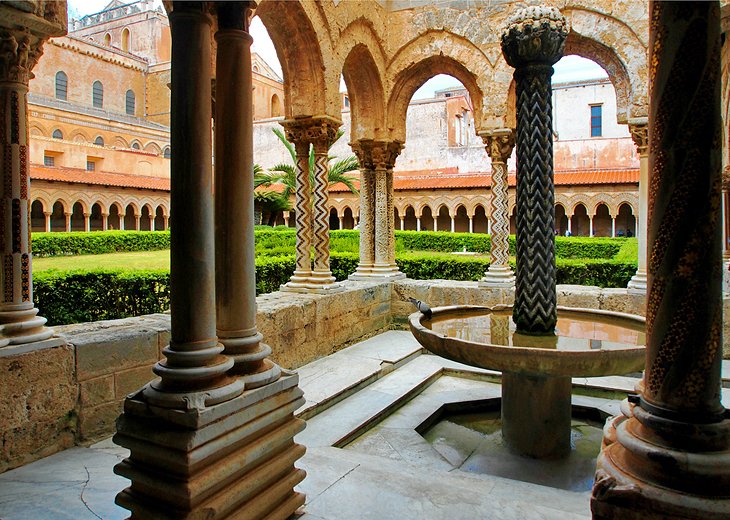
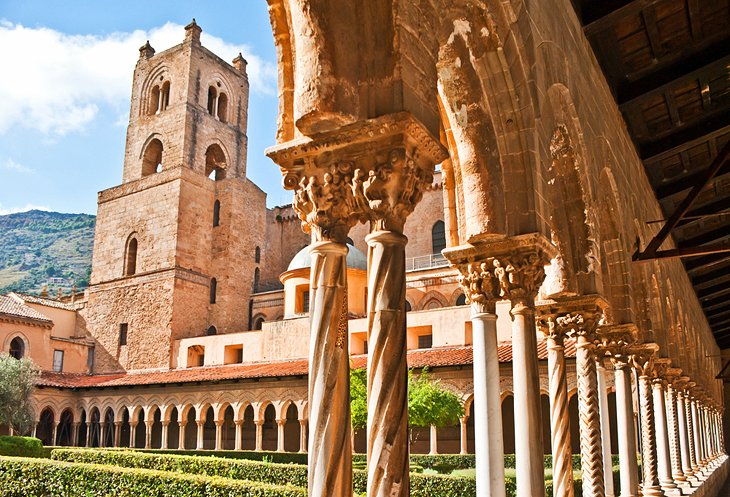
Breathtaking as the mosaics are, some would argue that the artistry in the cloister is every bit as spectacular. It is the most significant remnant of the former Benedictine abbey, which was also built on William's instruction. The 26 arches on each of the four sides open on to the luxuriant garden, and are supported by 228 double columns with double capitals.
These columns are either smooth or inlaid with colored stones, no two pairs alike, and in the corners, you'll find four smaller columns with relief work. The detail in the stone carving of the capitals is not only exceptional, but the subjects are engaging– whimsical animals, human figures, mythical beasts, and other motifs are executed in infinite detail.
In one corner there is a fountain with ornamented columns of even more exceptional work, and in the center, water pours from a pillar with a zigzag pattern and sculptured decoration at the top. Even more imaginative than the columns is the sculpture on the double capitals, featuring plants, animals, acrobats, archers, griffons, and other fantastic creatures, as well as biblical themes. Look for the 19th capital on the west side, which shows King William II offering the model of the church to the Madonna (presumably bypassing the Archbishop and the Pope himself).
Nave
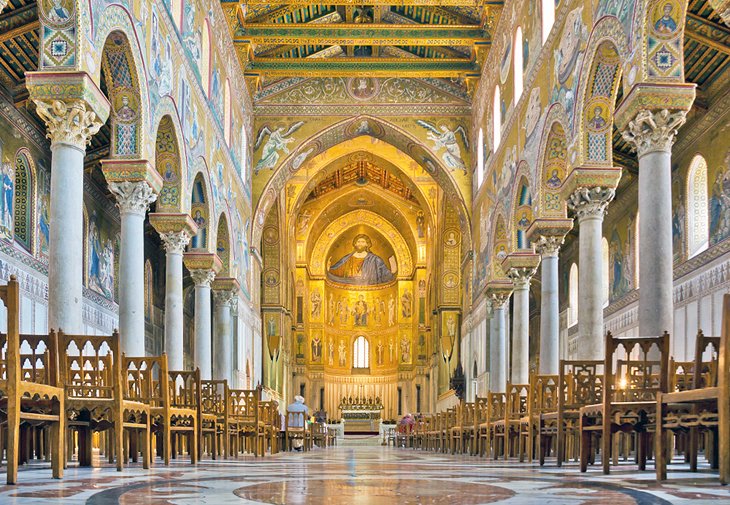
From the mystically shimmering gold background throughout the nave emerge biblical figures and scenes, a complete cosmos of pictorial narration. The nave has three aisles separated by two rows of nine columns with richly carved Corinthian capitals that support ogival (pointed Gothic) arches. The central aisle has a beautifully painted open roof truss.
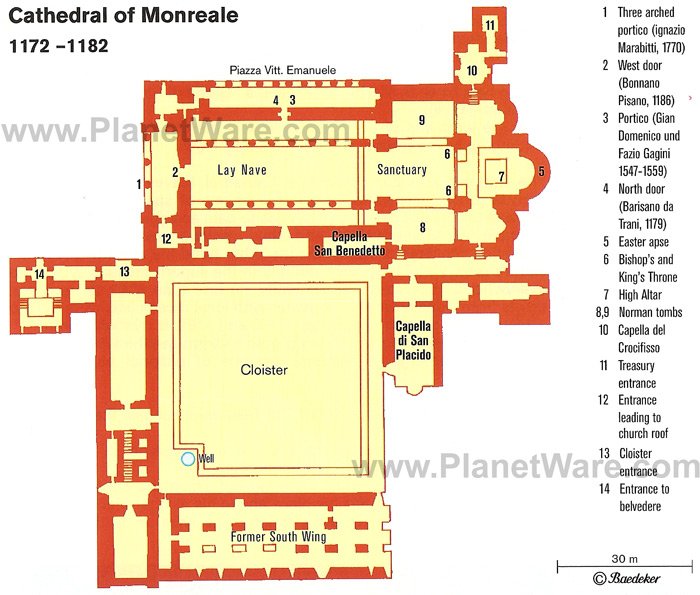
The marble floor dates from the time of the original building, with only a few refurbishments in 1560. The central aisle is composed of Old Testament scenes, and the side aisles show the miracles of Jesus. In the south side aisle is the entrance to the 16th-century Cappella San Benedetto with early 18th-century reliefs by G. B. Marino and a Gloria di San Benedetto by I. Marabitti, completed in 1776.
Sanctuary
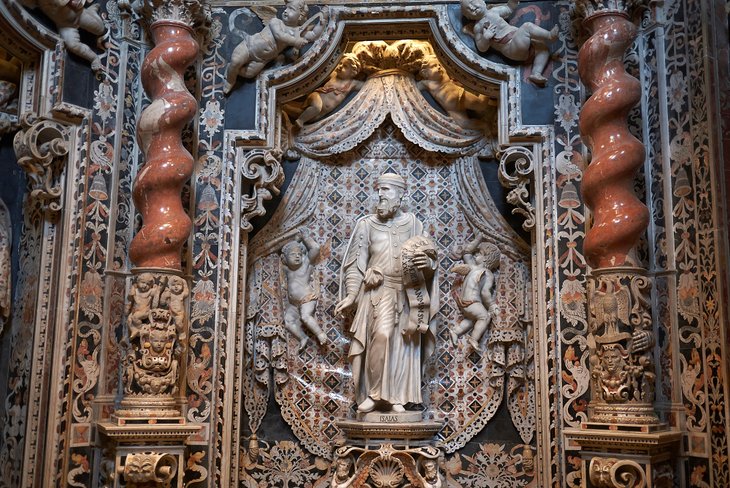
Separated from the choir by a barrier and slightly raised, the Sanctuary begins at the transept and is almost as long as the lay portion of the nave. In common with Byzantine Eastern Orthodox tradition, it consists of three areas: a chancel between a prosthesis, where the Eucharist is prepared, and diaconicon (sacristy).
In front of the crossing pillars in the central aisle, underneath mosaic pictures of William II, stand the thrones of the king (on the left) and the bishop (on the right). Look in the right-hand aisle of the sanctuary for the 12th-century tombs of the Norman kings: the porphyry sarcophagus of William I and the marble sarcophagus of William II.
On the left side are the tombs of William I's wife and younger sons. On the left wall is the urn with the heart of the canonized French King Louis IX, who died in 1270 during his crusade to Tunis. At the left side of the sanctuary are the 17th-century Cappella del Crocifisso and the cathedral treasury with reliquaries, vestments, and other ecclesiastic works of art.
Façade and Exterior
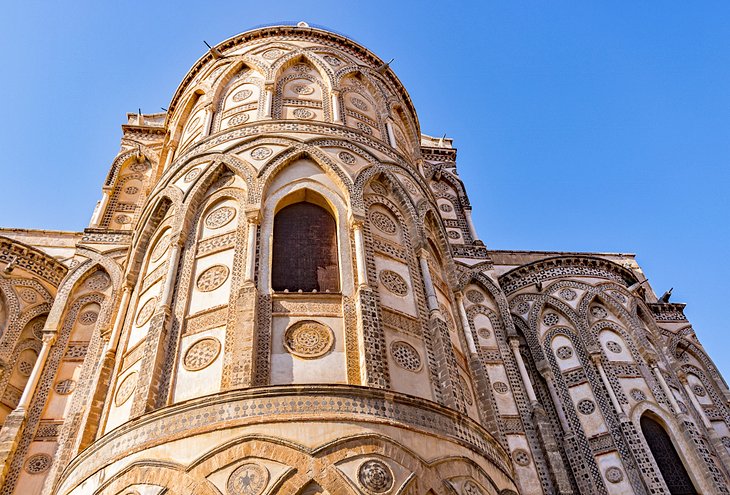
The strongest impression presented by the exterior is on the east side, with its three apses that retain their original appearance. Overlapping false arches and its varied decorations formed by bright tuffa and black lava epitomize the liturgical dignity that's evident inside.
The entrance façade is less impressive and relatively plain, with one of its two towers unfinished. But the two bronze portals are noteworthy. The west portal, the work of Bonanno Pisano in 1186, is the largest bronze door of its age at 7.8 meters by 3.7 meters, with 42 square panels each depicting a biblical scene.
The four reliefs that make up the base show fantastic animals symbolizing man's foolishness. The smaller north portal by Barisano da Trani, from the same era, has 28 panels depicting saints and evangelists.
Choir
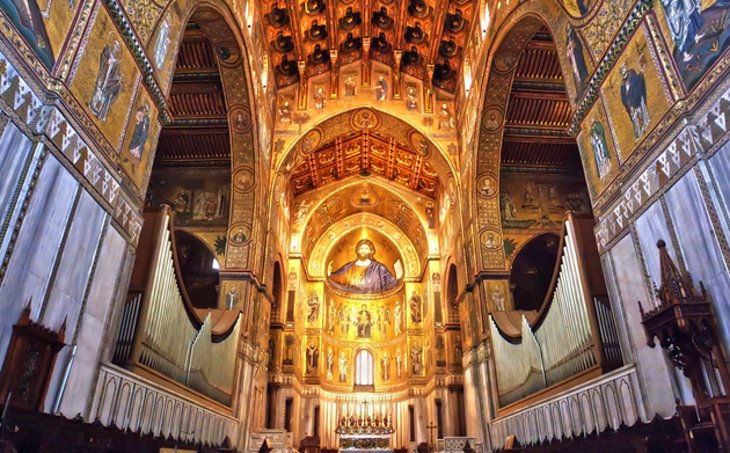
The choir is dominated by the mosaic image of Christ the Pantocrator, above the mosaic of his mother Mary. At the threshold at the top end of the choir, King William II is shown twice on the crossing pillars: first being crowned by Christ (on the left, over the King's throne) and then giving the Mother of God the model of the church founded by him at Monreale (on the right, over the bishop's throne).
The king wears–like his grandfather Roger II on the coronation mosaic in the Martorana in Palermo–the regalia of the Byzantine emperors, but the inscription is not in Greek, it's in Latin, an allusion to the gradual separation from Byzantium and the growing influence of Latin culture in Sicily.
Roof
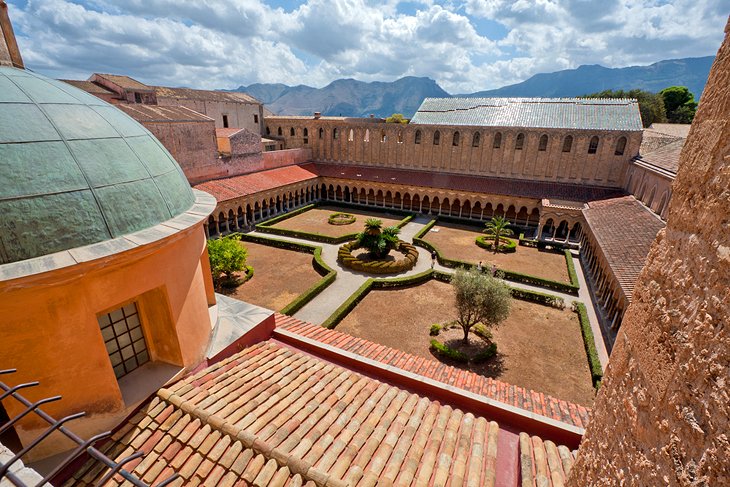
To complete your picture of the cathedral's enormity and grandeur, you should see it from above. At the west end of the aisle, on the south side, look carefully for the access to the steps that lead up to the cathedral roof.
Although some of the passageways are narrow and cramped, so not advisable for those suffering from claustrophobia, this gives visitors the opportunity to walk along the upper walls around the church. From this vantage point and from the tower are excellent views across the cathedral, the cloister, the town, and to the city of Palermo.
Where to Stay near Monreale Cathedral
We recommend these convenient hotels, all of which are in the budget-to-moderate range and offer easy access to magnificent Monreale Cathedral:
Closest to the Cathedral:
- Almost across the piazza from Monreale Cathedral, Locanda Re Ruggero has attractive rooms with double-glazed windows for quiet sleep. The hotel has its own restaurant, and several others are around it. Secure parking is just down the hill.
- It's a two-minute walk to the cathedral from the highly rated Palazzo Cuto, a distinguished family home decorated in antiques, paintings, and sculptures. Guests enjoy magnificent panoramic views of Palermo and the mountains.
A Longer Walk:
- About 200 yards from the cathedral, Palazzo Ducale Suites offers attractively decorated modern rooms with seating areas and hotel amenities. Restaurants are nearby, and there's a large indoor parking area.
- Although B&B Al Giardino is within walking distance of the cathedral, the accommodating hosts are always willing to drive guests there or to restaurants at no charge. Lovely wood-paneled rooms have balconies overlooking Palermo and the sea beyond. Breakfast is included, as is parking.
- With gracious hosts also happy to drive guests to sightseeing, B&B Elvira Al Duomo is on a quiet side street about half a mile downhill from the cathedral. Rooms are large, and there is a terrace surrounded by gardens.
Budget Hotels:
- Carrubella Park Hotel is about half a mile from the cathedral and has free parking. Some of the simply furnished rooms on the topmost floor have balconies and beautiful views across the valley.
What's Nearby
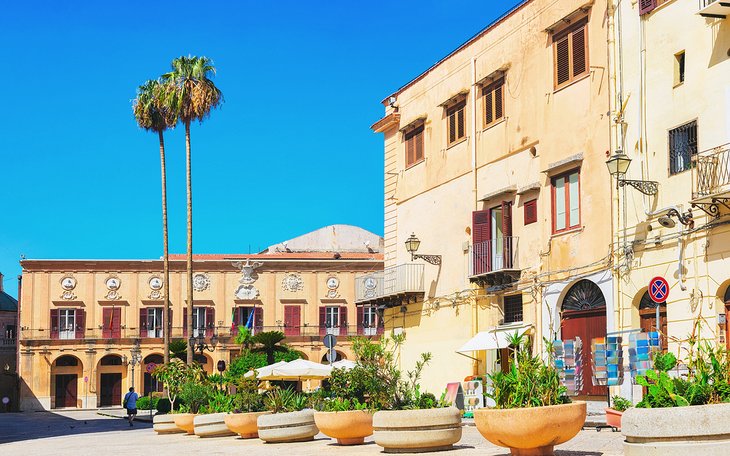
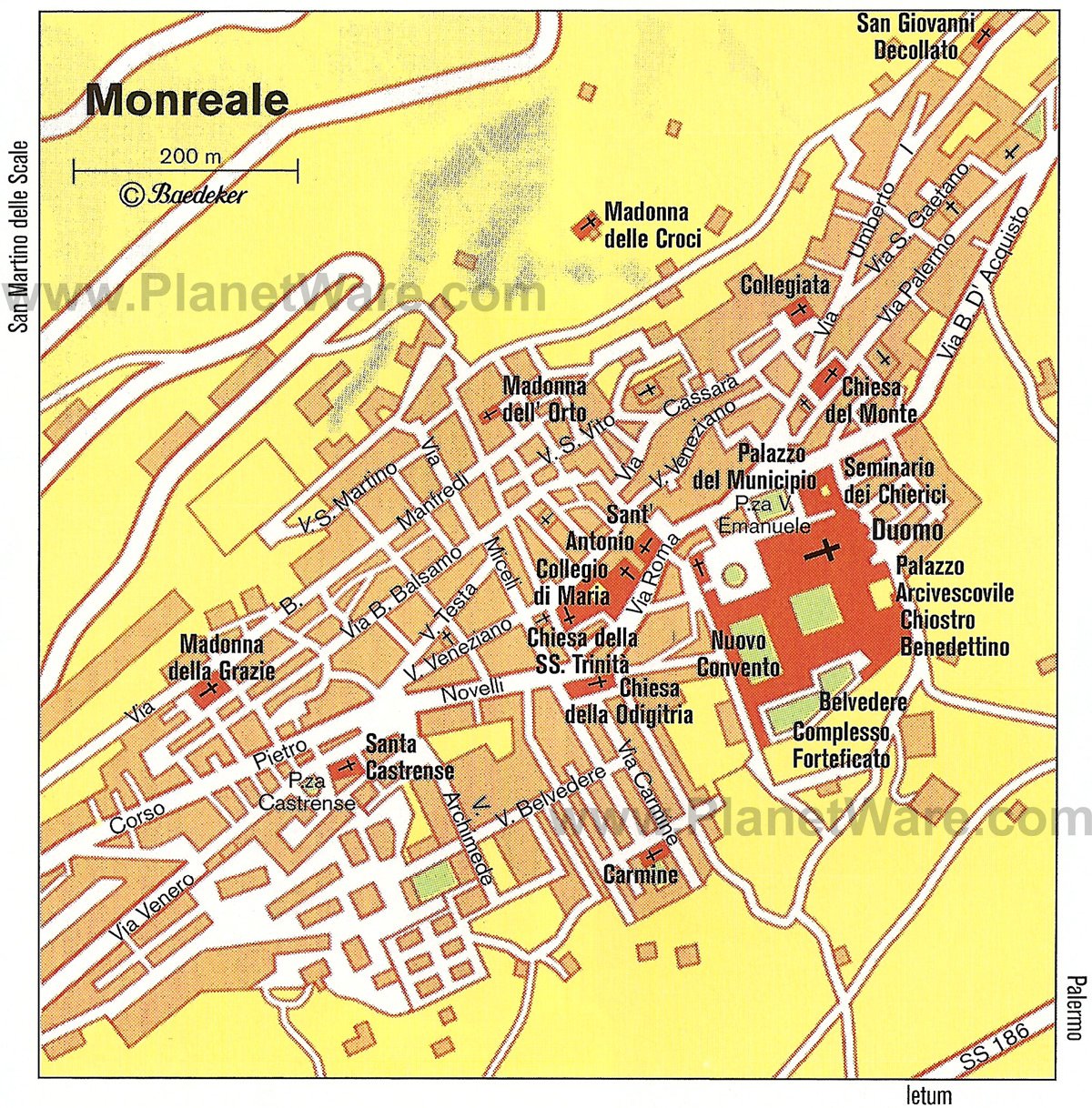
The town of Monreale is not very big, but it lies in a picturesque setting on a hillside overlooking the valley. Beside the cathedral on Piazza Vittorio Emanuele is the town hall in part of the former royal palace. Inside is a 1526 sculpture ascribed to Antonello Gagini and a 17th-century painting, The Birth of Christ by Matthias Stomer.
Via Umberto I leads north to Chiesa del Monte, a mountain church with stucco decorations, and you'll find more stucco work by Giacomo Serpotta in the Collegiata church, built in 1565. The wooden crucifix on the main altar is 16th century and another, on a majolica panel, dates from the 17th century.
The Church of Saint Odigitria, which dates from the end of the 16th century, contains a beautiful roof fresco by Pietro Novelli. On Piazza Santa Castrense is the church of the same name, erected in 1624, with stucco decorations from the studio of Giacomo Serpotta; the Madonna del Popolo on the high altar is the work of Antonio Novelli in 1602.
Monreale has a number of colorful festivals, and don't be surprised to see decorated traditional donkey carts in the streets. It is also known for ceramic and mosaic artists, whose work often reflects Byzantine and other historic motifs. When shopping for these and other souvenirs in Monreale, be sure to explore those shops and workshops on the smaller side streets.
Tips for Visitors
- Visitor Limits: Only a limited number of visitors are allowed inside the cathedral at a time, so be prepared to wait during busy seasons and on Sundays.
- Visitor Hours: Opening times may vary seasonally and are subject to changes, so it is best to check the current hours when planning a visit. In the winter, it is usual for the cathedral to close between noon and 4pm, reopening from 4 to 6pm. It is never open for sightseeing during mass.
- Dress Code: This is a place of worship, so dress accordingly (nothing revealing for women, shoulders should be covered, no shorts, and men must wear shirts).
- Services: The public is welcome to attend weekday and Sunday masses, but no sightseeing is permitted during these.
Getting to Monreale Cathedral
- By Bus: Monreale is 10 kilometers from Palermo, and the cheapest way to arrive is by bus 389, which departs hourly from Piazza Indipendenza in Palermo.
- By Road: From central Palermo, follow Corso Calatafimi and SS 186, following signs to Monreale.
- Parking: Parking is readily available.
Address
- Piazza Vittorio Emanuele, Monreale
- http://www.monrealeduomo.it
More Related Articles on PlanetWare.com
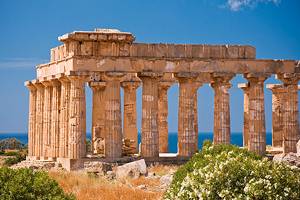
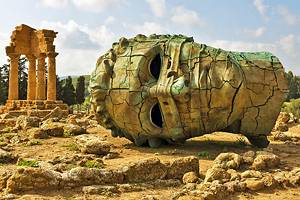
Discovering Sicily's Ancient Sites: While you're exploring the western end of the island, you can find an acropolis and eight Greek temples at Selinunte, an easy day trip from Trapani. On the southern coast, Agrigento achieved UNESCO status for its Valley of the Temples, and outstanding Greek and Roman theaters are among the tourist attractions of Syracuse.
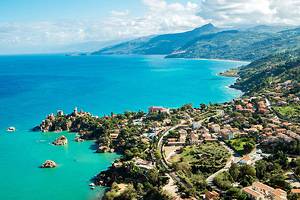
What to See near Monreale: While staying here you can easily visit the top tourist attractions of Palermo, only a short bus-ride away. Within driving distance are also the historic port town of Trapani, and the charming town of Cefalu, with a beach just below its winding streets.