

Brussels, Belgium's 12 Stunning Tourists Attractions You Should Never Skip
Brimming with history, art, great eats, and striking architecture, Brussels is an energetic city in north-central Belgium that's a cultural crossroads with youthful energy, artsy vibes, and endless museums — with the added benefit of feeling a little less crowded than other nearby destinations like Bruges and Ghent. A nearly endless selection of waffles, beer, and chocolate make the capital of Belgium a foodie destination. It also claims to be historical home of french fries, or frites, which are traditionally sampled here out of a paper cone or tray, and dipped into a bit of mayonnaise using a tiny fork.
You'll likely hear people speaking a mix of languages, too, as Belgium has three it considers official: French, Flemish Dutch, and German. Although most people use French in Brussels, you'll see signs typically posted in both French and Dutch. Aligning with this diversity, Brussels is also Europe's political capital, boasting the world's largest court building. It also has a reputation of being more of a bureaucratic, working city than some of Belgium's other smaller destinations, as it's home to thousands of EU and NATO employees. Nonetheless, it sure doesn't lag behind in terms of unique parks, famous art, charming commercial streets, amazing places to eat, and gorgeous architecture. Fans of the Art Nouveau style will discover particularly wonderful gems like the Horta Museum, Solvay House, Maison Hannon, and more. Read on to learn about 12 more stunning tourist attractions that are must-see on your visit to Brussels.
La Grand-Place

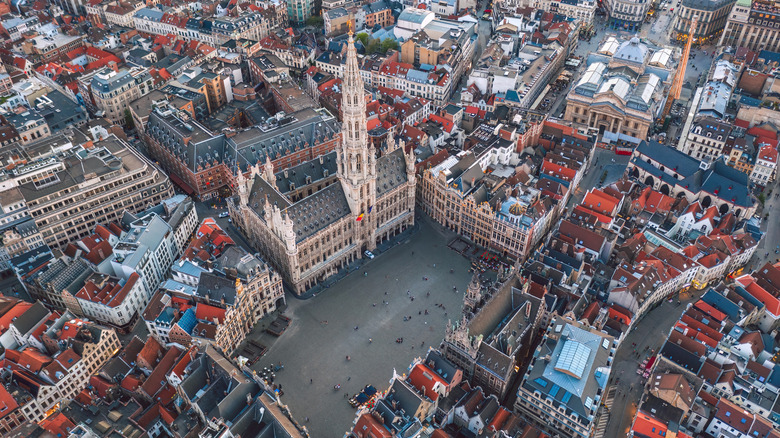
When UNESCO describes the buildings around La Grand-Place as "remarkably homogenous," it might be easy to take "homogenous" to mean "uninteresting," but don't be fooled. A large, cobblestone market square serves as something of Belgium's nucleus, surrounded by stunningly ornate architecture mostly constructed between the 1400s and the late 1600s. The square is home to the towering Hôtel de Ville de Bruxelles, or Brussels Town Hall, with its soaring Gothic tower. Across the way, you'll find the equally impressive Brussels City Museum. Beer aficionados might also appreciate a stop by the House of Belgian Brewers. This is different from the Belgian Beer World Experience, however, which is about a 5-minute walk northwest and located inside the former Brussels Stock Exchange.
The Grand-Place, also known as Grote Markt in Dutch, stands out for its numerous Guild Houses, which were constructed in the 15th century around the same time as the Town Hall. These houses were the main headquarters for Brussels' guildsmen, centered around specific religions, politics, and eventually, trades. For a quick side trip, head to the Square du Petit Sablon, located kitty-corner to Nôtre-Dame de Sablon — about a 15-minute walk south of the Grand-Place — to see 48 statues holding symbols of their specific guild trades, from coopers to bakers to surgeons.
St. Michael and St. Gudula Cathedral
One of central Brussels' most iconic and impressive buildings is a soaring Gothic masterpiece. The St. Michael and St. Gudula Cathedral is 800 years old, with subterranean footings and a crypt from the 11th century that was part of an earlier Romanesque church. On the main level, you can also explore a display of reliquaries, liturgical vestments, and more. The Romanesque foundations and the reliquary museum require a small admission fee of around $3.50 each, but entrance to the main cathedral is always free.
Guided tours of St. Michael and St. Gudula Cathedral are available Saturdays at 2 p.m., or via booking a specific time at least a week in advance. These one- to two-hour visits are a great way to learn about the history of the cathedral, and are available in either French or English. Between March and October, guests can ascend to great heights with a special tour of the 226-foot-high towers. This experience takes about three hours and requires visitors to be able to walk up a number of steep steps. It also needs to be booked several weeks in advance through the organization Church and Tourism Brussels. So, if you're planning a trip during that time, it's a good idea to do this early.
Palace of Justice
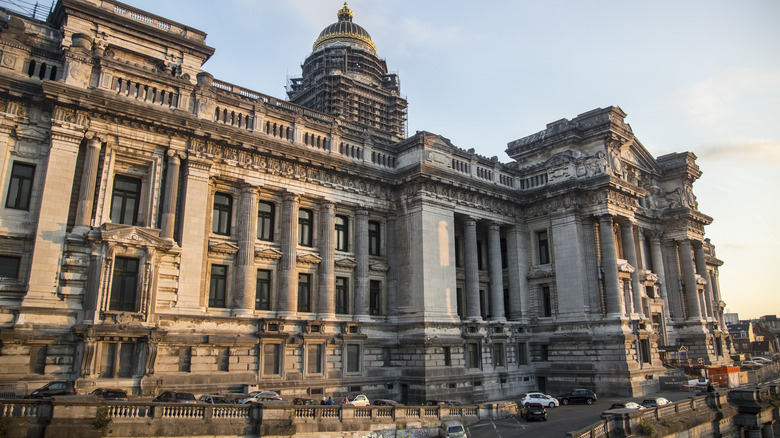
One of the most colossal buildings you'll find anywhere in Europe overlooks Brussels' city center. Built in the late 19th century, the Palace of Justice is a hulking, eclectic, neoclassical presence, and a symbol of Brussels' burgeoning success in the early 1800s as a major player on the world stage. When the last detail was completed in 1883, it clocked in as the world's biggest building. Its foyer has a ceiling that soars up to 328 feet high, and its footprint is nearly 280,000 square feet. The building also features eight courtyards so that sunlight could reach as many rooms as possible. Inside, statues depict ancient figures that represent some of the Western world's earliest lawmakers.
The Palace of Justice has been almost entirely enclosed in aging scaffolding for the past few decades, as the moisture accumulated within its iron structure had caused the stone masonry to crumble, and the city wanted to protect passersby from falling debris. Thankfully, the World Monuments Fund placed the building on a watchlist in 2016, and restoration efforts started in 2023 to stabilize the structure and return it to its former glory. Today, much of the scaffolding has already been stripped away, so visitors can again fully appreciate the astonishing scale of this building.
Koningsplein and the Royal Palace
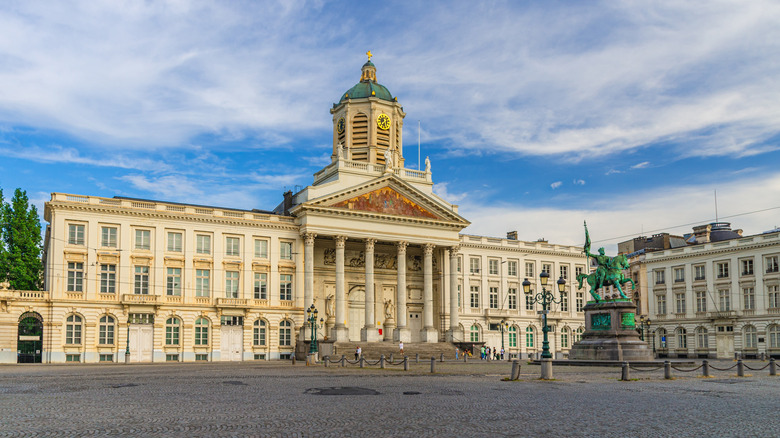
Koningsplein, also known as Place Royale, is a striking, cobbled square flanked by impressive neoclassical buildings. Art history enthusiasts won't want to miss a stop by the Musée Magritte, a space dedicated to the work of renowned Surrealist painter, René Magritte, who studied and exhibited in his first show in Brussels. Branching down Rue Montagne de la Cour, on the Mont des Arts, you'll also find the gorgeous Art Nouveau home of the Musical Instruments Museum. From there, you're just a few minutes' walk from the Royal Palace of Brussels, which remains a residential and administrative center for the Belgian monarchy. It's a beautiful place to take photos, especially amid the sprawling greenery of the Parc de Bruxelles. The regal facade of the palace becomes a focal point through the trees on one end, and the Palais de la Nation, or government chambers, on the other.
The Royal Palace was closed to the public for renovations throughout 2025, but it's slated to reopen for public tours in summer 2026. And, on the topic of renovations, Koningsplein has functioned most recently as a fancy roundabout. The city announced plans in early 2025 to redevelop the square with more emphasis on pedestrian access and better lighting that accentuates the buildings, including the removal of tram tracks. This project is scheduled to conclude in summer 2026.
Royal Museums of Fine Arts of Belgium

One of the reasons travel pro Rick Steves believes Belgium is one of the best countries to kick off your European vacation is its wealth of cultural attractions. And there's certainly no shortage of museums in Brussels! One not to be missed if you're an art-lover is the Royal Museums of Fine Arts of Belgium, which encompasses the Musée Magritte, Musée Old Masters, Musée Meunier, and Musée Wiertz — the latter of which is temporarily closed for renovations, with a reopening date expected sometime in 2026. The Old Masters Museum's collection specializes in pieces made between the 15th and 18th centuries by Dutch and Flemish artists, with great works by titans of art history like Hieronymus Bosch, Peter Breugel the Elder, and Peter Paul Rubens, among many others.
Explore an expansive collection of more than 20,000 artworks and artifacts from the 1400s to the present day, with a special emphasis on work by artists based in Belgium or nearby in the Southern Netherlands. The museums also feature an ambitious program of rotating exhibitions, which encourages encounters with a wide range of artists, genres, time periods, and techniques.
Atomium
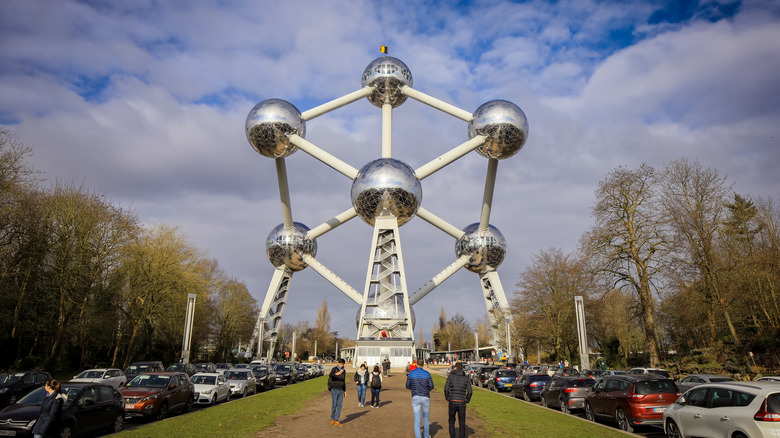
One of the more unusual attractions in Belgium is certainly historic — but not if you're expecting Gothic architecture or charmingly cobbled city squares. The Atomium transports us back to the Atomic Age, striking an unmistakable silhouette against the Brussels skyline, and its nine spherical modules resemble a monumental atom made of steel and glass. Built as the crowning structure of Expo 58, the Brussels World's Fair, the futuristic building was constructed as an emblem of the city's optimism for the future. Today, you can explore a permanent exhibition that traces the history of the Atomium and the world's fair. While the mirrored orbs make for great photo ops from the outside, the views it's most famous for are found up top.
On level 7, from 300 feet off the ground, visitors are treated to panoramic views of Brussels — on a clear day, you might even be able to spot Antwerp in the distance. On level 6, you'll get a spectacular view of both the landscape and the building's architecture itself, as you can see other spheres at that elevation. Keep in mind that there are quite a few steps involved to reach the different modules, but the stairwells are an experience unto themselves, which visitors sometimes liken to walking through a submarine or spaceship. Adult tickets are $19 and are valid for an entire day. Booking ahead will expedite you past any lines at the ticket counter.
Coudenberg Palace Archaeological Site
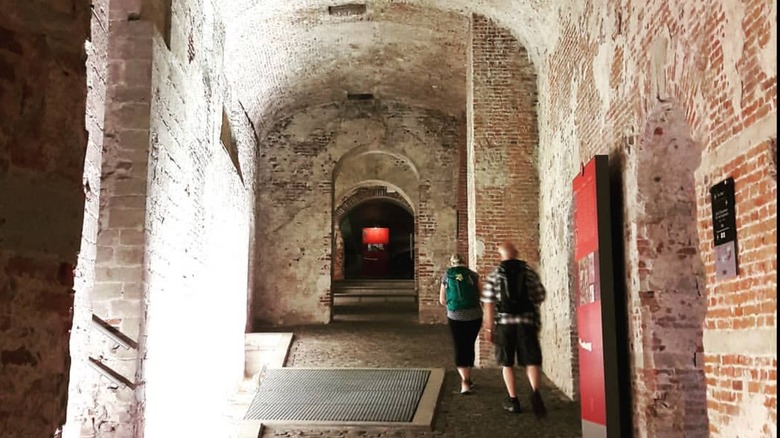
Tucked away in Place Royale is a fittingly regal attraction with a rich history — underground! Dating back to the 1100s, this hidden gem started as a strategic fortification. As the city became more prominent as an economic and political center, the castle was gradually transformed into the grand Palace of Brussels. By the mid-1400s, the space had become the site of a great hall, and throughout the early 16th century, the palace — including a Gothic chapel — took shape. Unfortunately, a huge fire in 1731 destroyed about half of the entire complex. This forced the royal family to move into to a nearby building, and the burnt section of the palace — known as the "Burnt Court —" was never reconstructed.
In the 1770s, the palace's remains were cleared to make way for Place Royale, which we see today. Lucky for us, we can still visit some parts of the original palace — namely its cellars and parts of the foundation — with a tour of the Coudenberg Palace archaeological site. During the experience, guests can tune into an audio guide that walks them through the history of the building, listen to music recorded within the historic palace's walls, or experience a series of 3D models that render visible parts of the palace that remain hidden.
Notre-Dame du Sablon
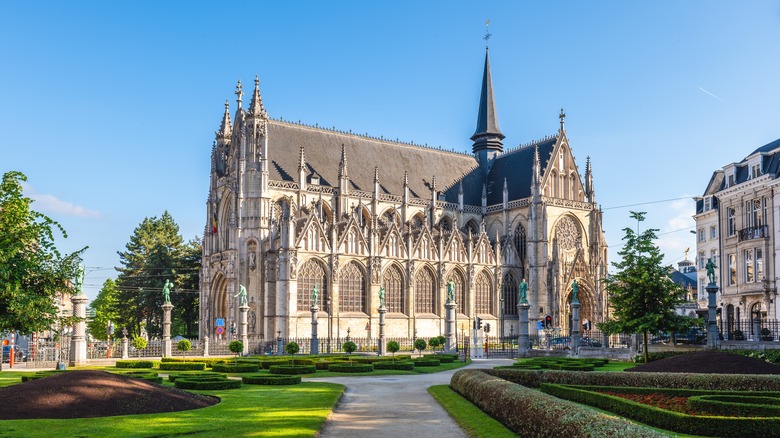
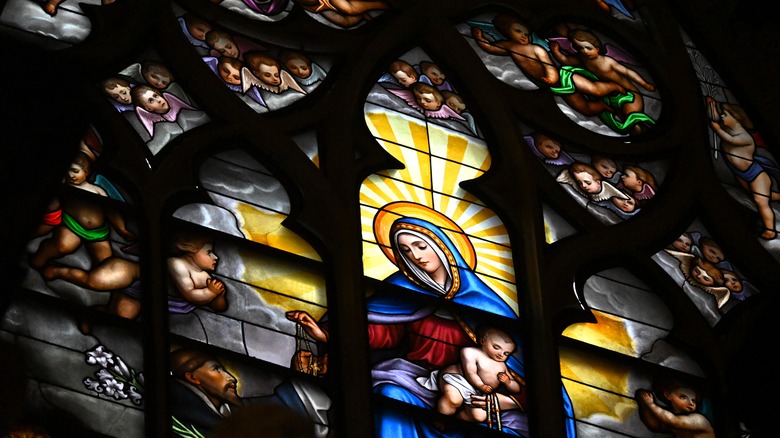
When it comes to Belgium, which Rick Steves considers Europe's "best-kept secret," hidden treasures are what make the visit feel most worthwhile. From medieval archaeological sites to 1,000-year-old church crypts, there's a lot to explore. The same goes for what's in store within Notre-Dame du Sablon — renowned for its vibrant stained glass windows that each measure nearly 50 feet tall. Although the interior remains fairly simple, keep an eye out for the pulpit, which is carved from wood and installed in 1697. The architecture as we see it today dates to the 15th century, with dramatic Gothic spires, but the history of this site can be traced back to a chapel that stood in the same spot in the 1300s.
Around the neighboring Place du Grand Sablon, visit the charming Sablon Antiques Market, which runs every Saturday and Sunday. While it's not quite as expansive as a famous Paris attraction that's one of the world's largest antique markets, this fixture of downtown Brussels has been running every weekend since 1960, and dealers fill stalls with a huge range of collectibles, jewelry, art, and more.
The Museums of Parc du Cinquantenaire
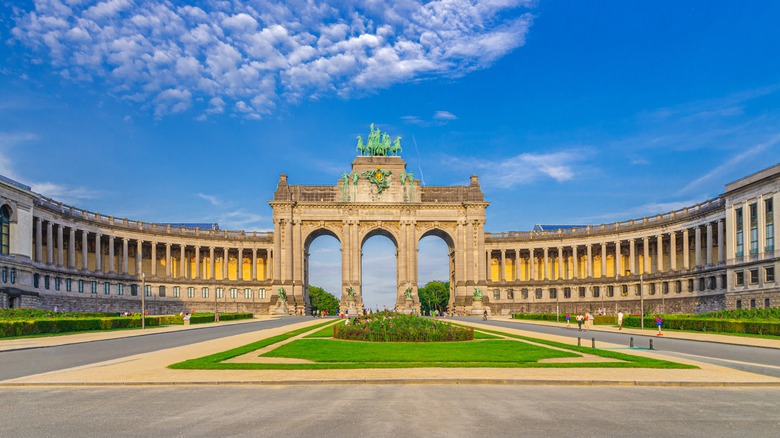
Parc du Cinquantenaire is a famous Brussels park abundant in nature and family-friendly activities. The space was constructed in 1880 — a celebration of Brussels' 50th anniversary at the time — with a chariot-topped triumphal arch as its centerpiece. Around this neoclassical complex, you'll find three museums well worth a visit. On one side, the Cinquantenaire Museum is part of the Royal Museums of Art and History, which focuses on 1,000 years of human art and ingenuity, boasting a collection of more than 350,000 pieces of art. The art and history museum abuts Autoworld, which showcases a spectacular range of automobile history. It's a unique, private institution built upon the personal collection of Ghislain Mahy, who amassed one of the world's most impressive car collections.
On the other side of the triumphal arch sits the Royal Museum of Armed Forces and Military History, which highlights the Belgian military from the medieval period to the modern day. Its soaring hangar is home to numerous fighter jets, vintage airplanes, and other vehicles. Inside the museum, guests can also access the elevator (or scale 186 steps) to ascend the triumphal arch and visit a viewing platform that offers panoramic views of Brussels. The best part is that this scenic bonus is already included in your military museum ticket.
The Royal Galleries of Saint-Hubert
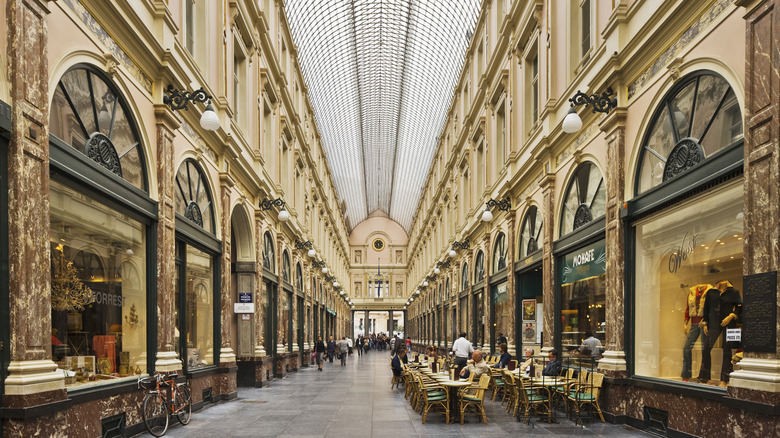
Brussels' iconic Galeries Royales Saint-Hubert are part of a tradition of ornate, covered retail arcades that became popular fixtures of cities around Europe in the 1800s. Designed by Belgian architect Jean-Pierre Cluysenaer, the space was completed in 1847. Its beautiful glass roof allows light to filter down into a long aisle, inspired by Italian palaces, that's full of shopfronts and apartment windows, where people still live. The gallery is also home to luxury confectioneries and boutiques like Corné Port-Royal Chocolatier, Delvaux, Ganterie Italienne, and BellePaga & Fine Belgian Designers. These are perfect for either window shopping or snagging a unique cultural souvenir, one of the most important things you can shop for while in Europe.
The arcade essentially consists of two parts that connect across the Rue de Bouchers, itself a charming little cobbled street with numerous cafes and shops to explore. Just northwest of the arcade, scout out a contemporary sibling to Manneken Pis — more on that in a little bit — known as Jeanneke Pis, a bronze fountain of a young girl that rivals its counterpart as a tourist attraction in this small, yet idyllic, little cul-de-sac. From there, stop by Delirium Cafe to sample a pint from a selection of more than 2,000 beers — 2,004 to be exact — which also happens to be a Guinness World Record.
Belgian chocolate experiences
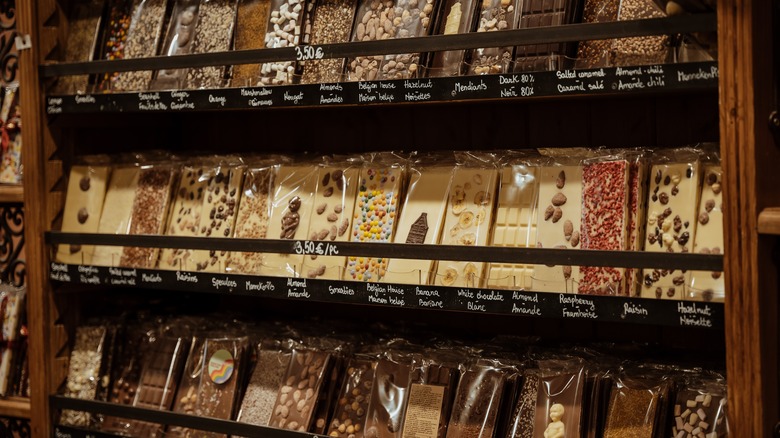
Brussels may have a bit of a reputation for being one of Europe's least friendly tourist destinations, but it's hard to argue with a place that's brimming with confectionery. After all, how could it not be sweet? Belgium is famous for its chocolate, so along with chocolatiers like Laurent Gerbaud and Pierre Marcolini, you can also dive into cocoa history. Learn about the origin of pralines, a regional delicacy, which got their start in Brussels when a 19th-century pharmacist began coating his remedies in chocolate to make them more palatable. His grandson ran with the idea, creating a soft, sweet filling instead, and the praline was born. Take a guided tour of Choco Story Brussels, where you wander through at your own pace with an audio guide or make your own confections. You might also enjoy learning how to make the signature treat at the Belgian Chocolate Workshop.
If chocolate isn't enough to sate your tastes, pop across the street to the Frietmuseum to explore everything french fry-related. Or, for a quirky tourist stop just down the street, take a picture of a little bronze statue known as "Manneken Pis," depicting a little boy urinating, that dates back to the 15th century and has been an icon of Brussels every since. He's often dressed up in different outfits, which appear on a schedule posted nearby.
La Cambre Abbey

About a 10-minute drive south of the Grand Place (a bus ride takes about a half hour) you'll find a relaxing escape in a garden haven at La Cambre Abbey. Its butter-yellow exterior is instantly inviting, with most of the buildings we see today hailing from the 18th century, but the history of the site goes all the way back to 1201. The abbey adjoins Église Notre-Dame de la Cambre, which features beautiful stained glass and a number of paintings. A walk around the French-style formal garden is a peaceful escape, popular with locals and visitors alike. "Not a huge garden, but lovely green space with sculpted topiaries, perfect for a stroll or a sit on the benches," reflected a visitor in a TripAdvisor review. "A welcome break from the bustle of the city."
To further your tranquil escape in this part of the city, head over to the Bois de la Cambre, a huge public park that sits to the north of the fabled Sonian Forest. Numerous walking trails wind through the trees and continue through the nearly 10,000 acres of woods. Parts of the Sonian Forest are prized for the ancient, well-preserved beech groves, earning them a spot on the UNESCO World Heritage list as part of a group of atmospheric and remarkably old beech forests throughout Europe.
Methodology
To find the top 12 attractions and destinations in Brussels, especially for a first visit, we researched tourism sites like Visit.Brussels, IntroducingBrussels.com, and AuthenticBrussels.com. For information and histories related to specific locations, we consulted official sites like Monarchie.be, Atomium.be, SonianForest.be, Fine-Arts-Museum.be, Coudenberg.brussels, and Choco-Story-Brussels.be. We also gathered information and data from sites like WorldStrides.com, Beliris, UNESCO, STIB-MIVB, and the World Monuments Fund. Especially for attractions geared specifically toward tourists, we relied on honest reviews and ratings from visitors on sites like TripAdvisor and Google.