Arhus Tourist Attractions
|
|
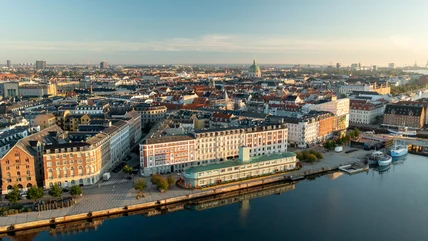
JutlandÅrhus, Denmark's second largest city, lies on the east coast of Jutland where the river "Århus Å" flows into Århus Bay, a bay of the Kattegat.
Århus Cathedral
The inner city of Arhus consists of a semicircle enclosed by a ring road (Ringgade), its heart being the Great Market (Store Torv), in which stands the Cathedral (Sankt Clemens Kirke), dedicated to St Clement. The first church was a Romanesque basilica built between 1200 and 1500. Romanesque features are still to be found in the external walls of the nave and transepts; the chapels on the east side of the transepts also date from this time.After 1400 the church was converted to a Gothic cathedral, Bishop Jens Iversen Lange (15th century) being the driving force behind the venture. The facade was replaced by a front with a single tower which bears an anchor motif, the attribute of St Clement.Features of the interior include the 1497 winged altar, with its rich array of figures of St Anne, John the Baptist, St Clement and the Apostles by the Lübeck master Bernt Notke, the beautifully carved 16th century pulpit by Mikkel van Gröningen, two organs and the font.The vault paintings date from the 15th century and portray St Clement as the patron saint of the church and Christ sitting in judgment. Also of interest are the coats of arms, including those of Jens Iverson Lange; in the choir are some medieval crucifixion scenes. As well as religious services, church concerts are also held here. In front of the cathedral stands a monument to King Christian X (1955).
Museum of Art
To the south of the Natural History Museum, in Vennelystpark, lies the Århus Museum of Art. It boasts one of the oldest and most interesting collections of Danish art, including paintings, sculptures and drawings dating from 1750 to the present day. In recent years the museum has been able to build up a sizable collection of modern Danish art, as well as works by foreign artists, especially from Germany and the United States. Special exhibitions are also held.
Århus City Hall
On the south side of the busy Rådhus Plads, the hub of the traffic of Arhus, stands the City Hall, built in 1938-42 to plans by Arne Jacobsen and Erik Moller and faced with Norwegian marble. From the 60m/200ft high tower there is a fine view of the city and the bay. In summer there are guided tours when visitors can see the civic hall, the council chamber and the marriage room.On the west side of the square can be seen the attractive "Pig Fountain" (Grisebronden) by M. Boggild, and at the foot of the City Hall tower is the fountain "Agnes and the Water Carrier".
Concert Hall
From Radhus Plads it is but a few steps to the concert hall, built in 1982, the headquarters of the Århus Symphony Orchestra and the Jutland Opera Company; many events of the Århus Festival Week are held in this building.
Church of Our Lady
In Århus, northwest of the cathedral in Vestergade stands the Church of Our Lady (Vor Frue Kirke), built in the 13th-15th century. Originally part of a Dominican priory, it is now a purely Gothic building with frescoes and a magnificent altar-piece from the workshop of Claus Berg (1520).In 1955, in the course of excavation work beneath the choir of the Church of Our Lady, a little church built of tuff stone was found. After careful restoration this old vaulted krypta is now a church within a church.The chapter-house which served as an old people's hospital from the Reformation was also dedicated as a church, so there are now three churches in all. The chapter house is adorned with medieval wall paintings. Remains of the Gothic cloister of the former Dominican monastery have also been preserved.
Århus Botanical Garden
West of the Church of Our Lady, Vesterbrogade borders the Botanical Garden (Botanisk Have), where in summer entertainment is provided for children and adults. There also are hothouses with subtropical plants from all over the world.
Open-Air Museum
In the southern part of the Botanic Garden of Århus lies the open-air museum "The Old Town" (Den Gamle By), a collection of some 75 houses from all parts of Denmark and one of the most popular places in Århus. The houses date from the 16th up to the early 20th century and have been faithfully reconstructed in line with the originals.The buildings include old town houses, shops, workshops with their equipment and windmills. The central feature is a burgomaster's house of 1597 which contains a collection of furniture. Visitors can also see a merchant's house from Ålborg, a house built on stilts, a two-storied stone house, and a storehouse. A toy museum, a textile museum and a historical musical collection are housed in a building from Nðstved. In a house from Viborg there is a bicycle museum. In addition, visitors can admire an apothecary's shop complete with healing herbs, candlemakers', coopers' and shoemakers' workshops, a tobacco factory, a sailmaker's and a windmill housing the museum's office. The museum also holds special exhibitions of historical costumes and old silver objects. In addition, there is an open-air inn and a restaurant.
Viking Museum
Near the Århus Cathedral, at No. 6 St Clemens Torv in the basement of a merchant bank, will be found the Viking Museum (Vikingemuseet). When excavating for the foundations of the present bank in the 1960s builders stumbled on remains of ramparts with which the Vikings had surrounded their little settlement 1,000 years earlier. In the museum can be seen a reconstruction of the ramparts, a typical house of the Viking period and tools used by these first inhabitants of Århus.
Danish Women's Museum
Århus'Danish Women's Museum in Domkirkeplads (No. 5) offers a rare opportunity of obtaining information on women's living conditions. The main emphasis of the exhibition is on developments in the 20th century, with displays covering everyday life, art and handicrafts.
Århus Festival
This annual 10-day festival takes place in August or early September and is Scandinavia's largest cultural event. The festival has a different theme every year. Among the more than 300 events on offer every year are operas, large-scale symphonic concerts, chamber and choral concerts, recitals, dance and theatrical performances, folk and jazz concerts, film screenings, art exhibitions, fringe events and even children's activities. The repertoires range from traditional to unusual, and from classical to contemporary.The venues are equally varied, and include local concert halls, churches, theaters, clubs and parks. Each year the festival revolves around a unique theme.
Women's Festival
This annual festival includes traditional theater, drama and dance performances, but adds a contemporary feminist feel to all the events. The 10-day festival runs from late June to early July.
House of the Artists
A museum with periodic contemporary art exhibitions. The house artists make etchings, prints, postcards, posters, etc. to sell.
Open Air Rock Concert
This annual day-long event brings together renowned Danish and international stars.
Viking Festival
This annual weekend festival takes place in late July. The festival includes a traditional market as well as various other outdoor activities.
Århus Urban Museum
The Urban Museum charts the history of Århus from its Viking roots to the present. It is located in a former railway station.
Numus Festival
This annual festival runs through April and May and showcases new classical music.
The North of the City
The North of the City of Århus contains the university and the Museum of Art.
Århus University
Århus University, founded in 1928, lies in a park in the northern part of the city. The main building was erected in 1946; the "Book Tower" being designed by Christian Frederik Moller.
Natural History Museum
The Natural History Museum (Naturhistorisk Museum) is in the southern part of the university park in northern Århus. There are exhibitions covering the topography of Denmark - heathland and forest, dunes, coast and sea, together with others devoted to minerals, anatomy and geology.
Danish Museum of the Sciences
The Danish Museum of the Sciences charts the history of natural science and medicine from ancient times to the present day. The exhibits include models, reconstructions, poster, and hands on activities. It also operates a planetarium and a medical herb garden.
Danish Press Museum
In the College of Journalism to the north of Århus University is the Danish Press Museum, which houses a large archive devoted to the history of the press.
The South of the City
The South of Århus has the city's amusement park, the summer residence of the Danish royal family and a wildlife park.
Tivoli Freedom
In the south of Århus, surrounded on three sides by the Marselisborg Woods, lies the amusement park known as "Tivoli Friheden (Tivoli Freedom), which provides fun and games for young and old alike. Concerts and appearances by well-known artists are included in the entertainment program. Nearby are a sports hall, a stadium, the Jutland Racecourse (horse-racing) and a cycle-track.The Tivoli Freedom amusement park has an interesting history. It originated as a picnic spot in the woods and later developed into a restaurant. The restaurant was then extended to include a large hall that was turned into a theatre. Later, a minigolf course was built in the compind and boating activities were also introduced. Finally, the location was turned into a complete amusement park and it now attracts many visitors of all ages.
Marselisborg Palace
In a park on the far side of Carl Nielsens Vej in Århus stands Marselisborg Palace. It was built in 1902 and is the summer residence of the Danish Royal Family. When the queen and her family are in residence the changing of the guard takes place at noon every day. There is a rose garden in the palace park.Between Marselisborg Palace and the coast to the east a memorial park (Marselisborg Mindepark) has been laid out in memory of the Danes from northern Schleswig who fell in the First World War. There is a monument engraved with the names of 4,144 Danish soldiers.
Wildlife Park
The Marselisborg Woods extend for several kilometers along the coast of Jutland towards the south of Århus. Part of the woods has been fenced in and made into a wildlife enclosure (Dyrehaven), where visitors can observe sika deer from Japan, fallow deer and wild boar in a natural environment.
Map of Arhus Attractions