19 Top-Rated Churches in Rome
The churches were, for many centuries, the goal of the majority of Rome's visitors. The faithful from all over Europe made the long and arduous journey to Rome to worship at seven particular sites that were designated as pilgrimage churches.
These included the four patriarchal basilicas (San Giovanni in Laterano, San Pietro in Vaticano, San Paolo Fuori le Mura, and Santa Maria Maggiore), as well as three others: Santa Croce in Gerusalemme, San Lorenzo Fuori le Mura, and San Sebastiano.
Today's tourists still include pilgrims, but far more visit Rome's churches as attractions, to admire their architecture and the art treasures they hold. In them, you'll find works by some of the greatest masters – Michelangelo; Raphael; Bernini; Caravaggio; Sansovino; Filippo Lippi; and many more unnamed masters of mosaic art, fresco painting, and stonework from medieval and earlier eras.
Learn more about these magnificent places of worship with our list of the top churches in Rome.
- 1. Basilica di San Pietro in Vaticano (St. Peter's Basilica)
- 2. Basilica di Santa Maria Maggiore
- 3. San Giovanni in Laterano (St. John Lateran)
- 4. Santa Maria del Popolo
- 5. Pantheon (Basilica of St. Mary and the Martyrs)
- 6. Santa Maria in Trastevere
- 7. Santa Cecilia in Trastevere
- 8. Basilica di Santa Croce in Gerusalemme
- 9. Santa Maria sopra Minerva
- 10. San Clemente
- 11. San Pietro in Vincoli (St. Peter in Chains)
- 12. San Lorenzo Fuori le Mura (St. Lawrence Outside the Walls)
- 13. Santa Maria in Cosmedin
- 14. San Paolo Fuori le Mura (St. Paul outside the Walls)
- 15. Sant'Andrea al Quirinale
- 16. Santa Pudenziana
- 17. Santa Prassede
- 18. Santa Sabina
- 19. Santa Maria in Aracoeli
- Map of Churches in Rome
1. Basilica di San Pietro in Vaticano (St. Peter's Basilica)
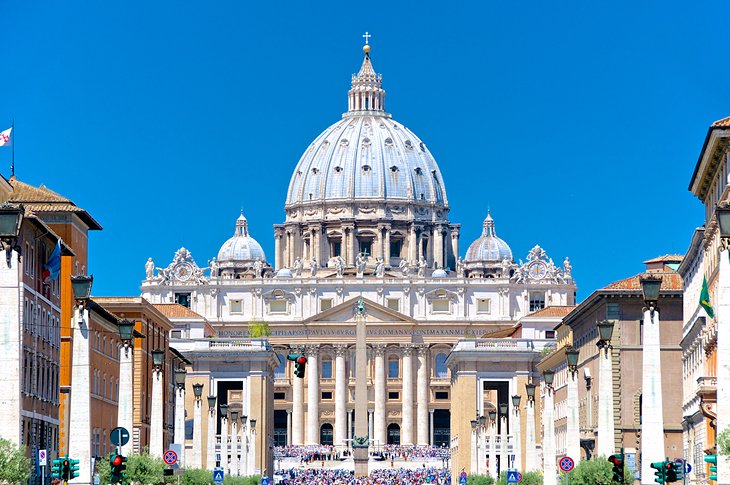
The most famous church in Christendom, St. Peter's is dedicated to the Apostle who is believed to have been the first Bishop of Rome, and as such the first Pope. The original church of St. Peter was dedicated in 326, built under the patronage of the Emperor Constantine. In 1452, Pope Nicholas V decided to build an entirely new church, which was not completed until the late 18th century.
Immediately upon entering the basilica's huge interior is Michelangelo's famous Pietà, completed in 1500 and protected by a reinforced glass panel. Other highlights of St. Peter's are the richly decorated Chapel of the Sacrament, with works by both Bernini (the tabernacle) and Borromini (the bronze grille); the great dome designed by Michelangelo.
Be sure to see the well-loved bronze statue of St. Peter Enthroned and over the tomb of St. Peter, the Papal altar with a bronze baldacchino – canopy – created by Bernini when he was just 25 years old and a masterpiece of Baroque sculpture. In the left-hand aisle are tombs of famous Popes created by leading artists of their day, including Bernini. More papal tombs are in the crypt.
Because it's one of the most popular places to visit in Rome, the lines at St. Peter's can be long and tiring, and finding your way through all the rooms in the Vatican can be difficult. A way to bypass the lines and navigate the attractions is to take a three-hour Skip-the-Line Vatican, Sistine Chapel and St. Peter's Basilica Tour. A guide will not only make sure you see the highlights, but will put them in their historical and artistic context as well. Included audio headsets will assure that you don't miss a word.
Address: Piazza San Pietro, Rome
2. Basilica di Santa Maria Maggiore
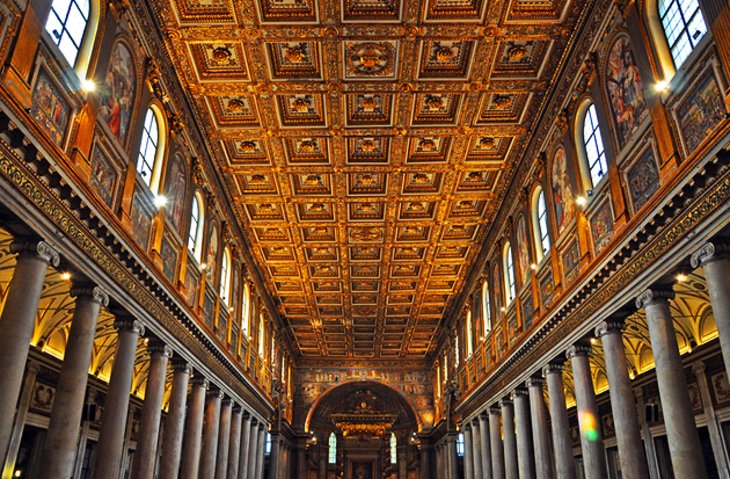
One of Rome's four patriarchal basilicas and an important pilgrimage church, Santa Maria Maggiore has the distinction of being the only church in Rome to have celebrated mass every single day since the fifth century. The location of the basilica was determined by a vision of the fourth-century Pope Liberius, in which the Virgin directed him to build a church where the snow fell the following day. When snow did fall on the Esquiline hill the next morning, August 5, the Pope ordered the church built.
Additions were made in later centuries: a new apse in the 13th century; Rome's tallest campanile in 1377; and in the late 15th century, the gold coffered ceiling by Giuliano da Sangallo, adorned with the first gold from America.
Two side chapels, added in the 16th century, form transepts: Cappella Sistina, on the right, contains a bronze tabernacle and the tombs of two popes, while Cappella Paolina has a richly decorated altarpiece. On the canopied high altar, a highly venerated image of the Virgin is traditionally attributed to St. Luke, but is in fact a 13th-century work.
This 86-meter-long interior is among the finest and most majestic in Rome, its three aisles separated by 36 marble and four granite columns. Rome's oldest mosaics, from the fourth or fifth century, decorate the upper part of the walls, and an intricate geometric inlay of colored stone, known as Cosmatesque work, from the mid-12th century, covers the floor.
Try to come early in the morning for the best light on the 13th-century mosaics in the triumphal arch and the apse, depicting Old and New Testament themes; they are considered the supreme achievement of the art of the Roman mosaic artisans.
Address: Piazza di Santa Maria Maggiore, Rome
3. San Giovanni in Laterano (St. John Lateran)
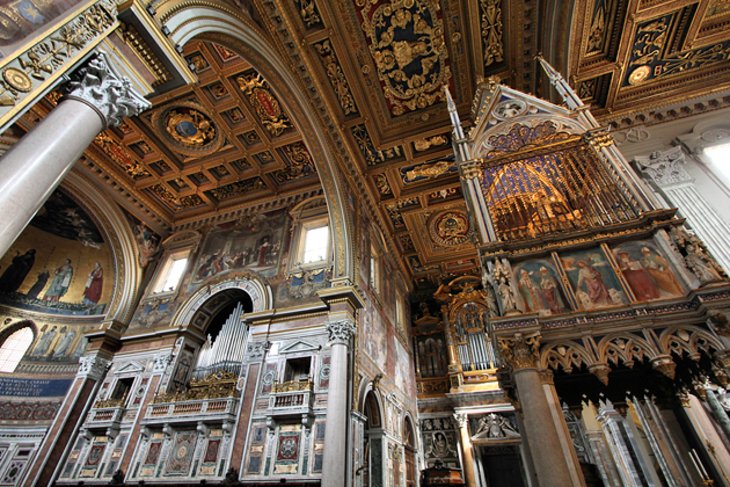
Before the Popes established their residence in the Vatican after their return from exile in Avignon, the Basilica of St. John Lateran was the Papal residence. St. John Lateran has remained the episcopal church of the Pope, thus the inscription on the façade: "Mater et caput omnium ecclesiarum urbis et orbis" (Mother and head of all the churches of the city and the world).
Begun in 313 with the building of a large church, it was enlarged and altered repeatedly, and almost completely rebuilt in the 16th and 17th centuries. But the basilican plan of the original Constantinian church was respected in this Baroque rebuilding by Borromini.
The wide facade, with its huge statues done about 1735 by Alessandro Galilei, is a masterpiece of late Baroque architecture. The bronze doors came from the ancient Curia in the Forum. Inside, the magnificent timber ceiling dates from the 16th century. In the apse, behind the presbytery, are some fine mosaics, faithful copies of early Christian originals.
From the left aisle, you can enter the cloister, a masterpiece of 13th-century architecture by the Vassalletti, a family of Roman artists. The octagonal baptistery, San Giovanni in Fonte, was built by Constantine on the site of a Roman nymphaeum in the Lateran Palace. It is the oldest baptistery in Christendom, providing a model for later baptisteries, not only in Italy but throughout Europe.
Diagonally across the spacious Piazza San Giovanni in Laterano is the church of the Scala Santa with the Holy Staircase, a flight of 28 marble steps (now clad in wood) believed to be from Pilate's palace in Jerusalem, brought to Rome in the fourth century by St. Helen. The faithful climb it on their knees in memory of Christ's Passion.
The Egyptian obelisk standing in Piazza San Giovanni in Laterano is the tallest and also the oldest in Rome, brought from Thebes in a specially constructed ship in 357.
Address: Piazza San Giovanni in Laterano 4, Rome
4. Santa Maria del Popolo
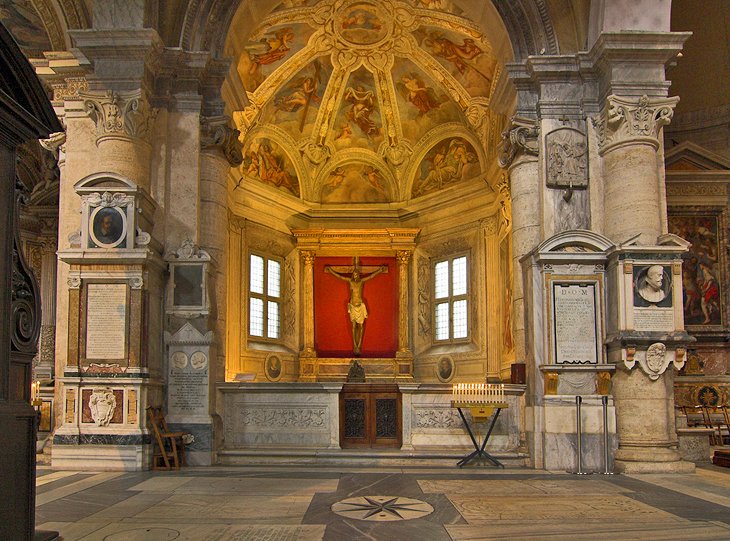
Legend holds that this church beyond the Pincio Gardens was enlarged from a chapel built to drive away the evil spirit of Nero. As the church of the Augustinian canons, with a fine Renaissance facade, dome, and campanile, it was extended by Bramante in 1505, and later restored by Bernini.
Martin Luther, who was an Augustinian, lived in the order's house during his visit to Rome in 1510-11, and after the Reformation, the altar at which he had celebrated mass was shunned by other members of the order. Its three aisles and side chapels contain a number of tombs including two in the choir by Andrea Sansovino. On the vaulting of the choir are frescoes by Pinturicchio depicting the Coronation of the Virgin.
The side chapels are particularly fine: the second on the left was designed by Raphael in 1515 for the Chigi family, and the Cesari Chapel, in the north transept, contains two famous pictures by Caravaggio, the Conversion of St. Paul and Crucifixion of St. Peter.
Address: Piazza del Popolo, Rome
5. Pantheon (Basilica of St. Mary and the Martyrs)
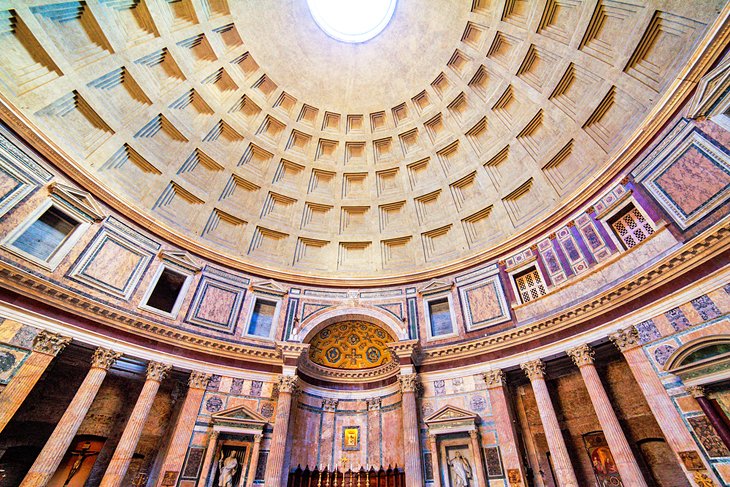
While the Pantheon is high on the list of the city's ancient Roman attractions and was built around AD 120 as a temple to honor Roman deities, today it is a Catholic church. It has been since the beginning of the 7th century, when it was converted by Pope Boniface IV and consecrated to St. Mary and the Martyrs.
Although its stones, columns, statuary, and even part of the original bronze ceiling, were cannibalized for other uses over the centuries (in the 1600s Pope Urban VIII ordered the portico ceiling melted down to cast cannons for Castel Sant'Angelo), the building remains essentially the same, and its dome is still the world's largest dome of unreinforced concrete.
Since the Renaissance, the Pantheon has become a burial place for important figures, including the painter Raphael, composer Arcangelo Corelli, and the two kings of Italy: Vittorio Emanuele II and Umberto I. After centuries of being one of the free things to do in Rome, as of the summer of 2018, the Pantheon has begun to charge a small admission fee.
6. Santa Maria in Trastevere
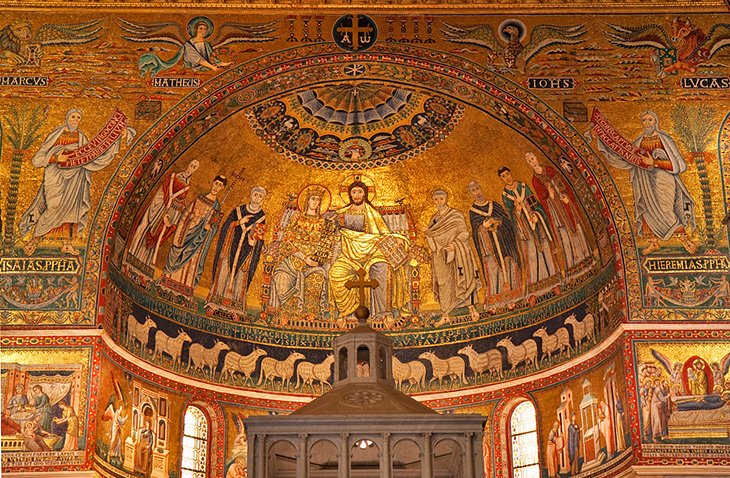
Santa Maria in Trastevere (the densely populated neighborhood on the right bank of the Tiber) may be the first place in Rome where Christians were able to hold services in public. Building began about 221 and was completed in 340; it was rebuilt in the 12th century and redecorated in the Baroque period. The church has a Romanesque campanile, a facade decorated with mosaics, and a portico housing early Christian sarcophagi.
Inside, it's hard to know where to look first – at the beautiful marble inlay in the floor; the gilded, coffered wood ceiling; or the mosaics in the apse, which are masterpieces of medieval art. These portray Christ, the Virgin, and saints above a frieze of lambs, and below this are scenes from the life of the Virgin by Pietro Cavallini in the late 13th century. The 15th-century tabernacle at the west end of the nave on the right is by Mino del Reame.
Address: Piazza Santa Maria in Trastevere, Rome
7. Santa Cecilia in Trastevere
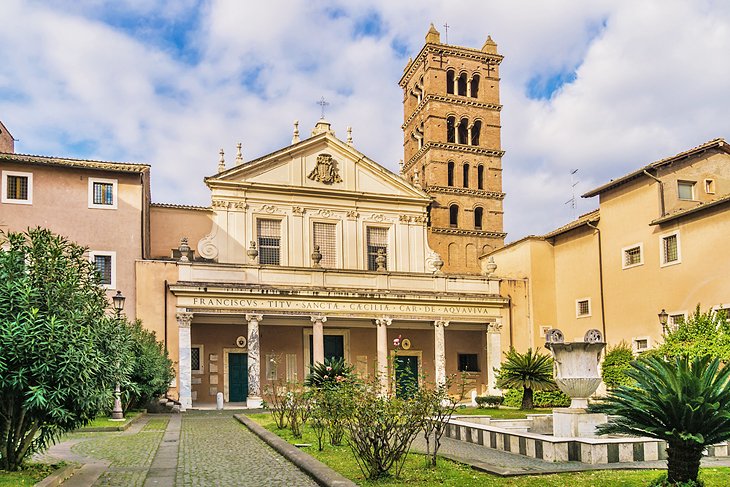
The 9th-century church was built over the home of a Roman girl who was martyred at age 14, and it is an interesting place to visit for several reasons. The exceptional 13th century fresco of The Last Judgement is by Pietro Cavallini, a precursor of Giotto, and the beautiful sculpture of St. Cecelia by Maderno was modeled on her incorrupt body exhumed in the 16th century.
Beneath the church, which also has some good mosaics, are two surprises: the foundations of a Roman home and an exquisite medieval sacristy with a secret – it isn't from the Middle Ages, but was created in the 19th century in an effort to re-capture some of the beauty of medieval works that had been destroyed in Rome. You enter the church through a lovely courtyard.
Address: Piazza di Santa Cecilia 22, Rome
8. Basilica di Santa Croce in Gerusalemme
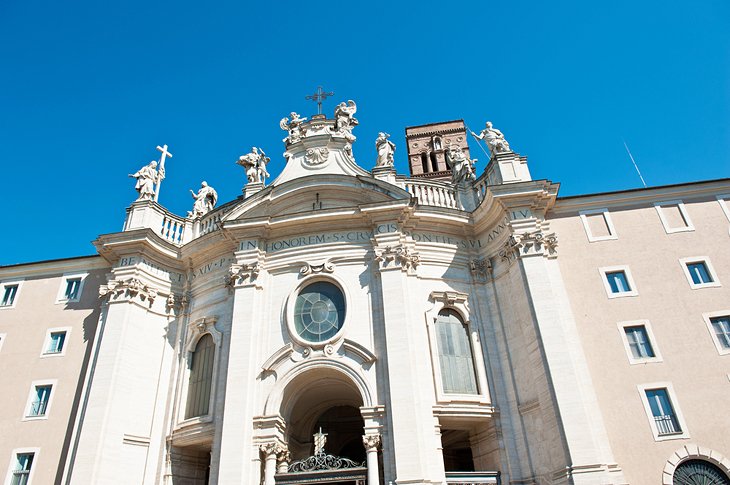
One of the seven pilgrimage churches, the Basilica of the Holy Cross in Jerusalem was built in the early fourth century to house the vast collection of holy relics brought to Rome from Jerusalem by St. Helena, mother of Constantine.
In the relic chapel are artifacts from the Crucifixion: thorns from the Crown of Thorns, pieces of the True Cross, fragments of the Grotto of the Nativity, and other holy relics. These are preserved in 19th-century reliquaries, displayed since the 1030s in a chapel specially constructed for their conservation and display.
Little is left of the fourth-century church after its reconstruction in the 18th century, but you can see the original granite columns in the later Baroque church.
Address: Piazza di S. Croce in Gerusalemme, Rome
Official site: http://www.santacroceroma.it/en/
9. Santa Maria sopra Minerva
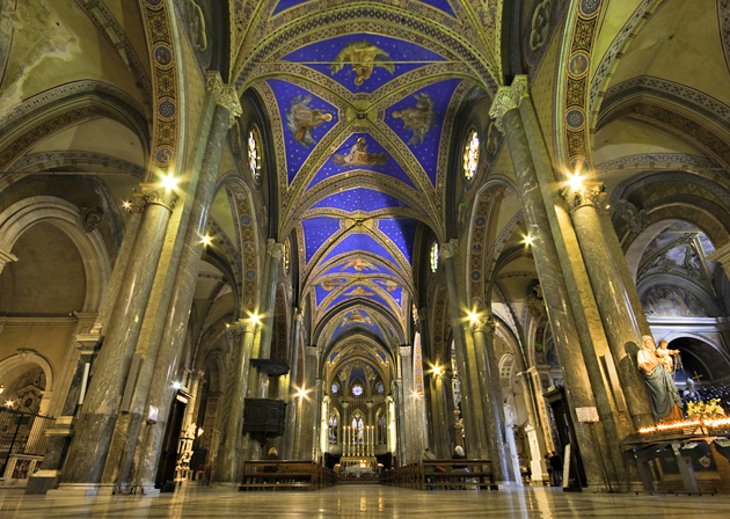
Built on the site of the former temple of Minerva, which accounts for its name, Santa Maria sopra Minerva is the largest Gothic church in Rome (and one of the few in that style). Begun about 1280 and completed in 1453, its center-city location and service by the preaching order of Dominicans made it popular with the people of Rome, and as you can tell from the number of grave-slabs in the floor and on the walls, it has played an important role in the city's religious life.
The best known of the funerary chapels in this three-aisled basilica is the Carafa Chapel at the end of the south transept, also known as the Chapel of the Annunciation of St. Thomas, famous for its frescoes by Filippo Lippi (1489). These glorify both the Virgin and St. Thomas Aquinas, a member of the Dominican order, with scenes from his life.
The high altar contains the relics of St. Catherine of Siena, and in front of the altar, on the left, is a 1521 statue of the Risen Christ by Michelangelo. Although it was criticized during Michelangelo's lifetime as looking more like a pagan god than the founder of Christianity (the loincloth was added later), the masterly skill in sculpturing impressed other artists -– the painter Sebastiano del Piombo maintained that Christ's knees in this work were worth more than all the buildings in Rome.
In a passage to the left of the presbytery is the tomb of the Florentine painter Fra Angelico, a member of the Dominican order. In Piazza della Minerva, behind the Pantheon, stands the much-loved marble elephant by Bernini, later used as the base for a small Egyptian obelisk from the sixth century BC.
Address: Piazza della Minerva 42, Rome
10. San Clemente
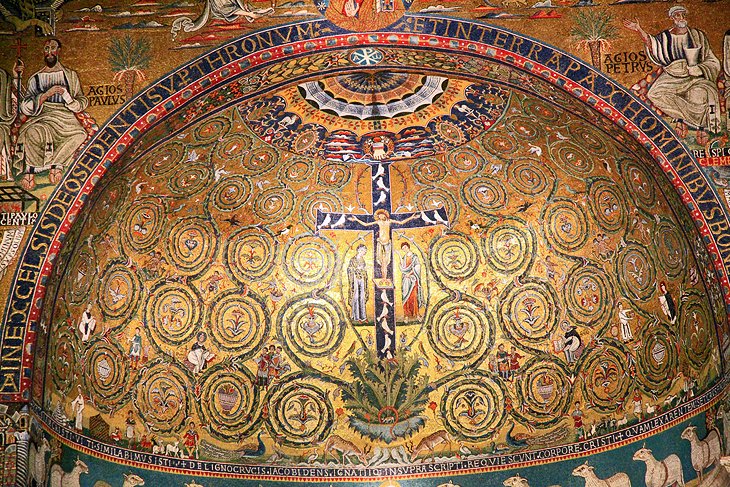
One of the oldest and most beautiful of Rome's churches, San Clemente was built before 385 by early Christians, on the site of a house containing a shrine of Mithras – now far below street level. After this church was destroyed by the Normans in 1084, a new basilica was built over its ruins at the beginning of the 12th century.
The upper church reflects the old basilican form with an entrance porch; atrium with a fountain; the nave where the congregation worshipped; and the high altar and apse, areas reserved for the clergy.
Notice the ancient columns and the beautiful inlaid marble work in the floor, the screens, the Easter candlestick, the tabernacle, and the bishop's throne. The triumphal arch and apse are the most richly decorated in Rome, covered in mosaics of Old and New Testament scenes, with the Tree of Life, saints and symbols, animals and plants intricately combined.
Also interesting are early Renaissance frescoes by Masolino, completed before 1431, in the little St. Catherine's Chapel at the west end of the north aisle. These scenes from the life of St. Catherine of Alexandria are particularly important because they show the earliest use of perspective painting in Rome.
The lower church, a fourth-century pillared basilica, has frescoes dating from different centuries in the Romanesque period of New Testament scenes and from the life of St. Clement. An underground passage leads to the excavated foundations of a second-century Roman house with the shrine of Mithras in a barrel-vaulted chamber. A relief on the altar shows Persian sun-god Mithras killing a bull.
Address: Via San Giovanni in Laterano, Rome
Official site: http://basilicasanclemente.com/eng/
11. San Pietro in Vincoli (St. Peter in Chains)
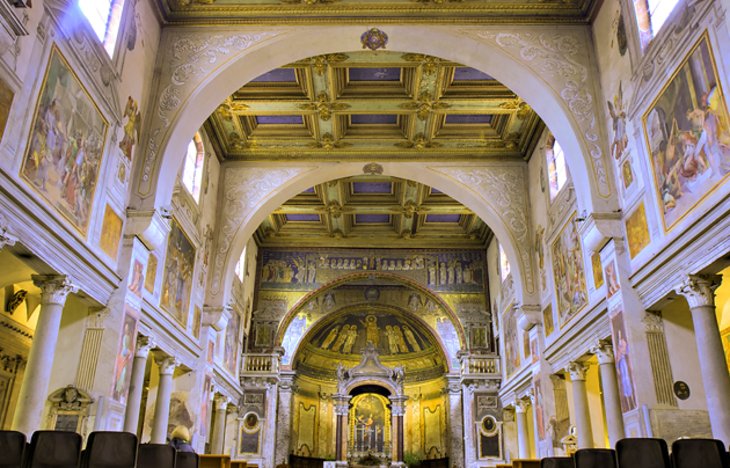
Begun in 431, St. Peter in Chains is one of Rome's oldest churches. Preserved as a precious relic in the high altar are the chains, which Peter was believed to have worn in the Mamertine Prison. The church, like most others of its age, has undergone considerable alterations by later additions. Twenty columns with Doric capitals line the nave, and in the north aisle is an excellent 15th-century tomb of Cardinal Nicholas of Cusa.
But the most important work of art here is Michelangelo's early 16th-century monument of Pope Julius II in the south transept. It was originally conceived by Michelangelo on a larger scale for St. Peter's. Only three figures of the sculpture he originally planned were done by Michelangelo himself: the central figure of Moses and Rachel and Leah, the two wives of Jacob.
The statues of Rachel and Leah are outstanding late works of Michelangelo, but the figure of Moses ranks among the finest achievements in the sculpture of the world. Moses is shown just as he has received from God the tables of the Law and is watching his people dancing round the golden calf, his face reflecting both divine illumination and anger at the people's faithlessness.
Address: Piazza di San Pietro in Vincoli 4A, Rome
12. San Lorenzo Fuori le Mura (St. Lawrence Outside the Walls)
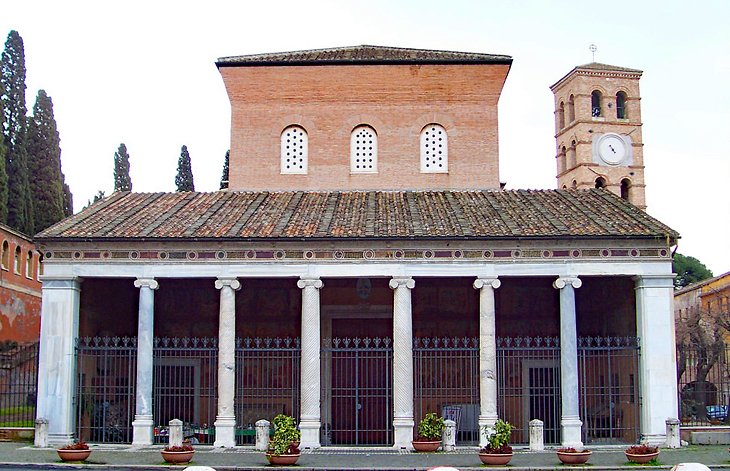
This early Christian basilica, one of the seven pilgrimage churches of Rome, was founded by Constantine the Great. Despite frequent rebuilding and restorations – most recently after World War II air raid damage – it has preserved its original basilica form, with its porch, its high nave with narrow lateral aisles, the chancel on a higher level, and its handsome columns.
Look for the particularly fine inlay of colored stones in marble on the two marble pulpits; the one on the right is considered the finest example in Rome, which is saying a lot in this city with so much excellent inlay work. Look for more in the floor, the tabernacle, the bishop's throne, the Easter candlestick, and the tomb of Cardinal Fieschi.
The mosaics on the triumphal arch show Christ surrounded by saints, flanked at the sides by elaborate renditions of Jerusalem and Bethlehem. Below, on the level of the first basilica, is the tomb of Pope Pius IX, who died in 1878. The plain cloister dates from the late 12th century.
Address: Piazza San Lorenzo, Rome
13. Santa Maria in Cosmedin
On the south side of the Piazza Bocca della Verità, Santa Maria in Cosmedin is one of the finest examples of medieval church architecture in Rome. Begun in 772 and completed about 1124, this architectural gem has a seven-story campanile and a wide two-story porch with a projecting canopy.
The interior is decorated with inlaid marble work by the Roman Cosmati family, including the floor, marble screens of the sanctuary, the marble pulpits, and the bishop's throne. The aisles are painted with frescoes, and several of the columns are recycled from ancient sites, including a stadium. In the crypt are early Christian tombs and the foundations of a pagan temple.
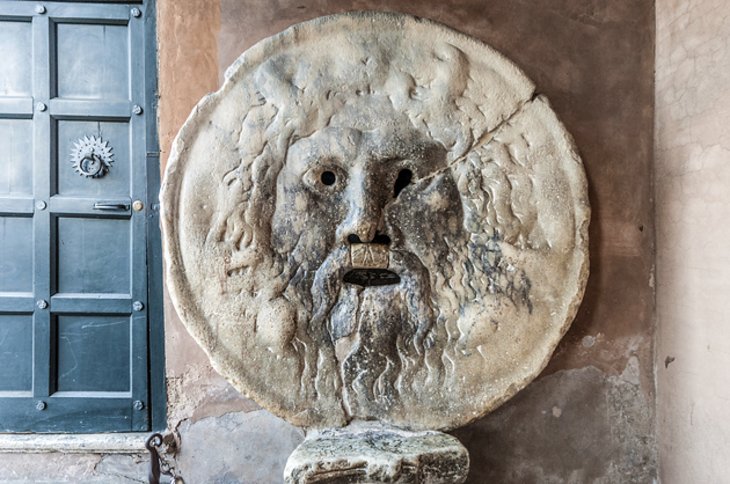
Unfortunately, the fame and popularity of this church rest not on its glorious interior or harmonious architecture, but on the large stone mask in the porch known as the Bocca della Verità, the Mouth of Truth.
Tour buses line the street – one of the few places in Rome where they can park – while tourists line up for pictures with their hand in the mouth. Guides claim this was where Romans swore oaths (the mouth supposedly bit off the hand of anyone telling a lie). It's a good deal more likely that it was a wall fountain or possibly a screen hiding an oracle, who talked through the mouth for greater effect.
The Piazza Bocca della Verità offers one of the finest views in Rome, taking in both Christian and ancient buildings (including two temples) and the Baroque Fountain of the Two Tritons.
Address: Piazza della Bocca della Verita 18, Rome
14. San Paolo Fuori le Mura (St. Paul outside the Walls)
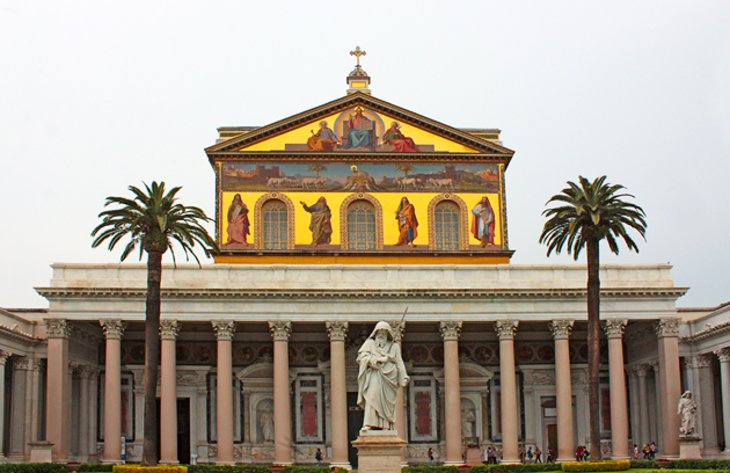
The original basilica built here in the fourth and fifth centuries and dedicated to St. Paul was, until the rebuilding of St. Peter's, the largest church in the world. It was rebuilt after being completely destroyed by fire in 1823 and resumed its position as one of the four patriarchal churches of Rome and one of the seven pilgrimage churches.
Some of the original interior art was saved, and although heavily restored, decorates the new church. The mosaics high up on the façade are 19th-century, but the on the inner side of the Holy Door, you can see the old bronze door, cast in Constantinople in the 11th century.
The vast nave – 12 meters by 60 meters – is divided into five aisles by a forest of 80 columns that lead your eye up to the triumphal arch, lined with fifth-century mosaics, and to the altar and the apse. High up on the walls are 265 portrait medallions of all the Popes.
Apart from the 13th-century Venetian mosaics, which were extensively restored, the decorations in the apse, including the Bishop's throne, are copies dating from the 19th century. Notice the magnificent five-meter Easter candlestick to the right of the altar, the Chapel of the Crucifix, and the baptistery.
In the sacristy, you'll find the entrance to the cloister of the Benedictine abbey, decorated with early 13th-century mosaics by the Vassalletti family. The variety of the columns and the color of the mosaics make this one of the most attractive cloisters in the Western world.
Address: Piazzale San Paolo, Rome
15. Sant'Andrea al Quirinale
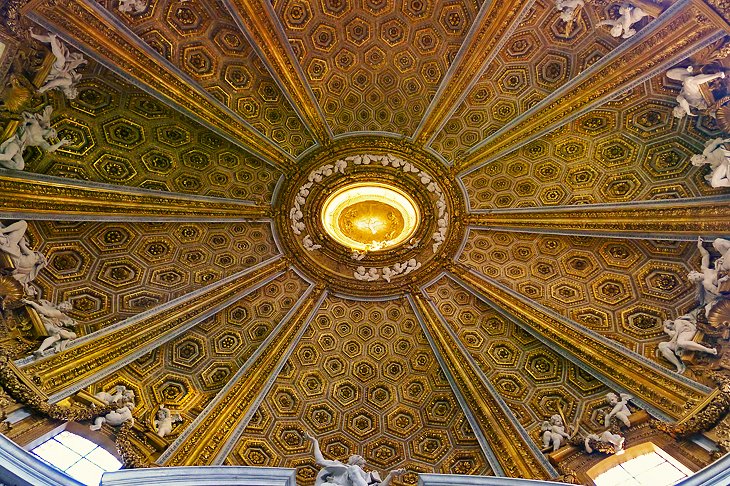
In any other city, this Bernini masterpiece would be filled with tourists, but in Rome, it is often overlooked among the plethora of churches. The interior is an exuberant expression of Baroque style, where art, architecture, and design meld seamlessly. It's no wonder this was Bernini's favorite of all his works, even though the cardinal who commissioned him to build it never paid him for the work.
Notice how the oval floor plan, further opened out by eight lateral chapels, creates the sense of space and movement as it rises from an elliptical space to the round golden dome overhead. In true Baroque style, the structural design is hard to separate from the lavish decoration of pilasters and friezes; arches and recesses; cornices and windows; coffered domes; and marble and stucco flourishes of rose, white, and gold.
Address: Via del Quirinale 29, Rome
16. Santa Pudenziana
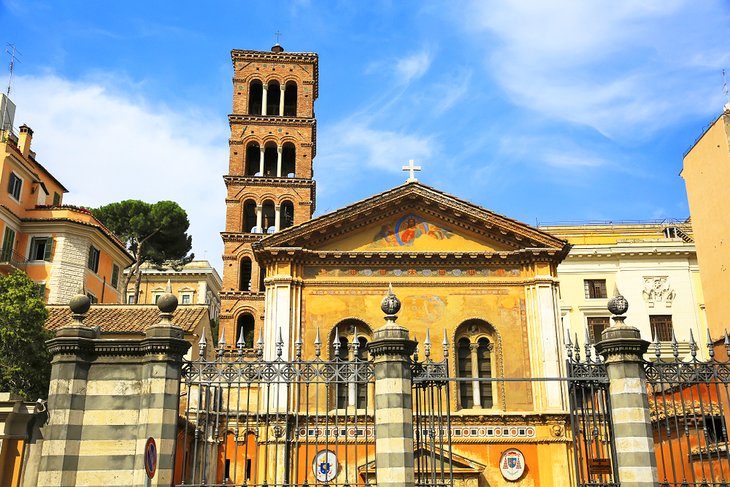
In the Monti neighborhood, about halfway between the Colosseum and Termini train station, the basilica of Santa Pudenziana is one of the rare churches in Rome that has survived intact from the mid-fourth century. Never destroyed and rebuilt, as were so many of Rome's churches, it has been used continuously since its founding. In addition, it holds the earliest Christian mosaic in Rome, dating from before AD 400.
Saint Pudenziana was the daughter of a Roman senator and sister of Saint Prassede, whose basilica is nearby. Together the sisters earned their martyrdom by retrieving the bodies of Christian martyrs and making sure they were properly buried.
Although the church has features from various periods of its history, from antiquity to Baroque, its greatest treasure is the mosaic above the high altar, depicting Christ and his apostles seated in front of the city of Jerusalem. Robed in gold that glitters today as it did in the late third century, Christ is seated on a bejeweled golden throne. The detail of the facial expressions and realism of the scene are especially remarkable. The mosaic was restored in the 16th century.
Address: Via Urbana 160, Rome
17. Santa Prassede
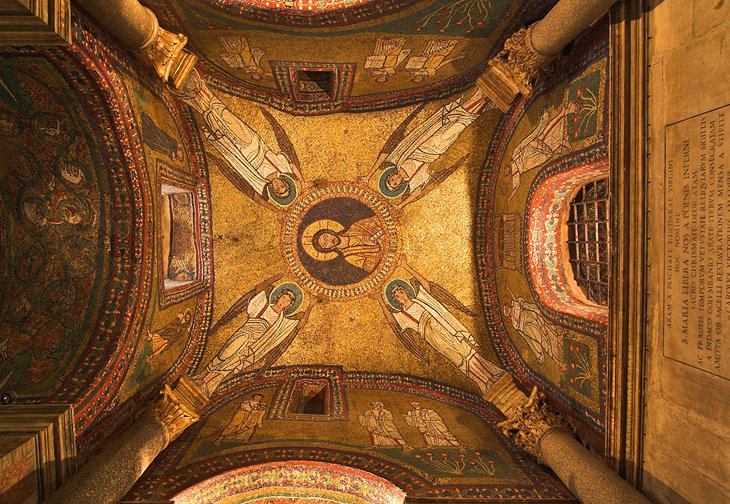
Dedicated to the sainted daughter of a Roman, St. Prassede has preserved the character of an early Christian basilica through a number of different building stages. Its high pillared nave rises into the presbytery, where the ninth-century mosaics lining the triumphal arch and apse are among the finest in Rome.
Those on the triumphal arch represent the heavenly Jerusalem; in the apse is the apocalyptic Lamb of the Revelation. Above a frieze of lambs are several saints. These, like other mosaics and frescoes, were intended not just as decoration glorifying Biblical events and saints, but as picture books to instruct the mostly illiterate medieval worshipers in the doctrines of the faith.
The Chapel of St. Zeno in the south aisle, built by Pope Paschal I to house the tomb of his mother Theodora, is like a medieval picture book, every part of the walls and vaulting are covered with mosaics depicting saints and Biblical symbols.
Address: Via San Martino ai Monti, Rome
18. Santa Sabina
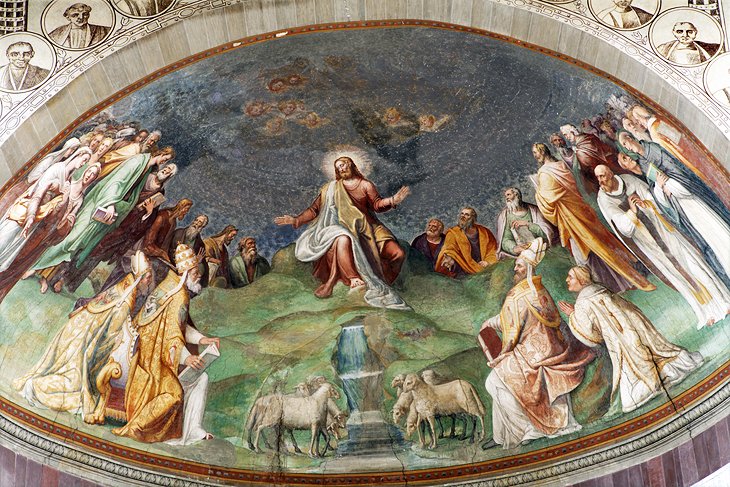
Both the inside and outside of Santa Sabina, built by Peter of Illyria in 425-432, preserve the character of an early Christian basilica, even though it was embellished in 824. On the wall above the entrance is one of the oldest mosaics in Rome, of two female figures, and the central doorway in the porch has the oldest carved wooden doors in Christian art, dating from 432. Carved from African cedar by unknown artists, their delicate and expressive reliefs illustrate Old and New Testament scenes. Eighteen of the original 28 panels survive.
Inside the church, the nave is flanked by 20 Corinthian columns of Parian marble, and the choir has beautiful marble screens with inlaid marble decoration. Adjoining the church, a Dominican monastery in which St. Thomas Aquinas was a monk has a beautiful Romanesque cloister.
A cell belonging to St. Dominic was later turned into a chapel by Bernini. From the terrace next to the church here, you can enjoy a magnificent view across the Tiber towards Trastevere, Piazza Venezia, and Vatican City.
Address: Piazza Pietro d'Illiria, Rome
19. Santa Maria in Aracoeli
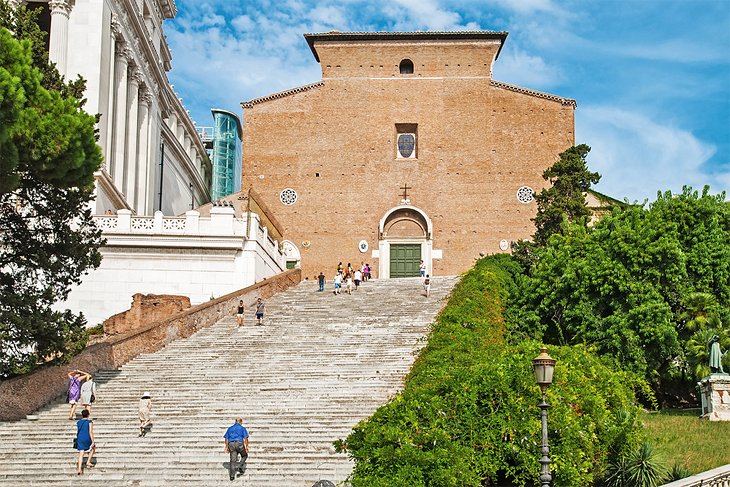
At the top of the Capitoline Hill and reached by the long series of steps known as the Stairway to Heaven, Santa Maria in Aracoeli doesn't overwhelm with its façade or its size, but with its stunning interior. Its three naves reflect both Gothic and Romanesque styles, but the reflections that will dazzle you are from the dozens of chandeliers whose lights are mirrored on the ornate decorations of the interior.
Notice the columns separating the naves – no two are alike, as they were recycled from ancient Roman buildings. Highlights are the ceiling and the statue of the infant Jesus carved of wood from an olive tree in the garden of Gethsemane.
Address: Scala dell'Arcicapitolina 12, Rome
Map of Churches in Rome
More Related Articles on PlanetWare.com
Where to Go in Rome: In addition to the churches, you'll want to see more of the top tourist attractions of Rome. Our pages on Visiting the Colosseum, Visiting the Roman Forum, and the Top-Rated Museums and Palaces in Rome will help you plan your time.
Places to Visit near Rome: With tours or Italy's efficient train system, you can easily make day trips from Rome. For gardens and Roman ruins, you can go to nearby Tivoli, or you could visit the many attractions in Naples. And there are several different ways to go from Rome to the island of Capri.