Great Slave Lake
|
|
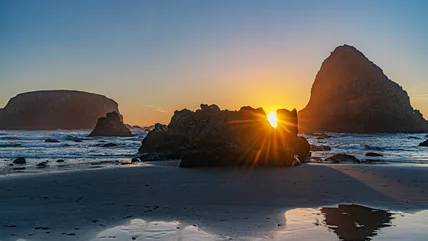
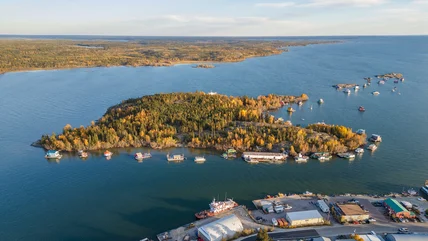
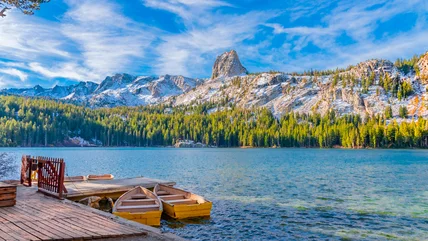
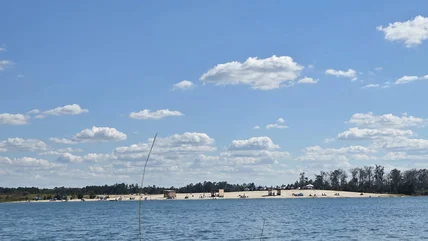
Great Slave Lake gets its name from the Slave Indians who used to live on its shores. Part of the Mackenzie river system, it is in the district of the same name and the fifth largest lake in North America, with a number of tributary lakes to the north-east and the south. The lake is more than 600 m (1970 ft) deep in places, reaching a length of up to 480 km (298 mi.) east to west, and 110 km (68 mi.) across at its widest part.It is covered with ice for eight months of the year. Its main source is the Slave River and it flows out into the Mackenzie River.Most settlement is at the mouths of the tributaries. Lead and zinc are also mined on the southern shore.Great Slave Lake is famous amongst anglers for its excellent trout and pike, while there are plenty of Arctic grayling in the tributaries.Spectacular sailing races are held on the lake, which also has some sandy beaches.Great Slave Lake was discovered by Samuel Hearne in 1771. He was followed by Alexander Mackenzie heading for the mouth of the river named after him, and by John Franklin. The gold prospectors who passed here on the way to Klondike in 1896-99 reported on the region's beauty, but nobody wanted to come here. It was not until 1930, when pitchblende was discovered on the lakeshore, that people got more interested in the area. The discovery of gold on Yellowknife Bay four years later led to a boom in Yellowknife.Fishing has gained in importance since the Second World War.
Related Attractions
Fort Resolution, Canada
Fort Resolution was built by the Hudson's Bay Company on Moose Deer Island in 1819, and transferred to its present site around 1822. It was an important center, with lighters bringing goods from Fort McMurray up the Slave River. The trading post lies 5 km (3 mi.) south-west of the main estuary of Slave River. The large mission house and the school are no longer used.
Fort Providence, Canada
The little town of Fort Providence lies on the Mackenzie River where it flows into the south-western corner of Great Slave Lake, on Highway 3 going towards Rae-Ezdo. The town is known for the wide selection of Indian arts and crafts and handmade anoraks and parkas in the shops. Boats can be rented at the filling stations in the town.The famous American Arctic explorer Sir John Franklin (1786-1847) chose Fort Providence as the starting point for his journeys of discovery to the Barren Grounds in 1819-22. At the western end of town stands a memorial to the American explorer Sir Alexander Mackenzie, who stopped off in Fort Providence in 1789 in the course of his putative trek to the Pacific Ocean which he hoped would take him to the Arctic Ocean.The Mackenzie Bison sanctuary lies north of Fort Providence on Highway 3 in the direction of Rae-Edzo. In 1963 the Canadian Government transferred here nineteen wood buffalo, a species threatened with extinction. This, the only herd of these buffalo still in existence in North America, has since grown to many hundred. Anyone driving along Highway 3 in the early morning or evening is almost certain to see one or two wood buffalo at the roadside. Mostly, though, they stay near the shores of the Great Slave Lake.