17 Top-Rated Tourist Attractions in Malta
In the Mediterranean Sea south of Sicily, the Maltese Islands (Malta, Gozo, and Comino) have a fascinating heritage. Being close to Tunisia, there is a distinct North African influence. The Maltese language is derived from Arabic mixed with Italian.
The country is also fiercely proud of the legendary Knights of Malta, who fought off the Turks and launched the Crusades.
Under the scorching sunshine, Malta's palm-tree-fringed landscape is dotted with beautiful places to visit, including picturesque hilltop towns, peaceful seaports, and colorful fishing villages.
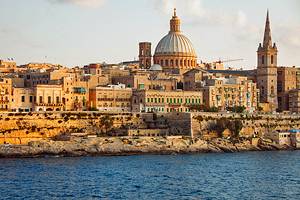
Packed with cultural attractions, the capital city of Valletta is an ideal base to explore the Island of Malta. As a traveler, you will appreciate Valletta's array of hotels, restaurants, historical sites, and cultural events.
Across the harbor, Sliema has less culture but more entertainment options and caters to 20-something travelers and students on school breaks. The Island of Gozo is the best choice for relaxing beach vacations.
Malta's weather is perfect in spring and autumn. During the hot summer months, villages come to life with religious festivals and outdoor concerts.
Plan your visit to these enchanting islands with our list of the top things to do and tourist attractions in Malta.
- 1. Valletta: Malta's Elegant Capital
- 2. The Idyllic Island of Gozo
- 3. The Medieval Hilltop Town of Mdina, Island of Malta
- 4. Historical Attractions in Rabat, Island of Malta
- 5. Ħal Saflieni Hypogeum, Island of Malta: A Neolithic Cult Site
- 6. Prehistoric Tarxien Temples, Island of Malta
- 7. Blue Lagoon, Island of Comino: Nature's Perfect Swimming Pool
- 8. The Blue Grotto, Island of Malta
- 9. Breathtaking Views at Dingli Cliffs, Island of Malta
- 10. Golden Bay Beach, Island of Malta
- 11. Ghajn Tuffieha Bay and Gnejna Bay Beaches, Island of Malta
- 12. The Seaside Charm of Mellieha, Island of Malta
- 13. Ħaġar Qim Temples, Island of Malta: A Prehistoric Megalithic Site
- 14. Mnajdra Temples of the Maltese Bronze Age, Island of Malta
- 15. Siggiewi, Island of Malta: A Traditional Maltese Village
- 16. The Country Village of Zebbug, Island of Malta
- 17. Family Fun Times at Popeye Village, Island of Malta
- Map of Tourist Attractions in Malta
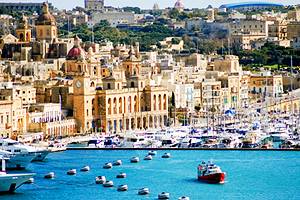
1. Valletta: Malta's Elegant Capital
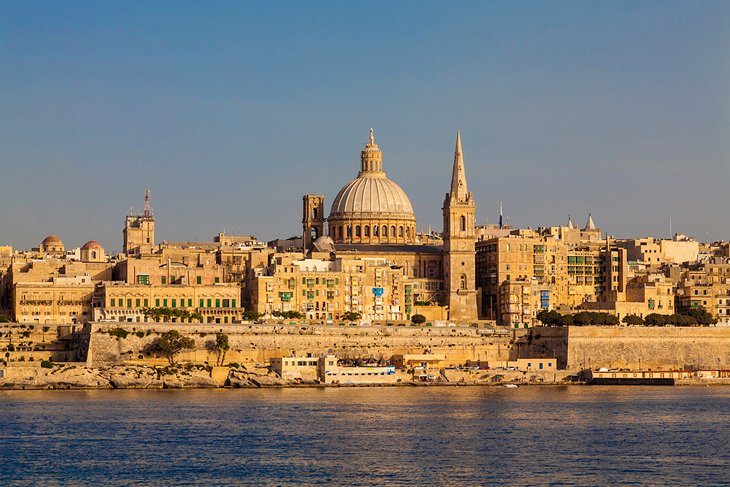
Valletta is the elegant capital of the Republic of Malta. The entire city is testimony to the grandeur of the Knights of Malta, the European noblemen who were granted the Maltese Islands by the King of Spain in 1530.
The Knights created a capital worthy of their aristocratic stature, on par with other great European capitals. Valletta's regular grid plan and orderly public squares reveal the Knights' logical 16th-century urban planning.
You can easily navigate this small city that is bounded by two harbors: the Grand Harbor and Marsamxett Harbor. It takes less than an hour to walk across the entire city.
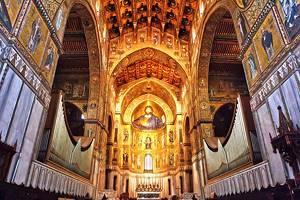
The heart of the city is St. John's Co-Cathedral, a 16th-century church built by the different Orders of the Knights, hailing from various countries such as France, Spain, and Italy. The moment you step into this magnificent sanctuary, you are awestruck by the lavish interior with its opulent gilded decor.
Nearby is the immense Grandmaster's Palace, once the residence of the Knights of Malta. This palace boasts splendid paintings, as well as an armory, that tell the story of the Knights' military victories.
If you appreciate culture and historic monuments, Valletta is one of the best places to visit on the Maltese Islands. Malta's most modernized city, Valletta is packed with tourist attractions and is a convenient base for exploring the Island of Malta without a car. The island has an efficient bus system with Valletta as its hub.
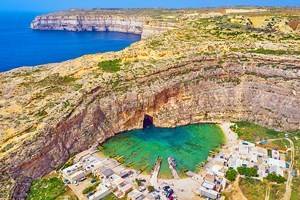
2. The Idyllic Island of Gozo
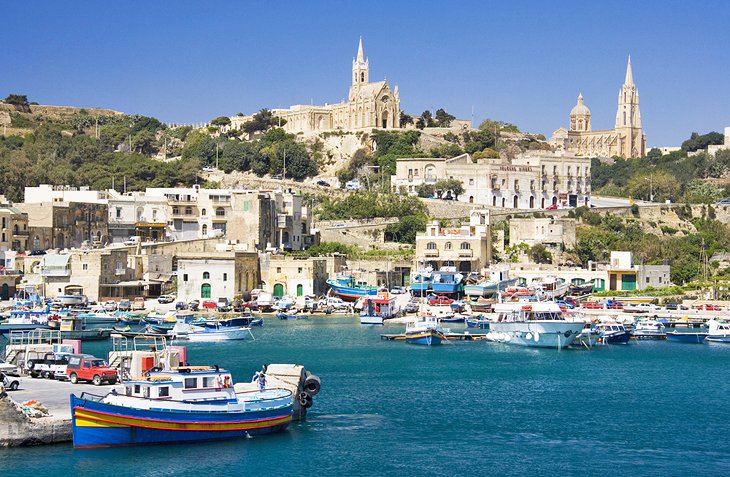
The Island of Gozo is the most idyllic destination of the Maltese Islands. With its quiet towns and pristine beaches, this little island is the perfect place to enjoy a relaxing vacation for several days or even a weeklong stay.
Although Gozo is less developed than Malta, the island has plenty of cultural attractions: a fortified medieval city, Victoria; a bustling seaside resort, Marsalforn; and the most important archaeological site of the Maltese Islands, Ġgantija Temples, dating back to around 3500 BCE.
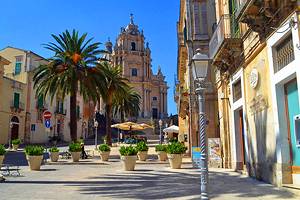
The countryside of Gozo offers a delightful retreat from the modern world. A patchwork of small farms covers the island's valleys and rolling hills. Traditional villages perch above the landscape, while the hillsides lead down to protected beaches and quaint old fishing ports. Even the tiniest towns have grandiose Baroque churches.
A favorite beach is at Ramla Bay with a wide, sandy shore and gentle waters that are safe for swimming. This well-equipped beach welcomes visitors with excellent facilities: lounge chair and umbrella rentals, showers, restrooms, changing areas, and snack bars.
The Island of Gozo is a short ferry ride from Cirkewwa on the Island of Malta.
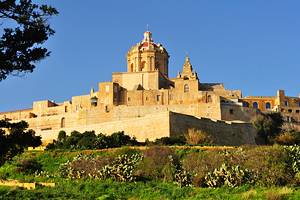
3. The Medieval Hilltop Town of Mdina, Island of Malta
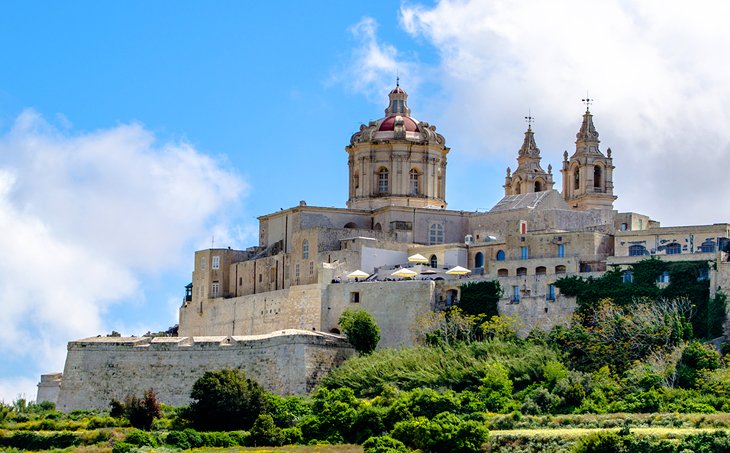
Step back in time and experience the allure of a walled medieval town. You must pass through the dramatic Main Gate to enter Mdina. Within the city's immense, ancient ramparts is a delightful world of car-free streets and beautiful, old sandstone buildings.
The entire town is a UNESCO World Heritage Site, brimming with historic monuments and cultural attractions such as its glorious Baroque cathedral, the 17th-century Carmelite Priory, and several old aristocratic palaces.
The Palazzo Falson Historic House Museum (Villegaignon Street) offers the chance to see an authentic medieval palace, decorated in the original style. The Palazzo Falson also displays exquisite art, antiques, and Oriental carpets, as well as a collection of ancient coins.
The Palazzo Vilhena (Saint Publius Square) is a stately 18th-century Magisterial Palace that now houses Malta's National Museum of Natural History.
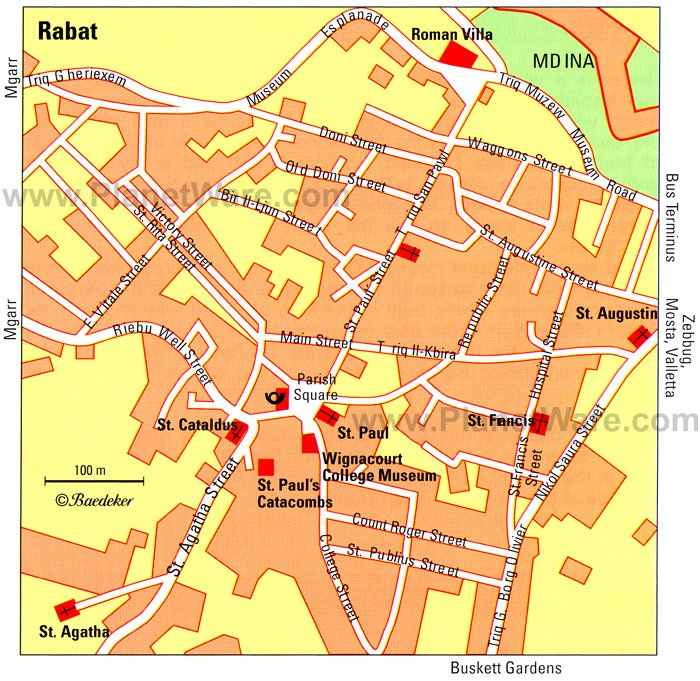
4. Historical Attractions in Rabat, Island of Malta
Just outside the Mdina ramparts is the neighboring town of Rabat. You can see both cities in the same day; Mdina and Rabat are sometimes considered to be one unified urban area.
In Maltese, the word "Rabat" means "suburb." Rabat is less touristy and more modern than Mdina, but there are noteworthy historical attractions.
One of the hidden gems is the Casa Bernard, a grand 16th-century house that is still a private residence but is open to the public for guided tours. The house is decorated with antique furniture, masterpieces of painting, and noteworthy objets d'art.
The Domvs Romana provides a glimpse of everyday life during the ancient Roman era, with exhibits about fashion, entertainment, and cuisine. The museum stands on the ruins of a Roman aristocratic townhouse and contains some of the finest 1st-century BCE Roman mosaics in the world.
The 17th-century Parish Church of St. Paul's stands above St. Paul's Grotto, where it is said that Saint Paul found refuge during his stay in Malta. Next to the church, the Wignacourt Museum displays ancient Roman artifacts and paintings by Mattia Preti as well as other European artists.
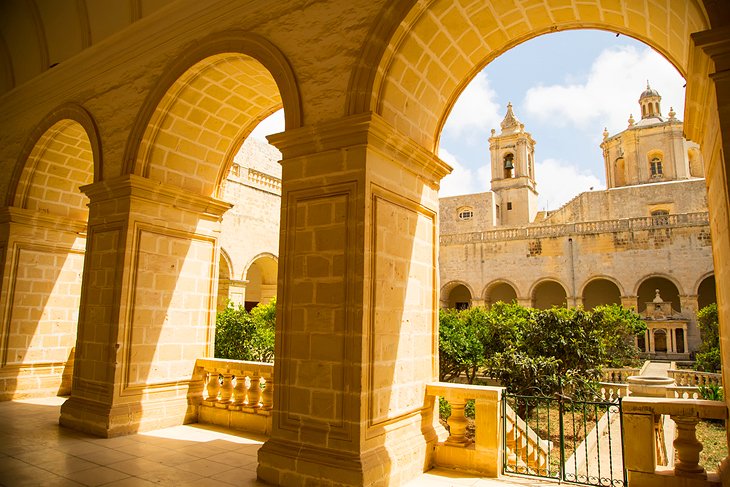
Dating back to the 15th and 16th centuries, St. Dominic's Convent is an important pilgrimage destination because it contains a marble statue of the Virgin Mary that is considered miraculous. The convent's courtyard garden was used in the filming of Game of Thrones.
5. Ħal Saflieni Hypogeum, Island of Malta: A Neolithic Cult Site
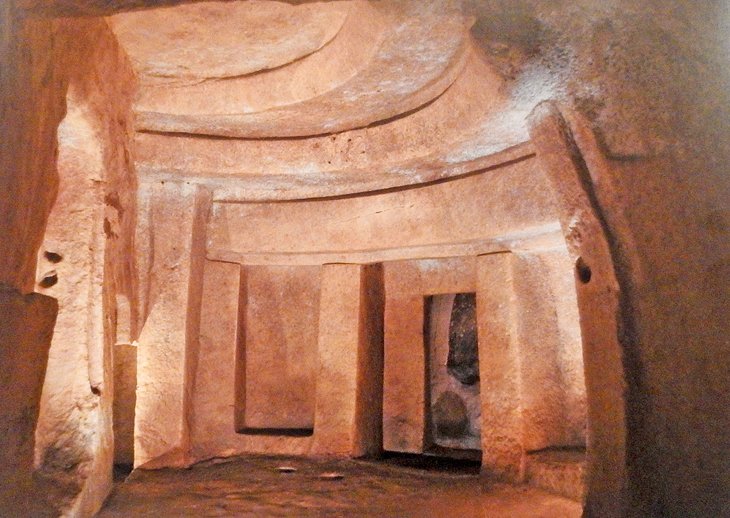
The massive dimensions and sheer mystery of Ħal Saflieni Hypogeum takes your breath away. This Neolithic-era underground cemetery is designated on the UNESCO World Heritage List because of its cultural value.
Ħal Saflieni Hypogeum has provided archaeologists and scholars with intriguing clues about the Neolithic mindset and culture. The complex stands as a rare testimony to a vanished civilization.
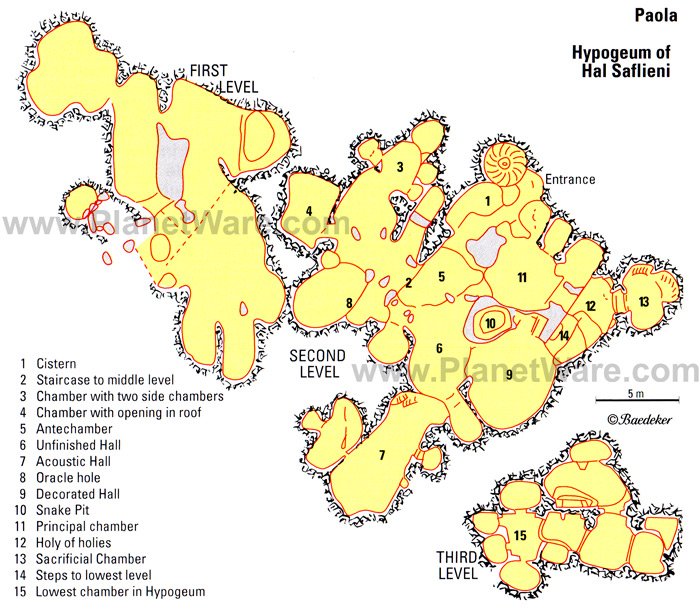
Visiting this site offers a beguiling experience. On a guided tour, you enter the site at ground level. Then, you will walk through underground passages and stairways to descend down into three levels of superimposed chambers. The lowest two levels are man-made caves, entirely carved out of limestone rock.
Natural light reaches the middle level of the complex, but not the lowest level. Archaeologists speculate that Neolithic-era people used some form of artificial illumination such as torches.
The lowest level is the chamber known as the "Holy of Holies," which is over 10 meters below the entrance to the first level at the top. Using your imagination, you might try to envision how this chamber was used by prehistoric man to perform burial rituals and ceremonies.
The site is remarkable for how old it is (4000 BCE to 1500 BCE) and for the excellent state of preservation, complete with beautiful sculpted details and paintings in red ochre. It is also fascinating the way structural elements of Ħal Saflieni Hypogeum mirror the architecture of contemporaneous (prehistoric-era) megalithic sites such as the Tarxien Temples.
Some of the artifacts found in Ħal Saflieni Hypogeum are now displayed at the National Museum of Archeology in Valletta, including clay sculptures; stone figures of birds; and The Sleeping Lady, a rare prehistoric object that depicts a woman lying on a couch.
Tip for Tourists: Book ahead! The site is open to the public for 50-minute guided tours. It is recommended to reserve your Hypogeum tickets online in advance for a specific day and time. For reasons of conservation, Ħal Saflieni Hypogeum has a limit of 10 visitors every hour.
Address: Burial Street, Paola, Island of Malta
6. Prehistoric Tarxien Temples, Island of Malta
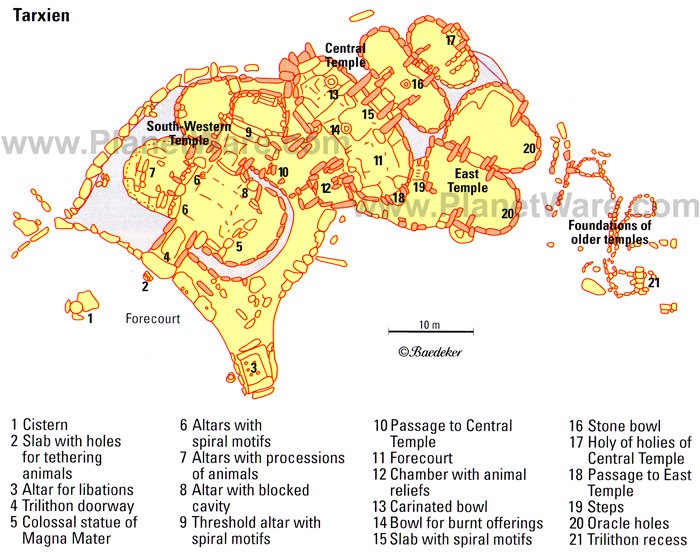
The UNESCO-listed Tarxien Temples is the largest and best-preserved prehistoric cult site in Malta, consisting of four megalithic structures. Excavated in 1914, the site covers an area of 5,400 square meters and displays the artistic achievements of Malta's mysterious prehistoric culture during the "Temple Period" (Late Neolithic Period) between 3,600 BCE and 2,500 BCE.
Stone reliefs and sculptures that were found here are represented on the site by excellent reproductions; the originals are displayed in the National Museum of Archeology in Valletta.
The stone walls of the four adjoining temples are decorated with surprisingly intricate spiral patterns and animal figures. The decorative South Temple contains the largest collection of art, including reliefs that depict goats, pigs, bulls, and a ram.
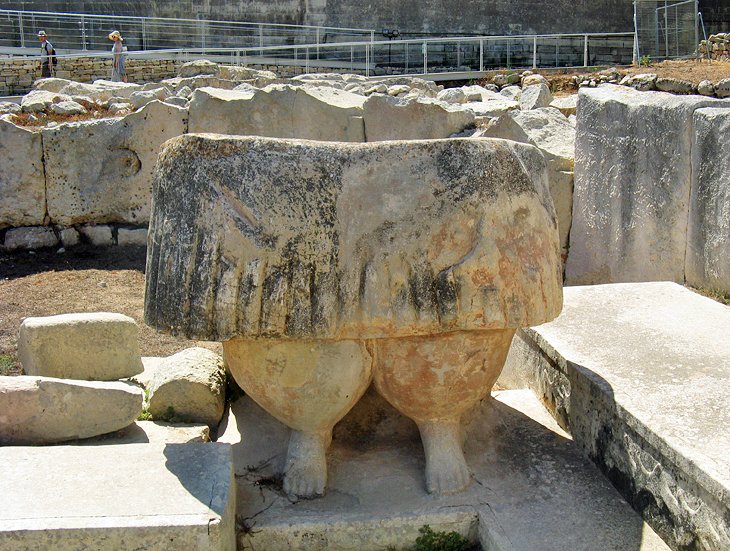
You will also find the remnant of a statue depicting a fertility goddess with robust legs, small dainty feet, and a pleated skirt. (Unfortunately, the top portion of the statue was missing when it was uncovered by archaeologists.)
The East Temple is made of sturdy slab walls with recognizable oracle holes. The Central Temple features a six-apse architectural plan and has an arched roof that reveals technically advanced construction techniques.
Tip for Tourists: The Tarxien Temples archaeological site is within easy walking distance of Ħal Saflieni Hypogeum. Both sites could easily be visited on the same day.
Address: Neolithic Temples Street, Tarxien, Island of Malta
7. Blue Lagoon, Island of Comino: Nature's Perfect Swimming Pool
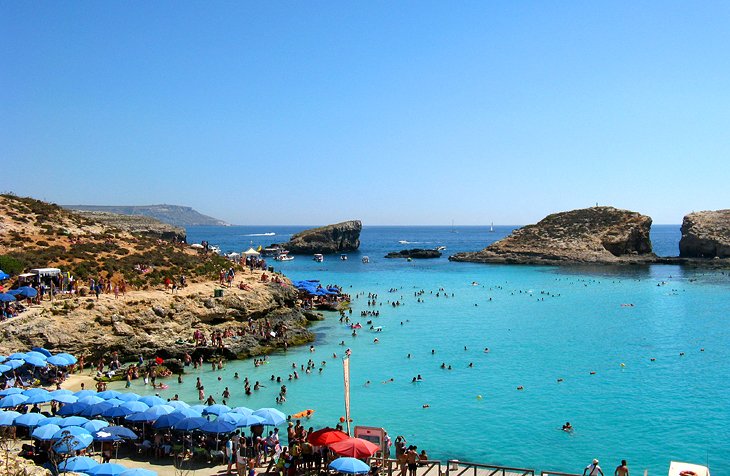
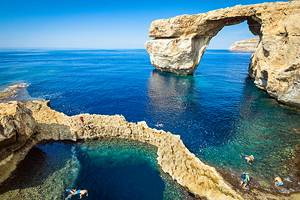
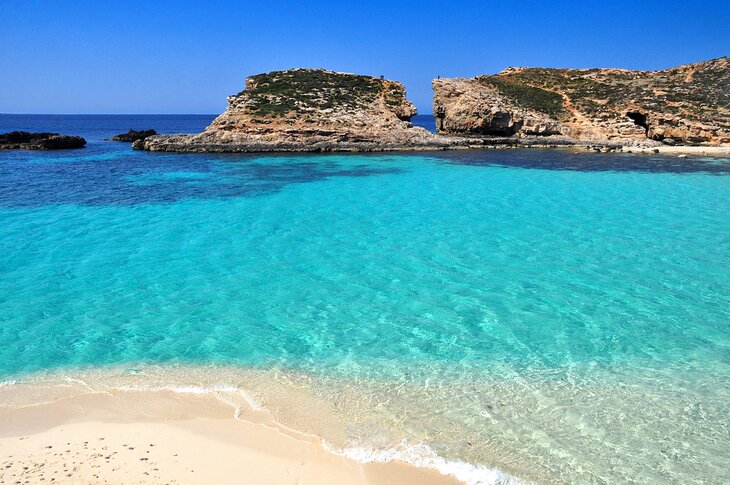
The Blue Lagoon is a mesmerizing scene of crystal-clear turquoise waters lapping over a white-sand seabed. This expansive lagoon gives the impression of being a giant swimming pool because the water is temperate, there are no waves, and the shallow end is safe enough for children.
Wonderful for swimming, splashing around, or floating on inflatable tubes, the core of the lagoon is roped off to boats. The lagoon is equivalent in length to several Olympic-size swimming pools. Good swimmers can cross to the cove on the other side.
The lagoon has a small beach with umbrellas and lounge chairs available for rent. The other option is sunbathing on the scorching-hot rocky hillside. At least, you can count on refreshment stands set up around the lagoon.
Things to do on Comino Island include nature walks, hiking, and water sports such as snorkeling and scuba diving.
Tips for Tourists: During high season, this beach is often crowded by 10:30am, so it is best to arrive early. The lagoon is less crowded after 4pm, however the returning ferries stop running around 5pm.
The ferry ride from Mgarr on the island of Gozo takes about 15 minutes to arrive at the Blue Lagoon on the Island of Comino. From the Island of Malta (departing from the port of Marfa or Cirkewwa), the ferry ride to the Blue Lagoon takes about 30 minutes.
8. The Blue Grotto, Island of Malta
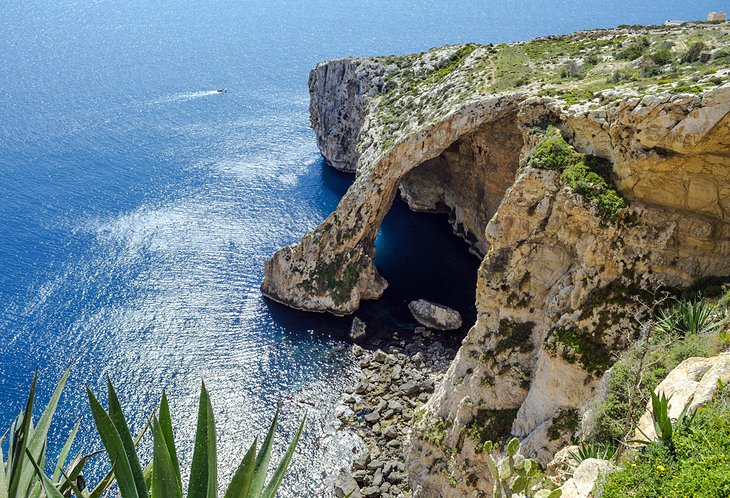
The breathtaking coastal vistas on the approach to the Blue Grotto provide an exciting introduction to this spectacular nature site. You arrive here by taking a scenic route along a winding cliffside road high above the Mediterranean Sea.
The scenery has a serene, mesmerizing quality with brilliant blue waters sparkling in limestone caves. It explains why according to mythology, the Blue Grotto was home to the sirens (sea nymphs), who captivated sailors with their charms.
You can take a guided boat tour in one of the brightly painted Maltese fishing boats called luzzus. Boats leave frequently year-round, when the sea is calm. The 20-minute joyride speeds through the sea past six caves, including the Blue Grotto, a 30-meter-high cave with a luminous pool of cobalt-hued waters.
Tip for Tourists: The best time to visit is early in the day, ideally before 2pm, when the sunlight best illuminates the water.
The village of Wied iz-Zurrieq (just one kilometer away from the Blue Grotto) has many souvenir stores, ice-cream shops, and cafés, as well as cliffside restaurants with marvelous views. You will enjoy a meal at one of the restaurant terraces overlooking the gorgeous expanse of azure sea.
The Blue Grotto is also a popular scuba diving destination because of its bountiful marine life.
9. Breathtaking Views at Dingli Cliffs, Island of Malta
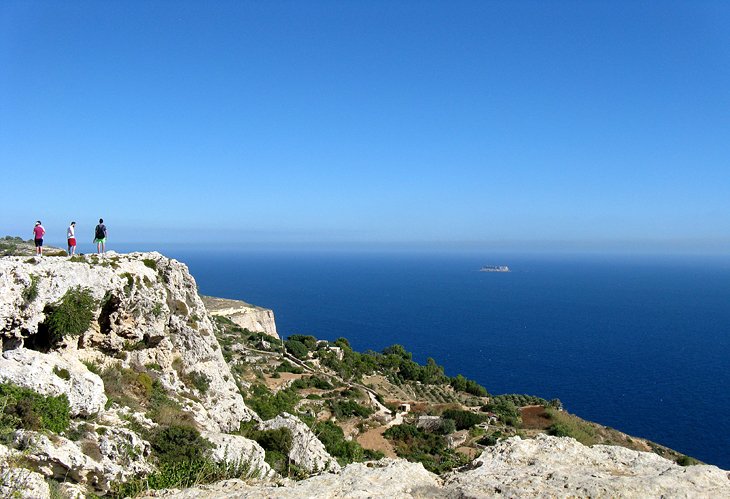
For awe-inspiring coastal scenery, take a short drive or bus ride from the Blue Grotto in Wied iz-Zurrieq to the Dingli Cliffs. The appeal (and the drawback) of this location is its remoteness.
The sheer 250-meter Dingli Cliffs plunge dramatically into the Mediterranean Sea, and the sloping hillsides are fertile land used by small farms.
The highlight of Dingli Cliffs is the viewpoint that offers stunning seaside panoramas.
Besides a short walking trail, there is nothing at Dingli Cliffs except a tiny hilltop chapel (closed to the public), which is devoted to Saint Mary Magdalene.
Tips for Tourists: Keep in mind that there are no restrooms or cafés. Sometimes you might find a pop-up souvenir and refreshment stand. Dingli Cliffs does not have a visible bus stop (ask the bus driver where to get out), and buses run infrequently, but the sensational photo-ops make it worth the trek.
10. Golden Bay Beach, Island of Malta
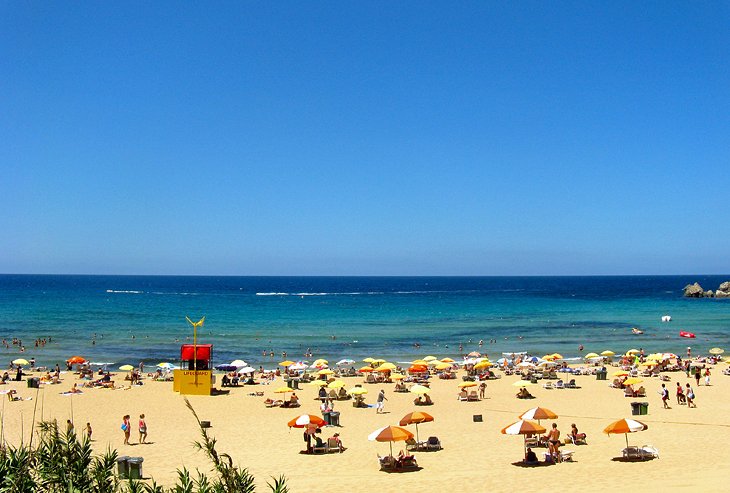
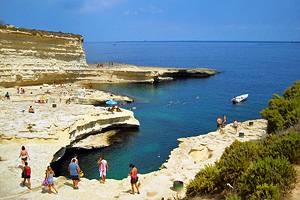
Golden Bay in Northwest Malta is one of the island's prettiest beaches. This picturesque and well-maintained beach features sheltered sandy shores tucked away behind a mountainous coastline and sloping cliffs.
The beach has an extremely wide shoreline with soft golden sands. The clean, calm waters are safe for swimming. You could spend the day here sunbathing, while listening to the soothing sound of waves lapping against the shore.
Lounge chairs and beach umbrellas are available for rent, and the site has well-maintained facilities including public toilets and changing rooms. There are also cafés and restaurants with terraces overlooking the shoreline.
The beach is found next to a luxurious five-star hotel, the Radisson Blu Resort & Spa, Malta Golden Sands, which has three restaurants, a café, snack bar, swimming pool, and fitness center.
Unlike other beaches in Malta, Golden Bay Beach is far away from street traffic, which makes it a perfect get-away-from-it-all seaside escape. At the same time, Golden Bay Beach is easily accessible by car or bus; the bus stop is only a five-minute walk away from the beach.
11. Ghajn Tuffieha Bay and Gnejna Bay Beaches, Island of Malta
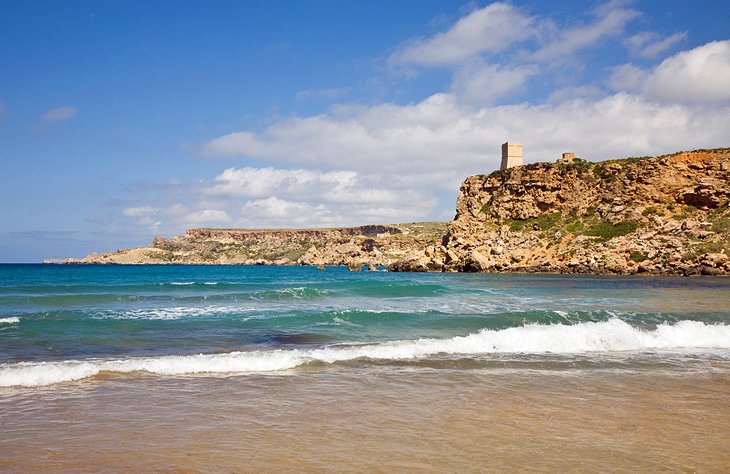
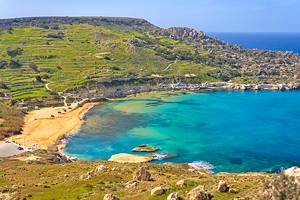
If you are exploring the area by car, it's worth driving two kilometers from Golden Bay to the unspoiled beach at Ghajn Tuffieha Bay. The beach is surrounded by cliffs and sloping hillsides. You get here by climbing down 200 steps.
Ghajn Tuffieha Bay Beach feels secluded in nature, except for the umbrellas and lounge chairs for rent, public restrooms, and a snack bar. Considered one of Malta's top beaches, Ghajn Tuffieha is favored by locals who appreciate the quiet, peaceful environment. The waters are safe for swimming except when the red flag is up (indicating strong currents).
Continuing seven more kilometers from Ghajn Tuffieha Bay is Gnejna Bay, a small protected bay surrounded by steep limestone cliffs. You must hike down a flight of steep steps to reach the gorgeous orange-sand beach, which is popular with swimmers and snorkelers. Water ski and canoe rentals are also available, as well as public restrooms and food stands.
Between Ghajn Tuffieha Bay and Gnejna Bay is the rural village of Mgarr in a bucolic landscape of vine-covered hills and small farms. Outdoorsy types will enjoy the scenic hiking trails from Mgarr into the countryside and along the coast to Gnejna Bay.
Nearby are ruins of Roman baths and ancient cart ruts (grooves in the limestone plateau), which intrigue scholars and visitors alike.
12. The Seaside Charm of Mellieha, Island of Malta
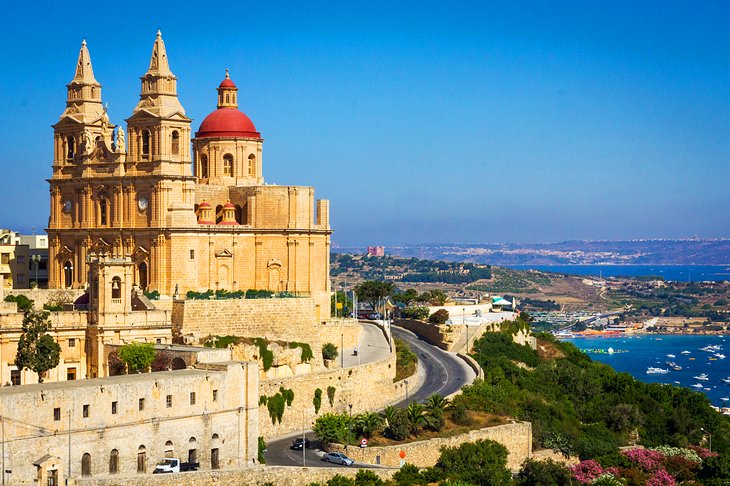
Mellieha is a family-friendly seaside destination in the scenic countryside of Northwest Malta. The beach is next to a busy road, which detracts from the natural beauty. However, the Mellieha Beach has the largest stretch of sandy shore on the Maltese Islands with a one-and-a-half kilometer shoreline of fine white sand.
Mellieha Bay has very gentle shelving, which makes it shallow enough to stand even quite far away from the shore. The calm waters with no undercurrents are safe for children to wade or swim.
The picturesque village of Mellieha stands on a craggy hilltop overlooking the pastoral landscape of rocky outcrops, vine-covered hills, and small farms.
At the highest point in the village, the lovely 19th-century Baroque Parish Church of Our Lady of Victory (Parish Square) contains the Shipwreck of Saint Paul painting by renowned artist Giuseppe Cali and a statue of the Virgin Mary.
The church's Virgin Mary statue is venerated during the annual Mellieha Village Festa. This nine-day festival begins on August 30th and features snack kiosks, traditional Maltese desserts, marching bands and fireworks.
Opposite the steps that lead down from the Parish Square is a mystical cave-shrine dedicated to the Madonna. An underground spring running through the cave is said to have miraculous healing powers.
Mellieha also has a protected habitat for migrating birds in the Ghadira Nature Reserve.
13. Ħaġar Qim Temples, Island of Malta: A Prehistoric Megalithic Site
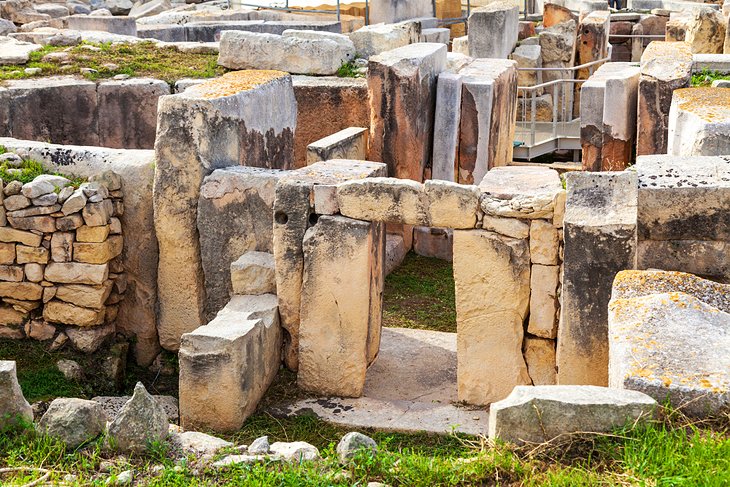
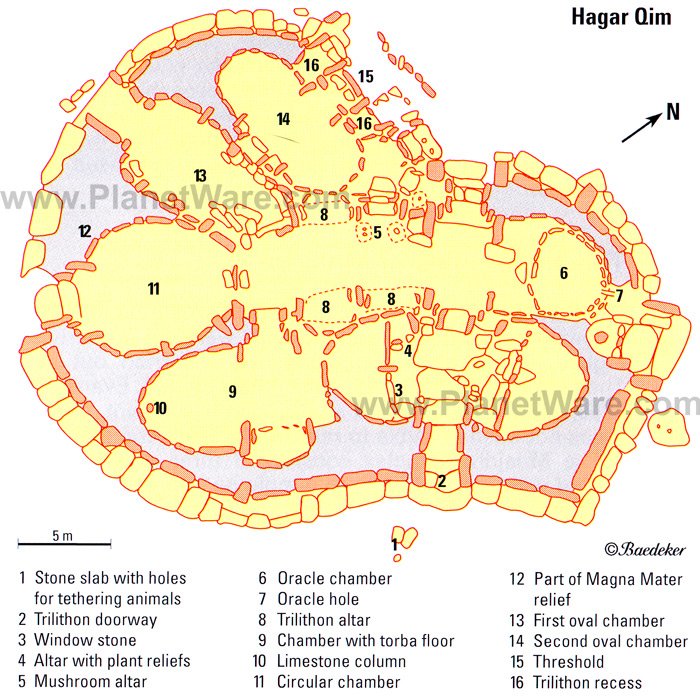
The UNESCO-listed Ħaġar Qim Temples appeal to travelers who are fascinated by Malta's megalithic sites. Perched on a rocky hilltop plateau, this archaeological park on Malta's rugged southern coast overlooks the Mediterranean Sea and the Island of Filfla in the distance.
Dating between 3600 BCE to 3200 BCE, the ancient site was buried under mounds of earth until its discovery in 1839. The facade, made up of two upright stones supporting one stone lintel, has a striking entrance.
The builders of these remarkable prehistoric temples did not use a symmetrical layout of the three chambers. Instead, the chambers and apses connect with one another but not in a uniform plan. Each temple was built as an individual place of worship.
The largest megalith of this 5,000-year-old site is more than seven meters long and weighs approximately 20 tons. The little boulders, the size of bowling balls, strewn about the site were used like castors to move the massive megaliths into place.
Artifacts found on the site, including the Fat deities, believed to be symbols of fertility, and the nude Venus of Malta, are on display at the National Museum of Archeology in Valletta.
Address: Triq Hagar Qim, Qrendi QRD 2501
14. Mnajdra Temples of the Maltese Bronze Age, Island of Malta
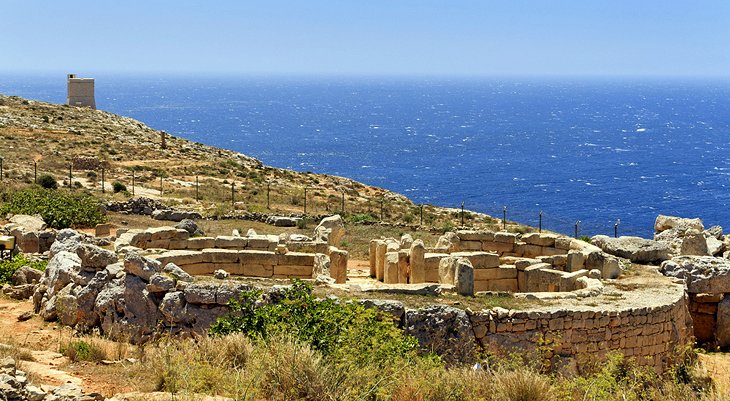
Another UNESCO World Heritage Site, the Mnajdra Temples are found 500 meters away from the Ħaġar Qim Temples in an isolated stretch with stunning sea views. This archaeological complex includes three different structures.
The oldest structure, the South Temple, dates to around 3600 to 3200 BCE. The other two temples were built between 3150 BCE and 2500 BCE. These three structures represent a significant stage in prehistoric human development known as the Ġgantija Phase (circa 3000 BCE to 2200 BCE), which was an important period of the Maltese Bronze Age.
The most intriguing feature of Mnajdra Temples is the doorway of the South Temple. The doorway is flanked by two immense blocks with small holes that mark the position of the rising sun on the Equinoxes (first day of spring and autumn) and the Solstices (the first day of summer and winter).
Address: Triq Hagar Qim, Qrendi QRD 2502
15. Siggiewi, Island of Malta: A Traditional Maltese Village
This traditional Maltese village is in southwestern Malta between Rabat and Marsaxlokk in the fertile Girgenti Valley, which begins near the Dingli Cliffs.
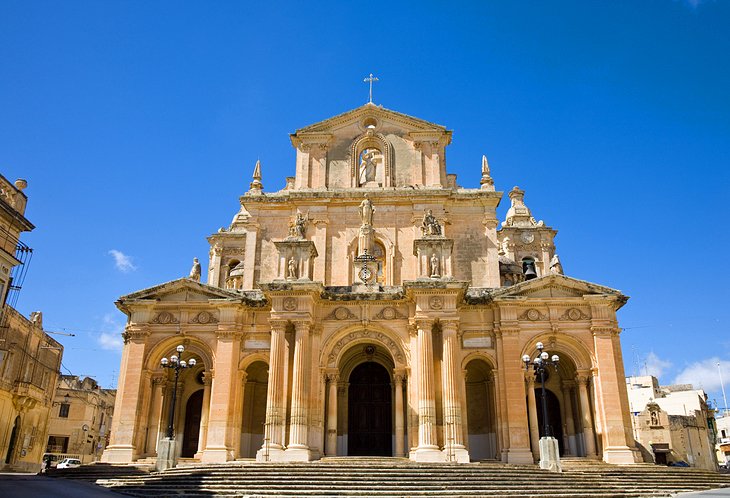
At the center of the village, the Parish Church of Saint Nicholas features an impressive Baroque facade created by Lorenzo Gafà in 1693. The church is usually closed except during the annual festival.
The Siggiewi Festa (Feast Days), honoring Saint Nicholas, is held at the end of June. The church is illuminated with multicolored lights, and its relics are paraded around the town. The four-day festival includes fireworks, brass band music, and authentic Maltese treats (such as pastry stuffed with dates and nougat made with almonds or peanuts).
From May through October, Siggiewi hosts the Maltese Summer Folklore Nights at the Limestone Heritage Park and Gardens. This lively event showcases Maltese culture with folkloric dance and music performances, as well as a buffet featuring delicious Maltese dishes. The Limestone Heritage Park and Gardens is also a popular venue for outdoor weddings.
16. The Country Village of Zebbug, Island of Malta
This country village has a history dating back to 1436. The Grand Master de Rohan elevated Zebbug to a city, renaming it Citta Rohan, and built the triumphal arch at the entrance of the town.
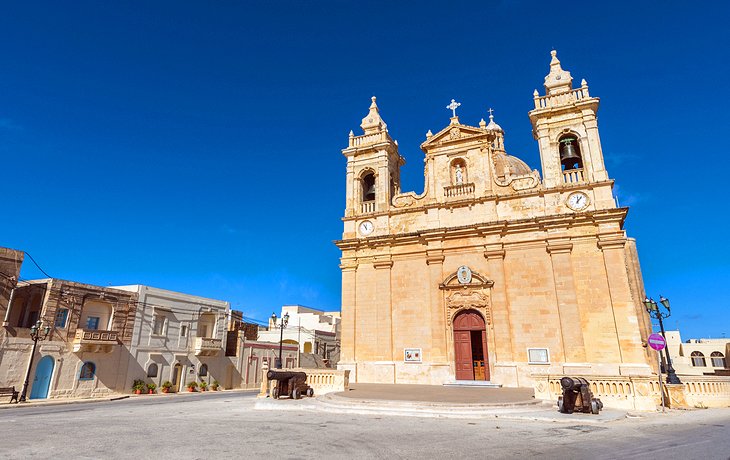
The main square is graced by the twin-towered Baroque Parish Church of Saint Philip with an ornately decorated interior. The initial design was created by Cassars, the architect of Saint-John's Co-Cathedral in Valletta.
Zebbug celebrates its annual religious festival, the Festa of Saint Philip, at the Parish Church in June. The celebrations include marching band processions, fireworks, and colorful decorations. A highlight of the festival is when the silver statue of Saint Philip is paraded through the village.
17. Family Fun Times at Popeye Village, Island of Malta
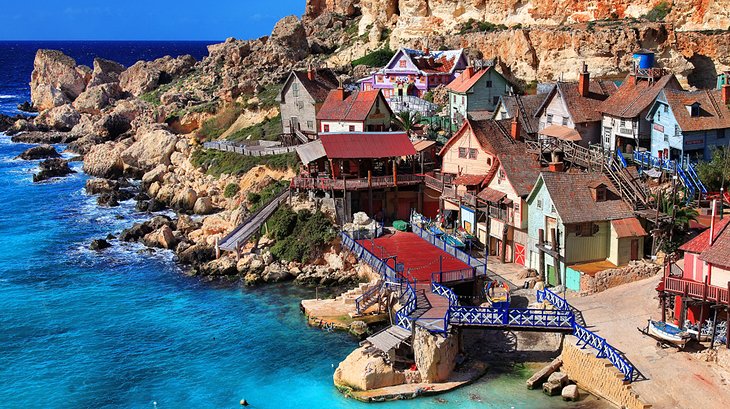
For families with young kids, the Popeye Village in Mellieha offers an entertaining place to spend the day. This charming tourist attraction was originally a film set for the 1980s movie Popeye starring Robin Williams and has become one of the top tourist attractions of Malta.
The film set is a quaint seaside village made of 20 wooden structures. You are greeted by Popeye the sailor and then can take a tour of the village to find the post office, bakery, firehouse, and other buildings. Popeye Village also has a beach, sunbathing decks, and a souvenir shop.
The village celebrates holidays, such as Carnival, Easter, and Halloween, with festive decorations and amusing activities.
Address: Popeye Village, Anchor Bay, Triq Tal-Prajjet, Mellieha, Malta