Visiting Mosteiro Palácio Nacional de Mafra: 14 Top Attractions
The Monastery and National Palace of Mafra, in the pleasant town of Mafra, 40 kilometers north of Lisbon, affords a rewarding sightseeing experience.
Construction of the palace began in 1717 on the orders of King João V to honor the birth of the monarch's first child and heir, the future King José I.
Originally intended as a modest Franciscan monastery, the simple convent quickly evolved into a lavish palace, designed by Italian-trained German architect Johann Friedrich Ludwig (1670-1752), paid for by Brazilian gold, and built by a workforce of 50,000 men. The basilica was consecrated in 1730, although it was 1750 before the monumental building was completed.
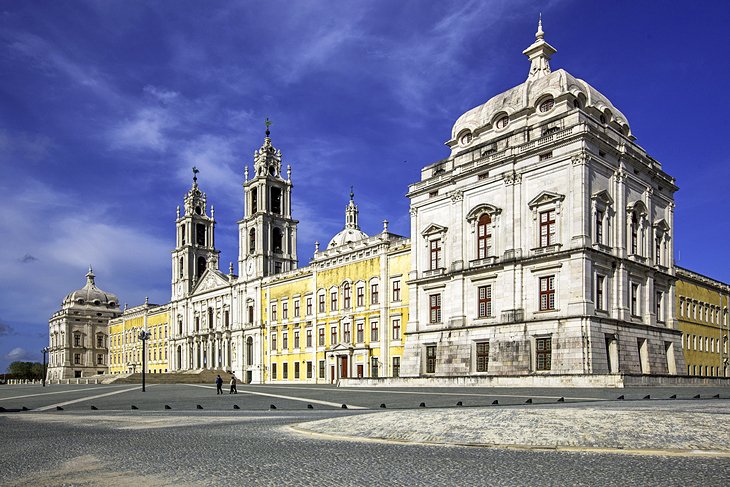
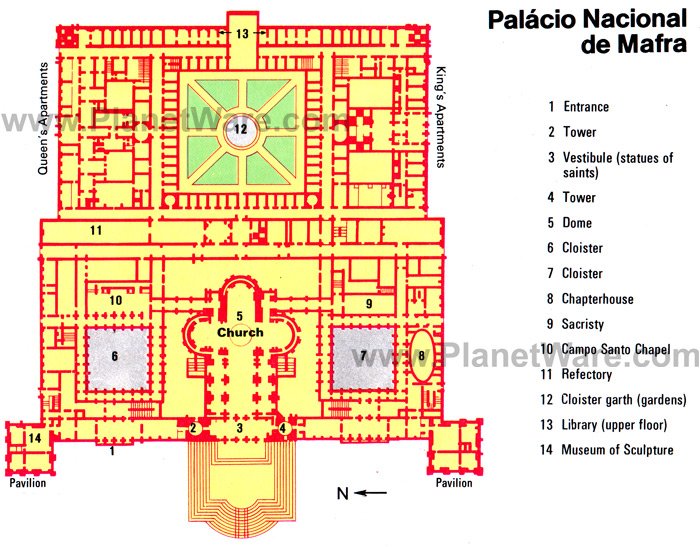
Its vast dimensions are staggering. The whole complex covers 40,000 square meters and has more than 1,200 rooms, 5,000 doors and windows, and 156 staircases - a wildly exuberant statement of Baroque magnificence, extravagance, and iron-fisted royal power.
The irony is that the royal apartments were hardly ever occupied. João V and his queen spent little time here, and the palace was only really popular with those members of the royal family who enjoyed stalking game in the nearby Tapada de Mafra hunting grounds.
King João VI did reside here throughout 1806-07, but fled to Brazil ahead of advancing French troops in 1808, taking most of the furniture and all the valuables with him. For the most part, what you see today at this popular tourist attraction are recreations of the rooms, refurbished with what was left behind. Besides the palace, some of the rooms and halls in the monastery are open to the public as is the splendid basilica.
- 1. Library
- 2. Throne Room
- 3. Music Room or Yellow Room
- 4. Infirmary
- 5. The Basilica
- 6. Palace Exterior
- 7. Queen's Bedroom
- 8. Trophy Room
- 9. Saint Martyrs of Morocco and Collection of Religious Art
- 10. Great Hall
- 11. King's Bedroom
- 12. Hall of Destiny
- 13. South Tower
- 14. The Royal Hunting Grounds: Tapada Nacional de Mafra
- Visiting Tips
- Address
1. Library
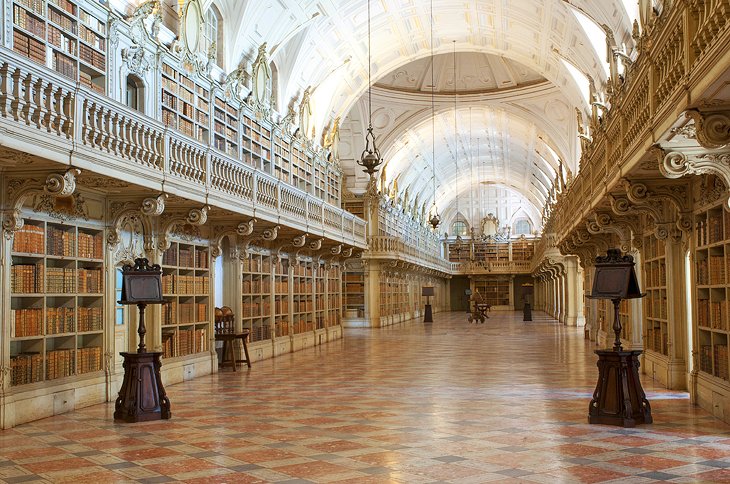
The magnificent Library is the undoubted highlight of Mafra Palace and one of the most celebrated book depositories in Europe. This is the largest and noblest of the palace's rooms.
Designed in the form of a cross, its marble floor is 90 meters long and 9.5 meters wide. The Rococo-style wooden bookcases hold a priceless collection of more than 40,000 books in gold-embossed leather bindings.
Among the more noted volumes housed here is the Nuremberg Chronicle, dated 1493, and a 1595 copy of Theatrum Orbis Terrarum by Abraham Ortelius, considered to be the first true modern atlas. A trilingual copy of the Bible from 1514 is also stored here, while a prized first edition of Os Lusíadas (1572) by the Portuguese poet Luís de Camões is regarded as a national treasure.
Not surprisingly, the public are not allowed to browse any of the books and can only proceed a short way in from the library's entrance. But it's enough to marvel at the sumptuous interior and to muse upon the fact that the valuable contents are kept free from insect infestation by a colony of bats that lives in the eaves.
2. Throne Room
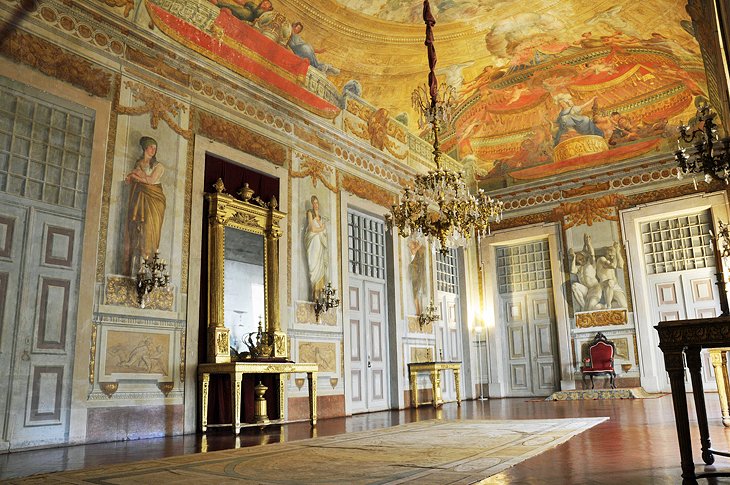
The dazzling Throne Room is where official audiences with the king took place. The striking wall frescoes decorating the hall are the work of court artist Domingos Sequeira (1768-1837) and represent the "Royal Virtues": Perfection, Tranquility, Kindness, Knowledge, Generosity, Concordance, Constancy, and Conscience.
It is the ornate coffered ceiling, however, that really turns heads. Painted by Cyrillo Volkmar Machado (1748-1823) as an allegory to "Lusitania" (Portugal) the scene's autumnal hues illuminate the interior with a warm copper glow that might have helped temper the stuffy and formal atmosphere of the day. The room itself is sparsely furnished, save for an 18th-century Lignum vitae carved armchair, upholstered in red velvet, and a number of gilded wall tables.
King João VI's private chapel adjacent to the Throne Room features another less extravagant ceiling painting by Machado.
3. Music Room or Yellow Room
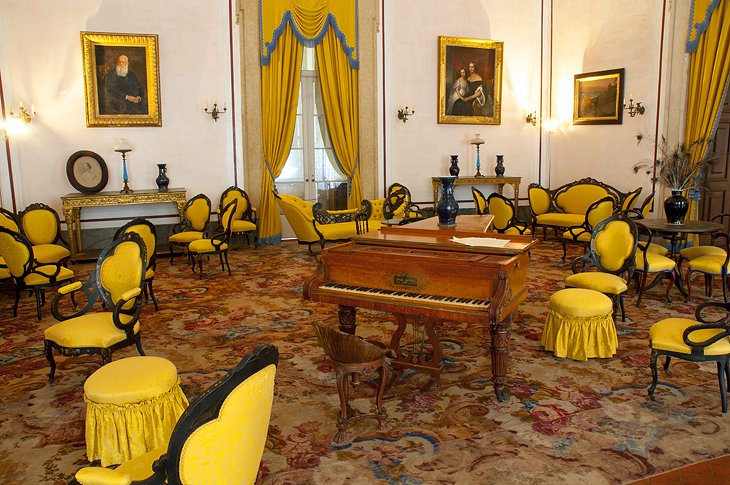
The most decorative and harmonious of all the state rooms, the Music Room is so named for the centerpiece grand piano made by Joseph Kirkman of London in the 19th century. The refreshingly light and airy salon is decorated with a suite of chairs and chaise longue upholstered in a mustard hue, hence the sobriquet.
Heightening the sense of elegance is a series of 19th-century paintings and lithographs set along the walls, one of which is by Austrian Josef Anton Strassgschwandtner (1826-1881).
4. Infirmary
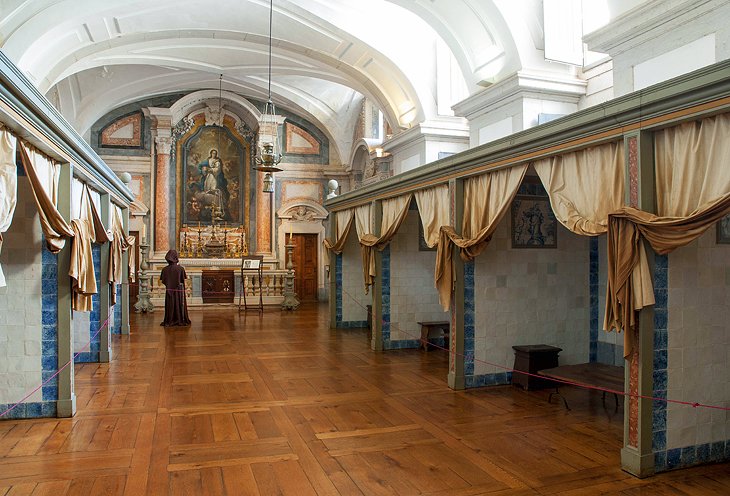
Past the simply furnished monks' cells, a kitchen decorated with an assortment of brass and copper utensils, and a small dispensary is the convent's Infirmary, the most noteworthy of the convent's rooms.
The sick and injured were treated in cubicles positioned along the walls of the long hall, each screened with heavy drapes for privacy. At the head of each oak bed is a tiled panel of Christ, and at the foot, one of the Virgin Mary.
At one end of the ward is a chapel, its altarpiece a depiction of The Virgin Mary, an 18th-century oil canvas attributed to Sebastiano Conca. On Sundays, the beds were pulled into the center of the ward, so that patients could see and hear mass. The steps near the chapel lead down to the cemetery.
5. The Basilica
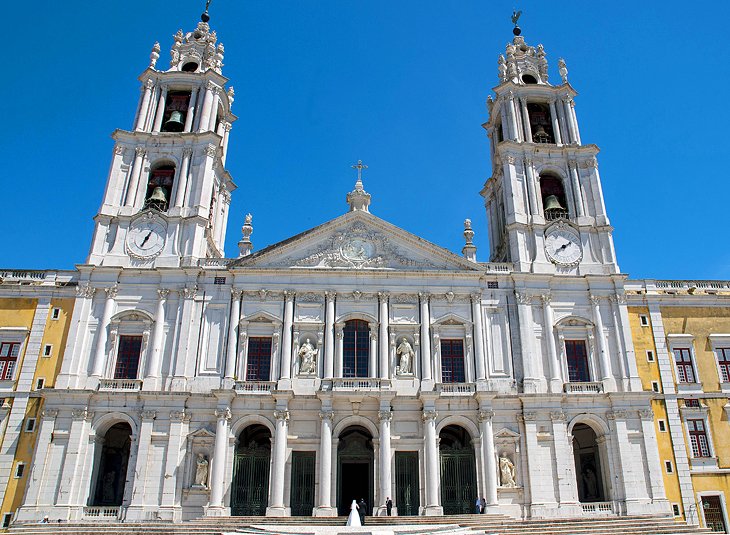
Consecrated in 1730, the magnificent domed basilica is the central point of the main façade. Designed by German architect Johann Friedrich Ludwig, who drew on inspiration from St. Peter's Church in the Vatican and the Jesus Church in Rome, this is the first church dome ever built in Portugal, and was later used as a model for the building of the Basilica da Estrela in Lisbon.
The twin 68-meter-high towers soaring over the basilica each hold 58 bells: those in the North tower carillon were wrought in Liège by Nicolau Levache, while those in the South tower were made in Antwerp by Willem Witlockx. They are the largest historic carillons in the world.
The interior makes abundant use of Sintra marble of contrasting colors. Adorning the basilica's atrium is a collection of 14 statues of saints carved by members of the Mafra School of Sculpture under the auspices of the Italian master Alessandro Giusti (1715-99). This is the finest assembly of Baroque Italian sculpture found outside Italy.
The striking marble altarpieces of the church's eleven chapels are also the handiwork of the Portuguese and foreign artists working at the school, founded by José I in 1754.
The basilica's six pipe organs are remarkable for the fact that they were all built at the same time (between 1806 and 1807) and were originally conceived to play together. The instruments were constructed by António Xavier Machado e Cerveira and Joaquim António Peres Fontanes, in their day, two of Portugal's most celebrated organ builders.
The church is open to the public and can be visited independently of the convent and palace.
6. Palace Exterior
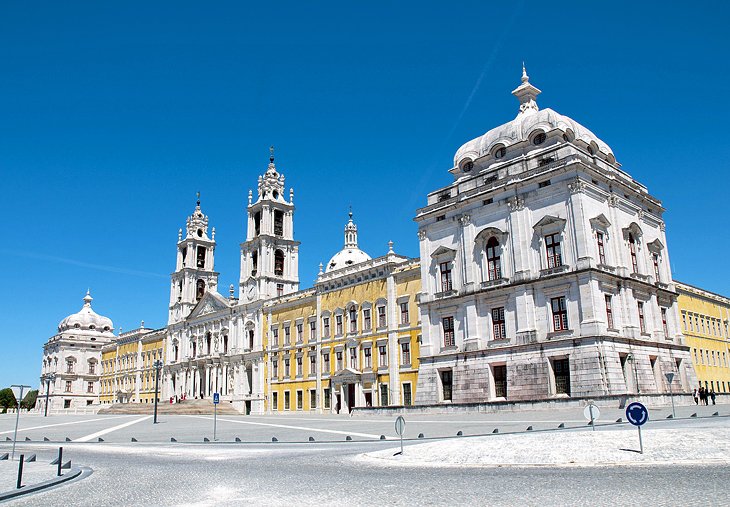
Nothing quite prepares the eye for the colossal dimensions of the Mosteiro Pálacio Nacional de Mafra. The historic 18th-century landmark defines the town and surrounding countryside and its monumental outline is discernible from several kilometers away.
A triumph of classical Baroque architecture inspired by papal Rome, the limestone and marble building covers an area of almost four hectares. The length of the main façade alone is 232 meters.
An image of perfect symmetry, the palace evolves from a central basilica balanced by two soaring bell towers. A wide sweeping esplanade, free of traffic, allows an uncluttered perspective of the palace's frontage, best appreciated when bathed in the afternoon sun.
Several cafés line the street opposite, where you can admire the view from a seat at any one of their terrace tables.
7. Queen's Bedroom
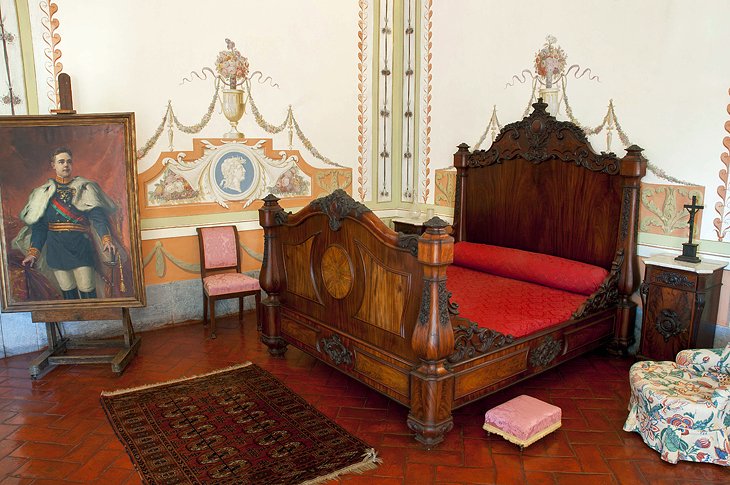
One of the most historic rooms in the palace is this one, not so much because it was the Queen's bedroom, rather it is in this salon that the last Portuguese monarch, Manuel II, slept the night before he went into exile in England on Wednesday, 5 October, 1910.
The solid 19th-century bed is designed in the Romantic style and kept company by a late 18th-century rosewood dressing table and an 18th-century Lignum Vitae chest-of-drawers. An unattributed portrait of a rueful Manuel II stands on an easel at the foot of the bed.
The exiled monarch lived the rest of his days in London and died in 1932.
8. Trophy Room
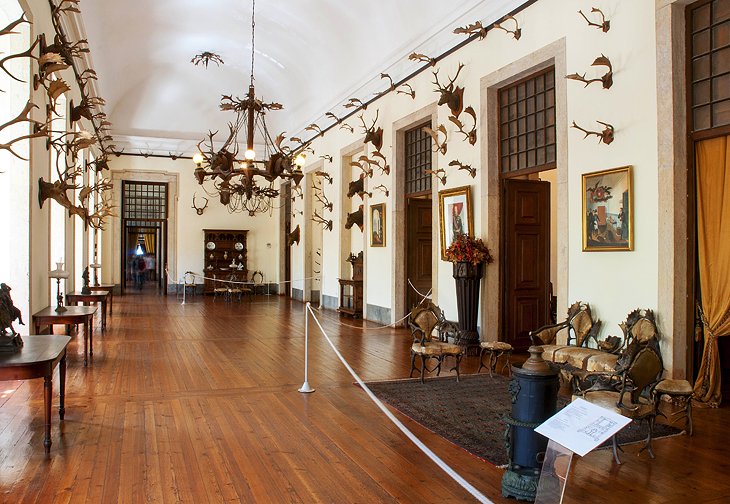
The Royal Family frequently hosted shooting parties in the nearby Tapada Nacional de Mafra, the palace's extensive hunting grounds. The Trophy Room, or Sala da Caça was created to showcase the spoils of such occasions and displays a grotesque collection of nearly one hundred sets of mounted deer antlers and several boars' heads.
But what truly shocks is the furniture, including the chandeliers, made from antlers and upholstered in deerskin. This is not a room for the squeamish to linger in, and it won't win any votes from animal rights campaigners. It's fascinating, yet terribly unnecessary.
9. Saint Martyrs of Morocco and Collection of Religious Art
A self-guided tour of the convent begins in the room dedicated to the Saint Martyrs of Morocco, a group of Franciscan friars dispatched from Italy in 1219 by St. Francis of Assisi to promote Christianity.
Arriving in Seville in Spain when it was still under Muslim rule, the missionaries, led by Berard of Carbio and accompanied by two other priests, attempted in vain to preach the Gospel. Undeterred, the missionaries traveled to Morocco, where the kingdom's Moorish ruler eventually had the hapless priests executed, making them the first martyrs of the Franciscan order.
The martyrs appear as polychrome terra-cotta figurines in the middle of the room, sculptured anonymously in the 18th century. Look out also for the 19th-century baptismal font in painted wood made especially for Princess Ana de Jesus, daughter of King João VI, who was born in the palace.
The adjacent salon houses an impressive display of 18th-century religious art and other ecclesiastical artifacts including the oak cross that was used during the consecration of the Basilica of Mafra in 1730.
10. Great Hall
The Great Hall, housed in the North Tower, served as the king's private apartments until the late 19th century and later converted to host visiting dignitaries after the death of King Ferdinand II in 1885. Four enormous canvases, painted in the early 1730s, themed around St. Peter and St. Paul, lend the room a pious and sober air.
Look closely, and you'll spy the 19th-century French silver writing set, ink bottle, and a sand container bearing the monogram of Queen Maria Pia of Savoy positioned on the table in the center of the room.
Also notable is the decorated earthenware aquecedor, an early example of a radiator, or water heater, made at the Real Fábrico do Rato ceramic workshops in Lisbon around 1769.
11. King's Bedroom
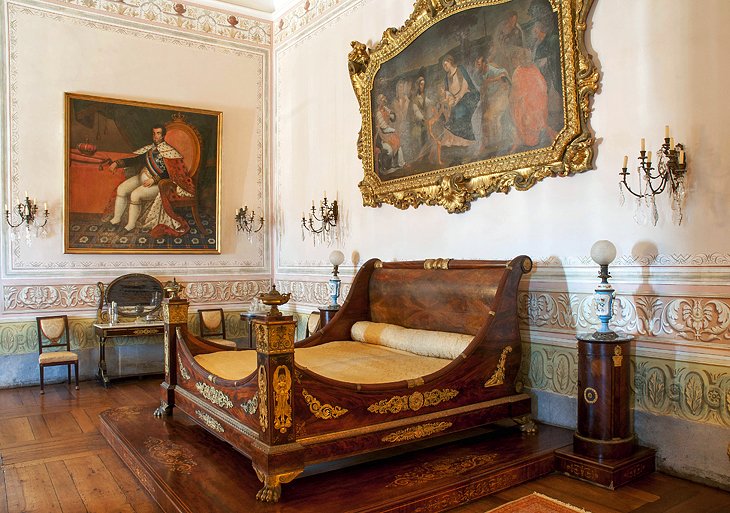
A grand, French-made, Empire-style mahogany gondola bed with matching side tables is the centerpiece of this otherwise visually muted chamber.
A portrait of a rotund and rather self-conscious looking King João VI, painted by José Inácio de Sampayo in 1824, looks down forlornly over a chest of drawers and a dressing mirror, also crafted in mahogany.
The scant silverware on show is 19th-century Portuguese and includes a single bowl and perfuming pan. Otherwise there is little to suggest that this was once the sleeping quarters of a monarch.
12. Hall of Destiny
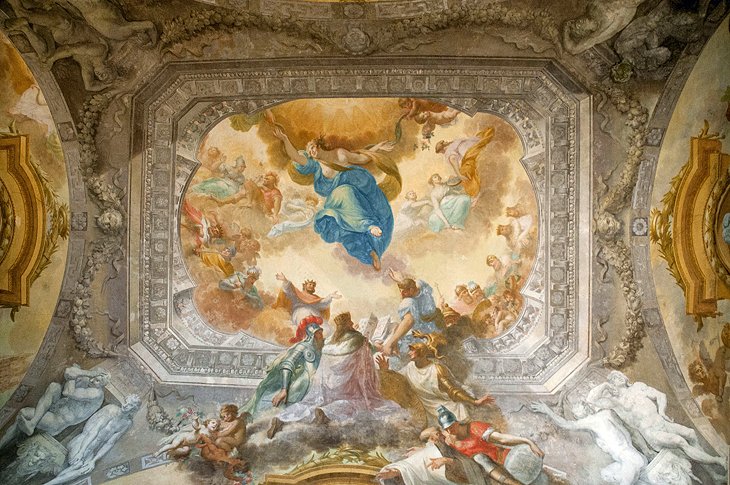
The best way of admiring the beautiful ceiling painting in the Hall of Destiny is by lying on your back in the corridor that runs directly underneath it. This astonishingly vivid artwork is another allegory to Lusitania (Portugal), with the country surrounded by all the kings of Portugal up until the end of the 18th century. Afonso Henriques (1109-1185), the nation's first king, is depicted clutching the book of destiny surrounded by Hugues Capet, King of France, and Henry of Burgundy, father of Afonso Henriques.
Those who prefer to stand upright can gaze at eye level towards the oil canvas on the wall by Máximo Paulino dos Reis showing Lord Wellington handing Portugal back to King João VI after defeating Napoleon's troops.
13. South Tower
Upon reaching the South Tower, you will have walked nearly 200 meters along one of the longest corridors of any building in Portugal. The South Tower housed the Queen's private apartments and included a kitchen in the basement, buttery and storeroom on the ground floor, and rooms for ladies-in-waiting on the first floor.
The apartments were removed in 1910 after the end of the monarchy in Portugal, and the huge empty space, embellished here and there with religious paintings, can only echo past glories.
14. The Royal Hunting Grounds: Tapada Nacional de Mafra
Located six kilometers northeast of Mafra on the Gradil road are the vast former royal hunting grounds, where King João V and his successors chased down red deer and wild boar. It's now a fantastic park geared towards rural tourism and outdoor adventures.
Enclosed by the original 19th-century walls, the 819-hectare estate is embroidered with several entry-paid hiking and mountain-biking trails that take you through rolling, verdant woodlands full of birdlife, where wild deer and boar still roam.
You can also pre-book a number of other activities such as horse riding and archery, and there are also falconry displays and wagon rides for kids. At weekends and public holidays, you can tour the park on the Enchanted Circuit road train (advance reservations advised).
Visiting Tips
- With around 30 different rooms to explore, plus the basilica, there are plenty of things to see and do at the Monastery and National Palace of Mafra. Allow at least 90 minutes for a self-guided tour.
- If possible, plan your visit for midweek; weekends can be busy with coach parties and larger tour groups.
- Classical and World Music concerts are sometimes held at the palace. Check the website for details.
Address
- Mosteiro Pálacio Nacional de Mafra, Terreiro D. Joao V, 2640 Mafra
More Related Articles on PlanetWare.com
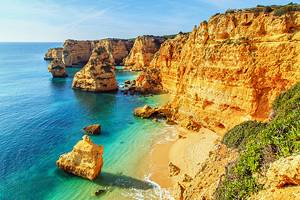
Other Must-See Sights near Mafra: Its proximity to the Portuguese capital makes Mafra an easily reached and rewarding destination for tourists. And if you're looking for other nearby places to visit, read our top-rated day trips from Lisbon page for ideas and inspiration. In fact, these number among the best places to visit in Portugal and include the stunningly pretty medieval walled town of Óbidos.
For those who'd rather explore the fairways, one of the finest golf courses in the country is a short drive away, while a little farther north is the lively port town of Nazaré, which boasts one of Portugal's best beaches.