14 Top-Rated Attractions & Things to Do in Syracuse, Italy
Don't mistake Syracuse for a city of braggarts if the terms "oldest," "biggest," and "best preserved" keep cropping up in descriptions of its many tourist attractions. These superlatives are well-earned by a city that has one of the largest theaters in the entire ancient Greek world, catacombs far larger than those in Rome, one of Italy's largest Roman amphitheaters, and one of the most complete and strongest fortifications remaining from the Greek era.
Add to those a cathedral with one entire wall formed by the columns of an ancient Temple to Athena, Sicily's second most important archeological museum, and fascinating quarries where Greeks and Romans found the stones for enormous ancient complexes, and you can see why Syracuse is high on any list of must-see places in Sicily.
Syracuse is combined with the Rocky Necropolis of Pantalica in a UNESCO World Heritage Site. Discover the best places to visit in this fascinating city with our list of the top tourist attractions and things to do in Syracuse.
See also: Where to Stay in Syracuse
- 1. Island of Ortigia and Fonte Arethusa
- 2. Santa Maria delle Colonne (Cathedral)
- 3. Neapolis Archaeological Park and Greek Theater
- 4. Latomia del Paradiso and the Ear of Dionysius
- 5. Museo Archeologico Regionale Paolo Orsi
- 6. Maniace Castle
- 7. San Giovanni Crypt and Catacombs
- 8. Piazza Duomo and the Ipogeo
- 9. Roman Amphitheater and Altar of Hiero II
- 10. Galleria Regionale
- 11. Eurialo Castle
- 12. Santa Lucia
- 13. Temple of Apollo
- 14. Latomia dei Cappuccini
- Where to Stay in Syracuse for Sightseeing
1. Island of Ortigia and Fonte Arethusa
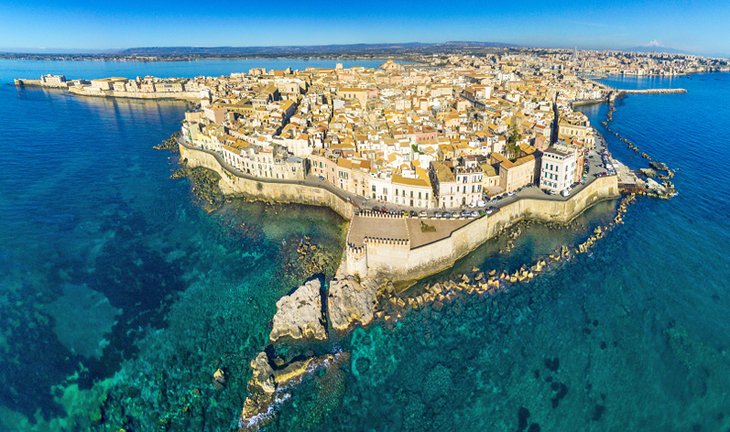
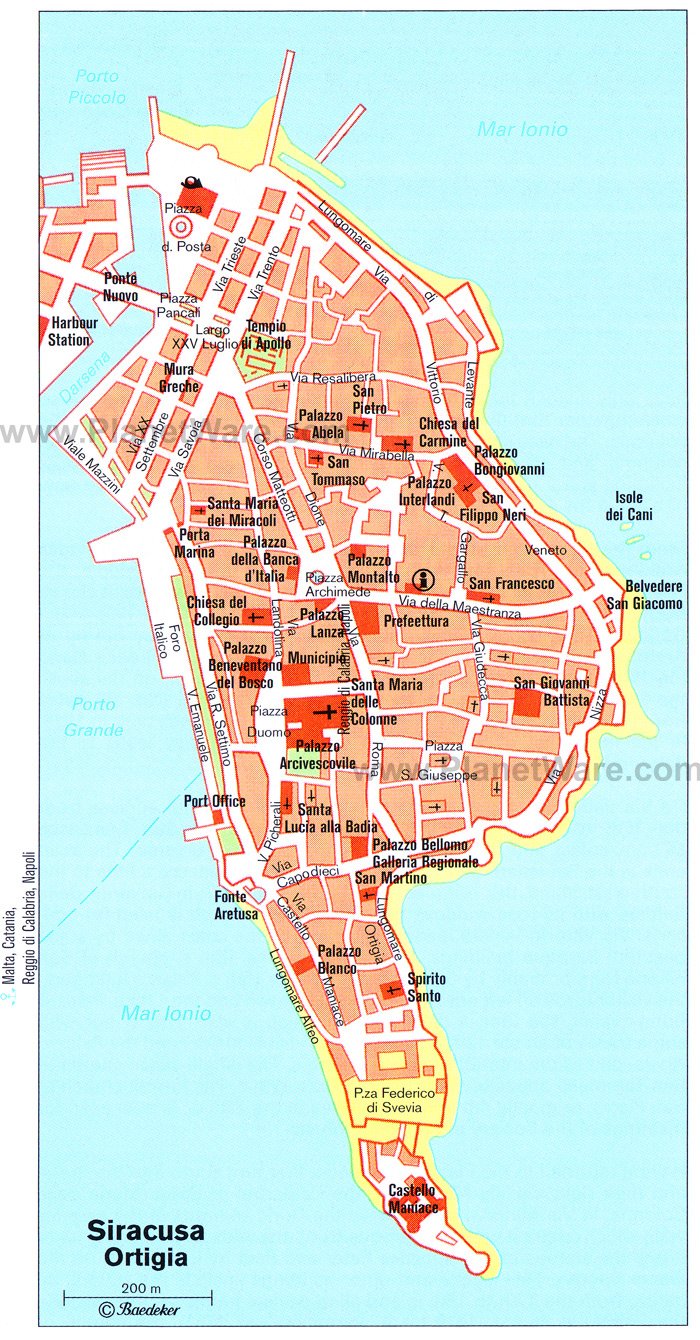
The small island of Ortigia (or Ortygia) is the historical center of Syracuse, and in ancient times it housed most of the city's population. Not surprisingly, many of the historic attractions are found in this Citta Vecchia (Old City), including the cathedral. Its narrow lanes are lined with cafes and shops, and it's a favorite place to get a feel for local life.
Along the shore at one side, the promenade of Foro Italico is a beautiful place for a walk, and its seats under the trees that invite you to sit and enjoy the shade and the sea view. The promenade extends northwards from the Fonte Arethusa (Spring of Arethusa) to the Molo Zanagora landing stage, and to the 15th-century Porta Marina, where you can see remains of the old city wall. The gate itself has 15th-century Spanish/Moorish decoration, and nearby is the little church of Santa Maria dei Miracoli, which was built at the very beginning of the 16th century.
At the southern end, where the Foro Italico begins, is the Fonte Arethusa, a pond with papyrus reeds formed by a freshwater spring near the sea. An ancient myth tells how the nymph Arethusa, while fleeing from the Greek river-god Alpheios, was turned into this freshwater spring by the goddess Artemis.
Wild papyrus has grown here for millennia, one of only two places where wild papyrus grows in Europe. Also at the south end of the Foro is a small park, where you'll find the entrance to the Acquario Tropicale, with rare fish from tropical seas.
2. Santa Maria delle Colonne (Cathedral)
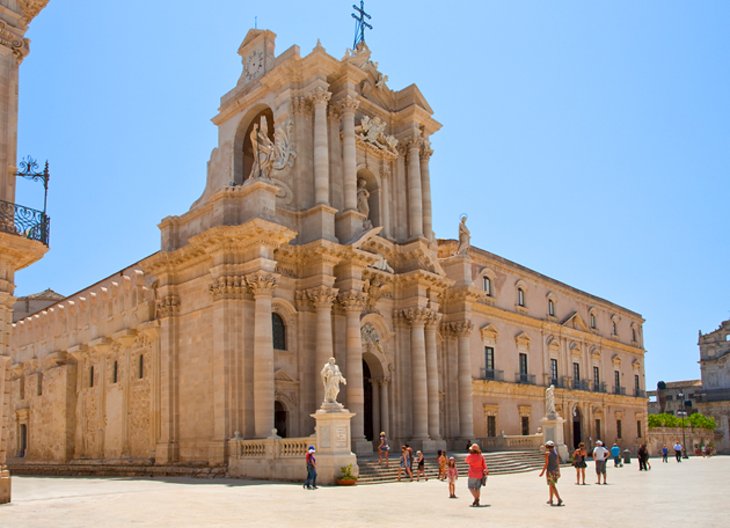
The fascination of Syracuse's cathedral, like so many other landmarks of Sicily, is its evolution showing the island's various periods and rulers. That is particularly evident in this building-one entire outer wall is formed by the Doric columns of the ancient Temple of Athena.
The cathedral was built around the temple, incorporating its columns, in the seventh century, and because they remained visible, the cathedral was named Santa Maria delle Colonne. These Doric columns facing Via Minerva contrast with the Baroque front, the wide steps leading up to it, and the statues of the Apostles Peter and Paul by Marabitti, which face onto Piazza Duomo.
That facade and other buildings encircling the square all date from the 17th to 18th centuries; they include the Episcopal Palace, the church of Santa Lucia alla Badia(1695-1703), Palazzo Beneventano del Bosco, and the Municipio (Town Hall).
The columns in the perambulatory were bricked up, and eight arcades were formed in each of the cella walls, making the cella into the central nave with the side perambulatory passages forming the side aisles of a triple-aisled basilica. The central nave was raised and the entire building reversed, moving the entrance to the west side, between two still-visible original columns.
After the 1693 earthquake, Andrea Palma constructed a lively Baroque facade and a portico with superbly turned columns. Many later additions, mainly Baroque, were removed during restorations in 1927, but several were preserved: the 1517 wooden ceiling; a 12th-century Norman font on seven small bronze lions; the 1659 high altar; the sacramental chapel built in 1653; a painting of San Zosimo in the crucifix chapel attributed to Antonello da Messina; and in the left side-aisle, statues by A. and G. Gagini. The restorers ensured that the ancient temple still shone through, but the contributions of later periods were still represented.
Address: Piazza Duomo, Syracuse
3. Neapolis Archaeological Park and Greek Theater
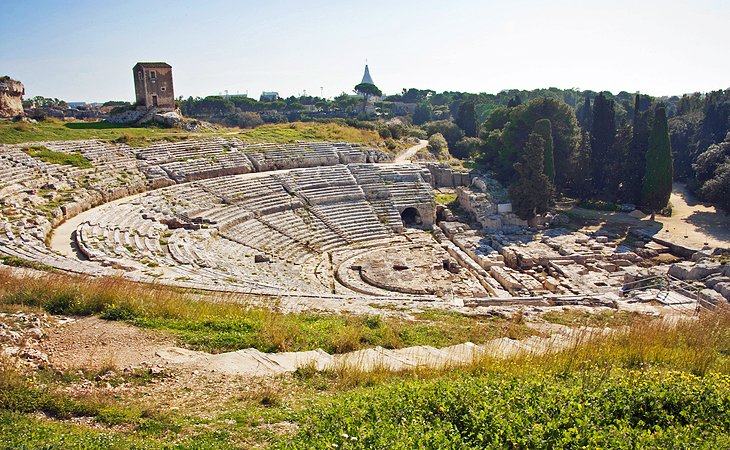
One of the largest theaters in the whole of the ancient Greek Empire, the Greek Theater at the Parco Archeologico della Neapolis was originally constructed in the reign of Hiero I, about 470 BC, by a builder named Demokopos. It was here that at least two tragedies by Aischylos premiered, and works by Sophocles and Euripides were performed.
The theater was later changed, taking its present form during a reconstruction that, as is shown by a dedication inscribed on the wall of the diazoma, was completed at the time of King Hiero II, his son Gelo and his two wives, dating it to between 238 BC and 215 BC.
With a diameter of 138 meters, it has 61 rows of seats hewn out of the rock, providing places for 15,000 spectators. The auditorium (cavea) has remained in its entirety, except for the lowest rows of seats, which were removed between AD 69 and 96 to make room for the orchestra that played at the gladiatorial games.
Roman amphitheaters constructed later were designed for this purpose. The original multi-storied stage and scenery buildings that stood between two cubes carved out of the rock have long since disappeared. On a terrace above the theater was a colonnade, and in the rock-wall behind, a nymphaeum dedicated to the Muses; spring water still flows from one of the niches. To the left lies a cemetery road cut into the rocks, with Byzantine grave-niches.
Address: Parco Archeologico della Neapolis, Viale Paradiso, Syracuse
4. Latomia del Paradiso and the Ear of Dionysius
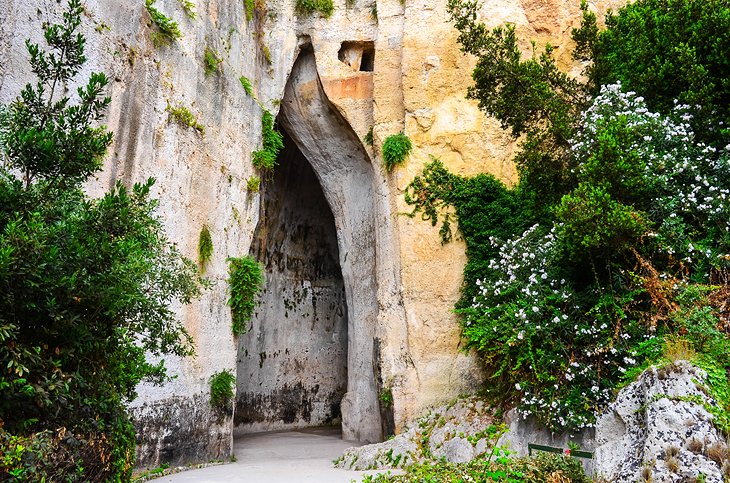
The Latomia are ancient stone quarries, which were worked from the sixth century BC onwards and eventually dug more than 20 meters down into the limestone. The largest and best known of these is the Latomia del Paradiso, part of the Parco Archeologico della Neapolis.
One of the two underground galleries measures 60 meters long, five to 11 meters wide, and 23 meters high, and because of its acoustics, has been named l'Orecchio di Dionisio, The Ear of Dionysius. According to legend, the tyrant Dionysius could stand at one end and listen to even whispered conversations of prisoners confined here, because the sound of voices was amplified without an echo.
The second gallery is the Grotta dei Cordari, where rope-makers worked. Immediately east of the Ear of Dionysius is the Latomia di Santa Venera.
Address: Parco Archeologico della Neapolis, Viale Paradiso, Syracuse
5. Museo Archeologico Regionale Paolo Orsi
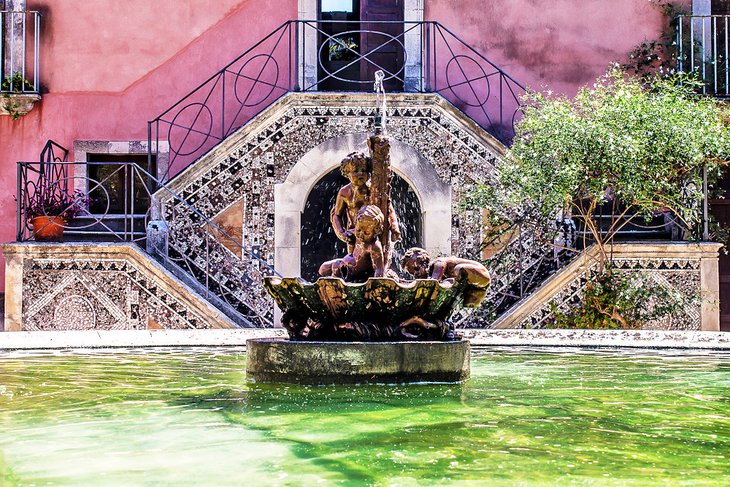
Villa Landolina houses Sicily's second most important archeological museum, after the one in Palermo. Its collections range from prehistoric to Byzantine times, but only those through the Classical period (fifth-fourth centuries BC) are exhibited; additional display space for the rest is under construction.
The collections shown include some rare and beautiful works, such as the astonishingly complete sixth-millennium BC vase from the Stentinello civilization in Matrensa, a bronze tomb panel from the necropolis of Castelluccio, and a number of other Bronze Age finds.
Finds from Pantálica include a collection of red translucent vessels from the 13th to 11th centuries BC, and there are vases and bronze weapons from the necropolis at Montagna near Caltagirone, dating from 1270 to 1000 BC. Exhibits provide detailed information on Greek colonization from the sixth century BC, and the finds are arranged by where they were found: a temple cornice in terra-cotta from Naxos, a terra-cotta Gorgon's head from about 450 BC, and ceramics from Attica.
An entire section is devoted to models of Syracuse temples, with detailed films and artifacts from them. The collection of statuary, like other exhibits, are well displayed, many so that you can see them from all sides.
Address: Viale Teocrito 66, Syracuse
6. Maniace Castle
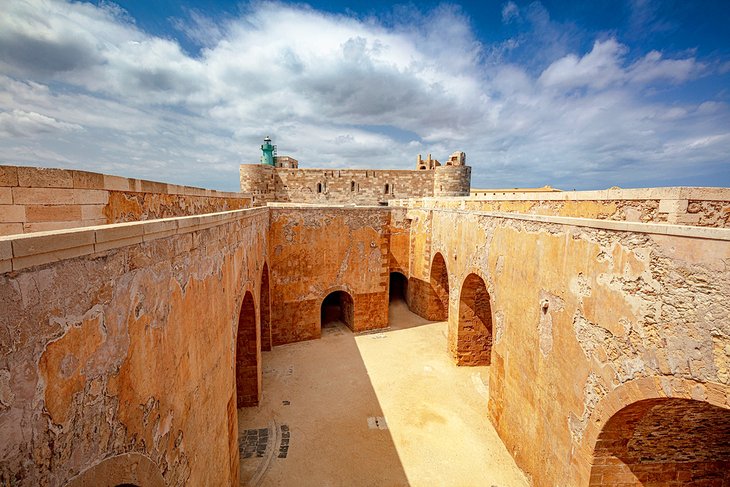
Overlooking the entrance to the bay from its position at the tip of Ortigia island, Maniace Castle was built by Frederick II between 1232 and 1240. It began as a royal residence but became a dreaded prison during the reign of Ferdinand II of Aragon in the late 1400s. In 1860, the well-fortified castle was captured by Giuseppe Garibaldi in the struggle to wrest Italy from the Bourbon kings, and unify Italy.
Highlights are the vaulted central hall and the massive main door with an archway of carved marble. There's also a small museum of artifacts found there, including ceramics from the Norman era.
7. San Giovanni Crypt and Catacombs
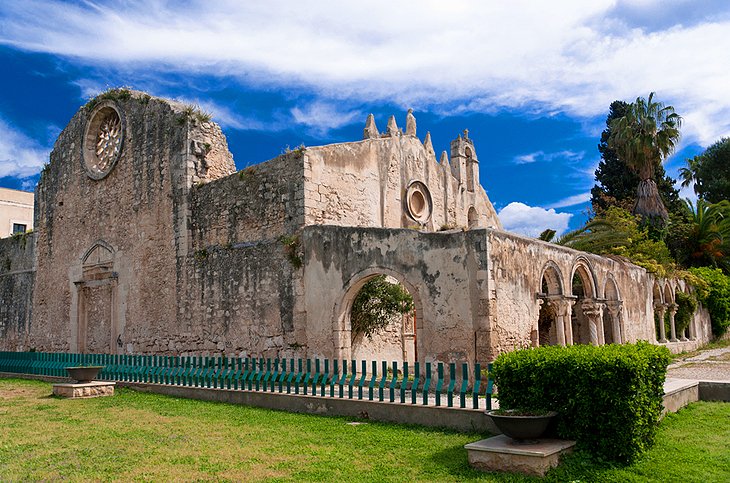
Originally built in the Early Christian period, the church of San Giovanni was extended in the sixth century, destroyed by the Saracens in the ninth century, restored by the Normans in the 12th century, and has remained a ruin since the 1693 earthquake.
The main section still standing is the 14th-century portal wall. From the church, a flight of steps leads down to the fourth-century cruciform Crypt of San Marziano and to the adjoining catacombs, which are among the most imposing known and far larger than the catacombs of Rome.
The crypt is thought to have originally been a Roman hypogeum (sepulchral vault), and you can still see eight of its Ionic column bases. It then became a church, and in the third or fifth century, a triple-domed complex in the shape of a Greek cross was built round it.
Designs carved on the capitals of the pillars show both ancient and Christian symbols, and at the crypt's eastern end are the altar where the Apostle Paul is believed to have prayed in the year 61 and the tomb of St. Marcian, who is thought to have been martyred here. The adjoining Catacombs of San Giovanni are an extensive underground necropolis dating from the fourth to sixth centuries, dissected by a network of main and side roads with round plazas where they meet.
Address: Via San Giovanni alle Catacombe, Syracuse
8. Piazza Duomo and the Ipogeo
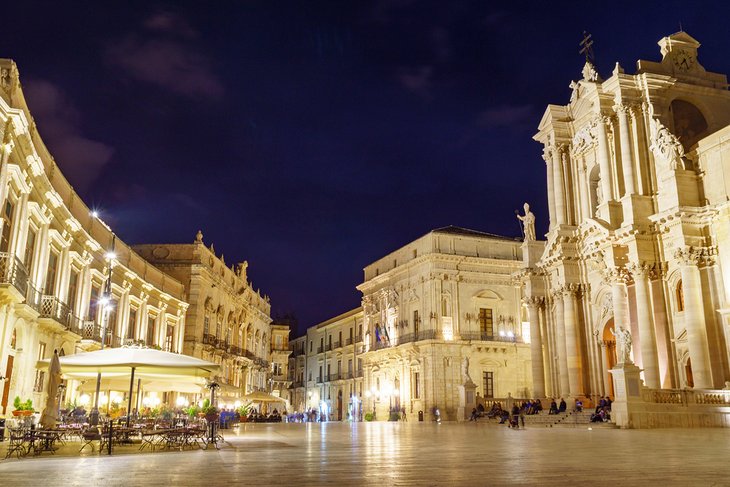
Syracuse's broad Piazza Duomo could be the poster child for Sicilian Baroque architecture, a beautiful ensemble of well-restored churches and public buildings. With vestiges of the Greek Temple of Minerva, this space also encapsulates much of what UNESCO cited in inscribing Historic Syracuse as offering "a unique testimony to the development of Mediterranean civilization over three millennia."
What you won't see as you stroll through the piazza or stop in a café to admire the lighted facades in the evening, is what lies underneath the paving stones. From an entrance below the gardens of the Archbishop's Palace, you can delve below the piazza to explore tunnels, ancient quarries, and the enormous cistern under the Archbishop's palace.
The Ipogeo di Piazza Duomo (Hypogeum of the Piazza Duomo) played a role in a much later history, as well. During the bombardment of Sicily in World War II, thousands of city residents crammed together as bombs exploded overhead. Videos document these events and there are information panels in English.
As you follow the route through the tunnels, you will not exit in the Piazza Duomo, but several blocks away near the seaside.
9. Roman Amphitheater and Altar of Hiero II
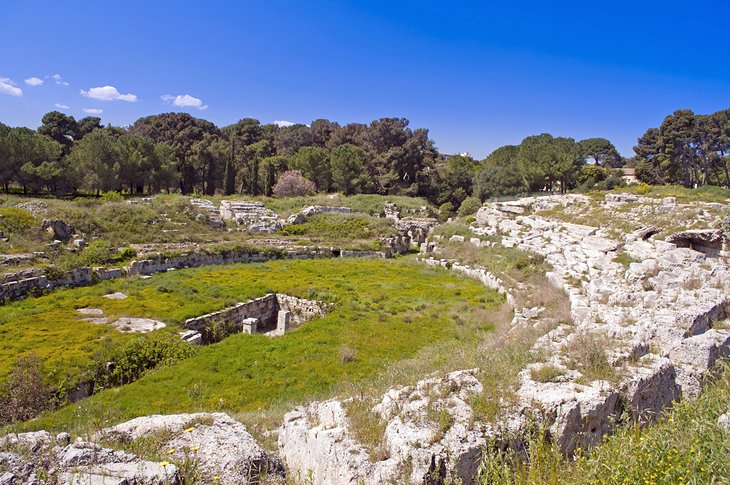
This third-century Roman amphitheater was partly hewn from the existing rock, with entrances at either end. Below the front row of seats is a walkway for the gladiators and the wild animals used in the competitions.
The original arena was constructed of stone blocks on top of the part you see today, but it was completely disassembled by the Spanish, and the stone was used to build the walls around the old town. The arena was also suitable for competitions representing fights at sea. Today, you can only walk along its top.
The massive Altar of Hiero II was built by Hiero II, who was king from 269 to 215 BC. During the annual Feast of Zeus Eleutherios, 450 bulls were sacrificed at this altar to provide a banquet for the citizens. The foundations, hewn out of the rock and measuring more than 180 meters long and 23 meters wide, have been preserved, and you can see the steps and ramps for the sacrifices at each end.
Northeast of the amphitheater are the Necropoli Grotticelli with large numbers of graves that were carved out of the soft limestone in Greek, Roman, and Byzantine times. Below is the gabled facade of the so-called Grave of Archimedes. Although the famous mathematician was indeed killed when the Romans conquered Syracuse in 212 BC, he is actually buried in Agrigento. This building is a Roman columbarium (sepulchral chamber) dating from the first century AD.
Address: Parco Archeologico della Neapolis, Viale Paradiso, Syracuse
10. Galleria Regionale
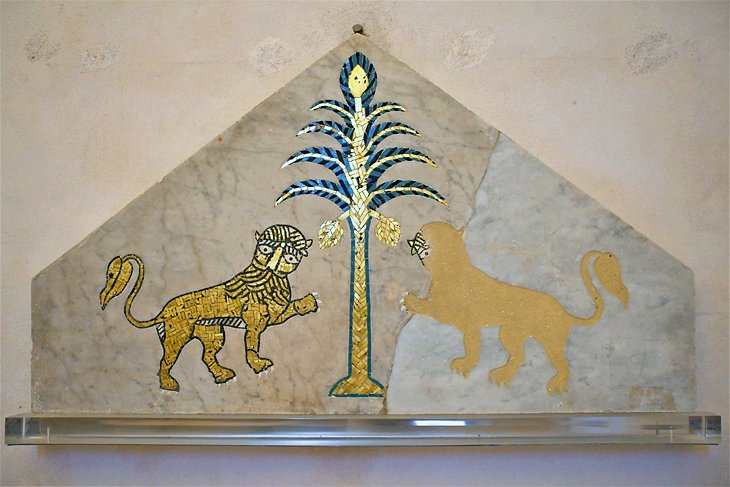
The Palazzo Bellomo houses the art museum featuring post-ancient works of sculpture, painting, and decorative arts. The ground floor displays sculptures from the Early Christian period up to the beginning of the 16th century, including the Madonna del Cardillo by Domenico Gagini.
Coaches and carriages from the 17th century are also on this floor, and an open staircase leads up to the top-floor art gallery, which contains important works from the 14th to 18th centuries. The highlight is Annunciation of Our Lady by Antonello da Messina (1474), a large painting that was heavily restored in 1917 and "unrestored" by experts in 1942. This process is explained in text and photographs shown with the painting.
Other important works are the Interment of St. Lucia by Caravaggio, Immacolata e Santi by the Flemish artist Willem Borremans (1716), the book of sketches by Filippo Paladino from 1544 to 1614, nativity scenes, and a large wooden model showing what Syracuse looked like in the 18th century.
Address: Via Capodieci 14-16, Syracuse
11. Eurialo Castle
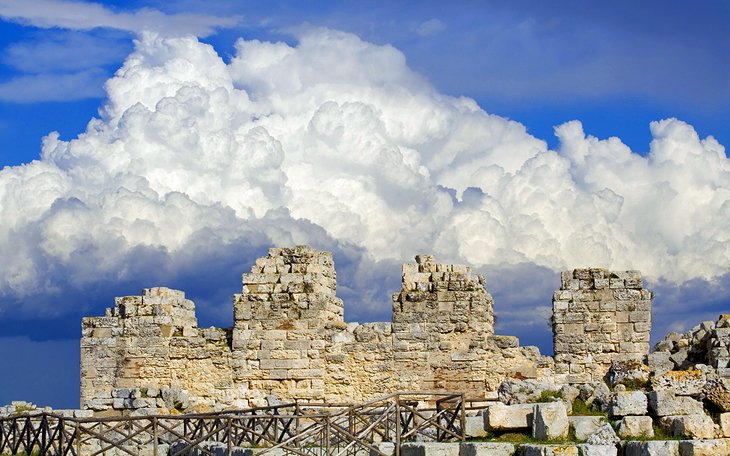
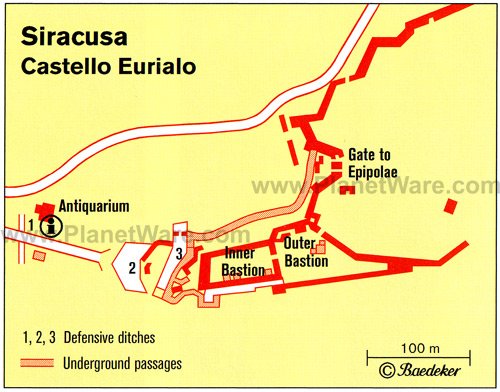
The castle, with an area of one-and-a-half hectares, is one of the strongest fortifications still remaining from the times of the Greeks, built in the reign of Dionysius between 402 and 397 BC. In subsequent years, up to the third century BC, the castle was modified to meet changes in military requirements.
It is said that it was here, when Syracuse was besieged by the Romans in 213-212 BC, that the giant mirror constructed by Archimedes was used to reflect the sun and set fire to the sails of the enemy fleet.
The castle is entered from the most vulnerable-and most strongly protected-side, near which are three tombs dug into the rocks. Behind them, the main bastion is protected by five massive towers. A later, possibly Byzantine wall separates the eastern part, where several wells provided water during sieges.
Some of the underground passages that allowed troops to pass undetected by the enemy are still usable. The castle, although in ruin, has an astonishing amount of remaining structure, especially considering its age. Near the entrance is a small museum. Views from here of the Old Town and the Porto Grande harbor area are especially impressive in the afternoon light.
Address: Viale Epipoli, Belvedere, Syracuse
12. Santa Lucia
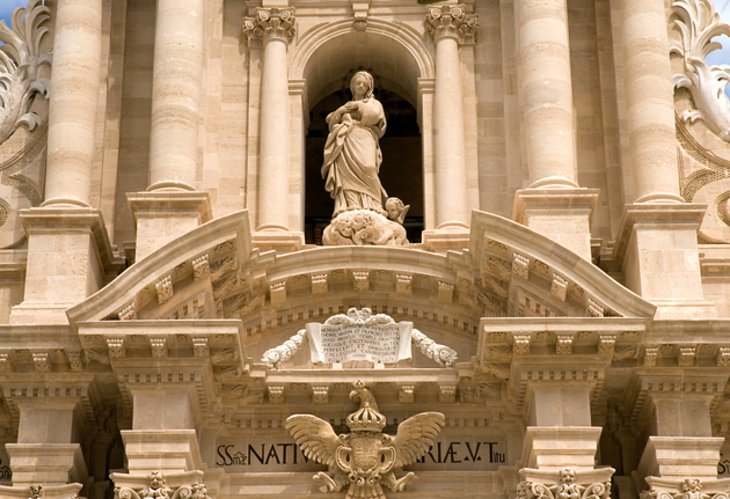
The 12th-century triple-aisled basilica replaced an earlier church, which was built in the sixth century on the spot where St. Lucia was murdered. The portal and rose-window above it at the west end of the church are remnants of the old Gothic building.
Baroque porticoes have been built on this end and on the south side. The original open roof trusses still remain, otherwise the interior has been converted to the Baroque style. A number of graves were uncovered in recent excavations made in the west portico of the church.
The church fills one end of the large, park-like Piazza Santa Lucia, and to its right is the octagonal 17th-century Chiesa del Sepolcro with the Tomb of St. Lucia, the patron saint of Syracuse, who was martyred when Diocletian persecuted the Christians in 304. The saint's remains are actually in Venice, taken there by Venetians who rescued them from Constantinople during the crusades. Underneath both the church and the square are catacombs, but these are not open to the public.
13. Temple of Apollo
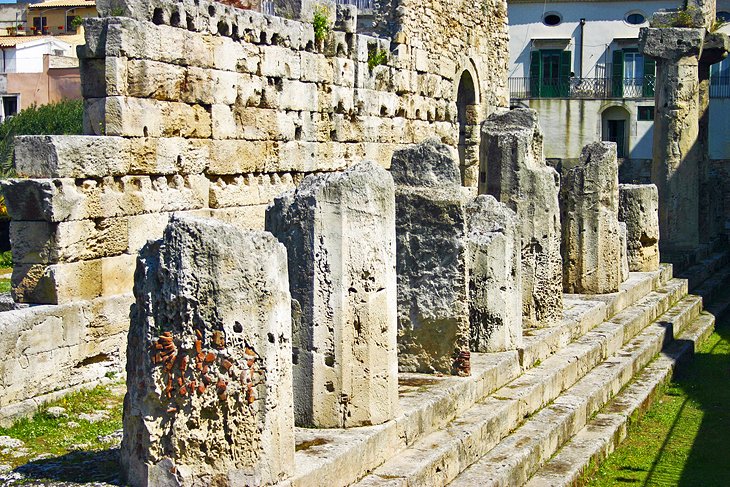
Built about 570 BC and excavated 1938-43, the Temple of Apollo is Sicily's oldest Doric temple. In later years, it was in turn a Byzantine church, an Islamic mosque, a Norman church, and a Spanish barracks, reflecting Sicily's various ruling groups. The foundations, some columns with their entablatures, and parts of the cella wall have survived.
The massive monolithic columns, scarcely eight meters tall, have only 16 flutes instead of the more usual 20, and are so close together that the space between is less than the diameter of the columns themselves. Finds made here, including some painted roof moldings (cymas) in terra-cotta, are now housed in the Archeological Museum. You can't walk inside the temple ruins, but they are clearly visible from the fence that surrounds them.
Address: Largo XXV Luglio, Syracuse
14. Latomia dei Cappuccini
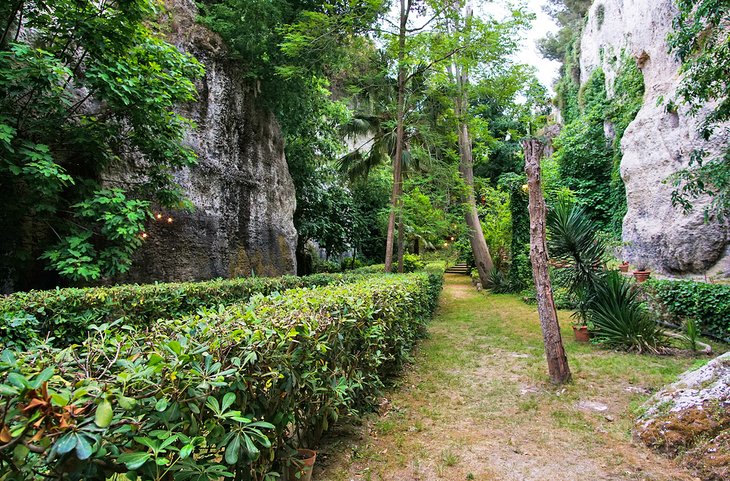
Beside the Capuchin monastery are the Latomia dei Cappuccini, one of the 12 ancient quarries that provided building stone for Syracuse, and the only one you can enter. The huge cavity was once underground, but large parts of its roof have collapsed from earthquakes and erosion, making an open-air pit.
Here and there are tall irregular pillars of stone that were left in place to support the ceiling as the quarried stone was removed. The Capuchin monks in the neighboring monastery have created gardens among the rocks, surrounded by the cliff-like quarry walls, sometimes as high as 30 meters.
It's hard to believe, as you stroll through this atmospheric place, that it was all dug by human power, and that in 414 BC, 7,000 Athenian prisoners were confined in its depths. Each summer, this becomes an open-air theater for music, performances, and dance.
Where to Stay in Syracuse for Sightseeing
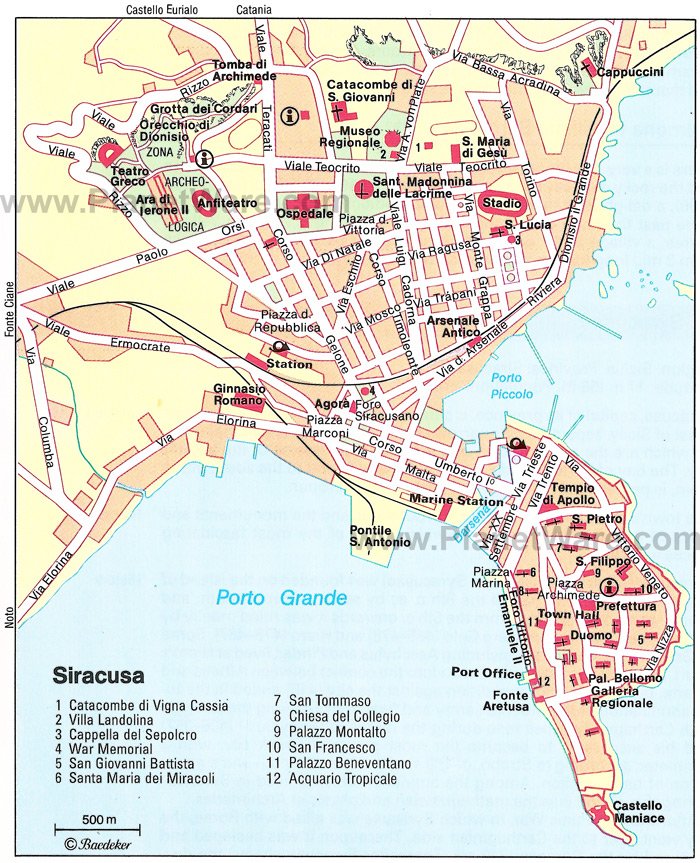
Tourist attractions in Syracuse are in two separate parts of town, with the old center on the island of Ortigia and the major archaeological sites about two kilometers away on the mainland. They are about a 25-minute walk apart and connected by bus. These highly rated hotels in Syracuse are convenient to both:
Luxury Hotels:
- Some rooms at Algila Ortigia Charme Hotel face the sea and others the surrounding buildings, with ornate Baroque balconies, but all rooms in this historic building are updated with modern conveniences, including good Wi-Fi.
- Also on the island, just off the main square, Antico Hotel Roma is in a traditional building with window balconies; breakfast and bicycles are free.
- Antiques and a warm atmosphere fill the family-run, boutique Charme Hotel Henry's House, overlooking the bay at the end of the island and an easy walk from all Origia's attractions.
Mid-Range Hotels:
- A 25-minute walk or short bus ride from Ortigia, but a good location for those interested in the ancient sites, Hotel Mercure Siracusa Prometeo is directly opposite the archeological park, with a pool and free parking.
- Near the tip of the island at the pebbly Cala Rossa beach, Royal Maniace Hotel is an easy walk from attractions and restaurants and includes free breakfast.
- For stays a bit outside the busy city and a kilometer from Arenella Beach, the Caiammari Boutique Hotel & Spa is five kilometers from the old town sights, accessible by shuttle. The former noble residence sits in a centuries-old garden, and rooms have wood-beamed ceilings and elegant furnishings.
Budget Hotels:
- Near the marina and small fishing harbor, a few minutes' walk to either Ortigia or the archaeological park, Hotel Sbarcadero has parking and large rooms with mini-fridges, good air-conditioning, and Wi-Fi.
- At the upper end of the island, 10 minutes from the Duomo and two minutes from the lively morning market, Hotel Posta has some rooms with balconies and sea views.
- A minute or two from both the San Giovanni Crypt and Catacombs and the archaeological museum, Hotel Teocrito is also close to the Roman Amphitheater and Greek Theater. Parking and a full breakfast are included in the budget rates.
More Related Articles on PlanetWare.com
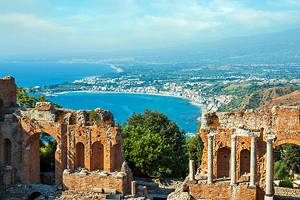
Where to Go from Syracuse: To the west are the Baroque attractions of Ragusa, and north along the coast is Catania, with its own Baroque architecture. Not far beyond is Taormina, a good base for exploring Mt. Etna.
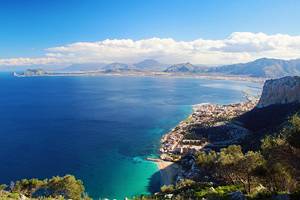
What to See in Sicily: Many of the top attractions in Sicily lie farther west. If you have time, considering visiting the attractions of Palermo and the beautiful Monreale Cathedral, nearby.