25 Top-Rated Attractions & Places to Visit in Brittany
Bounded by the sea and defined by its traditional character, Brittany is a beautiful region in northeastern France with welcoming and interesting places to visit.
Quaint fishing villages are nestled in bays along the Atlantic coastline, while the verdant countryside is dotted with picturesque medieval villages and fairy-tale castles.
The landscape varies from peaceful moors and pristine forests to secluded sandy beaches and dramatic seaside scenery. From its rocky promontories, the craggy northern coastline offers sweeping ocean views.
Brittany is also a land of myths, legends, and fascinating history. The region has a Celtic influence with a dialect related to Gaelic, and the local cuisine is delicious. Crêperies serve "galettes" (savory buckwheat crepes) and dessert crepes with toppings such as caramel, chocolate sauce, and fresh seasonal strawberries.
Bretons take pride in celebrating the ancient custom of "pardons," a special type of pilgrimage when townspeople attend Mass to ask forgiveness for their sins. The pardons also include religious festivals with participants wearing historical costumes.
Endless sightseeing opportunities and authentic local experiences await travelers to this captivating region. Discover the best places to visit and things to do with our list of the top attractions in Brittany.
- 1. Saint-Malo
- 2. Quimper
- 3. Nantes
- 4. Rennes
- 5. Belle-Île-en-Mer
- 6. Morbihan Megalithic Sites
- 7. Château de Josselin
- 8. Vitré
- 9. Île d'Ouessant (Ushant Island)
- 10. Côte d'Emeraude (Emerald Coast)
- 11. Côte de Granit Rose (Pink Granite Coast)
- 12. Cancale
- 13. Concarneau
- 14. Pont-Aven
- 15. Crozon Peninsula
- 16. Locronan
- 17. Dinan
- 18. Dinard
- 19. La Baule
- 20. Le Folgoët
- 21. Fougères
- 22. Île de Bréhat
- 23. Vannes
- 24. Rochefort-en-Terre
- 25. Roscoff and Île de Batz
- Map of Attractions & Places to Visit in Brittany
1. Saint-Malo
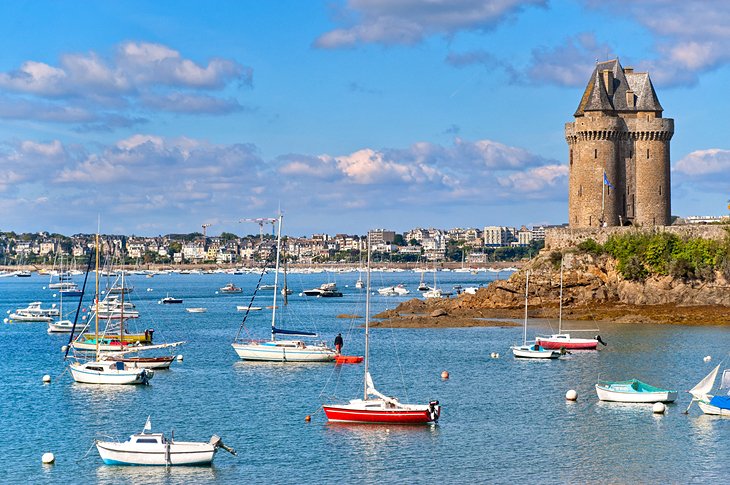
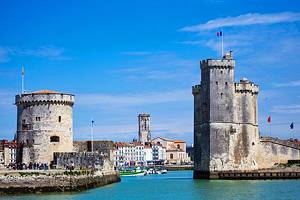
This quintessential Breton port is a former island near the mainland. Designed as a citadel, Saint-Malo boasts well-preserved medieval fortifications that lend a distinctive character to the city.
During the Second World War, the historic center (Vieille Ville) of Saint-Malo was largely destroyed, except for the old walls; the Château de Saint-Malo, which dates to the 14th and 15th centuries; and the Cathédrale Saint-Vincent, which was founded in the 12th century.
The town was rebuilt after WWII in its original style, with granite houses that appear ancient. The city has also retained its medieval ambience because the atmospheric old cobblestone streets have survived the centuries.
Narrow pedestrian lanes lead to bustling public squares and side streets, with many restaurants and crêperies found at every turn. Gracing the Place Chateaubriand is the Hôtel France & Chateaubriand in a neoclassical building modeled after the grand seaside resorts of the Napoléon III era. Guest rooms feature elegant minimalist decor; some look out to the coastline. Amenities include a stylish café, brasserie, and a rooftop restaurant with panoramic views.
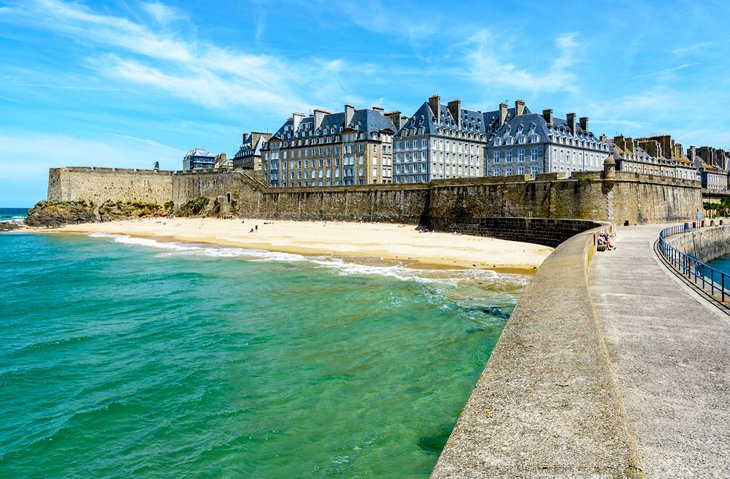
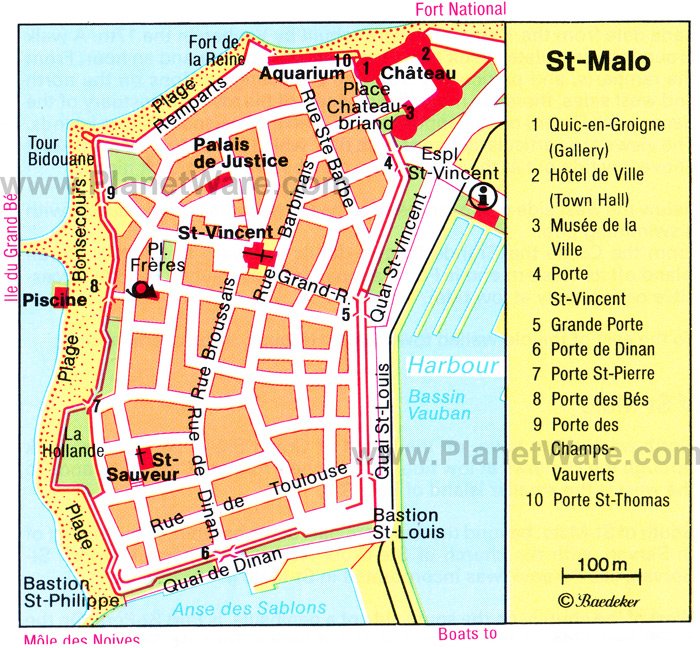
Near the Place Chateaubriand are steps leading up to the ramparts, which date back to the 12th century. A walk around the complete circuit takes about an hour. From the projecting bastions are spectacular vistas of the town, the estuary (with the town of Dinard on the opposite bank), the sea, and the offshore islands.
Below the west side of the ramparts is the Plage de Bon-Secours, a sandy beach with summertime lifeguard surveillance and fantastic facilities, including a seawater swimming pool, showers, restrooms, and a café. The beach also has a view of the Saint-Malo Bay and the town of Dinard in the distance.
2. Quimper
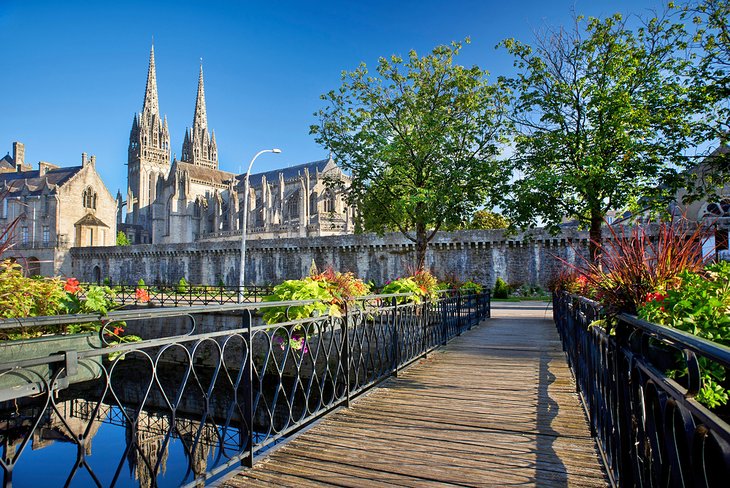
On the banks of the Odet River, Quimper is a picture-postcard historic town. Visitors are delighted by the authentic atmosphere of this Breton riverside community, with its sweet pastel-painted half-timbered houses, cobblestone streets, and pedestrian footbridges decorated with potted flowers.
In the center of the town is the Place Saint-Corentin, presided over by Quimper's awe-inspiring Cathédrale Saint-Corentin. Dating to the 13th century, the cathedral is considered Brittany's finest Gothic building. Between the cathedral's two high towers (which were completed in the 19th century), the legendary figure of King Gradion peers above the town.
Across from the cathedral, the Musée des Beaux-Arts displays a wonderful fine arts collection in an elegant neoclassical building. Highlights are the works by French, Italian, Flemish, and Dutch painters, as well as pictures by Max Jacob and the Post-Impressionist painters of Pont-Aven (l'Ecole de Pont-Aven), which included Paul Gauguin, Émile Bernard, Maurice Denis, Paul Sérusier, and Charles Filiger, among others.
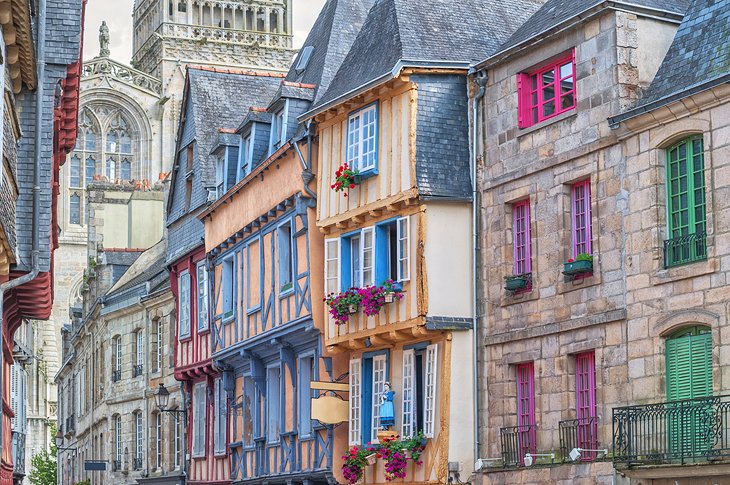
South of the cathedral, in the former Bishop's Palace, is the Musée Départemental Breton (Breton Museum) with a collection of archaeological objects, folk costumes, ceramics, and artworks, which reveal Brittany's rich cultural heritage. There is also a collection of landscape paintings that depict Brittany's Finistère region.
Quimper was the capital of the Duchy of Cornouaille during the early medieval period and now is the chief town of the département of Finistère in southwestern Brittany. One of the attractions of visiting Quimper is the surrounding countryside of Cornouaille. This stunning, rugged landscape is characterized by its rocky peninsulas and sensational sea views.
There are also many seaside resorts in the area, including Tréboul and the fishing port of Douarnenez. The Pointe du Raz is the most westerly point in Brittany and offers an amazing panoramic outlook from the tip of the promontory.
3. Nantes
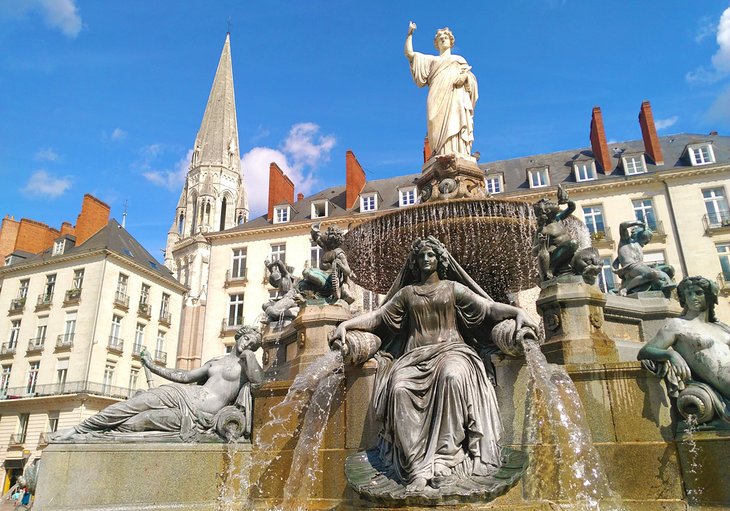
At the junction of the Erdre and Loire Rivers, the old Breton port of Nantes has played an important role in history. Nantes was the capital of the Duchy of Brittany during the Middle Ages, and it was here in 1598 that Henry IV signed the Edict of Nantes, which granted freedom of religious belief to Protestants.
Thanks to its advantageous port location, Nantes became a prosperous commercial town from the 16th to the 19th centuries. Nantes has also been a university town since the 15th century. Today, Nantes is still a thriving center of higher education, as well as France's sixth largest city.
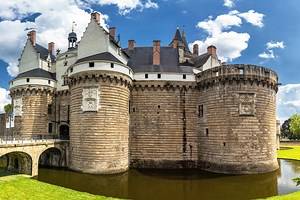
Visitors may begin a sightseeing tour of Nantes' top attractions in the historic center at the Château des Ducs de Bretagne (Castle of the Dukes of Brittany), founded in the 15th century by Francois II, one of the last Breton rulers. Surrounded by parkland, this enormous fortress has all the essentials of a medieval castle: a moat, imposing towers, and sturdy defensive walls.
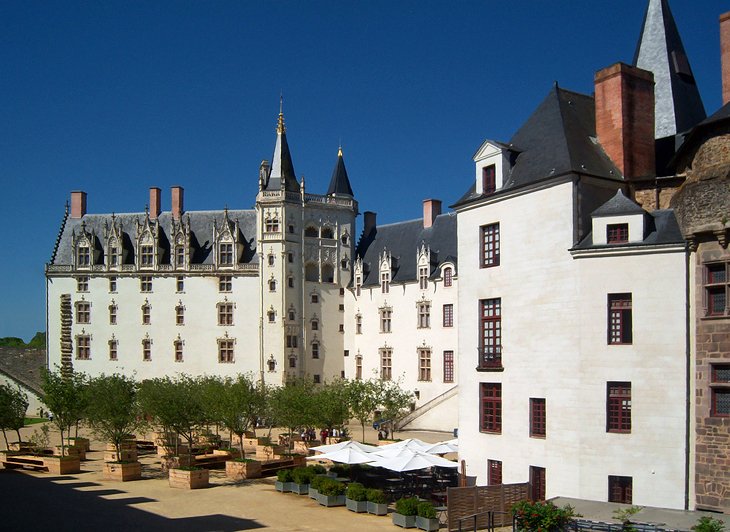
The château houses the Musee d'Histoire de Nantes (History Museum of Nantes) on display in the opulent Flamboyant Gothic reception rooms. The diverse collection includes paintings, sculptures, photographs, model ships, and scientific instruments.
The museum requires an entry fee, while the château gardens and rampart walk are open to the public for free. The Château des Ducs de Bretagne also has a crêperie restaurant, La Fraiseraie, that specializes in crêpes (both savory and sweet), as well as frozen desserts (sorbet and ice cream) made with seasonal ingredients sourced from local farms. The château's bookstore sells souvenirs, toys, special regional candies, and books about the history of the castle and the city.
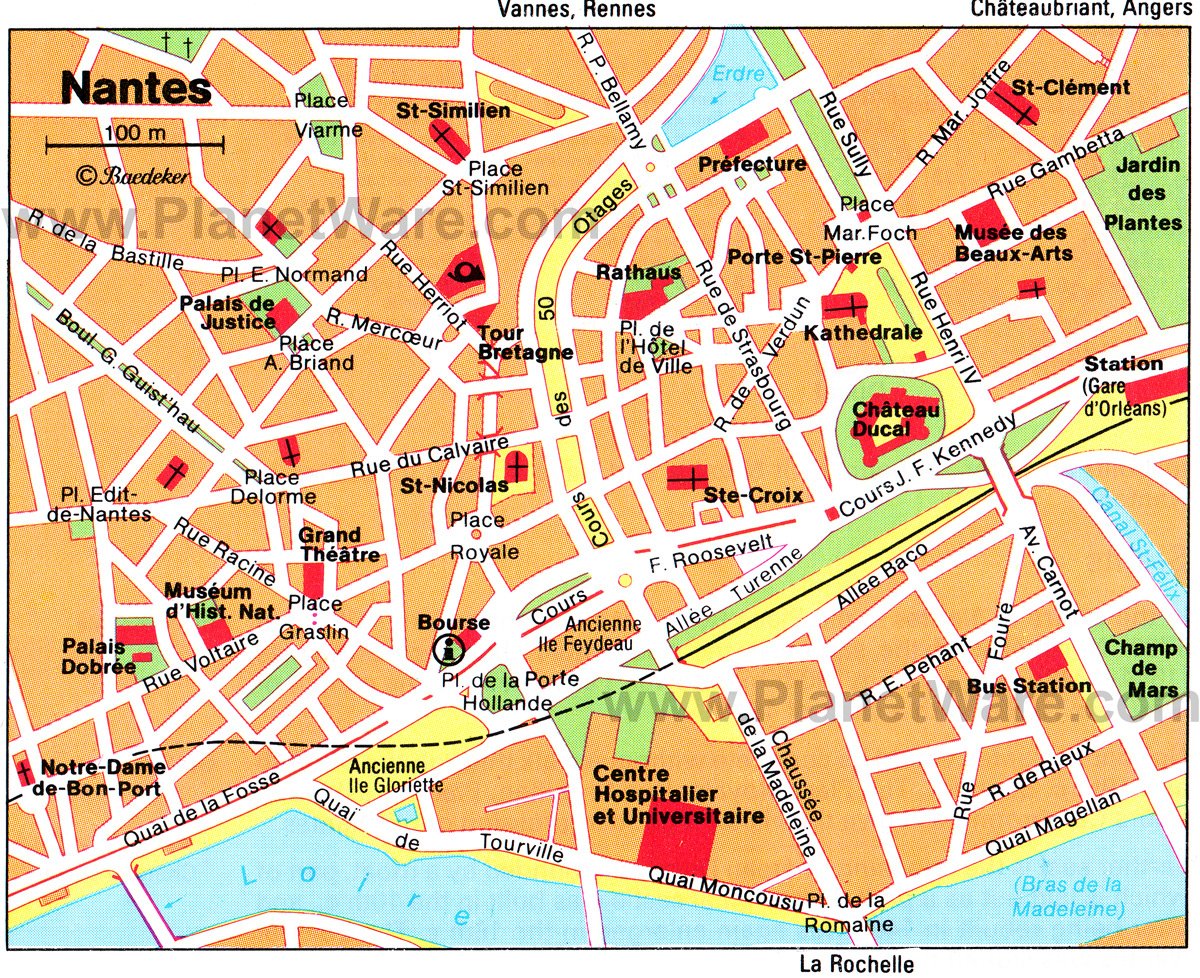
After touring the Château des Ducs de Bretagne, visitors should continue west of the castle to the historic quarter of Nantes known as the Bouffay district. In this medieval quarter of half-timbered houses, tourists may wander through the maze of winding streets and shop at the enticing boutiques.
In the center of Nantes is the Place Royale, an elegant 18th-century square. Nearby (within a 10-minute walk) is the busy thoroughfare of Rue Crébillon with many shops and restaurants and the Cours Cambronne square that has a small tree-lined green space with park benches.
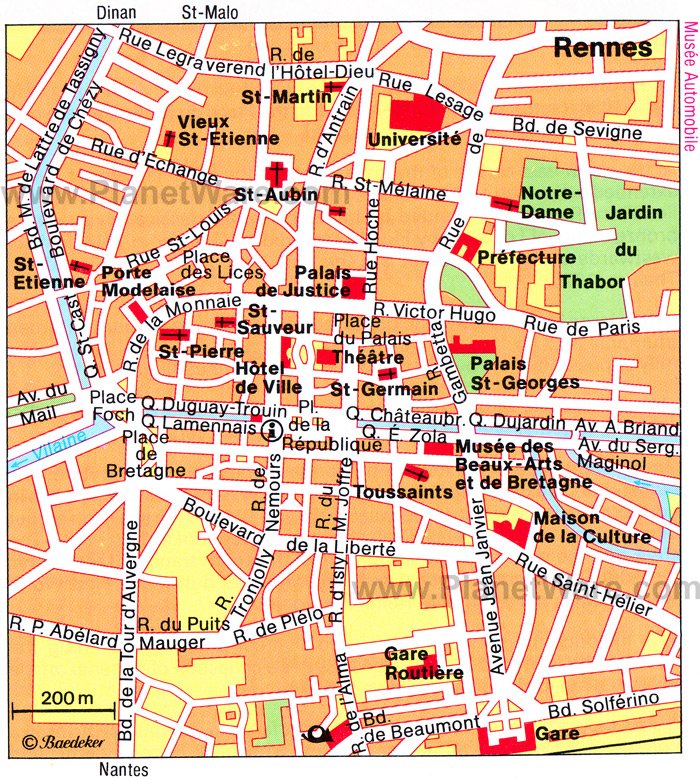
4. Rennes
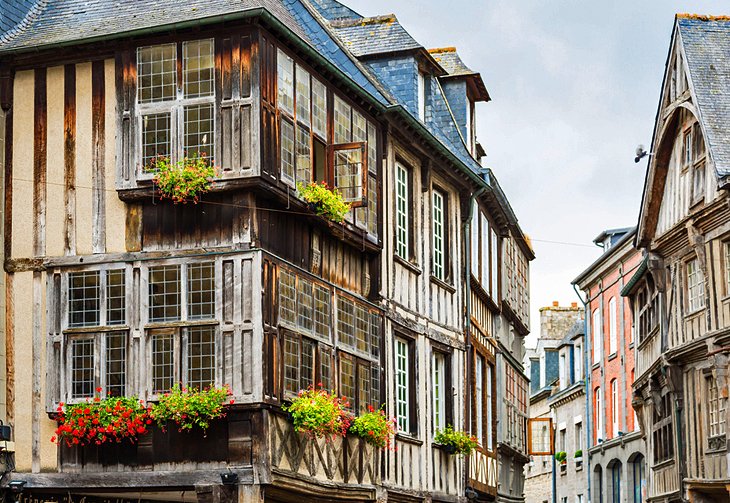
The old capital of Brittany, Rennes is still the region's economic and cultural center, as well as a university town. After a fire in 1720, much of the town had to be rebuilt, and more reconstruction was necessary after WWII. Rennes is now a modern city with streets laid out at right angles.
Visitors can begin a walking tour at the Place de la Mairie to admire the Hôtel de Ville (Town Hall), built in 1734. West of the Place de la Mairie is the Eglise Saint-Sauveur, a lovely church built from the 17th to the 18th centuries. East of the Town Hall is the Place du Parlement de Bretagne encircled by 18th-century houses.
Farther northeast, the Romanesque abbey church of Notre-Dame en Saint-Melaine dazzles visitors with its elaborately sculpted facade and ornately embellished cloister. Several blocks away is the Cathédrale Saint-Pierre with an interesting blend of architectural styles.
Tourists should also take time to stroll the narrow cobblestone lanes around the cathedral where there are perfectly preserved historic houses such as the Hôtel de Blossac at 6 Rue du Chapitre.
5. Belle-Île-en-Mer
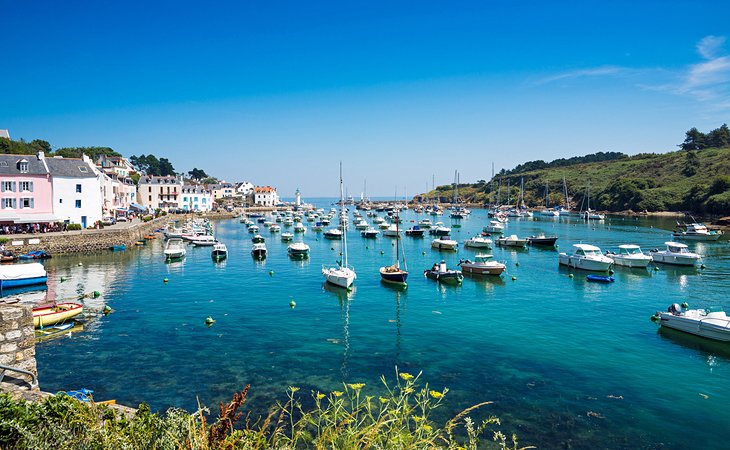
Belle-Île-en-Mer is the largest of the Breton islands but is still only 17 kilometers long and 10 kilometers wide. The island's name translates to "Beautiful Island in the Sea," fitting of its sublime natural setting on the Quiberon Bay of Brittany's southwest coast.
The main hub of activity on Belle-Île-en-Mer is Le Palais, an interesting town with many restaurants, hotels, art galleries, and artisans' workshops.
Above the harbor in Le Palais is the Citadelle Vauban, a medieval citadel that was enhanced by French military engineer Sébastien Le Prestre de Vauban in the 17th century. The site is now a Hôtel-Musée (Hotel-Museum), with the former barracks converted into upscale guest rooms, a museum focused on the history of Belle-Île-en-Mer, and a chic gourmet restaurant.
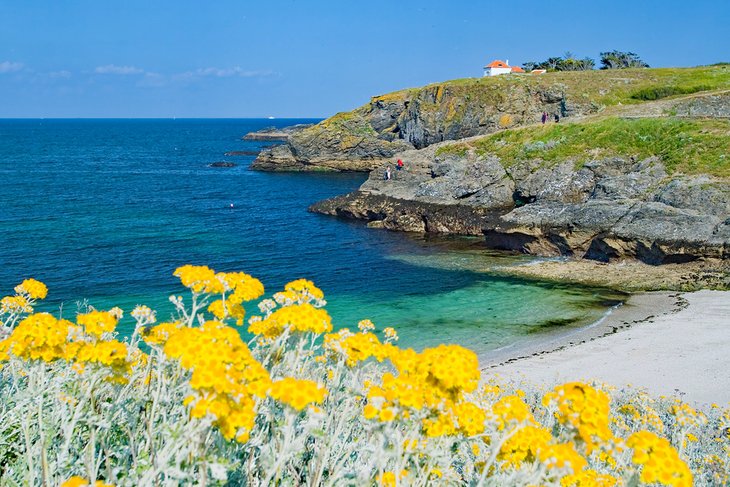
From Le Palais, there is a route running southwest across the island to the rugged Côte Sauvage (coastline). Southeast of Le Palais is the Plage des Grands Sables, the island's most beautiful beach. This sheltered beach has a fine-sand shoreline and gentle waters. It's a great place for water sports, including paddleboarding, kayaking, and sailing.
The island has three smaller villages. The village of Bangor, on the Côte Sauvage (wildest part of the island), was founded in the 6th century by British monks. Picturesque farmlands surround Locmaria, a rural township on the highest part of the island. Sauzon is a little fishing village with narrow streets and a thriving marina in its well-sheltered harbor.
To arrive at Belle-Île-en-Mer, tourists can take a 45-minute ferry boat ride (available year-round) from Quiberon. From April through October, ferries run from Port Navalo (about 50 minutes) and from Vannes (about two hours). During the high season, private taxi boats run from Quiberon to Belle-Île-en-Mer, and the ride takes about 30 minutes.
6. Morbihan Megalithic Sites
A peaceful, protected bay in southern Brittany, the Golfe du Morbihan is connected with the Atlantic Ocean only by a narrow channel. The bay is filled with numerous small islands featuring unspoiled natural scenery. The two largest islands Île aux Moines and Île d'Arz are popular summer vacation destinations (many tourists take a boat trip from Vannes).
Inhabited since prehistoric times, Morbihan is filled with fascinating megalithic sites, unique stone structures that are the most ancient found anywhere in the world (many are older than Stonehenge and the pyramids of Egypt). These monuments are evidence of a prehistoric culture of which almost nothing is known.
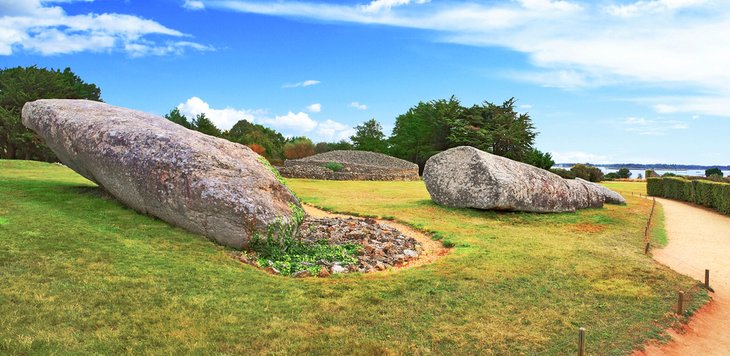
Locmariaquer has some of the most amazing megaliths. "Le Grand Menhir" was the largest stone monument ever erected in prehistoric Europe; this 20-meter-long, 280-ton stone structure was created around 4,500 BCE.
Also in Locmariaquer, the "Table des Marchands," features enigmatic engravings, and the "Tumulus d'Er-Grah" is a Neolithic monument from 5,000 BCE.
On the Île de Gavrinis is a remarkable Neolithic burial site, the "Cairn de Gavrinis," built around 4,000 BCE. The pyramid-shaped chamber is intricately decorated and covered with a grassy mound of earth. Engravings depict patterns and symbols such as swirl designs, axe heads, and horned animals. To visit the Cairn of Gavrinis, book tickets in advance.
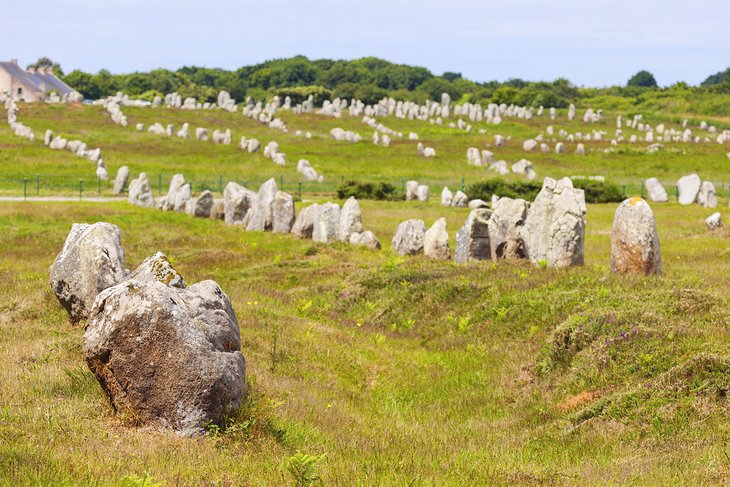
Carnac on the Quiberon Bay (near Locmariaquer), takes its name from the Celtic word "carn," meaning a stone monument. Visitors are awestruck by Carnac's Neolithic sites including the "Circuit des Alignements," freestanding circles and rows of stones up to six meters high, and the Tumulus Saint-Michel megalithic monument topped by a small chapel.
One of Europe's best museums of prehistory is found in Carnac, the Musée de Préhistoire, which presents objects discovered at archaeological sites in the area. The collection illustrates the development of humans from 450,000 BC through the Paleolithic Period (Stone Age) and the Neolithic era, up until the Gallo-Roman epoch.
7. Château de Josselin
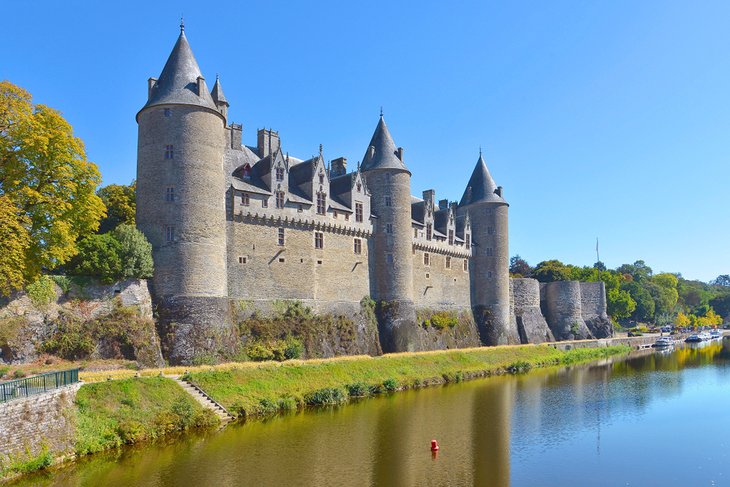
With its picturesque canals and pretty half-timbered houses, the medieval village of Josselin is a must-see tourist attraction in the Morbihan area of Brittany. Apart from the town's old-world charm, the highlight of Josselin is its medieval château, which is a perfect example of feudal architecture.
The Château de Josselin has been inhabited throughout the centuries by generations of the Rohan family. The town of Josselin takes its name from the son of the Viscount who built the château.
Presiding over the Oust River valley, this majestic castle dominates the landscape with its soaring walls and turreted towers. The austere exterior contrasts a sumptuous facade on the interior courtyard, exemplifying the Flamboyant Gothic style of the Breton Renaissance.
Tourists may take self-guided tours or guided tours of Château de Josselin to admire the lavish interior. The sitting and dining rooms feature monumental fireplaces, and the library contains more than 3,000 antique books.
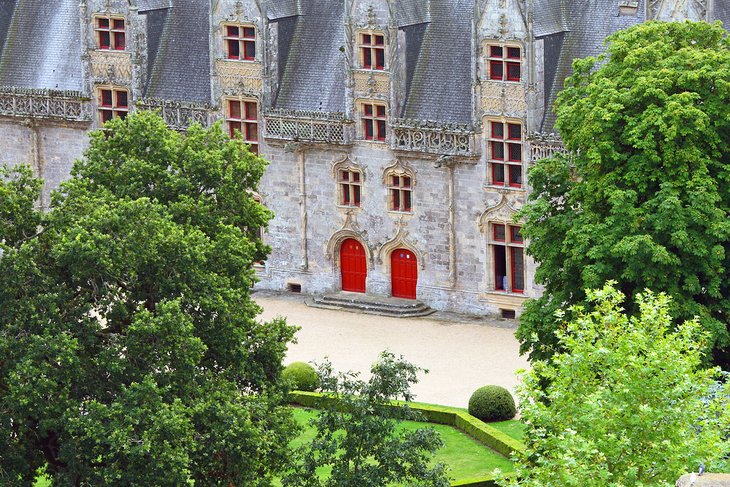
A formal French garden surrounds the château. Visitors will delight in wandering the perfectly manicured tree-lined lawns and rose garden with 40 different heirloom varieties. The grounds also include a romantic English garden full of lush flowering vegetation, with a picnic area and benches for relaxation.
The château also has a Dolls and Toys Museum, which displays dolls dating back to the 17th century. Many of the dolls are dressed in authentic Breton costumes. With nearly 5,000 items, this collection is the largest of its kind in France.
Official site: http://www.chateaudejosselin.com/en/
8. Vitré
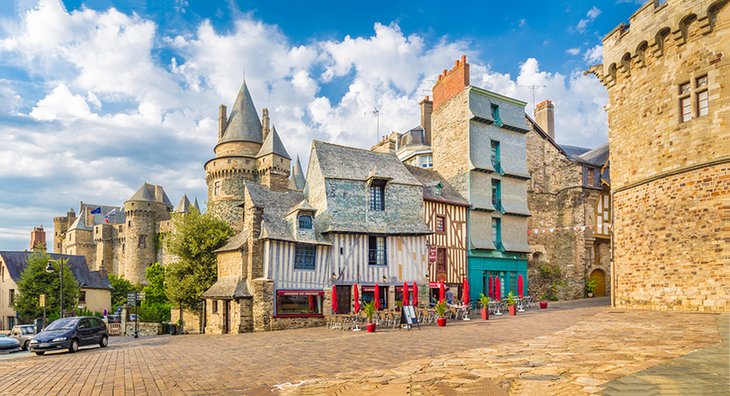
East of Rennes on the left bank of the Vilaine River, the town of Vitré has a magical old-world ambience complete with ancient town walls and towers. In 1999, Vitré was awarded France's title of "Ville d'Art et d'Histoire" ("Town of Art and History") because it is one of the few medieval towns in Europe that has remained so well intact.
Within this delightful historic town are many quaint narrow lanes and half-timbered houses. The prettiest street is Rue de la Baudrairie, once the quarter of the "baudroyeurs" (saddlers). The town's Gothic church, the Eglise Notre-Dame, was built in the 15th and 16th centuries. The interior features an intricate triptych consisting of 32 panels of Limoges enamel.
Testimony to the town's feudal past is the Château de Vitré, a fairy-tale vision crowning the spur of a rocky outcrop. Classified as a Historic Monument, the grandiose multi-towered and fortified castle was built around 1080 by the Baron of Vitré and renovated during the Middle Ages.
The Château de Vitré is open to the public and houses the Musée d'Art et d'Histoire (Museum of Art and History). The museum displays artworks dating from the 16th to the 20th centuries, along with beautiful gilded reliquaries. There's also an 18th-century apothecary's shop on view.
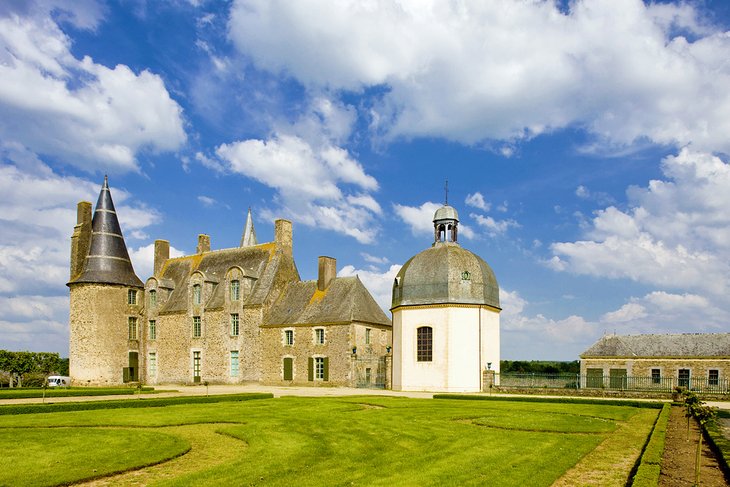
About seven kilometers southeast of Vitré is the Château des Rochers Sévigné, an elegant 15th-century Breton manor house. The château stands in an expansive parkland that includes woods with walking paths.
The celebrated letter-writer Madame de Sévigné stayed here between 1644 and 1690, during which time she wrote letters to her daughter (which are now well known in the French literary canon). In 1689, the son of Madame de Sévigné commissioned royal gardener André Le Nôtre to create the formal French gardens on the estate.
The Château des Rochers Sévigné is open to the public for guided tours; two rooms of the castle contain a museum collection devoted to Madame de Sévigné. Visitors will see the chapel, the tower, and the garden. The museum displays portraits of family members and other items that Madame de Sévigné cherished.
9. Île d'Ouessant (Ushant Island)
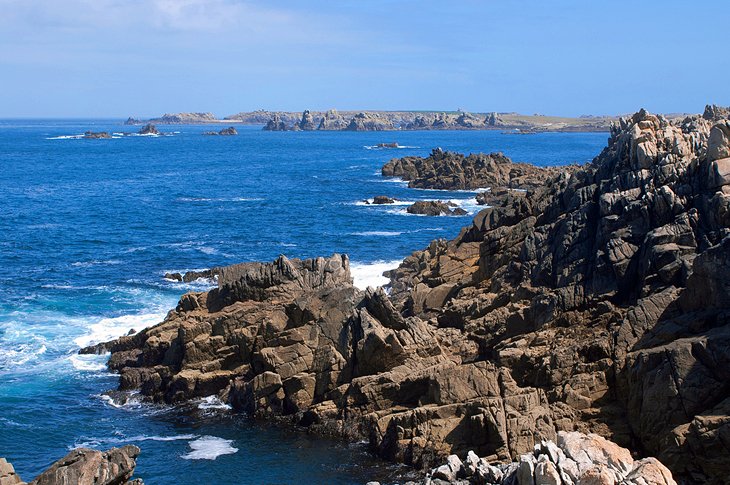
The Île d'Ouessant is a rugged island with incredible scenery, including treacherous cliffs and rocky promontories beaten by wild waves of the Atlantic Ocean. Only seven kilometers long and four kilometers across, this small island has an untouched and otherworldly feel.
Along the island's coastline is a ring of lighthouses, essential to the boats traveling by the island at nighttime. The Phare de Créac'h lighthouse on the northwest coast is passed by thousands of ships every year. This location marks the entrance to the English Channel.
Nature is the main attraction of visiting Île d'Ouessant, especially along the island's coastal paths. Île d'Ouessant is known for its indigenous sheep, and the island also has about 400 different species of birds. The best beaches are around the island's main village, Lampaul.
To arrive at Île d'Ouessant, tourists can take a ferry boat (approximately a 2.5-hour trip) from Brest or a shorter (about a one-hour) ferry ride from Le Conquet.
10. Côte d'Emeraude (Emerald Coast)
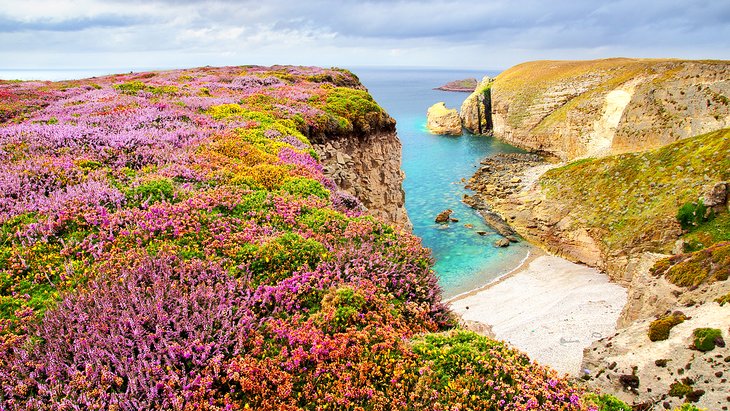
This gorgeous stretch of coastline runs along northern Brittany from Saint-Malo to Cap Fréhel. The Côte d'Emeraude includes many wonderful seaside resorts: Dinard (the most stylish), Paramé, Servan-sur-Mer, Rothéneuf, Saint-Briac-sur-Mer, Saint-Lunaire, Lancieux, Saint-Jacut-de-la-Mer, and Saint-Cast-le-Guildo, which are linked by a seaside road.
The most striking feature of the Emerald Coast is the Cap Fréhel, which reaches a height of 72 meters above the sea. This vantage point offers breathtaking panoramic views of the coast.
Inland from the coast are the towns of Dinan (a picturesque medieval town); Fougères, which boasts an impressive medieval castle; and the Château de Combourg, which was the family home of the 19th-century writer and statesman René de Chateaubriand.
11. Côte de Granit Rose (Pink Granite Coast)
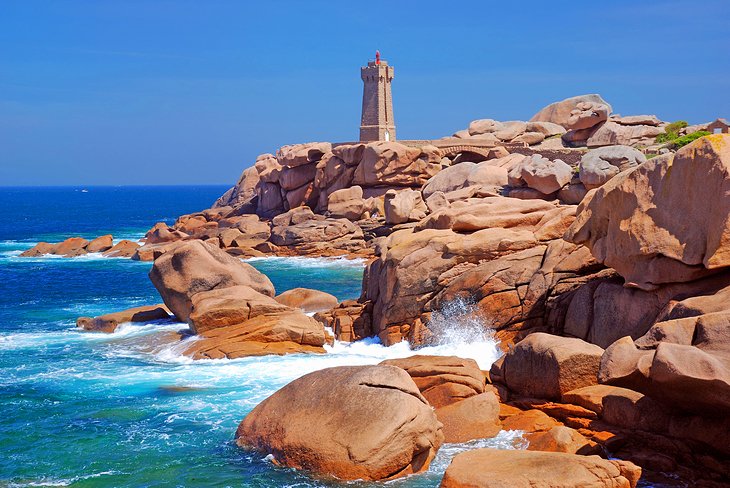
Named for the pink color of the rocky coastline, this marvelous seaside route runs between Perros-Guirec and the port of Ploumanac'h. The town of Ploumanac'h has a natural harbor that is a nice area to take a walk.
The Côte de Granit Rose is famous for its incredible rock formations, the Rochers de Ploumanac'h. These imposing weather-beaten rock structures are found between the beaches of Trestraou and Saint-Guirec. Some of the formations are as high as 20 meters, and many seem to take on the shape of recognizable figures such as a witch, Napoleon's hat, and a rabbit.
Visitors can go for a hike along the Sentier des Douaniers (The Custom Officers' Path) to admire the Ploumanac'h rocks. Beginning at the Plage de Trestraou (beach), this eight-kilometer out-and-back trail affords spectacular views of the pink granite landscape and the turquoise waters in the distance. The scenic path runs alongside the sea and traverses wild moors before reaching the yacht-filled marina of the Port of Ploumanac'h.
Tucked away on the Sentier des Douaniers is the Plage Saint-Guirec, a sheltered sandy beach where the calm waters are ideal for swimming, and the Maison du Littoral, which presents exhibits about the Ploumanac'h nature site.
For those who would like to go camping in the area, the Domaine de Trestraou offers sites for tent camping and camper vans. The Domaine de Trestraou is just a short walk from Trestraou Beach and has a water sports center, as well as a mini-golf course and tennis courts.
One of the highlights of this coastal area is Perros-Guirec, a popular seaside resort in Brittany and favorite destination among Breton families. Perros-Guirec has three sandy beaches with kids' clubs, as well as opportunities for water sports during summer.
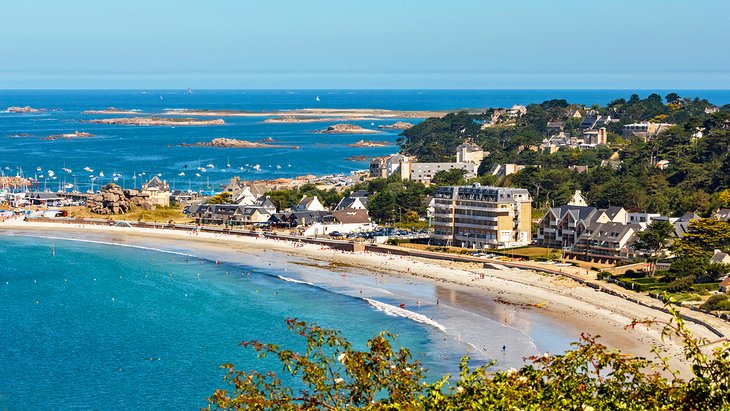
Trébeurden is another seaside resort that attracts many beach lovers in summer. The historic town of Trébeurden also delights visitors with its artisan craft shops, traditional farmers market, and gourmet restaurants. Visitors will enjoy dining at the town's crêperies, which serve the Breton specialty of buckwheat galettes, and seafood restaurants.
The Restaurant des Rochers in Trébeurden offers exceptional seafood dishes and stunning marina views. Another local restaurant, the Manoir de Lan-Kerellec, has earned a Michelin star for its superb modern cuisine.
Bird-watchers will appreciate the Pink Granite Coast because of its diverse avian life. Brittany's largest bird sanctuary lies nearby on the Sept-Îles (Seven Islands) archipelago. Regular boat trips run from Perros-Guirec and from nearby Port-Blanc to Sept-Îles.
12. Cancale
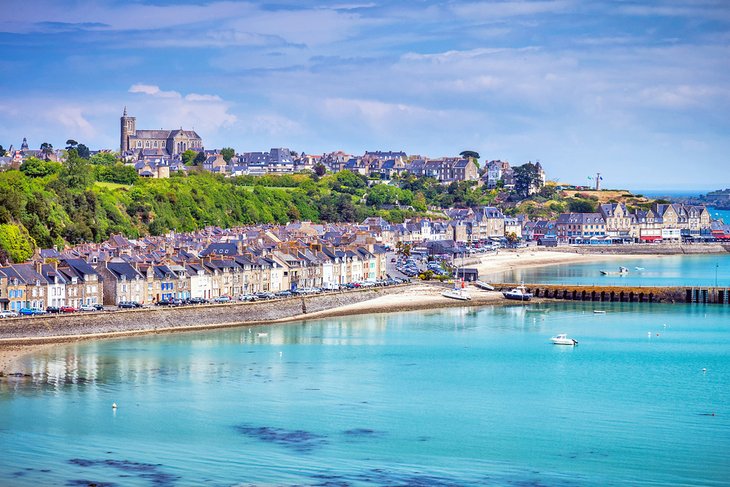
Cancale is a tiny fishing village on the Baie de Saint-Michel. The local cuisine makes use of all the fresh seafood. Some of the best restaurants are around La Houle port.
Anyone with a sweet tooth will want to try the pâtisserie boutique and tea salon, Grain de Vanille (12 Place de la Victoire), which serves artisanal pastries, ice cream, tea, coffee, and hot chocolate.
For those who would like to learn about oyster production, one of the best places to visit is the La Ferme Marine de Cancale. Located in a protected marine environment, this working oyster farm offers guided tours.
Above the port in the old town of Cancale is the 18th-century Eglise Saint-Méen, devoted to the 6th-century Welsh saint. The church houses the Musée des Arts et Traditions Populaires, with exhibits about the town's history of seafaring and fishing, as well as a collection of traditional local crafts and costumes.
Every year on August 15th, the town celebrates the Fête de l'Assomption de Marie (Festival of the Assumption of the Virgin) to pay tribute to the Virgin Mary, the protector of sailors, and to honor those who have perished while at sea. The festival's religious procession takes place through Cancale's streets, which are adorned with decorations for the occasion.
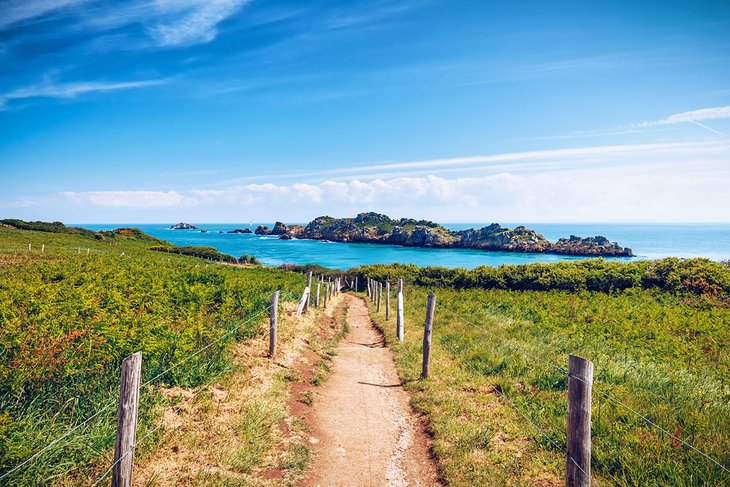
Refreshing scenic walks give visitors a chance to discover the coastline around Cancale. The Sentier des Douaniers (The Custom Officers' Path) is a hiking trail that follows the entire coastline of Brittany. The portion from Cancale to La Pointe du Grouin affords spectacular vistas of dramatic cliffs and beaches.
Cancale also has pristine sandy beaches that draw many vacationers during the summertime.
About five kilometers from Cancale overlooking the Bay of Saint-Michel, the Château Richeux is a dreamy three-star Relais & Châteaux property renowned for its fine-dining restaurant, Le Coquillage, which specializes in farm-to-table cuisine and fresh-caught local seafood. The bread served at the restaurant is handmade using organic flour and baked in a wood-fired oven. The hotel has only eleven guest rooms, all of which feature bay views.
13. Concarneau
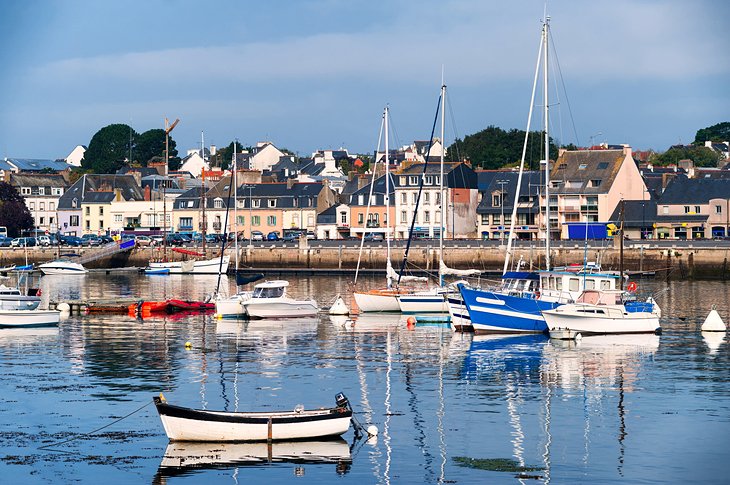
At the mouth of the Moros River, Concarneau is France's third largest fishing port. This historic fortified town is a called a "ville close" ("closed city") because it was a 14th-century stronghold entirely enclosed by sturdy granite walls and towers. The defenses were enlarged by Vauban in the 17th century.
This walled town transports visitors back in time. While ambling through ancient narrow streets past old stone buildings and houses adorned with colorful geraniums, visitors are immersed in the medieval ambience. However, Concarneau has enough to keep modern travelers happy; there are plenty of bustling restaurants and interesting shops to discover.
During summertime, Concarneau is a popular seaside destination thanks to its sandy beaches. The Plage des Sables Blancs is a family-friendly beach with a fine white-sand shoreline and rental facilities for water sports. Near the city center, the Plages de la Corniche beaches are found along the Sentiers des Douaniers hiking trail.
Another attraction in Concarneau is the Musée de la Pêche (Fisheries Museum), which displays exhibits related to fishing and has a documentation center with publications about maritime activities and fisheries. The museum also presents temporary artistic exhibits with a theme of fishing, sailing, or the sea.
In August, Concarneau hosts Le Festival des Filets Bleus. This traditional Breton festival gives town residents a chance to dress up in period costumes and allows tourists to learn about the local culture. The festival includes a parade, dancing, and games that are unique to the region.
14. Pont-Aven
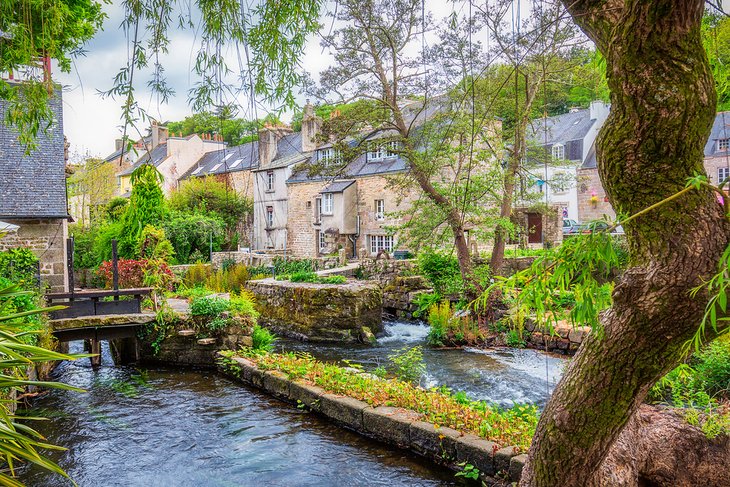
About 16 kilometers east of Concarneau, this charming artists' village takes its name from the river running through town. The riverside is lined with shady trees and old mills, a lovely backdrop for leisurely strolls.
Pont-Aven was discovered in the 1860s by American painters but is most famous for its association with post-Impressionist painter Paul Gauguin and the Pont-Aven art movement. Gauguin arrived in Pont-Aven in 1886, and along with artist Émile Bernard, created a new style of painting known as the "Ecole de Pont-Aven" (School of Pont-Aven).
The village's Musée de Pont-Aven displays many paintings by artists of the Ecole de Pont-Aven. For those who want to take in the scenes that inspired great art, a Painters' Trail map (available at the tourist office) indicates the sites in Pont-Aven and the surroundings that were captured by the School of Pont-Aven painters.
Pont-Aven is a delightful place to visit anytime of year, but is especially enjoyable in early August during the Fête des Fleurs d'Ajonc (Festival of Gorse Flowers). For this summer festival, townspeople dress up in old-fashioned regional costumes, while the streets are animated with traditional Breton dancing and bagpipe music.
15. Crozon Peninsula
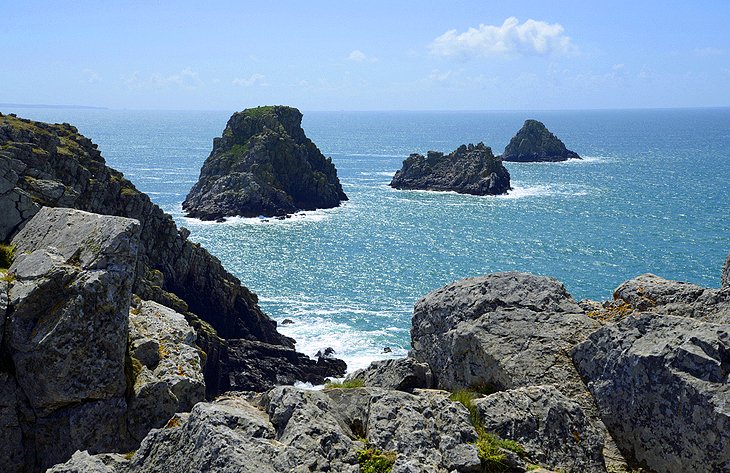
North of Cornouaille and the Pointe du Raz, the craggy Crozon Peninsula is distinguished by its rocky promontories, which offer some of the most outstanding views in Brittany. The peninsula is dotted with numerous seaside resorts including Camaret-sur-Mer, Morgat, and Roscanvel.
The most dramatic location, the Pointe de Pen-Hir rises to a height of 70 meters above the sea, boasting exceptional coastal views, particularly of the isolated crags known as the Tas de Pois. Nearby is a memorial to Bretons who fell in the Second World War.
To the north is the Pointe des Espagnols, with a view of Brest. Between the Pointe de Pen-Hir and the Cap de la Chèvre is the Pointe de Dinan, which provides a stunning view of the monumental rock known as the "Château."
16. Locronan
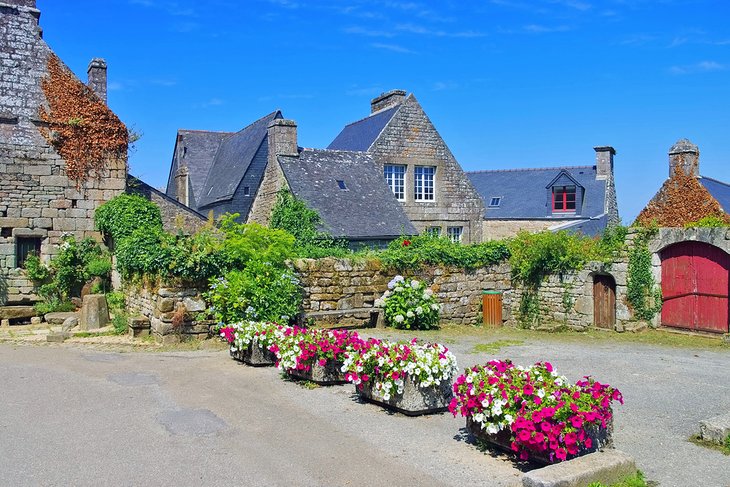
In Brittany's picturesque Finistère region, Locronan is one of the most charming towns in Europe. The town is listed as one of the "Plus Beaux Villages de France" (Most Beautiful Villages in France) and "Petite Cité de Caractère" (Small City of Character) because of its magnificent 15th-century church and grand Renaissance houses.
Locronan is a destination for a special type of Breton pardons (pilgrimage festivals) called a "troménie." The Grande Troménie pardon is held here in July every six years. Similar to a pilgrimage, the Grande Troménie is a 12-kilometer religious procession during which thousands of believers participate in walking prayer. A smaller troménie is held every year.
Near Locronan, just eight kilometers away, is another pilgrimage destination, the Chapelle Sainte-Anne-la-Palud. The chapel boasts a painted granite statue in veneration of Saint Anne, who was executed in 1548.
Just outside the village of Sainte-Anne-la-Palud is a well-sheltered sandy beach known for its breathtaking sunsets.
17. Dinan
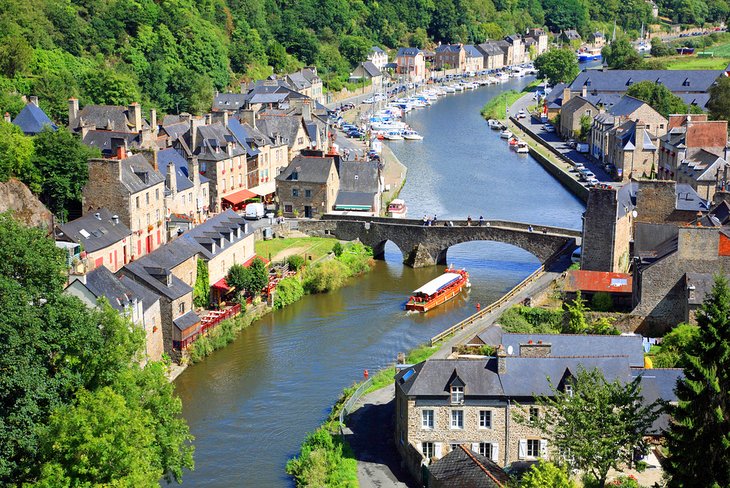
Perched on a hill above the Rance River's left bank (between Dinard and Saint-Malo), Dinan is one of the prettiest towns in Brittany. Still surrounded by its old walls, Dinan's old town boasts handsome late-medieval to Early Renaissance houses (particularly on the Rue du Jerzual) and the monumental 14th-century Château de Dinan (Palais des Ducs de Bretagne).
The château, with its 14th-century dungeon, impenetrable 15th-century fortifications, and imposing towers, recalls the austereness of the Middle Ages. For a glimpse of the medieval era, the château hosts Les Soirées, evening events in which actors in historical costumes bring to life the world of Jean IV, the Duke of Brittany, his knights, and his servants.
Another must-see attraction in Dinan is the Basilique Saint-Sauveur, a church built between the 12th and 16th centuries, which gracefully blends various architectural styles.
An interesting excursion from Dinan is the boat trip down the Rance River to Dinard or Saint-Malo.
18. Dinard
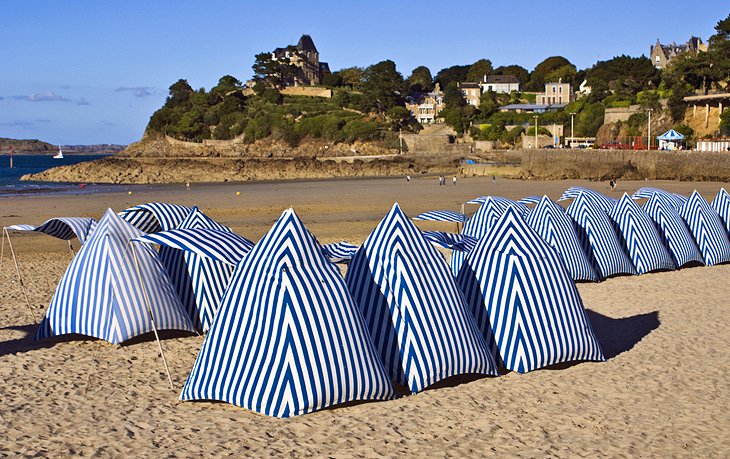
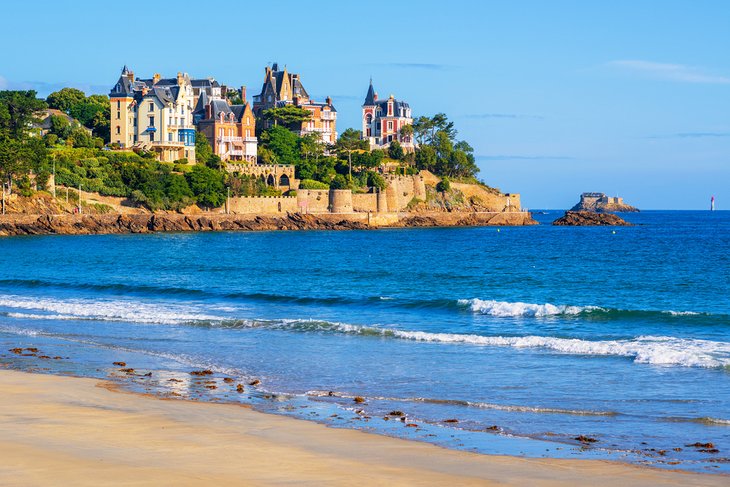
Dinard enjoys a splendid natural setting (across from Saint-Malo) along the Rance estuary. Mimosas and camellias flourish here under the influence of the Gulf Stream.
An old fishing village that was transformed into a prestigious seaside resort in the 19th century, Dinard retains its nostalgic charm. Elegant seaside villas; colorful striped beach huts; and a recently renovated historic waterfront hotel, the opulent Grand Hôtel Barrière, reveal the town's Belle Epoque heritage.
Today, Dinard is still considered one of the best beach destinations in France. Dinard has four beaches, which are all supervised by lifeguards during the high season (July and August).
Just north of the old town is the Plage de l'Ecluse, also called the Grande Plage ("Large Beach"), an expansive beach with a fine sand shoreline, and the Plage de Saint-Enogat in the Quarter Saint-Enogat, a good place for water sports; both of these beaches have lounge chairs and cabanas for rent.
Steps away from the Plage de l'Ecluse, the artisanal ice-cream shop, Vent de Vanille (3 Bis Boulevard du Président Wilson), sells ice cream prepared from organic local milk and sorbet made with seasonal fresh fruit. Vent de Vanille also specializes in mille-feuilles, a crispy layered puff pastry dessert with creamy fillings.
Near a public camp site, the Plage du Port-Blanc offers wild natural scenery and opportunities for water sports such as sailing, canoeing, and windsurfing. Tucked away in a sheltered bay, the Plage due Prieré across from the Port Breton park features beautiful scenery and coastal paths.
One of the most enjoyable things to do in Dinard is take a leisurely walk by the sea or along the palm-fringed waterfront Promenade du Clair de Lune (Moonlight Promenade), which overlooks the Baie de Prieré. The promenade is illuminated in the evenings during July and August.
Besides the beach, Dinard also has gourmet restaurants and many cultural offerings. At the end of September through early October, the town hosts the Festival du Film Britannique (British Film Festival), with a week of film screenings at various cinema venues throughout the town.
19. La Baule
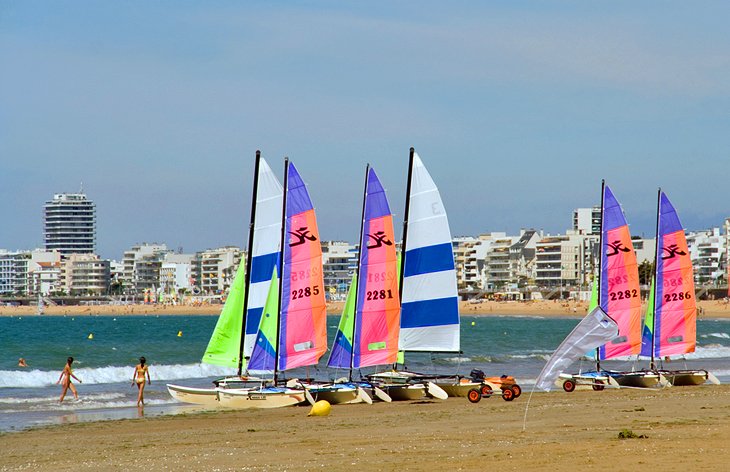
La Baule is one of France's top Atlantic Coast beach destinations, with a more modern feel than Brittany's 19th-century seaside resorts. Hugging a bay on the estuary of the Loire River between Nantes and Belle-Île island, La Baule has several miles of sandy beaches and a seafront boulevard lined with large hotels, which are packed during the high season.
Apart from sunbathing and swimming, the area is popular for sailing and windsurfing. Near La Baule is the smaller seaside resort of La Baule-les-Pins, and to the east is the Parc des Dryades botanical garden.
About six kilometers away from La Baule is Guérande, a walled medieval town that is best known for its salt marshes. Local artisans harvest the salt by hand, and it is sold all over the world.
In Batz-sur-Mer (eight kilometers from Guérande), the Musée des Marais Salants (Museum of the Salt Marshes) explains the history and techniques of harvesting sea salt.
20. Le Folgoët
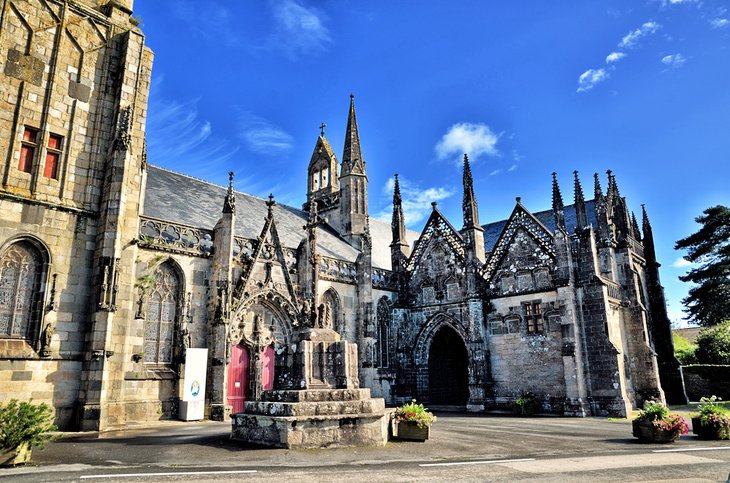
The medieval village of Le Folgoët is worth visiting to admire the Basilique Notre-Dame du Folgoët, a pilgrimage church that dates to the 14th century and still is an important spiritual destination.
Every day, many visitors come to pay tribute to the Notre-Dame de le Folgoët statue and to say prayers in front of the Virgin Mary.
The church features an exquisite Flamboyant Gothic style and an ornate north tower, which is considered one of the finest in Brittany.
21. Fougères
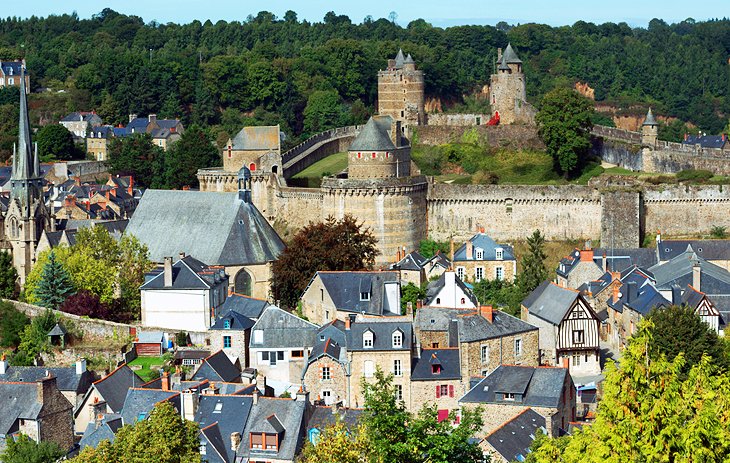
The Château de Fougères presides over the charming town of Fougères (50 kilometers northeast of Rennes), nestled in a tranquil landscape of forests and agricultural land. With the appearance of a fairy-tale castle, this formidable château has 13 towers around a circuit of fortifications.
The château was built between the 12th and 15th centuries, representing a period of feudal life in France during the Middle Ages. To immerse visitors in the historical ambience, the Château de Fougères presents spectacles that bring the medieval era to life. On Thursday evenings during summertime, the château stays open late and is illuminated by torchlight, and special events such as medieval games and festivals are held at the château on occasion throughout the year.
The medieval atmosphere continues in the walled old town, an enchanting, enclosed world of quaint half-timbered houses (with lovely examples around the Place du Marchix). There are also lively outdoor cafés and restaurants that appeal to modern-day tourists.
Other historic attractions in Fougères include the Eglise Saint-Sulpice, featuring a Flamboyant Gothic interior, and the Hôtel de Ville (Town Hall), which dates from the 14th century.
In a characteristic half-timbered house next to the Town Hall is the Musée Emmanuel de la Villéon, which displays the work of the Impressionist painter who was born in Fougères.
The town of Fougères also boasts a unique museum, the Musée des Métiers de la Chaussure (Shoe Museum) housed in a century-old shoe factory.
22. Île de Bréhat
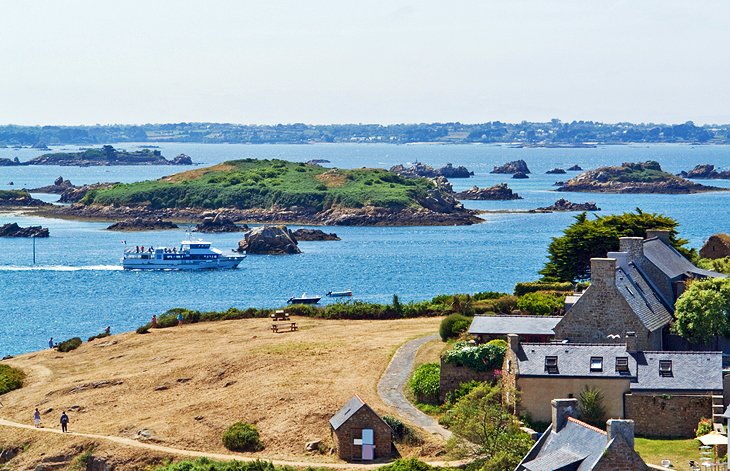
The Île de Bréhat is a tiny island, only three-and-a-half kilometers long. Completely free of cars, this idyllic island is appreciated for its temperate climate and beautiful natural scenery, including many wildflowers and striking red granite cliffs.
The main hub of activity is the village of Le Bourg, which has many cafés, restaurants, and hotels.
To arrive at the Île de Bréhat, visitors may take a ferry boat from the Pointe de l'Arcouest in Ploubazlanec. Ferries run regularly from Paimpol, and the journey takes only 10 minutes.
23. Vannes
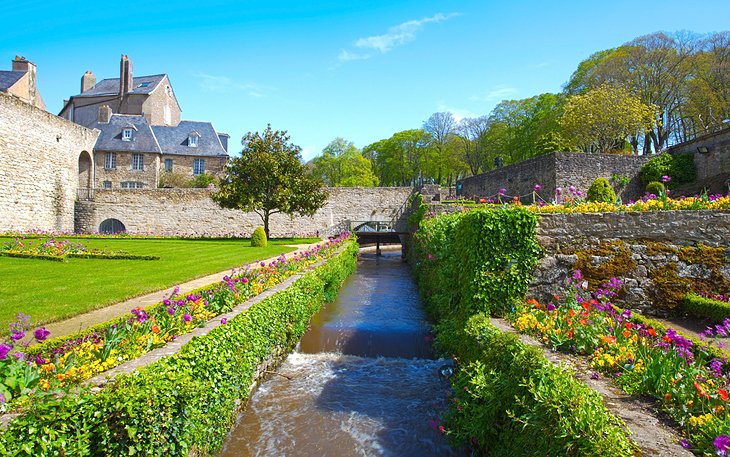
On the Gulf of Morbihan, the historic town of Vannes is halfway between Nantes and Brest. The old town grew up within the ancient walls and around the Cathédrale Saint-Pierre. Dating back to the 13th century, the cathedral has an Italian Renaissance-style rotunda-shaped chapel, which contains exceptional 17th-century tapestries and a valuable treasury.
From the Promenade de la Garenne, there is a fabulous view of the cathedral and the Tour du Connétable, a tower built in the 14th and 15th centuries.
The 15th-century Château Gaillard now houses the Musée d'Histoire et d'Archéologie, a museum focused on the heritage of Vannes, with a collection of archaeological finds, paintings, and objects d'art.
24. Rochefort-en-Terre
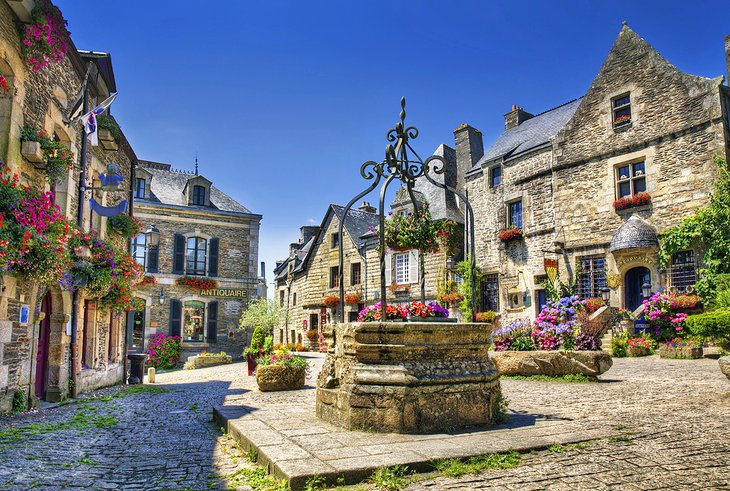
The village of Rochefort-en-Terre (35 kilometers away from Vannes) is listed as one of France's "Plus Beaux Villages" (Most Beautiful Villages) as well as a "Village Fleuris" ("Flowering Village") because of the vibrant flowers that decorate the town.
Tourists should take time to wander around the village through the atmospheric, narrow streets. There are many artists' ateliers, as well as attractive half-timbered and old stone houses featuring window sills bursting with bright geraniums. Potted flowers also adorn the squares and hidden corners of the town.
Surrounded by a tree-shaded parkland, the Château de Rochefort-en-Terre has all the elements of a medieval castle. However, it's actually a 17th-century horse stables that was updated in the 20th century. (The ruins of the original château are found on the grounds.)
In 1907, the Château de Rochefort-en-Terre was purchased by Alfred Klotz, the American painter who invested a fortune to renovate the building. Visitors can admire the exterior of the château while wandering through the park. The interior of the castle is not open for visits.
25. Roscoff and Île de Batz
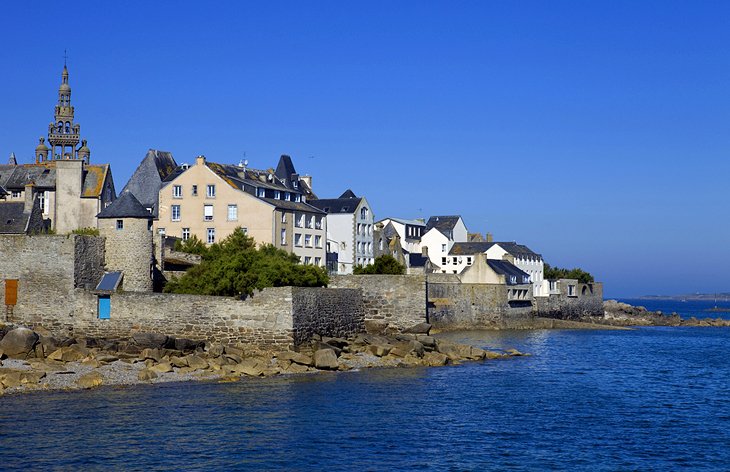
Roscoff has the most typically British character of Brittany's ports. Located on a scenic peninsula, the village delights visitors with its lovely harbor, historic shipowners' houses, and an exquisitely decorated Gothic church.
Just three kilometers off the coast from Roscoff is the Île de Batz, a tiny Breton island with a mild climate and serene environment, perfect for relaxation.
Visitors will enjoy the picturesque seaside scenery, sandy beaches, and lush exotic garden on the Île de Batz. During the summertime, ferries run regularly from Roscoff to the Île de Batz.