Visiting the Acropolis in Athens: The Essential Guide
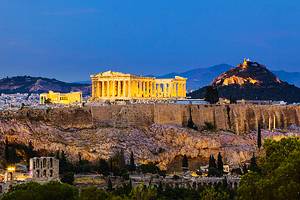
Visiting the Acropolis is a highlight of any trip to Athens. Even the most jaded of world travelers cannot visit ancient Greece's most iconic attraction without being awestruck. Crowning a dramatic limestone crag, the Acropolis stands high above modern Athens as a symbol of the city's former glory, recalling the culture that flourished more than two millennia ago.
In addition to the Parthenon, you'll find many more things to see among these emblematic ancient ruins. While wandering around the many archaeological remains of the Acropolis, you follow in the footsteps of Socrates, Pericles, and Sophocles and discover the building blocks of Western Civilization.
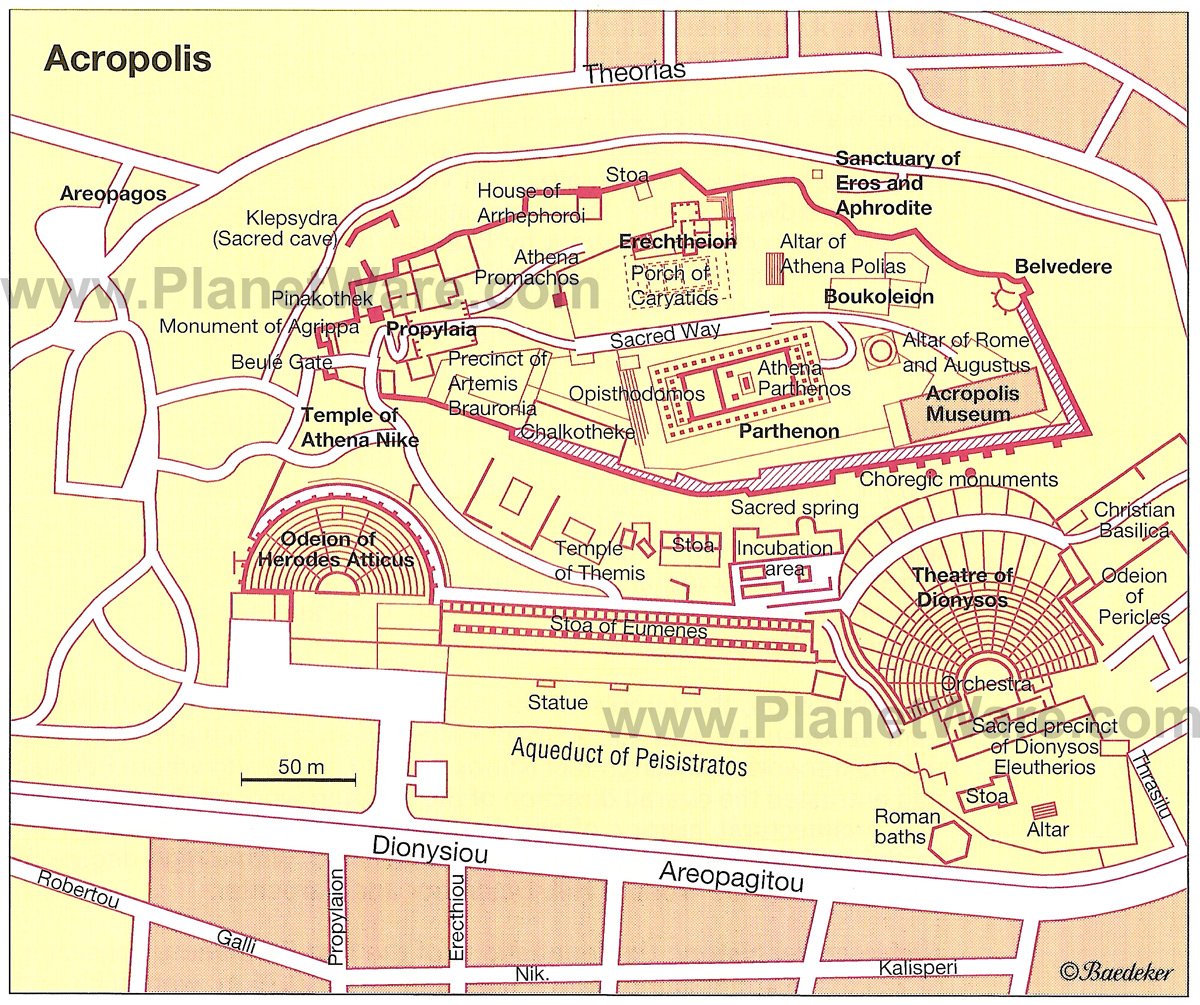
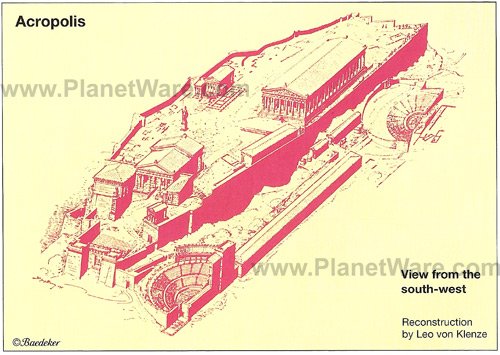
The main attraction at the Acropolis is the Parthenon, but there are several key sites. After entering through the main gate, you will pass the theater Odeon of Herodes Atticus, then walk through the Beulé Gate before reaching the Propylaia, which is the dramatic main entrance to the Acropolis. If you look to the right as you are climbing up to the Propylaia, you'll see the Temple of Athena Nike perched up high.
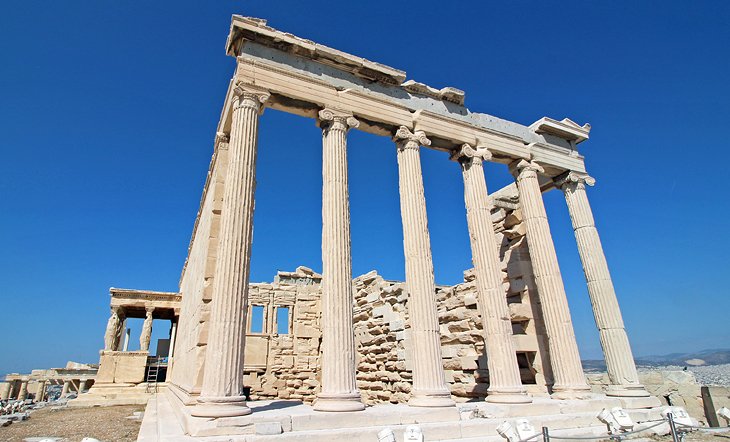
When you exit the Propylaia at the top, you can immediately see the Parthenon to the right and the Erechtheion complex on the left, with the easily recognizable statues of the Porch of the Caryatids. The attractions below offer more detail on each of these highlights of the Acropolis, as well as several others.
Use this list as your sightseeing guide as you tour the site. When you've finished, head over to the north side of the hill to the pedestrian street of Apostolou Pavlou, where you can enjoy a meal while you soak up a fantastic view of the Acropolis from below.
See also: Where to Stay near the Acropolis
- 1. Odeon of Herodes Atticus: A Second-Century Theater
- 2. Beulé Gate: The Roman-Era Entrance
- 3. Monument of Agrippa, First-Century BC
- 4. Propylaia: The Magnificent Entrance to the Acropolis
- 5. The Beautifully Preserved Temple of Athena Nike
- 6. The Parthenon: The Most Sacred Site of the Ancient World
- 7. Porch of the Caryatids at the Erechtheion
- 8. Old Temple of Athena Polias, Sixth-Century BC
- 9. The Legendary Olive Tree of the Pandroseion
- 10. Acropolis Museum
- 11. Theater of Dionysus
- Map of the Acropolis in Athens: The Essential Guide
- Where to Stay near the Acropolis for Sightseeing
- Tips & Tours: How to Make the Most of Your Visit to the Acropolis
- Best Time to Visit the Acropolis
1. Odeon of Herodes Atticus: A Second-Century Theater
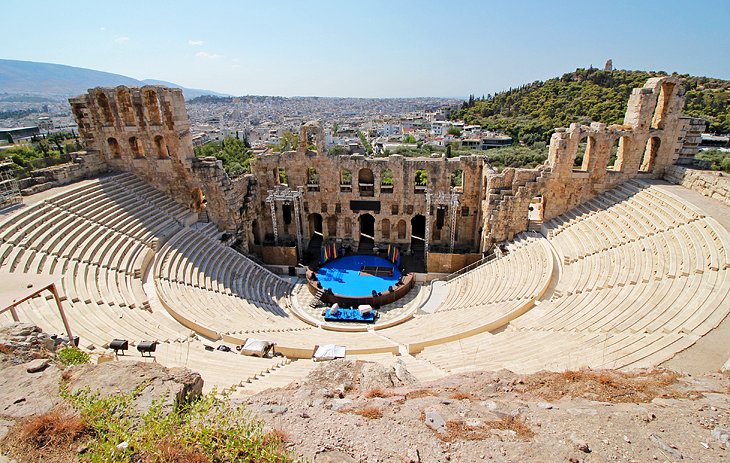
After entering the ticketed admission area of the Acropolis, you can visit the Odeon of Herodes Atticus. There is a side path off the main walkway up to the Acropolis, with a view over the theater.
This ancient theater is named after Herodes Atticus of Marathon (outside of Athens), who built it in memory of his wife Regilla in AD 161. The theater was designed with an auditorium fitted into a natural hollow. Semicircular rows of seating could accommodate nearly 5,000 people. The orchestra was originally located in the circular space in the center with the low stage (skene) close to it on one side. Between the auditorium and the stage were open passages for the entrance of the choir (parodoi).
Live performances are still held at this theater during the summertime. The Athens & Epidaurus Festival presents classical Greek operas, as well as musical and dance performances, offering tourists the magical experience of watching two-thousand-year-old drama in the original theater.
2. Beulé Gate: The Roman-Era Entrance
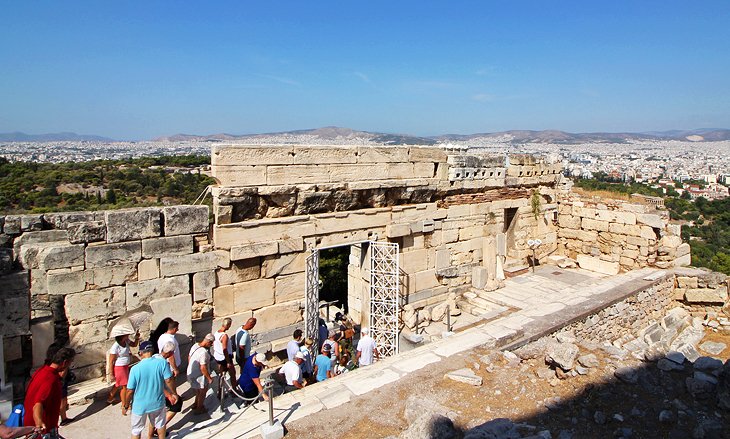
After passing through the admission area and the overlook to Odeon of Herodes Atticus, you enter the Acropolis site through the Beulé Gate. This Roman-era doorway was named after the 19th-century French archaeologist who discovered it.
The Beulé Gate is below the west side of the Propylaia, the majestic entrance to the Acropolis. Featuring two flanking towers, the gate dates to 280 BC and was originally linked to the Propylaia by a broad marble staircase built during the reign of the Emperor Septimius Severus. Part of the lower section of the staircase has survived.
3. Monument of Agrippa, First-Century BC
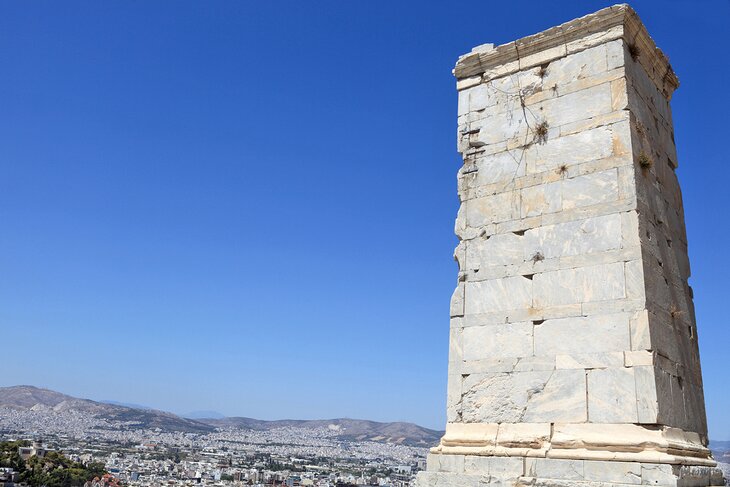
Beyond the Beulé Gate, on the way up to the Propylaia, you come across the Monument of Agrippa. This tall, rectangular two-color marble plinth was built in the second century BC for a benefactor of Athens, perhaps the King of Pergamon, the marvelous ancient city (now part of present-day Turkey).
The monument is named after Marcus Agrippa, the son-in-law of Augustus, because a bronze sculptural representation of his four-horse chariot (quadriga) was mounted on the base in 27 BC.
4. Propylaia: The Magnificent Entrance to the Acropolis
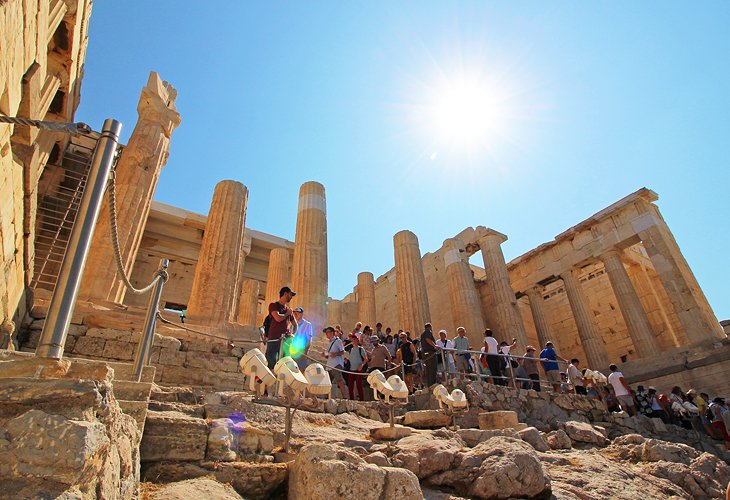
An ordinary entrance gate would not suffice for the glorious ancient city of the Acropolis. This majestic entranceway set the tone for arriving visitors, preparing them for the jaw-dropping site of the Parthenon and the other monumental temples on the rocky hilltop above. In the early evening, tourist line the stairs to watch sunset.
The Propylaia was built from 437 BC to 432 BC. First, a flight of marble steps leads up to a vestibule containing five gateways, which increase in width and height from the sides to the center. To the west is a deep portico, with a central doorway framed in Ionic columns. Along the front of this portico are six Doric columns, which originally supported the pediment. On the east side is a smaller but still impressive portico also with Doric columns. The multifaceted architectural complex, featuring intricate details, contributes to an overall sense of grandeur.
The entrance can become quite crowded at peak times. Be prepared to pack a bit of patience when making your way through.
5. The Beautifully Preserved Temple of Athena Nike
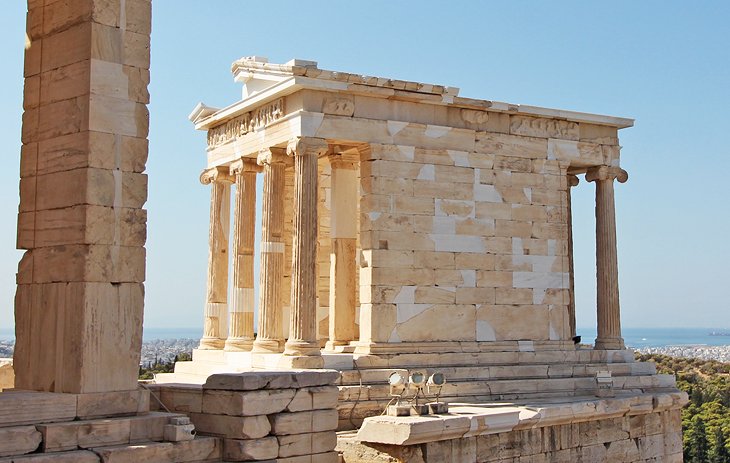
The Temple of Athena Nike is the most elegant and well-preserved of the Acropolis buildings, having been restored in the 19th and 20th centuries. Standing on a spur of rock on the south side of the Propylaia, this ancient sanctuary was dedicated to the Goddess Athena as the bringer of Victory (Nike).
The temple was built between 432 BC to 421 BC, after the completion of the Parthenon and the Propylaia. The temple features four delicately carved Ionic columns at the north and south ends. The form of the column bases and capitals was old-fashioned at the time they were built, leading archaeologists to suggest that the architecture was influenced by the earlier design of Kallikrates.
The balustrade that once adorned the temple platform is now on display at the Acropolis Museum, along with relief figures of Athena and several representations of Nike (the Goddess of Victory).
6. The Parthenon: The Most Sacred Site of the Ancient World
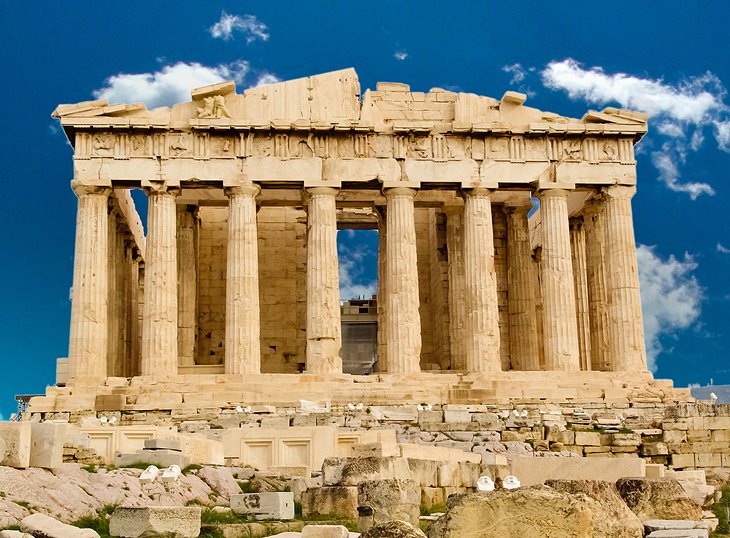
Standing majestically on the highest point of the Acropolis hilltop, this breathtaking temple was the most magnificent temple of the ancient world. For the best views of the Parthenon from a distance, go to Philopappou Hill directly across from the Acropolis.
The temple was built from 447 BC to 338 BC during Pericles' construction boom and is a masterpiece of the architect Iktinos and the great sculptor Phidias. As the ultimate sacred shrine in the city, the temple venerated the cult of Athena the Virgin (Athena Parthenos), the Goddess of Wisdom and Warfare, and the Guardian of Athens.
Exemplifying classical style, the temple features 136 fluted Doric columns (in repeated rows of 8 x 17), creating a sense of harmony and order. Notice how the columns are slightly bulkier at the base and the shape gradually narrows towards the top. Each 10.5-meter-high column has a diameter of 1.9 meters at the foot and 1.5 meters at the top, an ingenious technique, which creates the optical illusion of a perfectly balanced building. Otherwise, the temple would appear top-heavy.
Although the interior of the Parthenon is off-limits, you can walk around the exterior to admire the structure from every angle. Amid some controversy, a paved pathway was added in 2021 in the area of the Parthenon to make the site more accessible. A new lift was also added to the site, providing better wheelchair accessibility.
The temple's monumental scale and remarkable details of craftsmanship are awe-inspiring. At the east end, the pediments depict the Birth of Athena from the head of Zeus. At the west end, the pediments illustrate the conflict between Athena and Poseidon for the land of Attica.
Originally, the temple had a roof that was covered with marble tiles with run-offs for rainwater at its four corners. After serving as a temple for around 900 years, the Parthenon suffered considerable damage in the fifth century when it was transformed into a Christian church dedicated to the Virgin. The Parthenon remained in use as a church for another 950 years before becoming a Turkish mosque in 1456.
Unfortunately, the temple, which had stood for more than 2,100 years was destroyed by a bomb during fighting between the Venetians and the Turks in the 17th century. Today, the ruins of this massive structure remain as testimony to its former glory.
7. Porch of the Caryatids at the Erechtheion
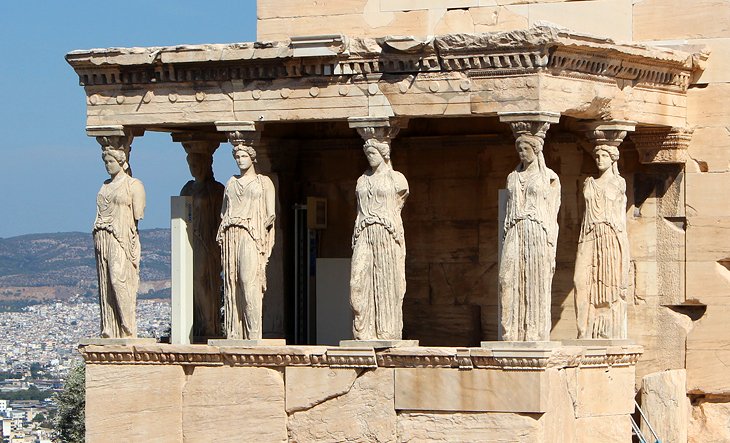
Built from 421 BC to 395 BC, the Erechtheion complex contains a number of ancient sanctuaries. The eastern part was occupied by a sanctuary built a century earlier, the Temple of Athena Polias. In the western part was the Tomb of King Erechtheus.
One of the most famous features of the Erechtheion is the Porch of the Caryatids, six columns sculpted as figures of maidens in place of ordinary columns. The Tomb of Kekrops, the founder of the Athenian royal line, was located under the Porch of the Caryatids. From the north portico, a side doorway leads into the adjoining cult precinct of the Pandroseion.
8. Old Temple of Athena Polias, Sixth-Century BC
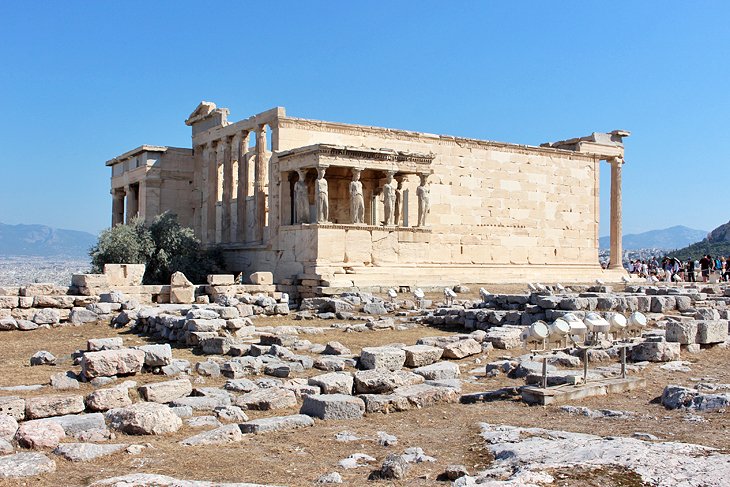
Found immediately south of the main Erechtheion sanctuaries, the Old Temple of Athena was built in the early sixth century BC within the precincts of the Mycenaean royal palace of the 14th century BC. (The only remaining architectural elements of the Mycenaean palace are two-column bases.) This temple was the sanctuary of Athena Polias (Athena of the City), the patron of the city. The temple held the venerated wooden Cult Image of the Goddess (Xoanon), in a tradition that most likely dated back to Mycenaean times.
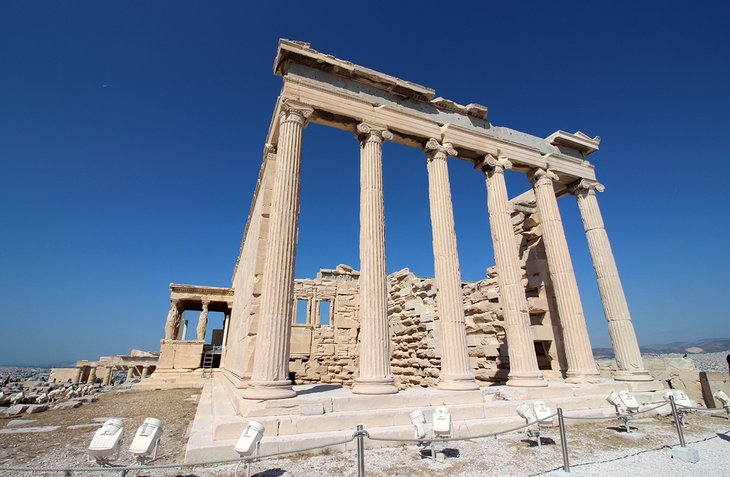
The Old Temple of Athena was destroyed by the Persians in 480 BC along with all the other buildings of the Archaic period. It was not until the 19th century that the foundations of the temple were uncovered by archaeologists.
9. The Legendary Olive Tree of the Pandroseion
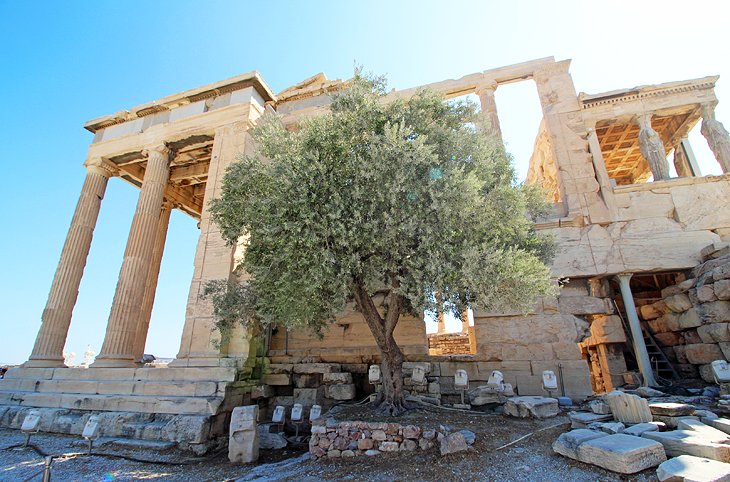
The Pandroseion lies between the Erechtheion and the Old Temple of Athena Polias. This small temple was named after Pandrosos, the daughter of the first king of Athens. The temple contained the altar of Zeus Herkeios (protector of the hearth) and a shrine to Pandrosos. Scholars believe that the sacred snakes of the Acropolis were kept here.
Also, according to legend, Athena presented the sacred olive tree to the city here after her victory over Poseidon in the contest for the land of Attica. The fifth-century BC Greek historian Herodotus tells us that on the day after the destruction of the Acropolis by the Persians in 480 BC, a fresh shoot had sprung from the trunk of the burned tree. This tree became a symbol of Athens' survival. As a tribute to this ancient event, an olive tree was planted here in modern times.
This is one of the few areas in the Acropolis where you'll be able to escape the blazing Grecian sun. Stone blocks and a small retaining wall provide much welcome seating.
10. Acropolis Museum
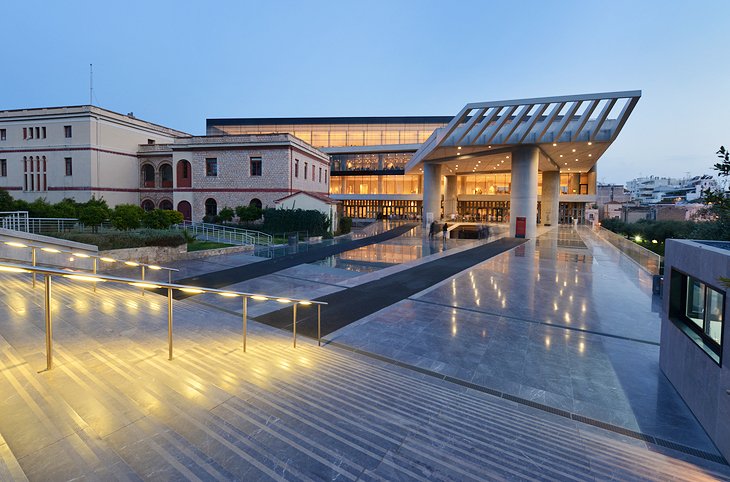
The Acropolis Museum is a must-see cultural attraction in Athens that opened in 2009. Below the Acropolis hill, about 300 meters away from the archaeological site, this incomparable museum contains one of Athens' most valuable collections of ancient Greek art.
In front of the museum is a designated archaeological site where archaeologists can be seen at work. After walking past this "archeological workshop," you arrive at the entrance to the sleek modern building designed by architects Bernard Tschumi and Michael Photiadis.
Illuminated by natural light, the extensive exhibition galleries display around 4,000 priceless objects. Most of the items in the collection were uncovered at the Acropolis archaeological sites.
The collection spans the Archaic Period, from the seventh century BC to the fifth century BC, and the Classical Period, from the fifth century BC to the second century BC. Highlights are the original Caryatids from the Erechtheion, the sixth-century-BC Moschophoros statue of a young man carrying a small calf, the fifth-century-BC relief of Mourning Athena, and the series of reliefs from the Temple of Athena.
The museum charges a separate entrance fee and is not part of your admission to the Acropolis.
Address: 15 Dionysiou Areopagitou Street, Athens
Official site: http://www.theacropolismuseum.gr/en
11. Theater of Dionysus
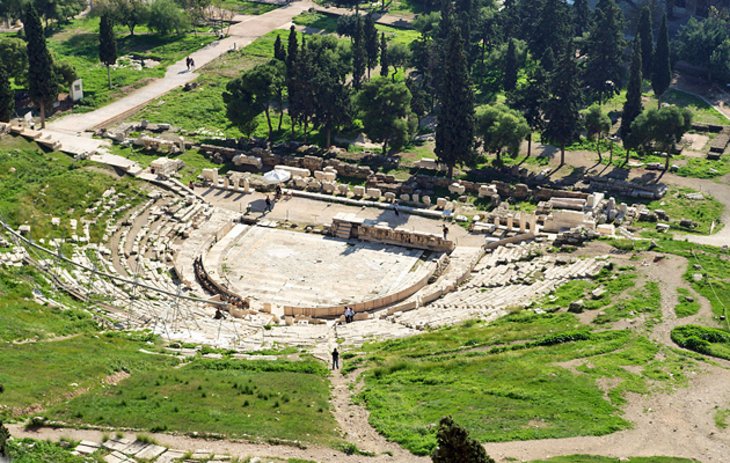
Near the Acropolis Museum is the fourth-century-BC Theater of Dionysus, which has a separate ticketed entrance from the rest of the Acropolis. (The Acropolis admission ticket includes entrance to this site, but it's possible to buy a cheaper ticket just to enter the Theater of Dionysus.)
The fourth-century-BC Theater of Dionysos is the oldest of the three architectural complexes built on the southern slopes of the Acropolis (Areopagitou Street). The great Greek tragedies of Sophocles and Euripides were performed here.
Near the Theater of Dionysos is the Stoa of Eumenes, built by King Eumenes II (197-160 BC) of Pergamon, a city of the Hellenistic period located in present-day Turkey. King Eumenes was renowned for founding a city filled with impressive buildings, including the Great Altar of Pergamon.
Map of the Acropolis in Athens: The Essential Guide
Where to Stay near the Acropolis for Sightseeing
Staying near the Acropolis is not only convenient for visiting this site, but it also puts you in a great area of restaurants and nightlife. Since the Acropolis is visible throughout Athens, it's also a good landmark for finding the way back to your hotel. We recommend these convenient hotels with easy access to the Acropolis:
- AVA Hotel Athens is a luxury boutique hotel with a fantastic location in the Plaka area, featuring elegant decor, and shopping and restaurants nearby.
- MET34 Athens Hotel is another 4-star boutique hotel, with a stylish design, rooms and suites with kitchenettes, and breakfast is included.
- Herodion Hotel offers beautiful views of the Acropolis and is within easy walking distance of the entrance to the Acropolis. This luxury property offers modern, comfortable rooms and a rooftop terrace.
Tips & Tours: How to Make the Most of Your Visit to the Acropolis
- Tours of the Acropolis: The comprehensive Athens Half-Day Sightseeing Tour is a great way to see the Acropolis and several other key sites in just a few hours. This includes admission to the Acropolis and allows for 1.5 hours to stroll through the site. You can upgrade this tour to include entrance to the Acropolis Museum. Also included with this package is a tour in an air-conditioned coach leading past several of the city's highlights. Another good tour that focuses exclusively on the Acropolis area is the Skip the Line Acropolis of Athens and the Acropolis Museum Tour. On this 3.5-hour tour, you'll be led through the Acropolis site and the Acropolis Museum by a qualified and knowledgeable guide. No need to line up or book tickets in advance; your guide gets you to the front of the ticket line and into the attractions in mere minutes. Note that the admission cost to enter the Acropolis and the Acropolis Museum is not included in the tour.
- Tickets to the Acropolis: You can buy tickets at the window or, to save time, you can buy e-tickets online. The wait times to buy a ticket at the entrance window can be lengthy.
- Comfort and Safety: Although more paving has been added around the Parthenon, some areas are still uneven, and can be slippery. Wear comfortable low-heeled shoes with rubber soles for sightseeing. Drinks are not easily available, so be sure to carry plenty of water, especially in the summer.
- Photography Tip: No matter what time of year you visit, the best time for photography is always first thing in the morning or late in the afternoon.
- Where to Eat: The museum has a café and restaurant with stunning views of the ancient ruins on the Acropolis hilltop. If you exit on the northern side, you'll be close to the charming neighborhoods of Anafiotika and Plaka, which are filled with restaurants and cafés hidden in a delightful maze of winding pedestrian streets.
Best Time to Visit the Acropolis
The best time to visit the Acropolis is in the spring or fall, typically the months of March, April, and early May along with mid-September, and October. At this time, daytime temperatures will be reasonable — warm but not too hot. November is still a good time but the days are more cloudy.
In summer, generally June, July, and August, the days, especially after 10am, can be extremely hot, and with limited shade, it's easy to get overheated. August is busy with big crowds. At this time, it's best to go as soon as the site opens to beat the heat and the tour buses.
The winter is a decent time to visit — crowds are small but the only downside is that days can be cloudy, wet, and gray.
More Related Articles on PlanetWare.com

Athens and Surroundings: Spend at least a couple of days seeing the top attractions in Athens. You can also easily do day trips from Athens to explore nearby sites. Beyond Athens, many visitors head out to visit the islands. For ideas on where to go, see our guide to the Best Greek Islands. Top choices often include Santorini and Crete, but there are many great options.